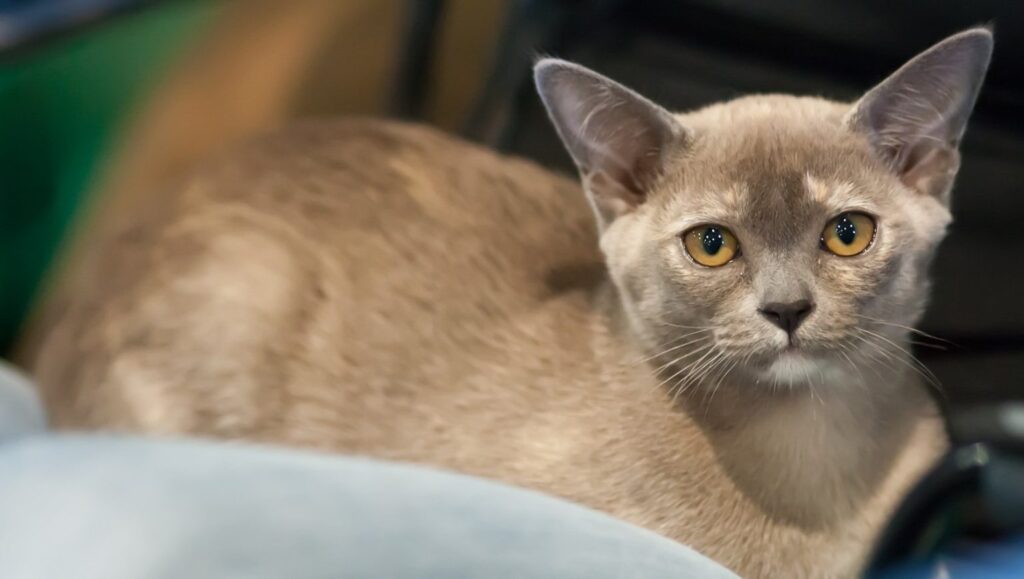
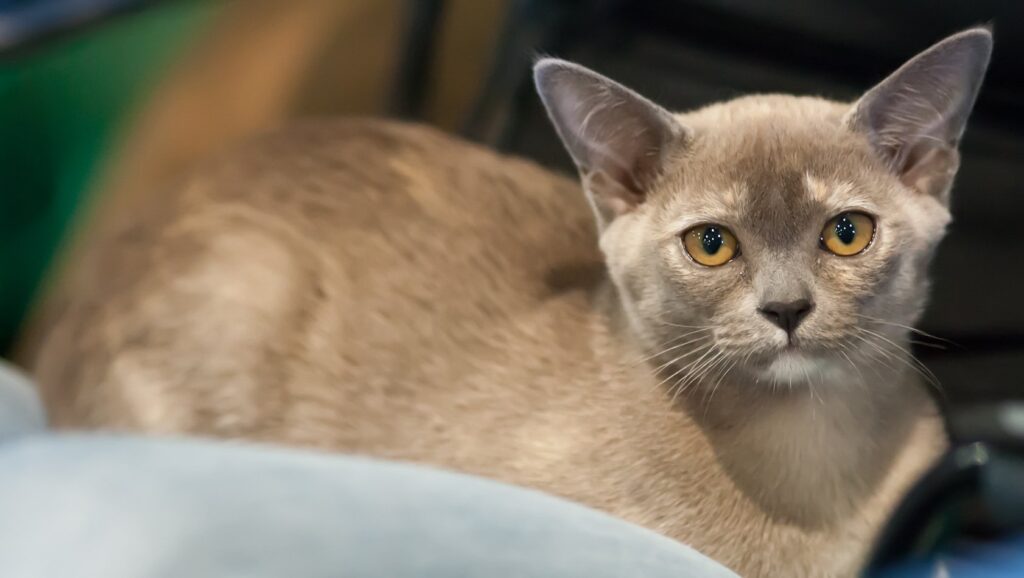
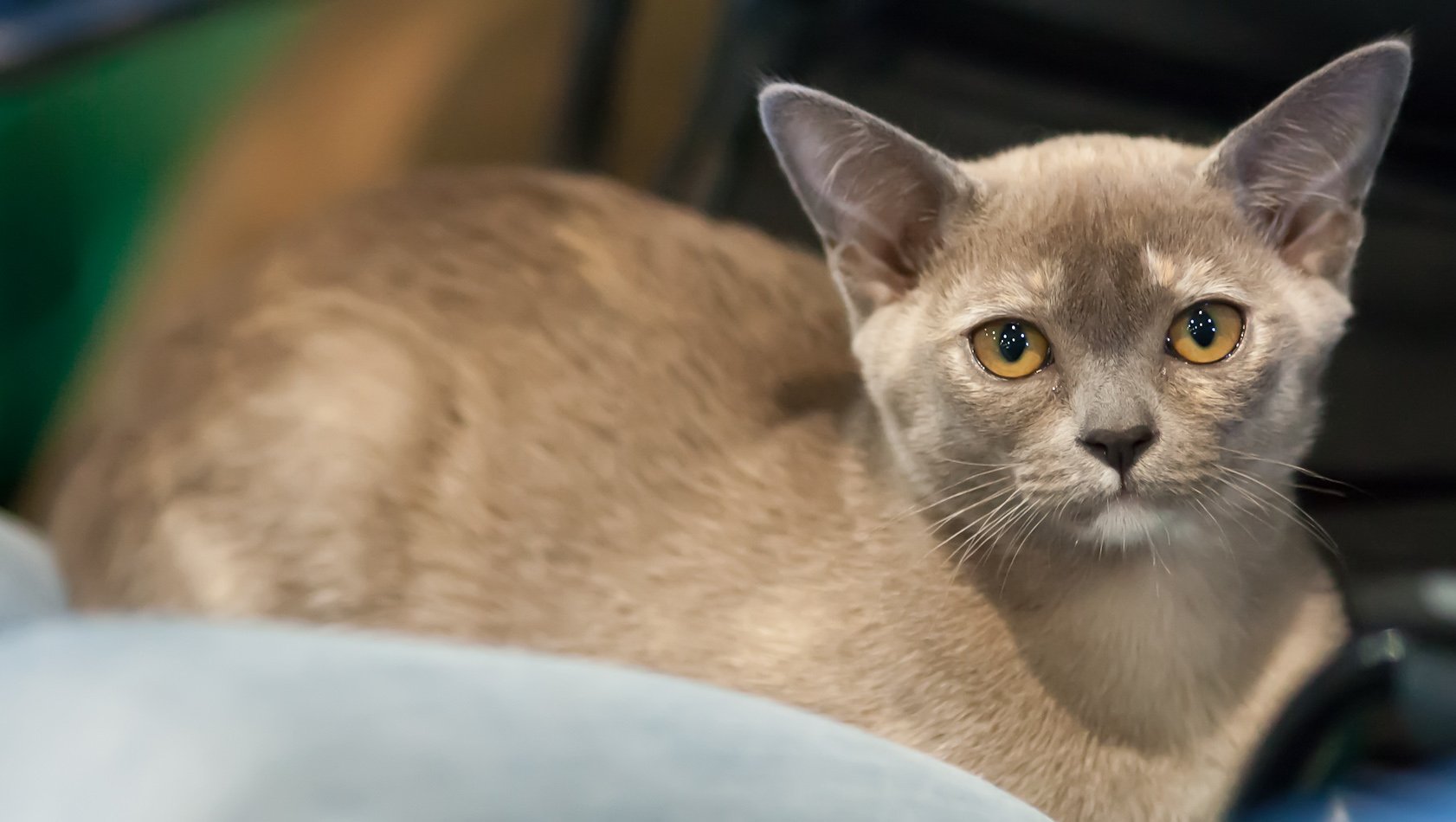
A satin “sunshine” cat with golden eyes and a warm heart — energetic and boundlessly affectionate: clever, “dog-like”, playful and people-dependent. The Burmese is a muscular breed with a short glossy “satin” coat and expressive golden eyes; extraordinarily attached, vocal and people-oriented, it adores company, follows its owner and cannot bear solitude at all.
KidsDogsOther catsBeginnersTime alone · not suitable
The Burmese cat is an incredibly social and people-oriented breed, blending elegance, playfulness, and deep affection for their human families. Known for their unique "dog-like" personality, high intelligence, and silky, low-maintenance coat, these cats make wonderful companions for active individuals and families who can provide plenty of attention. Loneliness is one thing this breed handles poorly. Their gentle demeanor, curiosity, and willingness to be involved in all household activities make them a favorite among many cat lovers. You can learn more about this and other fascinating breeds, like the playful Bengal cat and the charming British Shorthair, on Tvaryny.
Burmese Cat: A Quick Overview
Burmese Cat: A Quick Overview · 11
Characteristic
Description
Origin
Burma (modern-day Myanmar) / USA
Year of First Mention / Recognition
~1930 (arrival of Wong Mau); 1936 (first CFA recognition, later temporarily suspended)
Lifespan
12–18 years (average 10–15)
Height at Withers
10–12 inches
Weight
Females 8–11 lbs; Males 10–14 lbs (feel heavier than they look)
What the Burmese Cat Looks Like: A Detailed Description
The Burmese is a medium-sized cat with surprisingly heavy weight for its size, earning it the nickname, "a brick wrapped in silk." Their appearance combines strong musculature with undeniable elegance.
The physical description can vary slightly depending on the standard (American vs. European), but the core traits are as follows:
Head: The European type has a short, blunt wedge with broad cheekbones and a rounded forehead. The muzzle is well-developed but not pointed. The American type has a distinctly round head from all angles, with a short muzzle and a noticeable "stop" (the transition from forehead to nose).
Ears: Medium-sized, broad at the base, and slightly rounded at the tips. They are set fairly wide apart and tilt slightly forward.
Eyes: Large, expressive, and set wide apart. The upper line of the eye is slightly oriental (almond-shaped) in the European type, while the bottom line is rounded. In the American type, the eyes are completely round. The eye color is shades of yellow and gold; the richer, the better. Green eyes are considered a fault.
Body: Medium in size, muscular, compact, with strong bone structure and a well-developed, rounded chest. The back is straight. The American type is more cobby and "rounded" overall.
Paws: Proportional to the body, quite slender (especially in the European type), with neat, oval pads.
Tail: Straight, medium length and thickness, tapering slightly to a rounded tip.
Coat: Very short, fine, and lying close to the body, with almost no undercoat. It feels incredibly soft and silky, similar to satin, and has a characteristic glossy sheen.
Burmese Cat Colors
Traditionally, four main colors are recognized in the American standard. The European standard recognizes a wider palette.
Burmese Cat Colors · 7
Color (American / European Name)
Description
Paw Pad and Nose Leather Color
Sable / Brown
A rich, warm dark brown—the classic and most well-known color.
Dark brown
Champagne / Chocolate
A warm honey-beige or milky chocolate color.
Pinkish-brown or cinnamon
Blue / Blue
A warm gray-blue with a silvery sheen.
Dark gray
Platinum / Lilac
A pale grayish-pink (dove wing color) with a light lilac hue.
Lavender-pink
Red
A warm, orange-red.
Pink
Cream
A soft apricot.
Pink
Tortoiseshell
A combination of a base color (brown, chocolate, blue, lilac) with red or cream patches; this is a color exclusively for females.
Varies depending on the base color, can be mottled
A distinctive feature of the Burmese coat is that the underside of the body is always a bit lighter than the back and legs, but without sharp contrasts or markings (with the exception of torties). Kittens are born much lighter, and their final color develops gradually.
Interesting Facts About Burmese Cats
The Founding Mother: All modern Burmese cats worldwide are descendants of a single cat—Wong Mau.
"A Brick Wrapped in Silk": This nickname comes from the fact that they feel much heavier than they look due to their strong musculature and dense bone structure.
Golden Eyes: Bright golden eye color is one of the breed's hallmarks. Kittens are born with blue eyes that gradually change to yellow or gold over the first few months of life.
Role in Creating Other Breeds: The Burmese became the foundation for developing the Bombay cat (resembling a mini-panther) and the Tonkinese cat (an intermediate type between the Siamese and Burmese).
Two Types—One Breed? While the American and European standards describe slightly different appearances, most major cat registries consider them variations of the same breed. However, some organizations (like the CFA) do not allow inter-type breeding.
Therapy Cats: Due to their gentle and friendly nature, Burmese cats are sometimes used in pet therapy programs.
Detailed History of the Burmese Breed
The history of the modern Burmese cat is closely tied to one special feline named Wong Mau. This small, walnut-brown cat with darker markings was brought from Rangoon (Burma, now Yangon, Myanmar) to San Francisco in 1930 by Dr. Joseph C. Thompson. Initially, Wong Mau was thought to be a dark variant of a Siamese cat, but Dr. Thompson suspected she was something unique.
To test his theory and establish a new breed, Dr. Thompson, with the help of University of California geneticists and prominent breeders (Virginia Cobb, Billie Gerst, Clyde Keeler), began a breeding program. Since no other cats like Wong Mau were available, she was bred with a seal-point Siamese cat. The resulting litter produced three types of kittens: some resembled Siamese, some were like Wong Mau (hybrids), and others were a solid dark brown without markings—these were the first true Burmese cats.
The breed was first recognized by the Cat Fanciers' Association (CFA) in 1936. However, due to excessive outcrossing with Siamese cats (because of the small number of purebred Burmese), the breed's type started to become diluted. The CFA suspended registration in 1947, only to reinstate it in 1953 after breeders were able to prove three generations of purebred Burmese without any Siamese ancestry.
In 1949, the first Burmese cats arrived in the UK, where a slightly different breed type began to develop. Over time, two main standards emerged:
American (Contemporary) Burmese: A more compact, stocky cat with a rounded head, a short muzzle, and widely spaced, round eyes.
British / European (Traditional) Burmese: A more moderate, elegant type with a wedge-shaped head (with soft contours), almond-shaped upper eye lines, and a slightly longer body. This type is more common in Europe and Australia. The European standard also recognizes more colors (red, cream, and tortie).
It's worth noting that Burmese cats played a key role in the creation of other breeds, such as the Bombay cat (by crossing with a black American Shorthair) and the Tonkinese cat (a result of crossing the Burmese and Siamese breeds, similar to the original Wong Mau).
The Burmese Cat Personality: Temperament and Behavior
The Burmese cat's personality is arguably its most attractive trait. They are often described as "extroverted cats" or "cats with a dog-like personality" because of their incredible sociability, devotion, and need for human attention.
People-Oriented: Burmese cats love to be the center of attention. They want to be involved in all aspects of family life, follow their owners from room to room, greet them at the door, and love to sit on laps or simply be nearby. They are true "Velcro cats."
Need for Company: Loneliness is their greatest enemy. Burmese cats handle long periods of a owner's absence poorly and can suffer from separation anxiety. They are best suited for a home where someone is usually around or where there is another cat or dog for company.
Playful and Energetic: They remain playful and active throughout their lives, not just as kittens. They love interactive games, "hunting" toys, and can even learn to play fetch.
Intelligent and Curious: Burmese cats are very smart and clever. They are quick learners and can figure out how to open doors and cupboards. Their curiosity knows no bounds, so it's important to cat-proof your home by hiding dangerous objects.
Vocal: Burmese cats are quite "chatty" and love to communicate with their owners using a variety of sounds. However, their voice is typically softer and more pleasant than that of their Siamese ancestors.
Friendly and Trusting: They are generally good with strangers and quickly warm up to them. They get along well with children (if handled gently) and other pets, especially if raised together. Important: Their trusting nature can make them vulnerable outdoors, so keeping them as indoor-only pets is highly recommended.
Gentle Nature: Despite their energy, Burmese cats are very gentle and rarely use their claws when playing with people.
A Burmese cat is not just a pet; it's a full-fledged family member that requires attention, love, and companionship.
Training and Socialization of the Burmese Cat
Burmese cats are among the smartest and easiest to train of all cat breeds. Their intelligence, curiosity, and desire to please their owner make the training process interesting and effective.
High Trainability: Burmese quickly learn house rules and are easily litter-trained and taught to use a scratching post. They can be taught various tricks: fetching toys, responding to their name, and performing simple commands ("sit," "shake paws"). Some owners even successfully train their Burmese to walk on a leash.
Training Methods: The most effective method is positive reinforcement—praise, affection, and tasty treats for good behavior. Sessions should be short (5–10 minutes), regular, and conducted in a playful manner to keep the cat interested. Punishment is ineffective and can only frighten the animal.
Socialization: Early and proper socialization is very important. Introduce your kitten to different people, sounds, and environments. This will help them grow into a confident, calm, and friendly cat. Since Burmese get along well with other animals, they can be introduced to other cats or friendly dogs (under supervision and gradually).
Managing Curiosity: Due to their high curiosity, Burmese can get into trouble (climbing into tight spaces, opening cupboards). It's important to provide a safe home environment and give the cat enough "legal" entertainment and puzzle toys to channel its energy and intelligence in a positive way.
Pros and Cons of the Burmese Cat Breed
Pros and Cons of the Burmese Cat Breed · 7
Pros
Cons
Extremely loving and devoted personality: strong bond with their owner.
Very demanding of attention: handles solitude poorly, can suffer from separation anxiety.
High intelligence and trainability: easy to train, can learn tricks.
Excessive curiosity: can get into trouble, requires supervision and a safe environment.
Playful throughout their lives: an active and fun companion.
Prone to genetic diseases: BHD, FEHP, FOPS.
Gets along well with children and other pets: a wonderful family pet.
Increased risk of diabetes and obesity: requires strict dietary control.
Minimal coat care: sheds very little, doesn't need frequent brushing.
Fairly vocal: can be "chatty."
Elegant appearance and unique silky coat.
Trusting of strangers: not suitable for free-roaming.
"A brick in silk": a pleasant weight for cuddling.
Requires significant interaction and stimulation: not a good fit for people who are rarely home.
Grooming the Burmese Cat: Coat Care and Other Aspects
Grooming a Burmese cat is one of the easiest tasks thanks to its unique coat.
Coat Care: The short, silky coat with almost no undercoat requires minimal grooming. A quick rub down with your hand, a damp cloth, or a special rubber grooming mitt once a week is enough to remove dead hairs and enhance its natural shine. Some owners use a piece of chamois or silk for "polishing." Brushing is generally not needed, and furminators can damage the delicate coat structure. Shedding in Burmese is very minimal.
Bathing: Not required on a regular basis, only in cases of severe soiling or before a show. Use only a specialized cat shampoo.
Nail Care: Like all domestic cats, Burmese need their nails trimmed regularly (approximately every 2–3 weeks) with special cat nail clippers. A scratching post is a must-have.
Ear Care: Periodically check the ears for dirt or signs of inflammation. Clean only the visible part of the ear flap with a damp cotton ball or a special ear lotion if necessary.
Eye Care: Burmese eyes usually don't need special care. Just watch for cleanliness and the absence of excessive discharge.
Dental Care: Due to their predisposition to gingivitis, regular oral hygiene is extremely important. Ideally, brush their teeth daily with a special cat toothbrush and toothpaste. You can also use special dental care foods or treats to prevent tartar buildup. Regular veterinary check-ups are necessary.
Nutrition
Burmese Cat Nutrition: Key Recommendations
Health and risks
Burmese Cat Health: Common Ailments and Prevention
Frequently Asked Questions (FAQ) · 5
Are Burmese cats hypoallergenic? No, like most cats, Burmese are not hypoallergenic. Although they have a short coat and shed minimally, the allergic reaction is caused by the Fel d 1 protein found in their saliva and skin secretions, not the fur itself.
Are Burmese cats good for families with children? Yes, Burmese are considered one of the best cats for families with children due to their patient, playful, and gentle nature. They generally handle the activity of children well, but it's important to teach children to respect the cat's personal space and handle it gently.
Do Burmese get along with dogs and other cats? Usually, yes. Burmese are very social, and with proper, gradual introductions, they coexist well with other cats and friendly dogs. Having a companion can even help them cope better with an owner's absence.
How "talkative" are Burmese cats? They are quite vocal and love to "converse" with people, but their voice is usually quieter and softer than that of Siamese cats. They use a variety of sounds to express their needs and emotions.
Can you leave a Burmese alone for long periods? No, it's not recommended. Burmese cats are very people-oriented and handle loneliness poorly. If you spend a lot of time away from home, this breed may not be the best choice, or you should consider getting a second pet for company.
What is the main difference between American and European Burmese cats? The main differences are in appearance: the American type is more cobby, with a round head and eyes; the European type is more elegant, with a wedge-shaped head and almond-shaped upper eye lines. The European standard also recognizes more coat colors.
FAQ
Can the Burmese be left alone?
Not advisable — an extremely people-dependent, “dog-like” devoted breed that copes poorly with solitude; it needs attention, play and company, so it is better to keep a pair or be at home.
What is the Burmese's character?
A spirited cuddler: clever, playful and vocal (a softer voice than the Siamese), it adores people, follows its owner, loves to sit on laps and take part in everything.
What are the main health concerns?
Above all hypertrophic cardiomyopathy (HCM) and hereditary hypokalemia (Burmese polymyopathy); there is also a tendency to diabetes, so weight control and choosing a breeder who tests the parents matter.