| Weight | 8–15 lb (3.5–7 kg) |
| Lifespan | 12–16 years |
| Coat | short or semi-long, silver- or golden-tipped |
| Recognition | CFA · TICA · GCCF · FIFe · WCF |
| Origin | United Kingdom, 1981 |
Exact ratings
- Polycystic kidney disease, PKD1 — autosomal dominant, from the Chinchilla Persian line; DNA test available
- Hypokalemia, WNK4 variant — autosomal recessive, from the Burmese line; 17 of 133 Burmillas were carriers in a 2015 study; DNA test available
- Hypertrophic cardiomyopathy — no published prevalence figure for this breed; screen by echocardiogram, not by percentage
- Dental disease and gingivitis
- Weight gain after altering
Feed a complete food with an AAFCO nutritional adequacy statement for the right life stage, include wet food for water intake, and measure portions rather than free feeding — especially after spay or neuter surgery. Brush the short or semi-long coat once or twice a week. Buy from a breeder who can show PKD1 and WNK4 results for both parents.
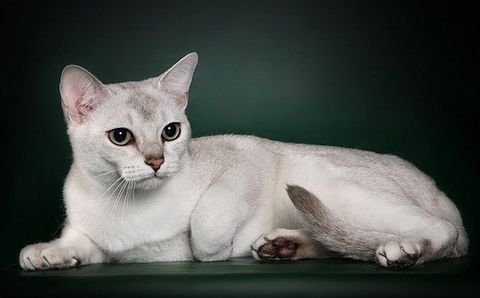
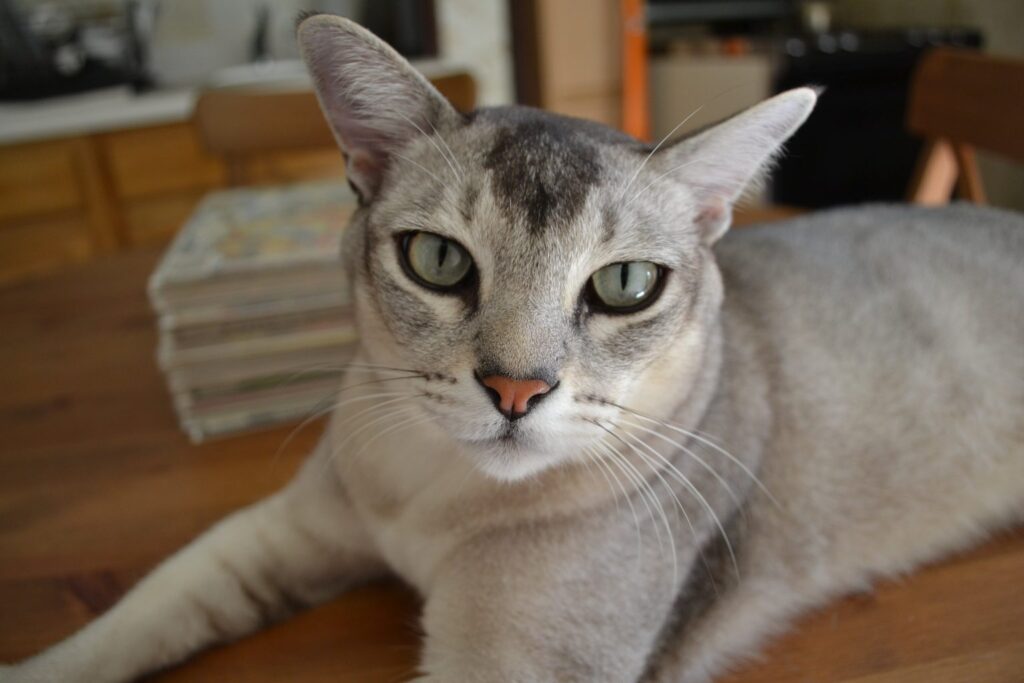
The Burmilla is a medium-sized cat whose coat carries color only at the very tips of an otherwise pale hair shaft, and whose eyes, nose, and lips look outlined in dark pencil that nobody drew. It exists because of one unplanned meeting between a Persian and a Burmese in an English cattery in 1981, and it reached American show halls only in this century. This guide is written for a reader in the United States: which registration papers to look at, which two DNA results separate a careful breeder from a careless one, and which state and city laws actually govern your cat’s claws, shots, and travel. You can read more about this breed and hundreds of others on Tvaryny.
Burmilla: Breed at a Glance

| Quick Facts About the Burmilla Breed | |
|---|---|
| Origin | United Kingdom, 1981 |
| Parent breeds | Chinchilla Persian and lilac European Burmese |
| CFA status | Registration 2011; championship 2014, shorthair and longhair divisions |
| TICA status | Board vote 2014, championship effective May 1, 2015; Burmilla and Burmilla Longhair listed separately |
| Other registries | GCCF within the Asian group, FIFe from 1995, WCF |
| Adult weight | 8–15 pounds; males noticeably heavier |
| Height at the shoulder | Roughly 9–11 inches |
| Average lifespan | 12–16 years |
| Coat | Short or semi-long, silver or golden, tipped or shaded |
| Eye color | Any shade of green, rimmed in dark pigment |
| Suits | Apartments and condos, families with children, homes where someone is around |
A note on genetics: the outgoing, people-centered half of the character comes from the Burmese cat, while the silver veil and the calmer half of the temperament come from the Chinchilla side of the Persian cat. Breeders who have worked with both describe the result as the Burmese personality with the volume turned down about a third.
How the Breed Happened: One Door Left Open
Most cat breeds have a founding story that involves a plan. The Burmilla’s involves a door that was not latched.
In 1981, Baroness Miranda von Kirchberg kept Burmese cats in England and had also bought a Chinchilla Persian male, Jemari Sanquist, as a pet rather than as breeding stock. He was scheduled to be neutered. Shortly before the appointment a door was left open overnight, and a lilac Burmese female named Bambino Lilac Faberge reached him. The litter arrived on September 11, 1981: four kittens, all female, all shorthaired, all black shaded silver. Instead of being placed as pets and forgotten, they became the foundation of a breeding program.
Two details are worth fixing in memory, because older articles get them wrong: the founder was a baroness, not a duchess, and Faberge was a lilac Burmese, not a lilac-tortoiseshell. The genetics behind the accident are what made it worth pursuing. The Chinchilla Persian carries the dominant inhibitor gene, which suppresses pigment along most of each hair and leaves color near the tip; the Burmese contributed body type, a short single coat, and the temperament.
Turning four kittens into a breed took a decade of unglamorous work. In Britain the Burmilla was folded into a wider group called Asian, which also covers the semi-longhaired Tiffanie; the Governing Council of the Cat Fancy granted a preliminary championship in 1990 and full championship status in 2003. The Fédération Internationale Féline recognized the breed from January 1, 1995, and the World Cat Federation lists it too. Burmillas reached the United States in the mid-1990s in small numbers, then spent roughly fifteen years in limbo: real cats with real pedigrees and no path to an American championship ring.
The Burmilla in America: CFA and TICA, Step by Step
The Cat Fanciers’ Association, headquartered in the United States and the largest registry of pedigreed cats in the world, accepted the Burmilla — shorthair and longhair alike — for registration in 2011. Registration is not competition: the cats and their litters enter the studbook and their ancestry is tracked, but they are not yet campaigning for titles. Championship status followed in 2014, after a CFA board vote in February of that year, with both divisions advancing together.
The International Cat Association, based in Texas, ran a parallel process: its board voted in August 2014 and championship status took effect on May 1, 2015. Within months the breed had its first TICA Supreme Grand Champion — a sign that American breeders had been waiting for the door to open.
So the Burmilla is fully recognized here, in both major registries, but the recognition is recent. Three consequences follow. American catteries are few compared with the Maine Coon or the Ragdoll, so waiting lists are normal and you may be looking outside your own state. Much of the gene pool still traces to Britain, Europe, and Australia, which is why the testing conversation below is not optional. And plenty of pages still claim the breed is not recognized by CFA — true before 2011, wrong ever since.
CFA vs. TICA: Two Different Ideas of What a Breed Is
American buyers often assume the two registries are interchangeable. They are not: they disagree about what makes a cat a member of a breed.
CFA registers by ancestry. A cat is a Burmilla because its parents were Burmillas, or because the mating was an outcross the breed’s own rules permit. The pedigree is the authority. That is the more traditional approach, and it is why CFA’s list of accepted breeds is shorter and skews toward long-established ones.
TICA gives far more weight to type. A cat can be registered as the breed it physically is, judged against the written standard, with fewer generations of documented ancestry behind it. That makes TICA much more hospitable to new breeds and to hybrids, and explains why its breed list includes cats CFA does not recognize at all.
They also structure the road to recognition differently. TICA publishes hard thresholds: moving from Preliminary New Breed to Advanced New Breed takes at least 25 registered litters, at least 25 individual cats shown at TICA events, and at least 15 members breeding it across five regions; reaching championship takes another year plus at least 200 adults registered in a full member association of the World Cat Congress, at least 50 of them with TICA. CFA’s ladder runs from registration through the Miscellaneous and Provisional classes and leans on people and judgments rather than head counts alone: 25 breeders working with the breed to leave Miscellaneous, then an application listing every breeder, every registered cat, every show entered, and the judges’ written evaluations. When championship arrives, the breed committee becomes a breed council, which votes on the standard itself.
The show halls differ accordingly. A CFA show runs perhaps four to ten rings across a weekend, with classes split by title, sex, and color; a TICA show is usually larger, ten to twenty rings over two or three days, with classes split mainly by color and more placements awarded. CFA’s top honor is National Winner, and it calls the altered class Premiership; TICA runs a longer ladder up to Supreme Grand Champion and awards separate Alter titles. Neither system is better — they measure different things.
Reading the Codes on an Imported Pedigree
Buy an imported Burmilla and you will eventually be handed a pedigree covered in three-letter codes. Here the breed hides a trap that catches experienced owners.
FIFe uses BML for the Burmilla — the shorthaired cat. The World Cat Federation lists the shorthaired Burmilla as BMS in its category 3 and uses BML for the longhaired variety. TICA’s own standings list BML as the Burmilla Longhair. The same three letters point at a shorthaired cat in one system and a longhaired cat in two others, so reading a pedigree with the wrong key can convince you that you own a coat length you do not own.
The long-coated cat’s name is tangled for the same reason. In Britain it is the Tiffanie, a member of the Asian group; in FIFe the Tiffanie has a code but is not recognized for championship; in CFA the Burmilla is one breed with two coat divisions; in TICA the Burmilla and Burmilla Longhair are separate entries. One cat, four bureaucratic fates.
A second hazard is specific to older American articles: several widely copied pages present Burmilla colors using codes beginning with BSH — the code for the British Shorthair. It is not a Burmilla code in any system, and its appearance is a reliable sign the color table was invented rather than copied from a registry document. If your kitten came with CFA papers the question never arises, since CFA describes color classes in words instead of codes.
What a Burmilla Looks Like

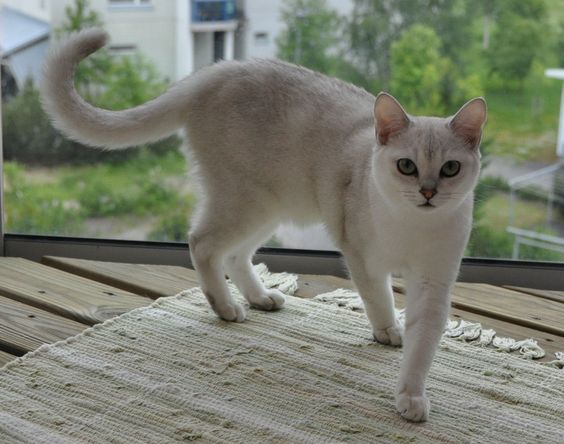
The Burmilla weighs more than it looks like it should: a muscular, compact body rather than a long tubular one, with a straight back, a broad chest, and slender but strong legs. Females run distinctly smaller than males.
- Head – A gently rounded wedge, wider at the top than at the muzzle, with a firm chin; mature males develop heavier cheeks.
- Ears – Medium to large, set wide, tilted slightly forward, with rounded tips.
- Eyes – Large and well spaced, with a full upper curve and a flatter lower line. Green in any shade is the goal; young cats often pass through yellow or amber first.
- The “makeup” – A dark line rims the eyes, lips, and edge of the nose leather in the same pigment as the tipping. This is the signature, and the fastest way to tell a Burmilla from an ordinary silver tabby.
- Tail – Medium to long, thick at the base, tapering to a rounded tip, often faintly ringed.
- Coat – Short, fine, and close-lying in the shorthair; semi-long and silky in the longhair, with an easy-care single coat that does not mat the way a true longhaired breed does.
The Coat: Tipped, Shaded, Silver, Golden
Two genes do most of the work. The inhibitor gene suppresses pigment along the shaft of each hair, leaving the base pale and the color concentrated toward the tip; the agouti gene decides how the remaining pigment is distributed. How far the pigment reaches decides which of the two patterns you are looking at. In tipped coats — also called shell or chinchilla — only the extreme tip carries color, and from a few feet away the cat looks almost white with a shimmer. In shaded coats the pigment reaches further down, giving visible depth along the back and flanks over a pale belly.
Both patterns come in two divisions: in the silver division the undercoat is white, and in the golden division it is a warm apricot to cream, which turns the same cat from moonlight into candlelight. CFA recognizes a long list of colors across both, including black, blue, chocolate, lilac, caramel, cream, red, seal sepia, and tortoiseshell variations.
| What you will hear | What it means | How it reads in a living room |
|---|---|---|
| Black tipped silver | White undercoat, black at the hair tips only | The classic frosted Burmilla; darkest along the spine |
| Black shaded silver | White undercoat, black carried further down the shaft | High contrast, almost a mantle over the shoulders |
| Blue tipped silver | Dilute black; soft gray at the tips | Cooler and smokier, less dramatic in photographs |
| Golden division | Warm undercoat instead of white | Reads as antique gold; often mistaken for a tabby |
Judges assess evenness of tipping by blowing gently against the lie of the coat and watching whether the shading transitions smoothly or breaks into patches. Kittens change substantially, so nobody can promise you a show cat at eight weeks.
Temperament and Behavior
CFA’s own description of the breed blends the mischievous, outgoing European Burmese with the placid Chinchilla Persian, and that is how it feels in practice: a cat interested in everything you do, following you from room to room, then settling instead of escalating.
- Sociable without being demanding. Burmillas greet visitors instead of hiding under the bed — a good fit for a household where people come and go.
- Quiet voiced. The Burmese line is famous for opinions loudly expressed; the Burmilla inherited the opinions and not the volume. Owners describe short chirps and trills rather than sustained yowling.
- Playful into adulthood. Kitten behavior persists well past the first year, so wand toys and puzzle feeders get used daily, not occasionally.
- Clever and food-motivated. Many Burmillas take readily to clicker sessions and learn to sit up, touch a target stick, or come when called. Two five-minute sessions a day beat one long one.
- Poor at solitude. The honest drawback. A Burmilla left alone through long workdays with no companion animal and no enrichment becomes bored and sometimes destructive, and that is the most common reason a placement goes wrong.
With children the breed does well, provided the children learn the lesson every cat requires: a cat that walks away has ended the interaction. Give it elevated retreats and most conflicts never start. With other pets the record is good — Burmillas usually integrate with other cats, and with a calm, cat-experienced dog, when the introduction runs gradually through a closed door and then a barrier.
Living With a Burmilla in an American Home
Indoor-only living is the norm for pedigreed cats in the United States, and it suits a trusting, people-seeking cat with no street sense whatsoever. What it needs in exchange is vertical territory and something to do.
- Height. A tall cat tree by a window is worth more than three floor toys; a cat with a high vantage point is a calmer cat.
- A window with traffic. A feeder outside the glass or a busy sidewalk fills the hours you are at work.
- A catio, if you own the outdoor space. An enclosed porch or window box gives outdoor stimulation without the risks of free roaming, and it has become mainstream in American suburbs.
- Scratching surfaces in several textures. Sisal, cardboard, and a post tall enough for a full stretch. This matters more than it sounds — see the section on declawing law below.
- Litter box math. Standard American shelter guidance is one box per cat plus one, in separate locations, scooped daily.
Climate deserves a thought: this coat has a modest undercoat, nothing like a northern breed’s insulation. In a Minnesota winter an older Burmilla goes looking for heat, and in Phoenix in July a cat shut in with the air conditioning off is at genuine risk.
Health: Two Inherited Risks Worth Naming
The Burmilla was made by crossing two breeds and inherited a documented risk from each. Both have a DNA test, which is unusually good news: it puts the decision entirely in the breeder’s hands and therefore makes it checkable by you.
From the Persian side: polycystic kidney disease, PKD1. The variant is a single change in the PKD1 gene, written c.10063C>A. Affected cats develop fluid-filled cysts in the kidneys, often detectable on ultrasound before the first birthday, and the cysts enlarge over years until kidney function declines. This is the classic Persian disease, and the Burmilla inherited access to it through the founding Chinchilla male’s line.
From the Burmese side: hypokalemia caused by a WNK4 variant. The variant, c.2902C>T, is a nonsense mutation that truncates the protein. Affected cats cannot hold onto potassium properly, and the result is episodic muscle weakness — a young cat that suddenly cannot hold its head up, moves with a stiff hunched gait, or collapses after exertion, then seems normal an hour later. Signs usually appear in the first year or two. Potassium supplementation manages it, but the episodes are frightening and the condition is entirely preventable by not producing affected kittens.
That variant is not confined to this breed. Because it entered through the Burmese, it runs across the whole Burmese-derived family, and testing is recommended for the Asian group, Australian Mist, Bombay, Burmese, European Burmese, Burmilla, Cornish Rex, Devon Rex, Singapura, Sphynx, Tiffanie, and Tonkinese. In the 2015 study by Malik and colleagues in the Journal of Feline Medicine and Surgery, 17 of 133 Burmillas tested were carriers — about 13 percent — alongside roughly 21 percent of Bombays and about a third of Tiffanies.
| Concern | What is actually established | What to do about it |
|---|---|---|
| Polycystic kidney disease (PKD1) | Autosomal dominant variant from the Chinchilla Persian founder line. The only Burmilla-specific published figure comes from an Australian ultrasound survey in which 2 of 14 Burmillas were positive — a sample far too small to become a breed rate. | DNA test both parents. One clear result on paper ends the question for that kitten. |
| Hypokalemia (WNK4) | Autosomal recessive nonsense variant from the Burmese founder line; 17 of 133 Burmillas were carriers in a 2015 study. | DNA test both parents. Two carriers must never be bred together. |
| Hypertrophic cardiomyopathy | No published prevalence figure exists for this breed. HCM is the most common feline heart disease overall, and no DNA test applies here. | Echocardiogram by a veterinary cardiologist, repeated on the schedule the cardiologist sets. A stethoscope is not a screen. |
| Dental disease and gingivitis | Common across pedigreed cats generally, not a Burmilla-specific defect. | Home brushing, an oral exam at every visit, professional cleaning when indicated. |
| Weight gain after altering | Predictable in every breed: metabolic rate drops and appetite does not. | Measured portions and active play. Adjust the food at the time of surgery, not six months later. |
| Kidney disease in older cats | An aging-cat issue across the species, distinct from PKD. | Bloodwork including SDMA and creatinine plus urine specific gravity, starting in middle age. |
Dominant vs. Recessive: Why the Difference Changes Your Questions
The two risks are inherited in opposite ways, and that changes what a clear result actually buys you.
PKD1 is autosomal dominant. One copy is enough. There is no such thing as a healthy PKD1 carrier that quietly passes it along — a cat with the variant is a cat with the disease, whether or not signs have appeared. Breed a positive cat to a clear cat and, on average, half the kittens are affected. This is the easier of the two to eliminate: test, and do not breed positives. A breeder who says PKD skips generations in this breed has misunderstood the inheritance.
The WNK4 variant is autosomal recessive. It takes two copies to make a sick cat. A cat with one copy is a carrier: completely healthy, indistinguishable by eye, by bloodwork, or by ultrasound, and perfectly usable in breeding as long as it is never mated to another carrier. Breed carrier to carrier and, on average, a quarter of the kittens are affected, half are carriers, and a quarter are clear. That is why the recessive one is the sneaky one — a cattery can go years without a sick kitten and then produce one, simply because it had never happened to pair its two carriers.
| Question | PKD1, dominant | WNK4 hypokalemia, recessive |
|---|---|---|
| Copies needed to cause disease | One | Two |
| Can a healthy cat pass it on? | No — one copy means affected | Yes — carriers are entirely healthy |
| What a clear parent guarantees | A clear parent cannot transmit it | No affected kitten, even from a carrier partner |
| The dangerous mating | Any mating involving a positive cat | Carrier to carrier |
| What to ask the breeder | “Is either parent positive?” | “Are both clear, or is one a carrier and the other clear?” |
Note the asymmetry in the last row: for the recessive condition, “one parent is a carrier” is a good answer provided the other is documented clear, and a breeder who understands this will explain it before you finish the question. Britain went a step beyond advice: since January 1, 2018, the Governing Council of the Cat Fancy has required the WNK4 test for Asian group cats registered with active breeding status, with the certificate submitted alongside the registration application and cats carrying two copies excluded from breeding. No American registry mandates anything equivalent — which is exactly why the buyer’s question carries so much weight here.
Numbers That Do Not Hold Up
Two figures circulate through Burmilla articles in every language, laid out in tidy tables as though they came from a study. Both fall apart on inspection, and an earlier version of this page carried both.
The claim that PKD occurs in three to five percent of Burmillas. No such measurement exists. The one published number specific to this breed comes from Barrs and colleagues in 2001, an ultrasound survey of pedigreed cats in Sydney and Brisbane in which 2 of 14 Burmillas were positive. Fourteen cats is not a breed, and the Burmilla figure was a footnote in a study designed to measure Persians. What is true is narrower and more useful: the variant reached the breed through the founding Persian, a DNA test settles it for any individual cat, and no percentage substitutes for a report with your kitten’s parents’ names on it.
The claim that HCM affects eight to ten percent of Burmillas. There is no published prevalence figure for hypertrophic cardiomyopathy in this breed at all. The number that keeps surfacing in that range belongs to a different breed — a Danish study by Granström and colleagues in 2011 measured roughly that rate in British Shorthairs. Borrowing another breed’s prevalence and printing it under the Burmilla’s name is how a plausible invention outlives an obvious one. The accurate statement: HCM is the most common heart disease in cats generally, it is documented in the Burmese-derived family, no breed rate has been established here, and the answer is a scan by a cardiologist rather than a percentage in a table.
DNA Testing in the United States: Where the Work Gets Done
The Veterinary Genetics Laboratory at UC Davis is the reference point. It offers the PKD1 test and the Burmese hypokalemia test as separate assays, and its list of breeds appropriate for the hypokalemia test names the Burmilla explicitly. Davis is also where much of the underlying science happened: the WNK4 mutation was identified by an international group that included the feline genetics laboratory there, working with colleagues in Bristol, Sydney, and elsewhere. Sampling is a cheek swab the owner takes at home and mails in.
Wisdom Panel’s Optimal Selection Feline is the breeder panel most commonly seen in American catteries, and the company is TICA’s official testing partner. Rather than ordering assays one at a time, it screens more than 45 genetic health risks, over 25 trait markers including coat color and type, blood type, and genetic diversity from a single swab, covering both the Persian-origin and Burmese-origin conditions.
Which to prefer depends on why you are testing: a breeder planning matings benefits from the panel, while a buyer verifying one claim benefits from the short, unambiguous single-assay report. Either way, insist that the document shows the cat’s registered name or microchip number, the laboratory’s name, and the variant tested. A screenshot with the identifying details cropped out is not evidence.
Veterinary Care, Vaccination, and the Microchip
American practice follows the AAHA/AAFP feline vaccination guidelines, which treat the combination vaccine against feline herpesvirus, calicivirus, and panleukopenia — the shot your clinic calls FVRCP — plus rabies as core for pet cats, with feline leukemia vaccination also core for cats under a year old. A typical kitten series runs three FVRCP doses at roughly 6 to 8, 10 to 12, and 14 to 16 weeks, with rabies at 12 to 16 weeks depending on the product and your state’s rules. Boosters follow at the interval your veterinarian sets, with rabies revaccination governed by state law and vaccine labeling.
Many American clinics carry the AAFP’s Cat Friendly Practice designation, which signals staff trained in low-stress feline handling — worth seeking out for a sociable but sensitive breed. Microchipping deserves its own sentence, because Americans routinely get it half right: the chip does nothing until it is registered to you in a chip company’s database, and there is no single national registry. If your kitten arrives chipped, transfer the registration into your name. The AAHA Universal Pet Microchip Lookup tool identifies which registry holds a given number.
Grooming the Burmilla: Coat, Claws, and Eyes
- Brushing – Once a week with a soft brush or grooming glove for the shorthair, twice a week for the semi-long coat. The single coat means mats are rare.
- Bathing – Rarely. Most Burmillas tolerate water well, but frequent washing dulls the silver rather than brightening it.
- Eyes – Wipe the inner corners with a soft damp cloth if discharge collects; on a pale coat, staining shows early.
- Teeth – Brushing several times a week with cat toothpaste is the highest-value grooming habit you can build, and far easier to start in a kitten than in a five-year-old.
- Claws – Trim the sharp tips every two to three weeks and provide scratching surfaces in several textures. Soft vinyl nail caps are an option for households worried about furniture.

Feeding a Burmilla
Start with the label rather than a formula. In the United States a complete diet carries an AAFCO nutritional adequacy statement naming the life stage it is formulated for — growth, adult maintenance, or all life stages. That single line does more for your cat than any protein-to-fat ratio you will read in an article. Include wet food, since cats are poor drinkers by evolutionary design; measure portions rather than free feeding, especially after spay or neuter surgery; and aim for a 4 or 5 on the nine-point body condition scale American veterinarians use.
One widespread piece of misinformation deserves correcting. Burmilla articles frequently recommend a low-phosphorus renal diet for healthy cats “because of the Persian genes.” That is backwards: therapeutic renal diets are formulated for cats with diagnosed kidney disease and are not a preventive measure for healthy animals. The same goes for urinary acidifiers and supplements added on internet advice. If your cat has diagnosed kidney disease, or PKD confirmed by test and imaging, your veterinarian builds the plan. Otherwise, feed a good complete food and keep the cat lean — that is the whole prevention program.
US Law for Cat Owners: Rabies, Declawing, Travel
There is no federal law telling you how to keep a cat. Almost everything that governs your Burmilla is state or city law, and it varies enough that owners moving across the country get caught out.
Rabies vaccination. Roughly two-thirds of the states, along with the District of Columbia, require cats to be vaccinated against rabies as a matter of state law. The rest — California, Michigan, Ohio, Wisconsin, and Georgia among them — have no statewide feline requirement, which does not mean no requirement: counties and cities in those states frequently impose one. “My cat never goes outside” is not a legal exemption in most jurisdictions.
Declawing. This is the fastest-moving area of American cat law. New York became the first state to ban elective declawing in 2019; Maryland followed in 2022 and Virginia in 2024; Massachusetts, Rhode Island, and California all enacted bans in 2025, with California’s Assembly Bill 867 signed on October 9, 2025, and taking effect at the start of 2026. The District of Columbia bans the procedure as well. Where there is no state ban, city ordinances often fill the gap: eight California cities acted years before their state did — West Hollywood, Los Angeles, San Francisco, Berkeley, Beverly Hills, Culver City, Santa Monica, and Burbank — and Denver, St. Louis, Pittsburgh, Allentown, Austin, and Madison have each passed prohibitions of their own. In every version, amputation for a genuine medical reason such as a tumor remains legal; what is banned is the elective procedure.
The cat fancy arrived there before the legislatures did. CFA show rules bar declawed cats from its shows entirely, in every class, and a judge will disqualify such an entry. TICA excludes them from competition classes too, allowing them in household pet classes, with an exception where the exhibitor produces a veterinarian’s certificate explaining a medical cause. So even in a state with no ban, a declawed Burmilla cannot be shown — and expect your breeder’s contract to prohibit the procedure outright.
Bringing a cat into the country. The import rules that changed dramatically in 2024 apply to dogs. Cats were not covered: the CDC does not require proof of rabies vaccination for a cat entering the United States, though it recommends the vaccine and notes that your destination may impose more. A health certificate is generally needed for the airline and often for the destination state. If you are importing a Burmilla from a British or Australian cattery, plan your time around paperwork rather than quarantine — with two exceptions. Hawaii and Guam are rabies-free and quarantine arriving cats, including cats flying in from the mainland. Hawaii can release a cat directly at the airport, but only after a precise sequence completed well in advance: a microchip, correctly timed rabies vaccinations, and a rabies antibody titer test at an approved laboratory, with a waiting period afterward. Miss a step and the cat serves a quarantine that can run from a few days up to 120 days at the state facility.
Buying a Burmilla Kitten in the United States
American law touches cat sales in three places, and each gives you leverage.
Federal licensing. Under the Animal Welfare Act, a breeder who maintains more than four breeding females and sells animals sight unseen — online, by phone, shipped to a buyer who has never seen the animal — must be licensed and inspected by USDA’s Animal and Plant Health Inspection Service. Breeders who sell only face to face fall outside that requirement, and most Burmilla catteries are small enough to be exempt. The point is to stay alert when a seller ships nationwide, keeps many queens, and holds no license.
State retail sale bans. California became the first state to prohibit retail sales of cats and dogs in pet stores, in 2017; Maryland followed in 2018; New York’s Puppy Mill Pipeline Act took effect at the end of 2024; several more states have joined since, and close to 300 cities and counties have their own versions. These laws target the pet store supply chain and generally do not restrict buying directly from a breeder — which is how essentially every Burmilla in America is placed anyway.
Pet purchaser protection laws. Around twenty-two states have enacted what Americans call puppy lemon laws, and many cover cats too. The typical structure gives a buyer a short window — commonly one to two weeks — to report an infectious disease and a much longer window, sometimes a full year, to report a congenital or hereditary defect, with remedies that can include a refund, a replacement, or reimbursement of veterinary bills. Florida’s statute, for instance, allows fourteen days for infectious disease and one year for hereditary defects in a cat or dog. Coverage is uneven: some states apply their law only to pet stores, and California requires disclosures for cats without giving the buyer the same remedy it gives buyers of dogs. So find out whether your state’s act covers cats and covers breeders — and have the kitten examined by your own veterinarian within days of pickup, since nearly every one of these laws requires that exam to start the clock.
Beyond the law, ordinary judgment applies. Ask which registry the litter is registered with and when the slip will be issued, ask to see both parents’ DNA reports, and expect a spay or neuter contract on a pet placement — that is normal, not distrust. Kittens should stay with the queen and littermates until at least twelve to fourteen weeks, because a Burmilla removed at eight weeks missed the socialization window this breed’s personality depends on. The contract should also state what happens if you can no longer keep the cat; the standard clause is that the cat returns to the breeder rather than going to a shelter.
Pros and Cons of the Breed

| Advantages | Challenges |
|---|---|
| Sociable and even tempered; good with children and other pets | Does poorly when alone all day, every day |
| Quiet voice — chirps rather than yowls | Wants daily interactive play, not just toys on the floor |
| Easy coat care, even in the semi-long variety | Gains weight readily after spay or neuter surgery |
| Both inherited risks have DNA tests available | Few American catteries; expect a waiting list and possible travel |
| Adapts well to apartments and condos | Recent US recognition means a lot of outdated information online |
Burmilla vs. Related Breeds
| Breed | How it differs | Choose it instead if… |
|---|---|---|
| Burmese | More intense, more vocal, more insistent; same body plan, no silver coat | You want maximum interaction and do not mind being told about it |
| British Shorthair | Heavier, calmer, more independent, plush double coat that needs more brushing in season | You want a placid cat that tolerates being alone better |
| Tiffanie or Burmilla Longhair | The same cat with a semi-long single coat; the name depends on the registry | You want a longer coat without the grooming load of a true longhair |
| Tonkinese | Also Burmese-derived and social; pointed rather than tipped, and busier | You like the Burmese personality but prefer point color |
| Chinchilla Persian | Same silver effect, very different cat: flat face, dense coat, far more grooming | You want the look and are prepared for daily coat work |
One point connects several rows: the Burmese-derived breeds share the WNK4 variant, so if you are comparing a Burmilla with a Bombay, a Tonkinese, or a Tiffanie, the hypokalemia question applies to all of them equally.
Interesting Facts About Burmillas
- The founding litter was entirely female, and the cat that sired it was days away from being neutered.
- The mutation behind Burmese hypokalemia was pinned down by an international collaboration that included the feline genetics laboratory at UC Davis — which is why an American laboratory offers the definitive test for a British breed descended from a Southeast Asian one.
- Britain requires that hypokalemia test for Asian group cats registered for active breeding; the United States requires it of no one — a difference of registry policy, not of science.
- Both American registries barred declawed cats from competition long before American legislatures began banning the procedure itself.
- Bronze figurines of the founding pair in a GCCF museum, a favorite detail of older articles, do not exist.
Frequently Asked Questions
Is the Burmilla recognized by CFA and TICA?
Yes, by both. CFA accepted the breed for registration in 2011 and advanced it to championship in 2014, with the shorthair and longhair divisions moving together. TICA’s board voted in 2014 and championship took effect on May 1, 2015. The registries organize it differently: CFA treats it as one breed with two coat divisions, while TICA lists the Burmilla and the Burmilla Longhair separately.
Should I look for a CFA or a TICA breeder?
Either is legitimate, and many American catteries register with both. CFA registers a cat as a Burmilla on the strength of its ancestry — the parents must be Burmillas or a permitted outcross. TICA gives more weight to type measured against the written standard and requires fewer documented generations, which is why it recognizes more new and hybrid breeds. What matters more than the logo is whether the litter is registered at all, when you receive the slip, and whether the breeder can produce health results for both parents.
Which two DNA tests should the breeder show me?
PKD1, the dominant polycystic kidney disease variant from the Chinchilla Persian founder, and the WNK4 variant that causes Burmese hypokalemia. Both are offered by the Veterinary Genetics Laboratory at UC Davis and both appear on Wisdom Panel’s Optimal Selection Feline panel. Ask for reports showing the cat’s registered name or microchip number, the laboratory, and the variant tested.
What is the practical difference between a dominant and a recessive risk?
For PKD1, which is dominant, one copy is enough to make the cat affected — there are no healthy carriers, so the breeder simply must not breed a positive cat. For the WNK4 variant, which is recessive, a cat with one copy is completely healthy and can be bred safely to a clear partner; only a carrier-to-carrier mating produces affected kittens, at an average rate of one in four. That is why “one parent is a carrier” is an acceptable answer for hypokalemia and an unacceptable one for PKD.
Are Burmillas hypoallergenic?
No, and no breed of cat is. Every cat produces the Fel d 1 protein in saliva and skin secretions, and it spreads over the coat during washing. Production varies enormously between individual cats — more than it varies between breeds — so claims that this breed carries a fixed percentage less allergen than average have no measurement behind them. If someone in the household is allergic, spend time with the specific cat and talk to an allergist.
Is declawing my Burmilla legal where I live?
That depends on your state and your city. New York banned elective declawing in 2019, Maryland in 2022, Virginia in 2024, and Massachusetts, Rhode Island, and California in 2025, with California’s ban effective at the start of 2026; the District of Columbia bans it too. Several cities prohibit it independently, including eight in California plus Denver, St. Louis, Pittsburgh, Allentown, Austin, and Madison. Separately, both CFA and TICA bar declawed cats from competition, and virtually every reputable American breeder writes a no-declaw clause into the contract. Regular nail trims, several scratching surfaces, and soft nail caps address the underlying problem.
Does my indoor-only cat need a rabies shot?
In roughly two-thirds of the states and in the District of Columbia, state law requires rabies vaccination for cats and makes no exception for indoor cats. In states without a statewide rule — California among them — county and city ordinances frequently impose one, so check locally. Beyond the legal answer: bats get indoors, an unvaccinated cat exposed to a suspected rabid animal faces far harsher quarantine, and the vaccine is core in the AAHA/AAFP guidelines.
How long do Burmillas live, and how big do they get?
Twelve to sixteen years is the realistic range with good care. Adults typically weigh eight to fifteen pounds, males substantially heavier, on a compact frame that feels heavier in the hand than the cat looks. Longer lifespan ranges that appear on some pages are not supported by anything.
Can a Burmilla handle being alone while I work?
A normal workday is manageable; a long commute on top of long hours, five days a week, is where this breed struggles. Burmillas are strongly people-oriented and get bored rather than being destructive by nature. The reliable fixes are a second cat, height and window access, puzzle feeders that turn one meal into a project, and interactive play when you get home. If nobody will be home for ten hours a day and a second animal is out of the question, there are better-suited breeds.
The Bottom Line
The Burmilla is one of the most pleasant cats to live with that most Americans have never met: sociable without being loud, decorative without being fragile, clever enough to be interesting and calm enough to be restful. Its recognition here is recent — CFA registration in 2011, championship in 2014, TICA championship from May 2015 — so finding a kitten takes patience.
What makes this an easy breed to buy well is that its two real health risks are named, understood, and testable. Ask for the PKD1 result and the WNK4 result, read them, and understand which is dominant and which is recessive. Ignore percentages no study produced, ignore promises of hypoallergenic cats, and check your own state’s rules on rabies vaccination and declawing before the kitten comes home. Do those few things and you get what the Baroness stumbled into in 1981: a silver cat with penciled eyes that follows you from room to room, and then lets you work.
- Sociable, even tempered, good with children and other pets
- Quiet voice — chirps rather than yowls
- Easy coat care, even in the semi-long variety
- Both inherited risks have DNA tests available
- Suits apartments and condos
- Does poorly when left alone all day, every day
- Gains weight readily after spay or neuter surgery
- Few American catteries; expect a waiting list
- No breed-wide cardiac data — screening depends on the breeder
| Burmese | British Shorthair | Tonkinese | |
|---|---|---|---|
| Weight | 6–14 lb | 9–18 lb | 6–12 lb |
| Energy | 4 | 2.5 | 4 |
| Apartment | 5 | 5 | 5 |
| Beginners | 4 | 4.5 | 4 |
Is the Burmilla recognized by CFA and TICA?
Should I look for a CFA or a TICA breeder in the United States?
Which two DNA tests should the breeder show me?
What is the practical difference between a dominant and a recessive risk?
Are Burmillas hypoallergenic?
Is declawing a cat legal in the United States?
Does an indoor-only cat need a rabies shot?
How long do Burmillas live, and how big do they get?
Can a Burmilla handle being alone while I work?
CFA breed profile and show rules; TICA registration and show rules; GCCF Asian group rules; FIFe and WCF breed lists; UC Davis Veterinary Genetics Laboratory; Wisdom Panel Optimal Selection Feline; AAHA/AAFP feline vaccination guidelines; Barrs et al. 2001; Malik et al. 2015; Granström et al. 2011
For apartments · For kids · For beginners · Most affectionate · Quietest · Hypoallergenic · All rankings →