Tvaryny ›
Dogs ›
Fila Brasileiro (Brazilian Mastiff)
Group 2 · molossoids · Brazil
Fila Brasileiro (Brazilian Mastiff)
A Brazilian guardian of boundless devotion and innate distrust: massive, brave, faithful to its person and fearsome to strangers. The Fila Brasileiro has the unique trait of “ojeriza” — an inborn suspicion of strangers; a serious guarding breed exclusively for very experienced owners.
Apartment · not suitableKidsCats · not suitableOther dogs · not suitableBeginners · not suitable
The Fila Brasileiro is a serious and powerful dog with impeccable guarding qualities. This overview, prepared by the Tvaryny team, will delve into the unique characteristics of this breed. Ideal for protecting private properties, the Fila Brasileiro is fearless, somewhat aloof, and displays an inherent distrust and aggression towards strangers, which is a hallmark of the breed. Possessing immense physical strength, this dog is certainly not for everyone. Representatives of this breed are extraordinarily devoted and loyal, loving their owners to distraction, yet not everyone is capable of handling such a strong-willed and incredibly powerful dog.
Fila Brasileiro (Brazilian Mastiff): A Brief Breed Overview
Fila Brasileiro (Brazilian Mastiff): A Brief Breed Overview · 8
Origin
Brazil
FCI Classification
Group 2 (Pinscher and Schnauzer, Molossoid, Swiss Mountain and Cattle Dogs), Section 2.1 (Molossoid, Mastiff Type)
Year of Recognition
1968
Life Expectancy
9–11 years
Height at Withers
Males: 65–75 cm, Females: 60–70 cm
Weight
Males: from 50 kg, Females: from 40 kg
Temperament
Brave, resolute, loyal, obedient to family, aggressive towards strangers
Other Names
Fila Brasileiro, Brazilian Mastiff
Interesting Facts about the Fila Brasileiro
"Loyal as a Fila" – this is a popular saying in Brazil, highlighting the incredible devotion of this breed.
At exhibitions held under CAFIB club rules, judges are forbidden to touch the dog. Evaluation is conducted visually only. Any aggression towards the judge is not penalized, but considered confirmation of correct temperament.
Historically, Filas were used for hunting jaguars. The dog would corner the predator in a tree and hold it until the hunter arrived.
Despite their formidable appearance, many owners compare the Fila's behavior at home to that of a cat – they are just as affectionate and love comfort.
Comparison with Other Mastiffs
The Fila is often compared to other large Molossers, such as the Dogue de Bordeaux or the Broholmer. However, it has key differences.
Characteristic
Fila Brasileiro
English Mastiff
Dogue de Bordeaux
Temperament towards strangers
Innate distrust and aggression ("ojeriza")
Reserved, wary, but not aggressive without cause
Wary, can be aggressive when threatened
Build
Powerful, but more "lean" and agile
Very massive, heavy, broad
Athletic, stocky, very muscular
Main Purpose
Guard dog, companion
Companion, guard dog
Guard dog, companion
Activity Level
Medium
Low
Medium
History of the Fila Brasileiro Breed
The history of the Fila Brasileiro's emergence is shrouded in mystery, with many versions existing, though none are officially confirmed. Most experts lean towards the belief that the Fila is a breed that developed naturally, adapting to the harsh conditions of Brazilian fazendas. Therefore, we cannot precisely state which dog breeds were the ancestors of the modern Fila. It's thought that the blood of ancient Molossers, brought to Brazil by Portuguese and Spanish conquistadors, flows in its veins, along with the blood of old English Mastiffs, Bloodhounds, and ancient Bulldogs.
From Mastiffs and Molossers, the Fila inherited its powerful build, heavy head, and strength. From the Bloodhound – its pendulous ears, loose skin, neck folds, and incredible sense of smell, which made it an excellent tracker. And from the Bulldog – a stubborn and fearless character. These dogs were used for guarding homes and livestock, hunting large game, including jaguars, and for tracking runaway slaves. Their ability to "hold" prey (Portuguese: "filar") without causing serious injury until the hunter arrived gave the breed its name.
A huge contribution to the recognition and spread of the breed was made by Dr. Paulo Santos Cruz. He penned the first official standard, which was recognized in 1946. By 1968, the Fila was acknowledged by the Fédération Cynologique Internationale (FCI). Following this, Brazilian Filas became highly popular not only in Brazil but also across Europe. However, breeders sought to "improve" the dogs' appearance, making them even larger and more massive. They began crossing purebred Filas with other large breeds, such as the Great Dane, English Mastiff, and Neapolitan Mastiff. This led to a so-called "hybridization" of the breed, leaving very few purebred Filas. To rectify the situation, Dr. Paulo Santos Cruz organised a single-breed Fila club (CAFIB), which focused on preserving the purity of the breed. In 1984, a new, slightly modified and detailed breed standard was adopted. Due to its specific reputation, these dogs are banned or their ownership is strictly regulated in some countries (the UK, Norway, Israel, Australia).
Breed Standard and Appearance
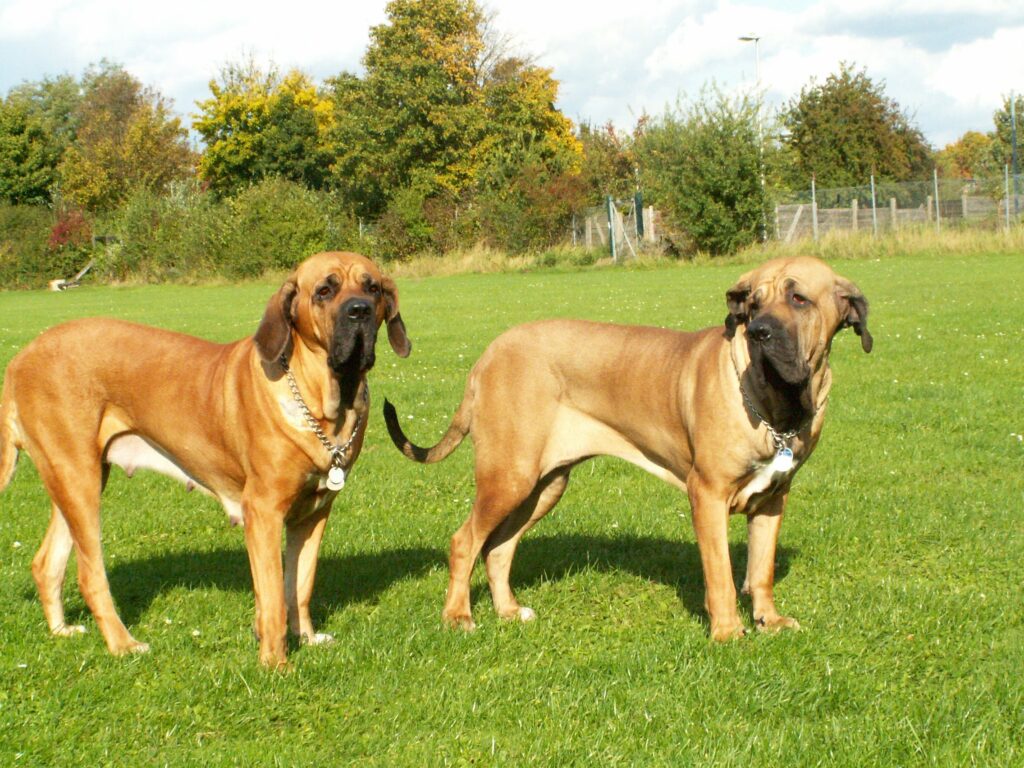
Fila Brasileiros are very large and powerful dogs, possessing a strong bone structure and a proportionate build that radiates strength and confidence.
Head: Large, heavy, very broad with a massive muzzle.
Ears: Large, thick, pendulous, V-shaped, very broad at the base and rounded at the tips.
Eyes: Medium-sized, almond-shaped, wide-set. Color can vary from honey to dark brown, depending on the dog's coat color. The gaze in a calm state is sad and noble.
Neck: Very strong and muscular. Under the throat, there is a double, thick skin that hangs loosely (dewlap), which is a characteristic feature of the breed.
Body: Powerful, with a deep and broad chest. The topline is often slightly raised towards the croup, which is typical for the breed.
Skin: One of the most distinctive features is the thick, loose skin that forms wrinkles, especially on the neck, chest, and belly. This served as protection against the teeth of predators.
Tail: Strong, set at a medium height, broad at the base, tapering towards the end. When moving, it is raised but does not curl over the back.
Coat: Short, smooth, dense.
Color: All solid colors are permitted, except white, mouse-grey, black, and black and tan. The most common are fawn, golden-red, and brindle. A black mask may be present. Permissible white markings on the paws, chest, and tail tip, if they do not exceed 1/4 of the body surface. Black color is considered a sign of hybridization.
Another distinguishing feature of the Fila is their so-called "camel gait" (pacing). They move by simultaneously shifting two limbs on the same side. This ensures a smooth, sweeping movement. It is assumed that precisely due to this characteristic, these dogs can cover vast distances with minimal energy expenditure.
Character and Temperament of the Fila Brasileiro
The Fila's character is the quintessence of devotion to its family and distrust of strangers. In Portuguese, there is a term "ojeriza", meaning "aversion" or "dislike". This term perfectly describes the Fila's attitude towards outsiders. It's not just wariness, but an instinctive, deeply ingrained dislike of anyone who isn't a member of its "pack". You cannot simply approach and pet this dog. With strangers, it behaves extremely seriously and uncompromisingly. Its reaction can be instantaneous and decisive. This trait makes it one of the best guardians in the world, similar in protective instincts to the Caucasian Shepherd Dog, but with a different working style.
However, once you cross the threshold of its home, this formidable wolf transforms into a gentle kitten. For its family, the Fila is the embodiment of love and tenderness. They are extraordinarily attached to their owners, literally following them everywhere and seeking constant contact. Filas get along wonderfully with the children of their family, patiently enduring all their antics. However, under no circumstances should strange children be allowed near a Fila – it is extremely dangerous. They are very devoted and loyal friends who keenly sense their owner's mood and are always ready to offer their silent support.
Pros and Cons of the Fila Brasileiro Breed
Before acquiring such a serious dog, it is essential to weigh all the pros and cons soberly.
Pros and Cons of the Fila Brasileiro Breed · 6
Pros
Cons
Incredible family devotion. The Fila lives for its owner and their family.
Innate aggression towards strangers. Requires strict control and early socialization.
Outstanding guarding qualities. One of the best guard dogs in the world.
Requires an experienced owner. Not suitable for novices.
High intelligence. Intelligent, learns quickly if it perceives the owner as a leader.
Large size and strength. Maintenance requires a lot of space and financial expenditure.
Undemanding in care. Short coat does not require complex grooming.
Tendency to dominate. Will constantly test the owner's resolve.
Patience with children in the family. Very gentle and caring with "its own" children.
Legal restrictions. The breed is banned or restricted in many countries.
Robust health. Rarely gets ill with proper care.
Cannot live on a chain. Requires constant contact with the family.
Training and Socialization
The Fila Brasileiro is a very intelligent and astute dog. It always understands what is expected of it, but will only obey commands when it respects its owner and considers them the undisputed leader. Training must be based on respect, consistency, and firmness. Harshness and physical punishment are unacceptable – they can permanently destroy trust and provoke aggression in response. These dogs live by the pack principle, and only the pack leader will be obeyed without question.
Early and proper socialization is a key aspect of upbringing. From a young age, the puppy needs to be introduced to various sounds, places, calm people, and animals (under strict supervision). This won't make it friendly to everyone, but it will help it react appropriately to stimuli in an urban environment. Remember that socialization of a Fila does not mean suppressing its "ojeriza", but merely teaches it to control its reactions. Not everyone will be able to handle raising a Fila. You must be an experienced, confident, and knowledgeable dog owner.
Care and Maintenance
The Fila Brasileiro can live in apartment conditions, but this is far from the best option. The ideal place for it is a private house with a large, securely fenced area, where it can move freely and fulfill its guarding instincts. Keeping a Fila on a chain is strictly unacceptable, as it destroys its psyche.
Caring for these dogs is very simple:
Coat: Brushing with a rubber brush 1–2 times a week is sufficient to remove dead hairs.
Skin: It is necessary to monitor the condition of skin folds, especially on the neck, and wipe them as needed to avoid irritation.
Eyes and Ears: Regularly inspect and clean them using special lotions.
Claws: Trim as needed if they do not wear down naturally.
Physical Activity: The Fila does not require intensive training like sporting breeds, but it needs long walks and the opportunity to move freely around the territory.
Remember that for a Fila, there is only one owner and one family. It should under no circumstances be given to other people in adulthood – it will never accept them, and this could lead to tragedy.
Nutrition
Nutrition: What to Feed a Brazilian Mastiff
Health and risks
Health and Typical Diseases
Frequently Asked Questions about the Breed (FAQ) · 4
Is the Fila Brasileiro suitable for a family with children?
Yes, but only for its own family. The Fila adores its owner's children and will be a gentle nanny for them. However, it poses a deadly danger to strange children who might enter its territory.
How much does a Fila Brasileiro puppy cost?
The price for a Fila Brasileiro puppy from responsible breeders can be quite high, especially if they are descendants of purebred CAFIB lines. Note that ownership of the breed is restricted in some municipalities and by some insurers — always check your local regulations first. Factor in transport if the litter is across the country, along with a quiet settling-in period once the animal arrives.
Can a Fila be kept in an apartment?
Theoretically yes, provided there are long and fulfilling walks. But the ideal conditions for this breed are a private house with a large, fenced plot.
Does the Fila Brasileiro shed a lot?
Shedding is moderate, intensifying seasonally. Regular brushing helps keep it under control.
Video about the Breed
FAQ
What is “ojeriza” in the Fila Brasileiro?
The breed's inborn distrust of strangers — a historically valued working trait; this is precisely why the breed demands a very responsible owner and careful socialization.
Is the Fila Brasileiro suited to a novice?
Absolutely not — a massive guardian with innate suspicion; it needs great experience, space, control and early socialization.
Is the Fila Brasileiro legal everywhere?
No. The breed is banned or restricted in several countries (the UK, Norway, Israel, Australia), and in the US some municipalities and insurers restrict it — check local regulations before getting one.