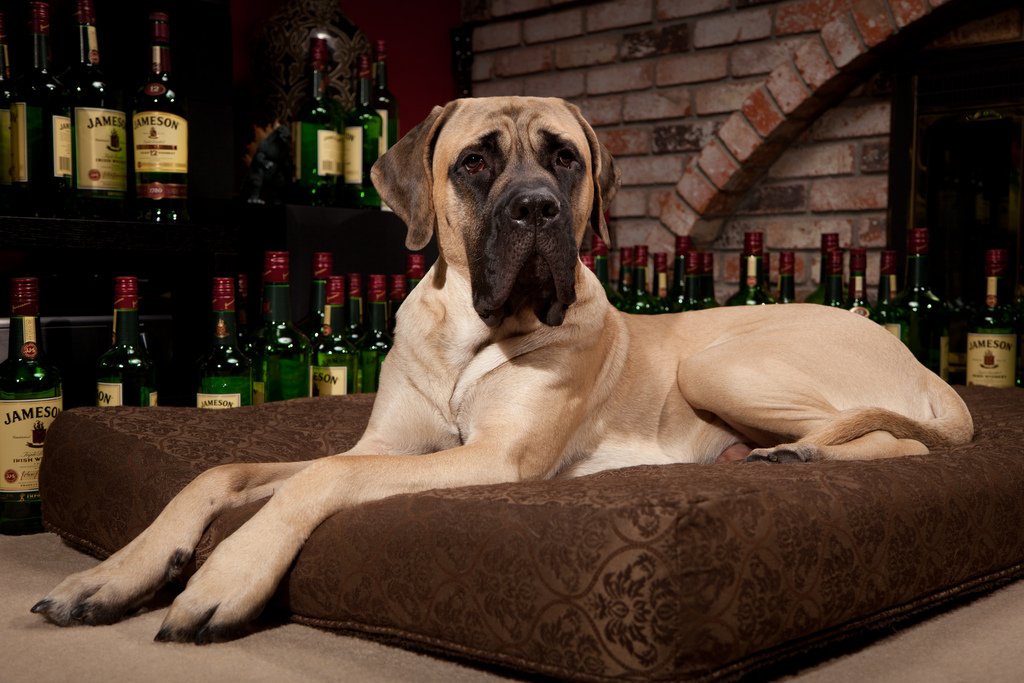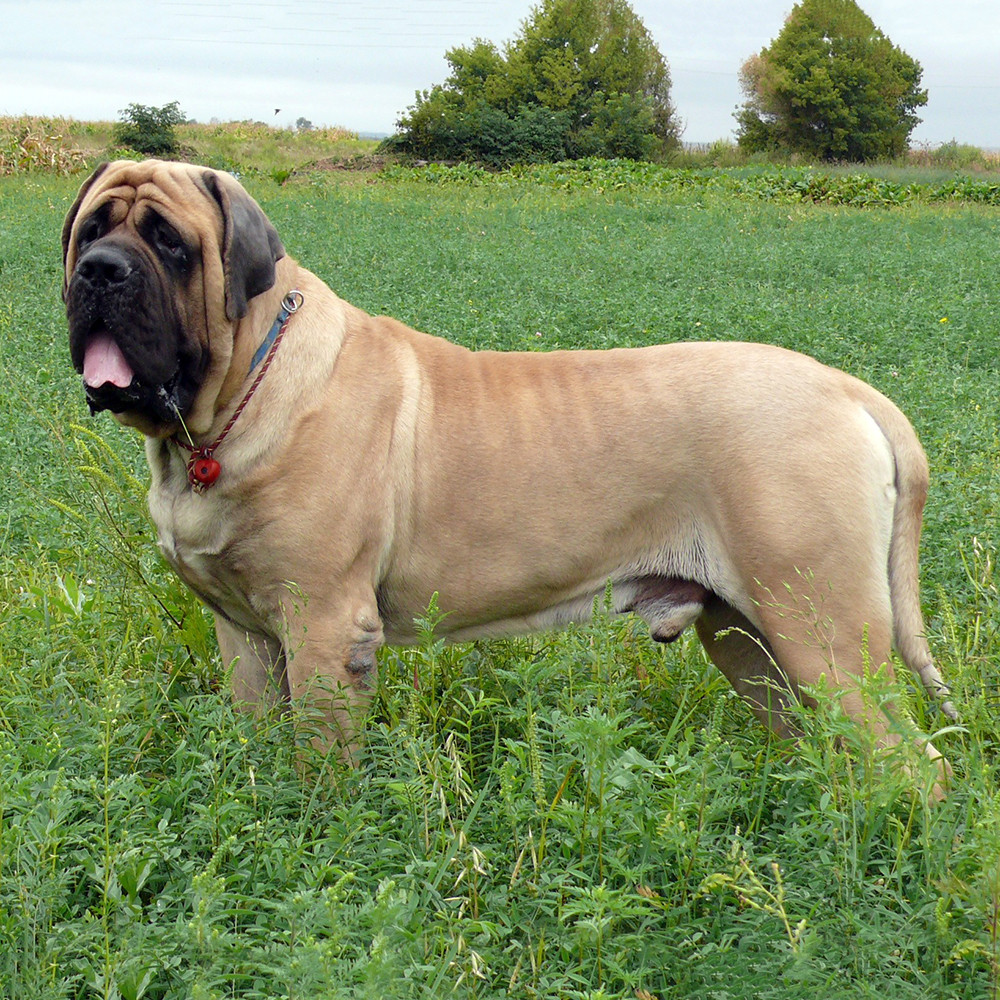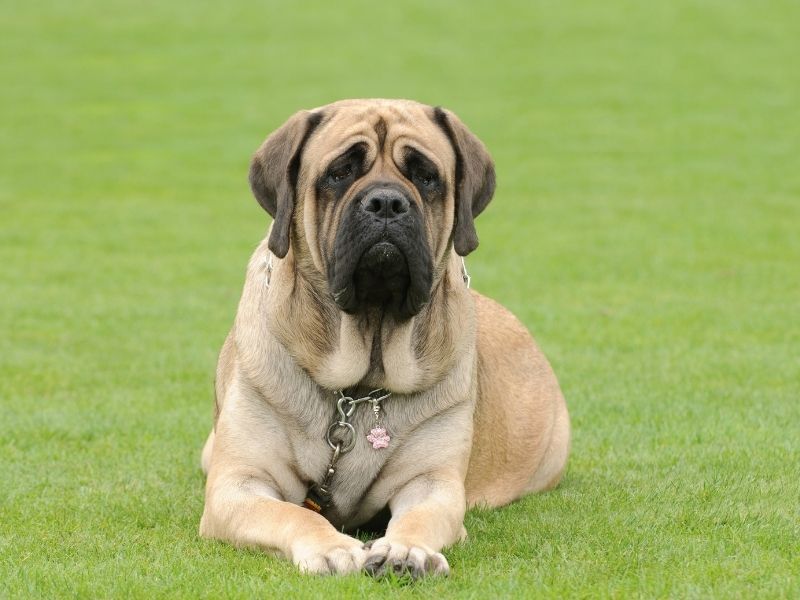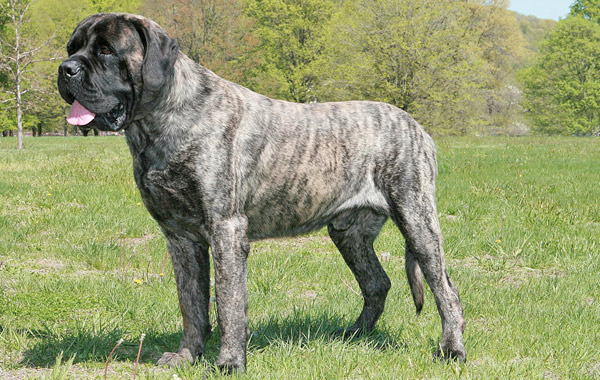
The English Mastiff is a giant molosser in a black mask — a breed almost nobody fails to recognize and almost everybody confuses with something else. No other breed of British origin has collected so many retellings, and a good share of them fall apart the moment you open the document. This page works in the opposite order: what a registry standard, a veterinary cohort or a primary source will support comes first, and the handsome stories come afterward, labeled as stories. The subject that matters most here is not size but time — a Mastiff's life is markedly shorter than an average dog's. More breeds and ratings on Tvaryny.
The English Mastiff at a glance
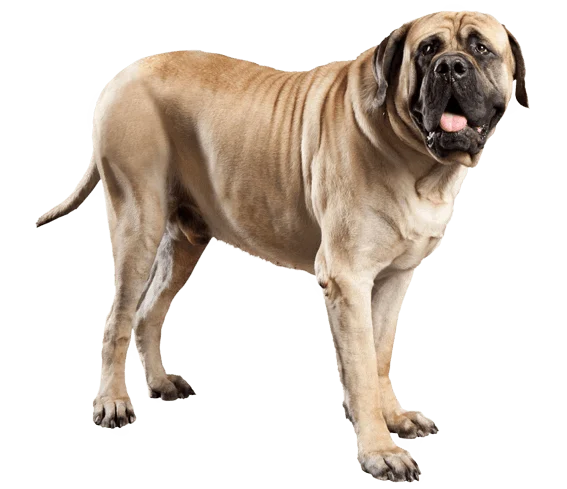
The English Mastiff at a glance · 9
| Origin | Great Britain |
|---|---|
| Height: what the document says | The AKC standard sets a minimum only — 30 inches at the shoulder for males, 27½ for females, or roughly 76 and 70 cm. The Canadian Kennel Club prints the same floor metrically: 76.25 and 69.75 cm. The FCI and The Kennel Club give no height at all |
| Weight: what the document says | No registry sets a weight. The AKC breed profile and the British breed club agree independently: males 160–230 pounds (73–104 kg), females 120–170 pounds (54–77 kg) |
| Life expectancy | The AKC profile says 6–10 years; a British cohort puts the median at 9.0 |
| FCI group | Group 2, section 2.1 — molossoid breeds, mastiff type; without working trial |
| Purpose under the standard | Watch and security dog |
| Temperament under the standard | Grandeur and courage; calm, devoted to its owners, able to guard; usually indifferent toward strangers |
| Coat | Short, close-lying, coarser over neck and shoulders; dense undercoat |
| Drooling and snoring | Heavy — a consequence of the build |
How long a Mastiff lives: the number that should come first
In 2024 Scientific Reports carried a paper by McMillan and coauthors on breed lifespan in the United Kingdom. This was no owner poll and no club estimate: material from 18 sources — shelters, registries, insurers, veterinary networks, university archives — was cleaned and de-duplicated down to 584,734 individual dogs, 284,734 of them already deceased, then run through Kaplan–Meier estimation for 155 recognized breeds.
For the Mastiff the median came to 9.0 years, with a hazard ratio of 2.3 against the reference group (confidence interval 2.2–2.4) — placing it among the breeds most exposed to an early death. Crossbred dogs in the same dataset reached a median of 12.0.
What matters is not the familiar point that giants live less. It is that the Mastiff falls short of its own weight class: large breeds together came out at 11.9 years (n = 123,072), medium breeds at 12.5, small at 12.7. Nearly three years separate the Mastiff from large dogs generally, and body size will not account for that by itself. The authors also measured the phylogenetic signal (Pagel's lambda 0.808) and found short lifespan concentrated in a handful of branches of the breed family tree — one of which carries the mastiffs and the bulldogs.
The British breed club, the Old English Mastiff Club, founded in 1883, reached the same place on its own. Answering owners' questions, it states flatly that Mastiffs seldom reach double figures, that eight years of age is a realistic goal, and that anything past it is a gift.
A third line of evidence comes from a different direction entirely and lands close by. An owner survey published in 2021 in Veterinary and Animal Science yielded, for the English Mastiff, 659 dogs and a mean age at death of 8.00 years, with females ahead of males at 8.27 versus 7.51. Cancer was the cause owners reported most often, osteosarcoma and lymphoma leading among tumors. Because this is a survey rather than a clinical registry, use the age it supplies and not its cause-of-death percentages.
A peer-reviewed cohort of over half a million dogs, the breed's oldest club, and an independent owner survey all settle near nine — about as solid as any statement on this breed gets. The takeaway is practical rather than clinical: expect less shared time than with a medium dog, and start treating a Mastiff as a senior around its sixth year.
Four registries, four different documents
Reading the standards against each other turns up something rarely mentioned: they disagree not only about numbers but about which bite is correct.
| Registry | Height | Weight | Color | Bite |
|---|---|---|---|---|
| AKC | minimum 30 / 27½ inches | not given | fawn, apricot, brindle | scissors bite preferred |
| Canadian Kennel Club | minimum 76.25 / 69.75 cm | not given | apricot, silver fawn, dark fawn brindle | scissors bite preferred |
| FCI No. 264 | not given | not given | apricot, fawn, brindle | level, or lower jaw projecting (reverse scissors) |
| The Kennel Club (Great Britain) | not given | not given | apricot, fawn, brindle | level, or lower jaw projecting (reverse scissors) |
About the bite: the North American standards prefer scissors and tolerate a moderately undershot jaw. The British and European documents treat as normal either a level bite or one in which the lower incisors sit ahead of the upper ones — never far enough for the teeth to show with the mouth closed. Neither side is mistaken; these are separate editorial traditions, and fusing them into one rule would misrepresent both.
Color is the second split. Silver fawn shows up constantly in breed descriptions and is genuinely in a standard — the Canadian one; the British and European texts name three colors and leave it out. So the precise statement is not "Mastiffs come in silver fawn" but "the Canadian standard recognizes silver fawn." A dark muzzle, dark ears and a dark nose with dark rims around the eyes are required in every version.
Also worth noting is what the standards have added recently. The current FCI text calls exaggerated wrinkle or excess skin unacceptable in a mature adult at rest, requires eyes free of obvious problems, and describes loose eyelids as highly undesirable — language aimed at exaggeration of type, a registry reacting to health rather than cataloging an exterior.
Legends that should be labeled legends
The strangest fact about Mastiff history is that the breed's own foundational book took the loudest stories apart — "The History of the Mastiff" by M. B. Wynn, 1886. Present-day descriptions repeat the legends and cite Wynn in the same sentence, when Wynn is the man who dismantled them.
- "Mastiffs fought Caesar's legions, and the impressed Romans shipped them home for the arena." Caesar's "Gallic War" mentions no dogs anywhere. The real classical witness is Strabo: Britain did export dogs, but hunting dogs, and the Celts were the ones who took them to war, not the Romans. Oppian, writing early in the third century, calls the British dog small, gaunt and shaggy — the opposite of a Mastiff.
- "A Roman official supervised Britain's war dogs." That is a sixteenth-century misreading. The late Roman register of offices lists a procurator gynaecii — the head of a state weaving works at Venta, now Winchester. Someone read the word as cynegii, "of the hunt," and invented an overseer of dogs. Wynn caught the swap in 1886 and observed that writer after writer copies other men's mistakes.
- "Sir Piers Legh's bitch guarded her wounded master at Agincourt in 1415 and founded the Lyme Hall line." Wynn opens the account with "for the legend runs." Legh died in 1422 in Paris, not at Agincourt; the memorial tablet offered as proof dates from 1626, two centuries after the fact, and says nothing about a dog. A natural history of Lancashire and Cheshire from 1700, written by a Legh relative, covers the cattle and deer of Lyme Hall in detail and never a word about remarkable dogs — and the founders of the modern breed called the Lyme Hall mastiffs a traditionary myth in correspondence of 1873.
- "A Mastiff was aboard the Titanic." Twelve dogs are documented on board and three survived — two Pomeranians and a Pekingese, small enough to be handed into the lifeboats. No Mastiff is on any list.
- "The name comes from Anglo-Saxon masty, meaning powerful." Etymological dictionaries route it through Old French mastin from Vulgar Latin mansuetinus, from mansuetus — "tamed, gentle," literally "trained to the hand." The joke on the breed is that a giant guard dog's name means "tame." And masty is not the source at all but an English word derived from it later.
One popular claim needs correcting on its own, because it has been inverted. You will often read that medieval England reserved Mastiff ownership to the nobility. Forest law did the reverse: a Mastiff was exactly the dog a commoner could keep. The assize of 1184 ordered the "lawing of mastiffs" inside the royal forests, and the Forest Charter of 1217 spelled out the method — inspection every three years, three claws removed from the forefoot, and a penalty for any dog left uninspected. The intent was to leave a householder his guardian while taking away the dog's ability to run down deer. Forest law did contain a restriction by rank, but it covered greyhounds, and the text normally cited for it is a late twelfth-century forgery presenting itself as the laws of Cnut.
Zorba's record: what Guinness publishes today
A Mastiff called Aicama Zorba of La-Susa turns up in nearly every account of the breed, and nearly always with identical figures. We went to what Guinness World Records publishes now, and it does not match.
Zorba's current record is not "heaviest dog" but longest dog ever: 2.554 m. The entry also lists a chest girth of 1.447 m, a neck of 87.7 cm, a height at the withers of 88.7 cm and a weight of 144.66 kg. There is no "heaviest dog" category among the standing records anymore.
The decisive detail attaches to the most quoted number. A heavier weight was recorded — 153.5 kg in March 1989 — but the Guinness entry explains how: the dog was left with a relative who overfed him, he ballooned, and afterward he came back to his normal weight. That is an obesity episode, not a breed achievement, and quoting it as a record misstates it. Still larger numbers in circulation trace to printed editions of earlier years rather than to anything the organization publishes today. The rule generalizes: the more spectacular a breed "fun fact," the likelier it has passed from write-up to write-up without anyone opening the source.
What the English Mastiff looks like
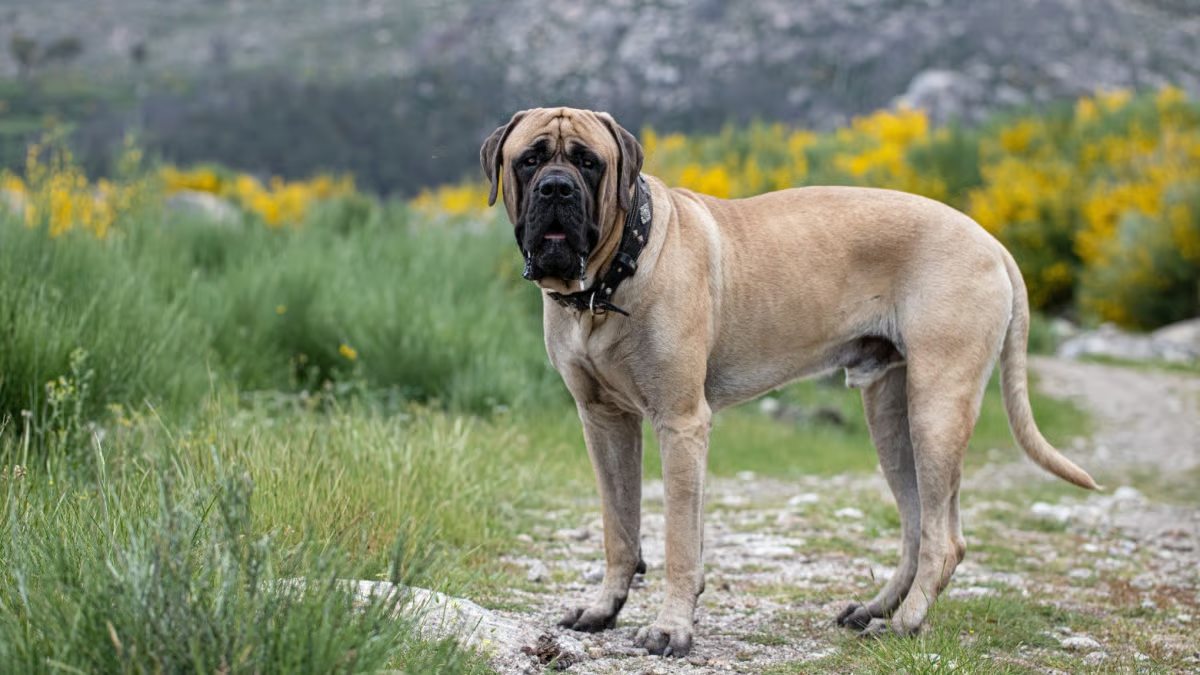
The standard defines the Mastiff by mass and proportion, not by inches. The head should read as square from every angle, and the breed's whole type rests on the head's proportions.
- Head. Skull broad between the ears, forehead flat, wrinkling when the dog takes an interest. Width to length of head, 2 to 3.
- Muzzle. Short and broad beneath the eyes, holding nearly that width out to the nose, as if cut off square. Length is one third of the whole head; muzzle girth to head girth in front of the ears, 3 to 5.
- Eyes. Medium in size, set well apart, hazel brown and darker is better. The standard wants them free of obvious problems and calls loose eyelids highly undesirable.
- Ears. Small and thin to the touch, set high and wide, lying flat against the cheeks at rest.
- Body. Chest broad, deep and well let down between the forelegs; back wide and muscular; body longer from shoulder to point of buttock than the dog is tall at the withers.
- Neck. Moderately long, heavily muscled; 2.5–5 cm smaller in girth than the skull in front of the ears.
- Tail. Set high, reaching the hocks or slightly below, wide at the root and tapering.
- Coat. Short and close-lying, coarser over neck and shoulders, over a dense undercoat.
Wrinkles are worth a note by themselves. Owners often treat them as a decorative feature of the breed, but the current European standard draws a limit: on a mature adult at rest, exaggerated wrinkle and surplus skin are unacceptable. The practical reason is visible to anyone who lives with one — folds are where moisture collects and skin inflammation begins.
Bloat: where the dependable data stop
Gastric dilatation and volvulus is measured in hours. The classic numbers come from a series of prospective cohorts by Glickman and coworkers, and it matters a great deal who those numbers actually cover.
In a cohort of 1914 dogs, incidence ran 23 cases per thousand dog-years in large breeds and 26 per thousand in giant breeds. Of the 105 dogs that bloated, 30 died — 28.6% — and cumulative incidence across the observation period was 5.7%. A second study from the same group, covering 1637 dogs, hunted for non-dietary risk factors: risk rose with age, with a first-degree relative that had bloated, with faster eating — and with a raised feeding bowl.
Stop here, because the recommendation to feed a big dog from a stand is still printed in breed write-ups, and it is presented as bloat prevention. The data run the other way: in that cohort, about 20% of bloat cases in large breeds and about 52% in giant breeds were attributed to a raised bowl. No study demonstrating that a raised bowl reduces risk has been published. So it is not a neutral convenience but a factor pushing the wrong direction.
Now the honest boundary of these findings. Eleven breeds made up both cohorts: Akita, Bloodhound, Collie, Great Dane, Irish Setter, Irish Wolfhound, Newfoundland, Rottweiler, Saint Bernard, Standard Poodle and Weimaraner. The Mastiff is not one of them. The accurate statement is that the Mastiff sits in the weight class those numbers describe and has a build regarded as bloat-prone — but we publish no breed-specific bloat statistics for it. Chest depth as a risk factor comes from a separate study of Irish Setters with a very wide confidence interval: a mechanism, not an estimate.
Practically: smaller meals more often rather than one large one; bowl on the floor; slow down a fast eater; and above all learn the signs — restlessness, retching that brings nothing up, a distended and tight abdomen, rapid breathing. Those mean driving to a clinic now, not waiting for morning.
Joints, heart, and eyes
Heat: the underrated risk
Everyone writes that Mastiffs handle heat badly; fewer say how badly, or why. A British study drawn from primary veterinary care reviewed 905,543 dogs under care during 2016 and identified 395 confirmed heat-related illness episodes. Incidence was low — 0.04% — but case fatality per episode ran 14.18%: rare, and genuinely lethal.
The number that applies to this breed: dogs weighing over 50 kg had 3.42 times the odds of heat illness compared with dogs under 10 kg. That is a weight-class finding rather than a breed one, and the Mastiff sits in that class with room to spare. The Mastiff does not appear in the same study's list of breeds with the highest incidence — which is why we do not write "the Mastiff tops the list" and write instead what was measured.
The second finding from the same program is more useful still and runs against intuition. Median outdoor temperature on days when episodes occurred was 16.9 °C. Not a heat wave, not a parked car — an ordinary cool day, and most episodes involved exertion rather than a closed vehicle.
For an owner that translates directly: the hazard is less the temperature than the work done in it, and a long walk at a human's pace on a mild summer day is the standard scenario. Stop and cool the dog for heavy noisy breathing that will not settle at rest, bright red gums, unsteadiness or vomiting — use room-temperature water and go to a veterinarian.
Anesthesia and pain control in a giant
The giant puppy: growth you cannot rush
Don't mix up the breeds
The word "mastiff" inside several breed names guarantees confusion, and other breeds' facts ride along with it. The English Mastiff is a breed of British origin that the registries list simply as Mastiff, with no qualifier.
Do not confuse it with the Bullmastiff, a separate and later breed, with the Neapolitan Mastiff out of Italy, or with the Tibetan Mastiff, which has nothing to do with British history. The distinction is not a formality. In the British cohort that supplies the median of 9.0 years for the Mastiff, the Neapolitan Mastiff has its own line at 9.3 years and the Cane Corso at 8.1. Joints separate them even more sharply: in the same American database where the Mastiff shows 20.7% dysplastic hips, the Neapolitan Mastiff shows 51.3%, the Bullmastiff 25.4% and the Tibetan Mastiff 15.9%. These are distinct populations with distinct numbers, and figures do not transfer between them.
Who the Mastiff is for — and who it isn't
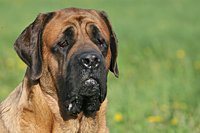
The Mastiff fits someone who wants a calm indoor giant, is content to walk slowly every day, and expects neither sport nor working drive from a dog. It does best in a home where somebody is around most of the time and where a large dog in the room counts as normal rather than as an obstacle.
It is the wrong dog in three situations. The first is long stretches of being left alone: this breed orients hard on people, and even comparatively self-sufficient breeds such as the Portuguese Water Dog need company, while a Mastiff cannot manage without it. The second is a home with no place for a giant to lie out of the way and no way to keep it cool through summer. The third, and the one that counts most, is not being ready for a short life together and for old age that arrives early.
With children a Mastiff is usually patient, but physics governs here rather than temperament: a dog that weighs what an adult weighs can knock a child down just by turning around. Arrange the shared space so a small child and a grown Mastiff are never together unsupervised, and so the dog has a spot of its own that children stay out of.