not FCI-recognized (Ukrainian guard breed) · Ukraine
Ukrainian Shepherd
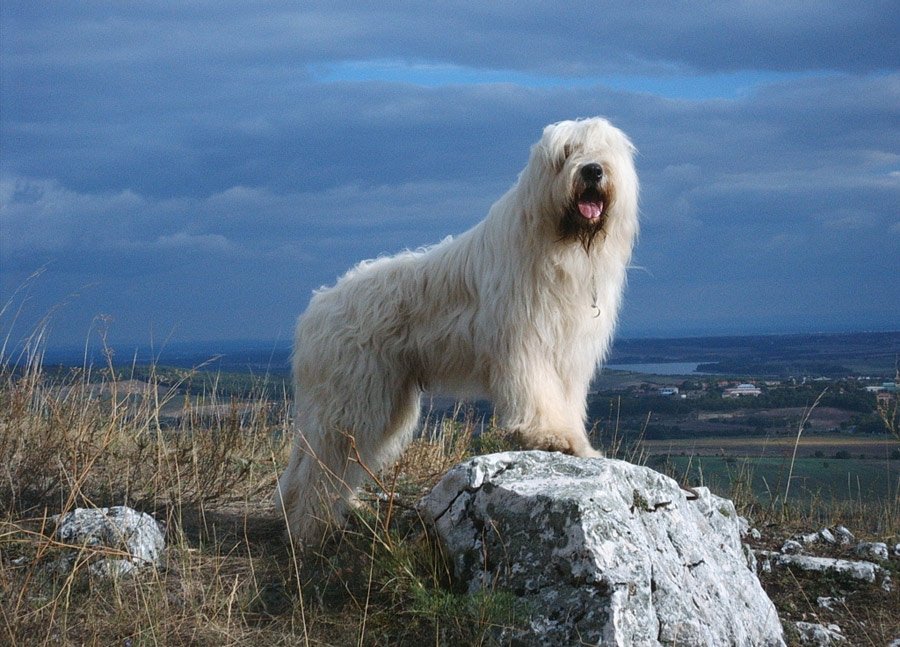
A stately, powerful Ukrainian guardian with a fearless heart — strong and undemanding: devoted to duty, clever, territorial and merciless toward threats. The Ukrainian Shepherd is a powerful guarding-herding dog related to the South Russian Ovcharka; a fearless defender of flocks, property and family, it is clever and devoted but self-reliant and distrustful of strangers, so it needs space and an experienced owner.
Self-reliant, merciless toward threats — not for a novice
Distrustful and territorial with strangers
Not for an apartment — needs space
Dense coat sheds heavily
Size
ToySmallMediumLargeGiant
Compatibility
Apartment · not suitableKidsCats · with caveatsOther dogs · with caveatsBeginners · not suitable
The Ukrainian Shepherd is a majestic and powerful dog breed that has earned respect for its exceptional loyalty, fearlessness, and impressive guarding abilities. This overview will help you get a deeper understanding of this unique breed's characteristics, its history, personality, and its care and training needs. Learn more on Tvaryny.
The Ukrainian Shepherd is a remarkably responsive, strong, brave, and low-maintenance animal. This dog is highly intelligent and incredibly devoted to its duties, dealing mercilessly with anyone who dares to approach what it's guarding. It also selflessly protects flocks of sheep from wolf attacks, often handling them single-handedly. However, the breed also has a natural distrust of strangers and a pronounced fierceness, which needs to be controlled and channeled correctly through proper training and early socialization.
Ukrainian Shepherd: A Brief Breed Overview
Ukrainian Shepherd: A Brief Breed Overview · 6
Origin
Ukraine
First Mentioned
Late 19th century (final formation), standard 1931
Lifespan
9–11 years (some sources say up to 12–15 years with proper care)
Height at the withers
Males: at least 25.5 inches, Females: at least 24.5 inches
South Russian Shepherd Dog, South Russian Ovcharka (outdated)
Interesting Facts About the Ukrainian Shepherd
"White Bear of the Steppes": Due to its appearance - large size, thick white coat, and fearlessness - the Ukrainian Shepherd is sometimes called the "white bear of the steppes."
Master of Camouflage: The white coloring helped the dogs blend in with the flock of sheep, making them inconspicuous to predators and intruders.
Independent Guardians: Historically, these dogs were capable of independently guarding large flocks of sheep over vast territories, making decisions without human intervention. This trait has been preserved to this day.
Protective Fringe: The thick fringe falling over the eyes not only protects them from the sun, dust, and wind but, according to one theory, also conceals the dog's line of sight, disorienting an opponent.
Not for Everyone: Due to its size, strength, character, and training requirements, the Ukrainian Shepherd is strongly not recommended as a first dog for inexperienced owners, nor for the elderly or physically frail.
Messengers at War: During World War II, Ukrainian Shepherds were used not only for guarding but also as messenger dogs, delivering messages under difficult conditions.
Falz-Fein's Favorite: Baron Falz-Fein highly valued this breed and put a great deal of effort into its development and popularization at the Askania-Nova nature reserve.
History of the Ukrainian Shepherd
The history of the Ukrainian Shepherd is inextricably linked to the growth of sheep farming in the steppe regions of southern Ukraine (then the Taurida Governorate of the Russian Empire). It's believed that the breed's development began in the late 18th to early 19th century. The foundation for these dogs came from local herding dogs, as well as sheepdogs brought in with Merino sheep from Spain and other European countries. One theory suggests that the Asturian Shepherd may have been one of the Ukrainian Shepherd's ancestors.
A major role in the breed's establishment was played by Baron Friedrich Falz-Fein, the founder of the famous Askania-Nova nature reserve. It was on his estate that targeted selective breeding took place. Through rigorous artificial selection based on working abilities - the capacity to independently guard large flocks of sheep from wolves and other predators, as well as from thieves - a unique breed was created. The dogs needed to be not only strong and brave but also hardy, able to withstand the harsh climate of the steppe, and have a thick coat for protection against bad weather and bites.
For a long time, these dogs successfully fulfilled their herding and guarding roles. In 1931, the first official breed standard was approved. During World War II, the breed was pushed to the brink of extinction as many dogs were lost and breeding programs were halted. Thanks to the efforts of enthusiasts and state-run kennels, the breed was saved and its population was restored. In the post-war years, Ukrainian Shepherds were mainly used for guard duty.
What Does the Ukrainian Shepherd Look Like: Appearance and Standard
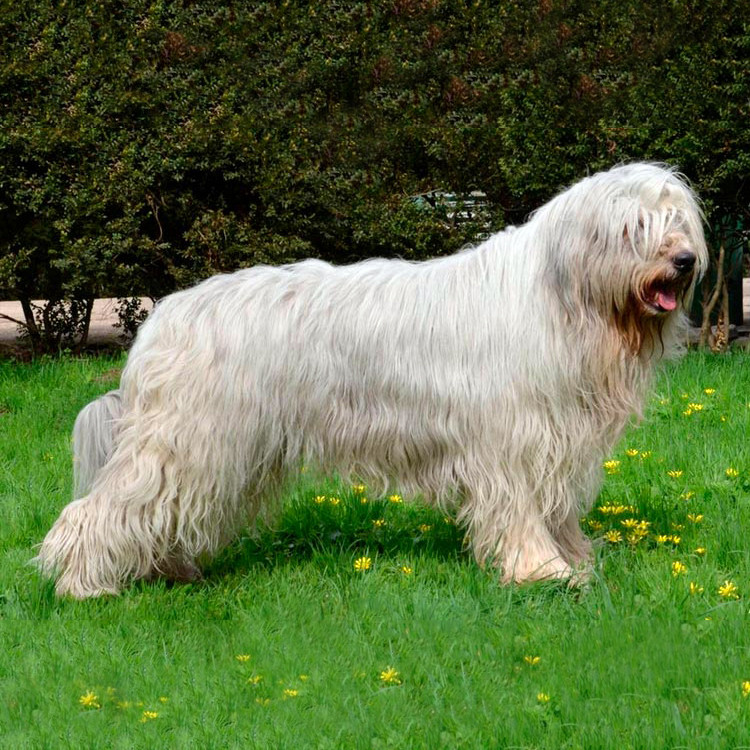
The Ukrainian Shepherd is a large dog of above-average height, with a strong but not coarse build, well-developed muscles, and a sturdy frame. Sexual dimorphism is clearly pronounced: males are larger, more massive, and more masculine than females.
Head: Elongated, with a moderately broad forehead; the occipital protuberance and cheekbones are well-developed. The stop (transition from forehead to muzzle) is gentle and barely noticeable. The muzzle is well-filled, somewhat pointed, and its length is roughly equal to the length of the skull. The lips are dry, tight, and pigmented black.
Teeth: Large, white, and fitting closely together. The bite is a scissor bite.
Nose: The nose is large and black.
Eyes: Oval-shaped, set horizontally, and dark. The eyelids are dry, tight, and black. The expression is intelligent, confident, and somewhat stern.
Ears: Small, triangular, hanging, and set close to the head. They are set relatively low.
Neck: Lean, muscular, of medium length, set at an angle of approximately 45 degrees to the backline.
Body: The withers are well-defined, especially in males. The back is straight, strong, and broad. The loin is short, broad, and slightly arched. The croup is broad, muscular, and nearly horizontal. The chest is moderately broad, deep, reaching the elbows or slightly below. The belly is moderately tucked up.
Tail: Long, hanging down to the hock or lower when calm, saber-shaped. When excited, it rises to the level of the back or slightly higher. It is covered in thick fur.
Limbs: The front legs are straight and parallel. The shoulder blades are long and sloping. The shoulders are muscular. The elbows point straight back. The forearms are straight. The pasterns are short, strong, and slightly angled. The hind legs are straight and parallel when viewed from behind, with well-defined angles from the side. The thighs are long, broad, and muscular. The shins are long and sloping. The hocks are lean and well-defined. The metatarsals are strong and vertical. The paws are oval and arched, with tightly clenched toes. The claws are dark.
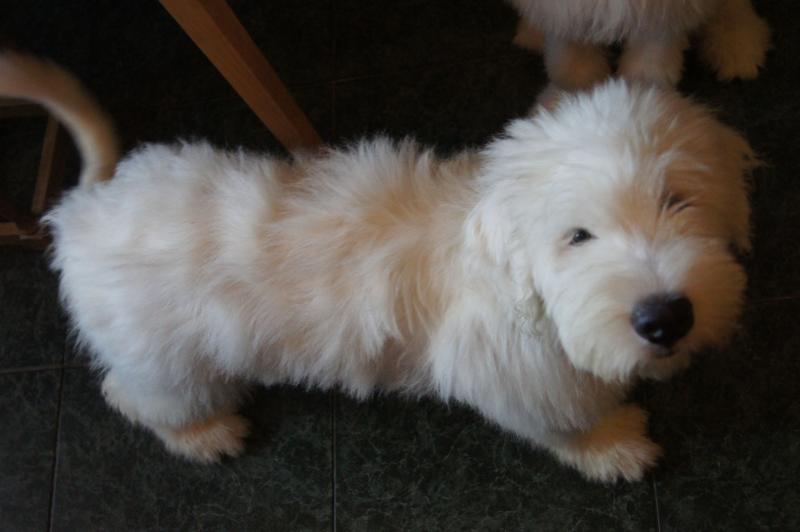
Coat: The most distinctive feature of the breed. It is long (4–6 inches or more over the entire body, forming a fringe over the eyes, a mustache, and a beard on the head), coarse, thick, slightly wavy or straight, with a well-developed undercoat. The undercoat is soft and dense. The coat is of uniform length on the head, chest, legs, and tail. It provides excellent protection from any weather. Even a breed like the Komondor, with its unique cords, has a different type of coat.
Color: Predominantly white, but other colors also occur: white with a yellowish tint (fawn), white with gray (smoky) patches, or fawn-piebald and gray-piebald. Less common are pure gray and various shades of fawn. The nose, eyelids, and lips are always black.
Character of the Ukrainian Shepherd: Temperament and Behavior
The Ukrainian Shepherd is a dog with a strong, balanced, and lively nervous system. It is characterized by an active defensive response, a marked distrust of strangers, sometimes bordering on aggression. This is one of those breeds where working qualities and guarding instincts are dominant. When talking about this breed's character, its explosive temperament and lightning-fast reactions must be considered first and foremost. Despite its long coat, which can create a somewhat clumsy appearance, the Ukrainian Shepherd is extremely agile, quick in both decision-making and action. It is considered one of the fastest among large guard breeds.
An adult Ukrainian Shepherd is a strong, brave, and self-assured animal. It is devoted to its owner and family members, whom it considers its "pack" and the object of its protection. It is patient and tolerant with children in the family if it grows up with them. However, due to its size and strength, playtime with young children must always be supervised by adults. It's important to understand that the Ukrainian Shepherd chooses one main owner to whom it submits unconditionally; it may treat other family members with respect, but not always with the same level of obedience. This trait makes it a less-than-ideal choice for very large families without a clear hierarchy, or for inexperienced owners.
The intelligence and shrewdness of the Ukrainian Shepherd are top-notch. It is capable of independently assessing situations and making decisions, an essential quality for a guard dog. However, this same trait can manifest as stubbornness if the dog sees no point in a command or if the owner is not an authority figure to it. With proper upbringing, where bravery doesn't escalate into uncontrolled aggression and self-confidence doesn't turn into stubbornness, the owner gets not only a stunningly beautiful companion but also an extremely intelligent one with interesting behavior. The breed requires a serious approach to training and upbringing from a young age.
Training and Socialization of the Ukrainian Shepherd
Training and early socialization are critically important for the Ukrainian Shepherd. This is a breed with a strong charachter, independent thinking, and innate guarding instincts. Without proper upbringing and a clearly established hierarchy, a Ukrainian Shepherd can become unmanageable and even dangerous.
Key Points:
Early Start: A puppy's upbringing and socialization should begin from its first days in the home. Introduce it to different people, sounds, places, and other animals (under supervision).
Owner's Leadership: The owner must immediately establish themselves as the undisputed leader ("pack leader"). This is achieved through consistency, fairness, firmness (but not harshness!), and confidence. A Ukrainian Shepherd will not obey an insecure or overly timid person.
Positive Reinforcement: Although the breed can be stubborn, it responds best to training methods based on positive reinforcement (praise, treats, play). Harshness and physical punishment can provoke aggression or cause the dog to become withdrawn.
Professional Help: For inexperienced owners or if difficulties arise, it is highly recommended to seek the help of a professional dog trainer who has experience with working and guard breeds.
Aggression Control: The Ukrainian Shepherd is prone to an active-defensive response. Unprovoked aggression towards people or other animals must never be encouraged, especially at a young age (up to 1.5–2 years, before the psyche is fully formed). Any signs of unjustified aggression should be gently but firmly corrected.
Obedience Classes: Completing a general obedience course or similar program is essential. This will help to build a bond with the dog and teach it basic commands.
The Ukrainian Shepherd is highly trainable if the right approach is taken. It can be taught not only guarding and sentry duty but also other disciplines. During wartime, dogs of this breed were even successfully used as messengers. It's important to remember the statistic that sometimes places the Ukrainian Shepherd among the top breeds for bite incidents. This is not an indicator of the breed's unmanageability, but rather a reflection of the incompetence or irresponsibility of some owners. With proper upbringing, your Ukrainian giant will impress with its intelligence, delight with its loyalty and sincere love, becoming a true gem and the pride of the family. Its graceful beauty and power will leave no one indifferent.
Pros and Cons of the Ukrainian Shepherd Breed
Before getting a serious dog like the Ukrainian Shepherd, a potential owner should carefully weigh all the pros and cons.
Pros and Cons of the Ukrainian Shepherd Breed · 7
Pros
Cons
Exceptional Guarding Qualities: A natural guardian of territory and family. Fearless and decisive.
High Dominance and Potential Aggression: Requires a very experienced, strong, and confident owner. Not suitable for novices. Can be aggressive towards strangers and other dogs without proper socialization.
Loyalty to Owner and Family: Forms a deep bond with its "pack".
Chooses One Master: May not obey other family members as readily.
High Intelligence and Shrewdness: Capable of independent decision-making. Learns well with the right approach.
Prone to Stubbornness: May ignore commands if it doesn't see the point or respect the owner.
Undemanding Living Conditions: Tolerates cold well, can live in a kennel. Not a fussy eater (with a natural diet).
Needs Lots of Space and Exercise: Not suitable for living in a small apartment. Requires long, active walks.
Striking Appearance: A majestic, beautiful dog with a thick white coat.
Difficult Coat Care: Requires regular and time-consuming brushing, prone to matting.
Generally Robust Health: As a native breed, it is less prone to genetic diseases than some artificially developed breeds.
Long Maturation Period: The psyche and character are not fully formed until 2–3 years of age.
Lifespan: With good care, can live 9–11 (sometimes up to 15) years.
Loud Bark: Has a loud and deep bark, which it uses actively when guarding.
It's also worth noting that the Ukrainian Shepherd, unlike some other large pastoral dogs such as the Old English Sheepdog (Bobtail), which is known for its more friendly disposition towards everyone, is a one-person breed with pronounced guarding instincts that require a special approach.
How to Groom a Ukrainian Shepherd's Coat
The Ukrainian Shepherd's magnificent long coat is its signature feature, but it also demands regular and meticulous care. Without proper grooming, the coat quickly mats, which not only ruins the dog's appearance but can also lead to skin problems. The Ukrainian Shepherd's coat is coarser and more prone to forming dense mats than that of many other long-haired breeds.
Key Aspects of Coat Care:
Brushing: This is the most crucial step. A puppy must be accustomed to brushing from an early age. An adult dog should be brushed at least 2–3 times a week, and daily during seasonal shedding (spring and fall). Use special combs with long, sparse teeth, slicker brushes, and de-matting tools. Pay special attention to areas where the coat mats most often: behind the ears, on the neck, under the armpits, on the inner thighs, on the "trousers," and the tail.
Fringe (Topknot): The long fringe that covers the eyes is a characteristic feature of the breed. It can be carefully thinned with thinning shears to help the dog see better, or gathered into a topknot with special bands (especially for show dogs). A complete trim of the fringe is not recommended, as it protects the eyes from dust and sun.
Shedding: In March and April, there is an intense shedding of the undercoat. During this period, the dog must be brushed particularly thoroughly to remove all the dead undercoat. If this isn't done, the coat can become a solid felt-like mass that can only be shaved off.
Bathing: It is not recommended to bathe a Ukrainian Shepherd frequently, only when it's very dirty. Frequent washing can strip the natural oils from the skin and coat, making it more vulnerable. Use shampoos specifically designed for long-haired dogs. After bathing, the coat must be thoroughly dried with a towel and a hairdryer (on a warm, not hot, setting), while brushing simultaneously to prevent matting.
Clipping: Generally, a Ukrainian Shepherd's coat is not fully clipped. This is only done for medical reasons or if it is heavily matted. After a full clip, the coat grows back slowly, sometimes taking up to two years, and may change its texture. A hygienic trim (around the anus, between the paw pads) is acceptable.
Ukrainian Shepherds can be kept in a private house with a large yard or, theoretically, in a spacious apartment, although the latter is less desirable due to their size, activity level, and exercise needs. Thanks to their thick coat, they tolerate cold well and can be excellent guardians of a property, even living outside in a kennel with an insulated doghouse in winter. These dogs are undemanding about their living conditions and adapt easily to different climates. However, they require serious physical exercise and long, energetic walks, which demands an active lifestyle and free time from the owner. Compared to the less space-demanding Dutch Smoushond, the Ukrainian Shepherd needs significantly more space and activity.
Nutrition
Feeding the Ukrainian Shepherd: Key Recommendations
Health and risks
Health of the Ukrainian Shepherd: Common Ailments and Prevention
Frequently Asked Questions About the Ukrainian Shepherd (FAQ) · 7
Is the Ukrainian Shepherd suitable for living in an apartment? Theoretically, if the apartment is very spacious and the dog is provided with long (at least 2–3 hours a day), active walks with physical exercise, it is possible. However, the ideal home for a Ukrainian Shepherd is a private house with a large, well-fenced yard where it can fulfill its guarding instincts and have enough space to move.
How does the Ukrainian Shepherd get along with children? With proper training and early socialization, if the dog has grown up with children, it can be patient and even gentle with them within its own family. However, due to its large size and strength, playtime with small children must always be supervised by an adult. It's important to teach children how to behave correctly around the dog and not to bother it while it's eating or sleeping. It may be wary of strange children.
Does the Ukrainian Shepherd shed a lot? Yes, the Ukrainian Shepherd sheds heavily, especially seasonally (spring and fall). During this period, daily, thorough brushing is required. Without proper care, the coat quickly becomes matted.
Is the Ukrainian Shepherd easy to train? The Ukrainian Shepherd is intelligent and capable of learning but can be stubborn and independent. It requires firm, consistent, but fair training from an experienced owner who can become an authority figure for it. Harsh methods are ineffective. Early socialization and professional training classes are recommended.
How long do Ukrainian Shepherds live? The average lifespan of a Ukrainian Shepherd is 9–11 years. With good care, proper nutrition, and sufficient physical activity, some individuals live to be 12–15 years old.
Does the Ukrainian Shepherd need a lot of physical exercise? Yes, this is a very active and energetic breed that requires significant daily physical exertion. This can include long walks, running, and playing outdoors. A lack of activity can lead to behavioral and health problems (such as obesity).
Can a Ukrainian Shepherd be left alone for long periods? Like any dog, the Ukrainian Shepherd does not tolerate prolonged solitude well. If the dog is regularly left alone for long periods, it may become bored, which can manifest as destructive behavior or excessive barking. This breed thrives when it has close contact with its owner and family.
FAQ
What breed is the Ukrainian Shepherd?
A powerful guarding-herding dog, historically related to the South Russian Ovcharka (a type of large white shaggy steppe guardian); it fearlessly defends flocks, property and family.
Is the Ukrainian Shepherd suited to a novice?
No — a self-reliant, strong guard animal that is distrustful of strangers and acts decisively against threats; it needs space, an experienced owner, early socialization and firm, calm leadership.
Is the Ukrainian Shepherd good with a family?
Yes — with its own family it is devoted and good with children; but territorial and merciless toward strangers and threats, so socialization and control are essential.
Similar breeds
South Russian Ovcharka
Height 62–75 cm · Energy 3 · Beginners 1.5
not in the guide
Caucasian Shepherd
Height 64–75 cm · Energy 3 · Beginners 1.5
not in the guide
Central Asian Shepherd (Alabai)
Height 65–78 cm · Energy 3 · Beginners 1.5
not in the guide
Sources
Ukrainian guard breed (South Russian Ovcharka type)