

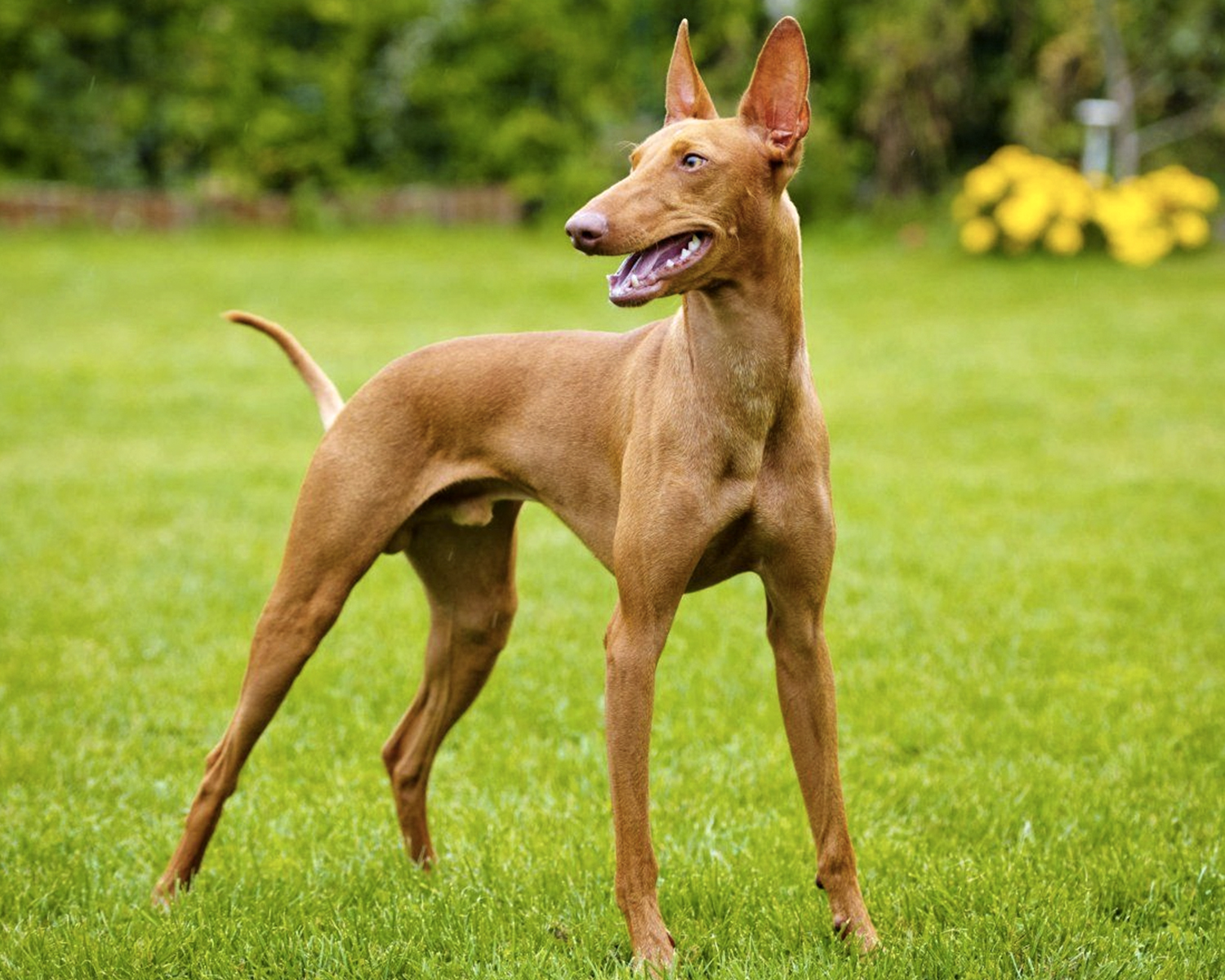
| Height | 42–52 cm |
| Weight | 8–12 kg |
| Lifespan | 12–14 years |
| FCI group | 5 · primitive |
| Origin | Italy (Sicily) |
Exact ratings
- Generally a very healthy primitive breed
- Hip dysplasia (rare)
- Elbow dysplasia (rare)
- Anesthetic sensitivity (as in sighthounds)
- Sensitive skin
Quality food for an active breed, with weight control. As a primitive sighthound its health is generally robust; keep the sighthound anesthetic sensitivity in mind.
The Cirneco dell’Etna is a sleek, medium-sized hunting dog hailing from sunny Sicily. This breed turns heads with its sophisticated look, chiseled body lines, and a beautifully sculpted head. But the Cirneco isn’t just about looks – they draw people in with their warm and friendly personality. Their coat is short and stiff, somewhat like a horse’s, making them low-maintainance and easy to keep. Known for a deep bond with their owners and a complete lack of aggression toward strangers, they make excellent companions. Learn more on Tvaryny.
Cirneco dell’Etna: Breed Overview
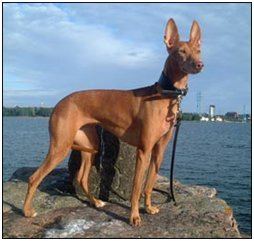
| Origin | Italy (Sicily) |
| FCI Classification | Group 5 (Spitz and primitive types), Section 7 (Primitive type hunting dogs) |
| FCI Recognition | 1989 |
| Life Expectancy | 12–15 years |
| Height at Withers | Males: 18–20 inches, Females: 17–19 inches |
| Weight | Males: 22–26 lbs, Females: 17–22 lbs |
| Temperament | Friendly, independent, active, intelligent, loyal |
| Usage | Small game hunting (rabbits), companion dog |
History and Origins
The history of the Cirneco dell’Etna is wrapped in mystery and spans thousands of years. The name literally translates to “Dog of Etna,” pointing directly to its homeland – the slopes of the famous Sicilian volcano. There are two main theories regarding how these unique dogs came to be.
The Ancient Egyptian Theory. It was traditionally believed that these dogs descended from ancient hunters bred in the Nile Valley during the time of the Pharaohs. Relief carvings dating back to 4000 BC show dogs remarkably similar to the modern Cirneco. According to this theory, the Phoenicians – famous seafarers and traders – brought these dogs, which are close relatives of the Pharaoh Hound, to Sicily. Once there, the breed adapted to the local environment and was used to hunt rabbits in the rocky terrain.
The Sicilian Theory. However, recent DNA studies suggest that the Cirneco dell’Etna is actually an indigenous breed that originated directly on Sicily. Archaeological finds, including coins and engravings, confirm the existence of these dogs in the region centuries before the Common Era, even before the Phoenicians arrived. Legends say that thousands of these dogs guarded the temple of the god Adranos, built in 400 BC on the slopes of Etna. It is said the dogs had an amazing gift for sniffing out thieves and non-believers, attacking them immediately while remaining friendly to pilgrims.
Regardless of their exact origin, the Cirneco dell’Etna has been an indispensable helper to Sicilian hunters for centuries, capable of chasing prey for hours under the scorching sun on difficult volcanic terrain. The breed only recieved official recognition in the 20th century, with the standard being approved in 1939.
Appearance and Breed Standard
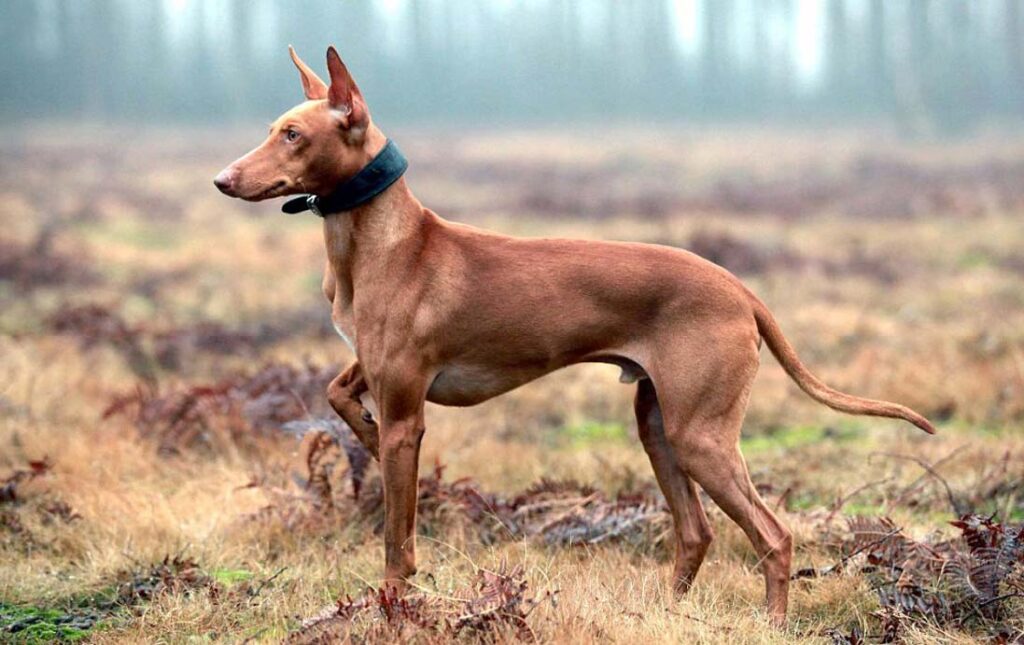
The Cirneco dell’Etna is the embodiment of grace and function. The dog has a dry but sturdy build, a square body format, and elegant lines. In appearance, it resembles its Mediterranean cousins, such as the Ibizan Hound (Podenco Ibicenco), but stands out due to its more compact size.
- Head: Long, narrow, with refined lines. The skull is slightly convex, with a smooth transition from forehead to muzzle.
- Muzzle: Pointed but not weak. The nose is large and rectangular, ranging in color from light brown to flesh-colored, depending on the coat.
- Ears: Large, triangular, high-set, and erect. They are very mobile and always alert, which is a hallmark of the breed.
- Eyes: Small, oval-shaped, usually ochre, amber, or gray. The expression is intelligent and attentive.
- Body: Square format, meaning the body length is roughly equal to the height at the withers. The back is straight, the loin is strong, and the croup slopes slightly.
- Tail: Low-set, thick at the base, and tapering to the tip. It hangs down when at rest and is carried like a saber when moving.
- Coat: Short (up to 1.2 inches on the body), stiff to the touch, smooth, and close-fitting. There is no undercoat.
- Color: Mostly solid fawn (shades ranging from sand to rich red). White markings are allowed on the head (a narrow blaze), chest, toes, and tail tip. Solid white or white with orange patches is accepted but less desired.
Temperament and Behavior
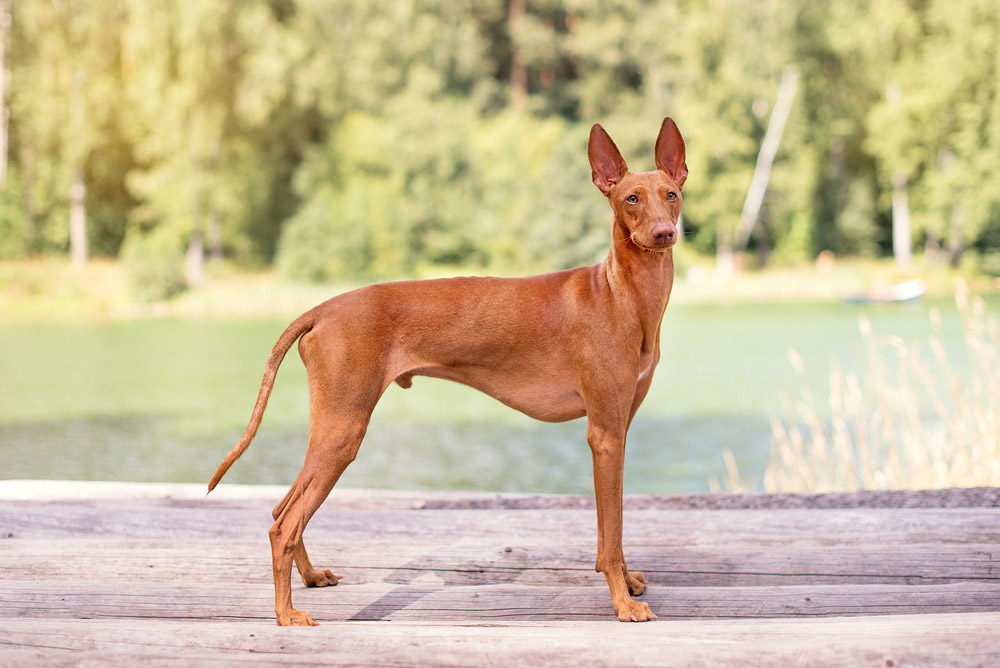
Thanks to their natural gentleness and friendliness, the Cirneco dell’Etna easily becomes a full-fledged member of the family. This is an extremely loyal dog that bonds deeply with its owners and wants to spend as much time with them as possible. At the same time, they have a streak of independance – a legacy of their hunting past when the dog had to make decisions on its own.
Their total lack of aggression toward people makes them poor guard dogs, but it allows the Cirneco to live comfortably in families with small children. They are patient and playful with kids. With house guests, these dogs are typically welcoming and curious. You’ll rarely hear them bark; they usually only vocalize when extremely excited or trying to get attention.
Cirnecos are high-energy dogs. They need daily physical exercise to stay happy and healthy. They love running, playing, and exploring new areas. A strong hunting instinct drives them to chase anything that moves quickly, so a leash is mandatory when walking in uncultivated or unfenced areas.
Health: Common Issues and Prevention
The Cirneco dell’Etna is a breed formed in harsh conditions, which has gifted it with exceptional health and stamina. They handle heat beautifully, which isn’t surprising for a Sicilian dog. Adults, despite having short hair and no undercoat, can handle some cold, though they will need a sweater or coat in freezing temperatures.
Health is generally robust, but no breed-wide list of hereditary diseases has been compiled — “not described” means “not studied”, not “not there”. This is due to both natural selection and the fact that the breed is quite rare and hasn’t suffered from the mass commercial breeding that often locks in hereditary defects. However, like any dog, the Cirneco can suffer from general ailments. It is important to ensure:
- Regular Vet Check-ups: Annual vaccinations and parasite prevention (fleas, ticks, worms) are a must.
- Balanced Diet: Proper nutrition is key to a healthy digestive system and a shiny coat.
- Sufficient Physical Activity: This prevents obesity and joint problems.
- Dental Care: Regular brushing helps avoid tartar buildup and gum disease.
Care and Maintenance
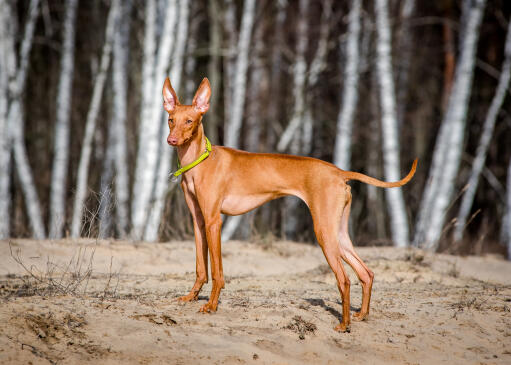
This moderate-sized hunter can live comfortably in a city apartment, provided its activity needs are met. Thanks to the lack of an undercoat and the short, stiff hair, shedding is practically unnoticeable. Grooming is simple but requires consistency.
- Grooming: Wiping the dog down once a week with a damp cloth or a rubber grooming mitt is enough to remove dead hair and keep the coat clean. Baths are only needed occasionally.
- Nails: Trim nails regularly if they don’t wear down naturally during walks.
- Ears and Eyes: Periodically check and clean the ears and eyes to prevent infections.
- Exercise: This is the key aspect of care. The Cirneco needs at least 1 to 1.5 hours of active walking per day. Ideally, they should have a chance to free-run in a safe, fenced area. These dogs excel in sports like lure coursing or agility.
Training and Socialization
Cirneco dell’Etna dogs are smart and quick-witted, but training them has its quirks. They pick up new commands fast, but their independence can sometimes look like stubbornness. They might decide to do things their own way, especially if a command seems pointless to them.
Effective training requires a firm but fair hand. Roughness, yelling, and physical punishment are unacceptable – this can permanently destroy the trust between you and the dog. Positive reinforcement methods work best: praise, treats, and toys. Sessions should be short, interesting, and varied so the dog doesn’t lose interest.
Early socialization is absolutely critical. Introduce your Cirneco puppy to different people, sounds, places, and other animals from a young age. This helps raise a confident and balanced dog that reacts calmly to new situations.
Nutrition: Key Recommendations
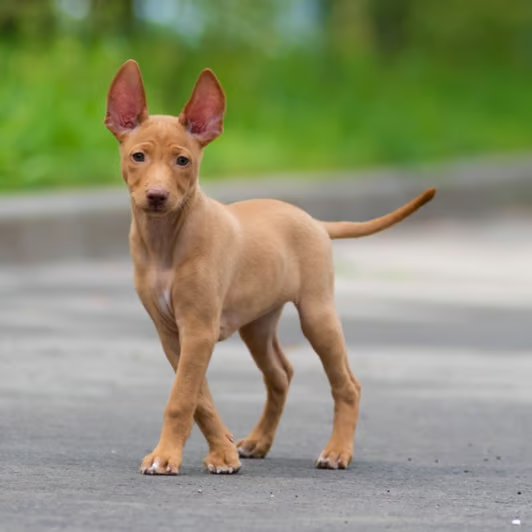
Proper nutrition is the foundation of your pet’s health and longevity. For primitive breeds, which include the Cirneco as well as the similar Thai Ridgeback or the Taiwan Dog, a diet close to what they would eat in nature is often recommended. The daily food intake for an adult Cirneco is roughly 2-3% of its body weight.
There are two main feeding approaches:
- Raw/Natural Diet: The base should be raw lean meat (beef, turkey, rabbit), organ meats, raw soft bones (never cooked, as they can splinter and injure the esophagus), fermented dairy products, vegetables, fruits, and a small amount of grains. Avoid a monotonous diet.
- Commercial Food: If you choose dry kibble, it must be high quality (super-premium or holistic class) with a high animal protein content. Some Cirnecos may be sensitive to chicken protein, so it’s worth choosing formulas based on turkey, lamb, or fish.
| Recommended Foods | Foods to Avoid |
|---|---|
| Lean meat (beef, turkey) | Chocolate, cocoa |
| Saltwater fish (boneless) | Grapes, raisins |
| Organ meats (liver, heart) | Onions, garlic |
| Fermented dairy (kefir, cottage cheese) | Tubular bones (cooked) |
| Vegetables (carrots, pumpkin, zucchini) | Fatty, fried, or smoked food |
| Fruits and berries (apples, bananas) | Sweets and pastries |
Pros and Cons
| Pros | Cons |
|---|---|
| ✅ Loyal and affectionate companion | ❌ Requires a high level of physical activity |
| ✅ Minimal coat care, barely sheds | ❌ Very strong hunting instinct (needs a leash) |
| ✅ Gets along well with kids and other pets (with proper socialization) | ❌ Can be independent and stubborn during training |
| ✅ Robust health and stamina | ❌ Does not handle being alone well |
| ✅ Rarely barks, suitable for apartments | ❌ Rare breed, hard to find a puppy |
| ✅ High intelligence and cleverness | ❌ Not suitable for inexperienced owners |
Fun Facts
- Scent, Sound, and Sight: Unlike most sighthounds that hunt primarily by vision, the Cirneco actively uses all three senses – sight, hearing, and smell – making it a versatile hunter.
- The Mountaineer Dog: Thanks to its agility and grippy paws, the Cirneco is capable of hunting in the difficult, rocky terrain of Mount Etna’s slopes.
- They “Blush”: When the dog is excited, happy, or embarrassed, its nose and the edges of its ears turn bright pink due to increased blood flow.
- Ancient Art: Images of dogs resembling the Cirneco can be found on ancient Greek coins from the 5th-3rd centuries BC.
- Quiet Companions: This is one of the least “chatty” breeds around. They only use their voice in exceptional cases.
Frequently Asked Questions (FAQ)
Is the Cirneco dell’Etna suitable for a first-time owner?
Due to their independence and high activity needs, this breed is better suited for people who already have experience with dogs, especially active and intellectual breeds.
How does the Cirneco get along with other pets?
With proper and early socialization, they get along well with other dogs. However, due to their strong prey drive, it is not recommended to keep them with small animals (cats, rodents, rabbits), as they may view them as prey.
Can the Cirneco be left alone for long periods?
These dogs are very people-oriented and do not handle loneliness well. Long absences can lead to destructive behavior and anxiety.
How much does a Cirneco dell’Etna puppy cost?
Since this is a rare breed, finding a puppy can be difficult and pricey. It is important to only buy from reputable breeders who care about the health and socialization of their dogs. Expect a wait: established breeders have their litters spoken for well in advance.
Breed Video
- Generally very robust health
- Elegant, compact, clean
- Affectionate and gentle at home
- Undemanding to groom
- Independent, “willful” in training
- A strong hunting instinct
- Needs plenty of exercise
- Sensitive to harsh methods
| Pharaoh Hound | Ibizan Hound | Basenji | |
|---|---|---|---|
| Height | 53–63 cm | 60–72 cm | 40–43 cm |
| Energy | 4.5 | 5 | 4 |
| Apartment | 2 | 2 | 3 |
| Beginners | 2.5 | 2.5 | 2.5 |
Is the Cirneco dell'Etna healthy?
Is the Cirneco easy to train?
Is the Cirneco suited to an apartment?
FCI Standard No. 199 · The Kennel Club
For apartments · For kids · For beginners · Active · Smartest · Hypoallergenic · All rankings →