

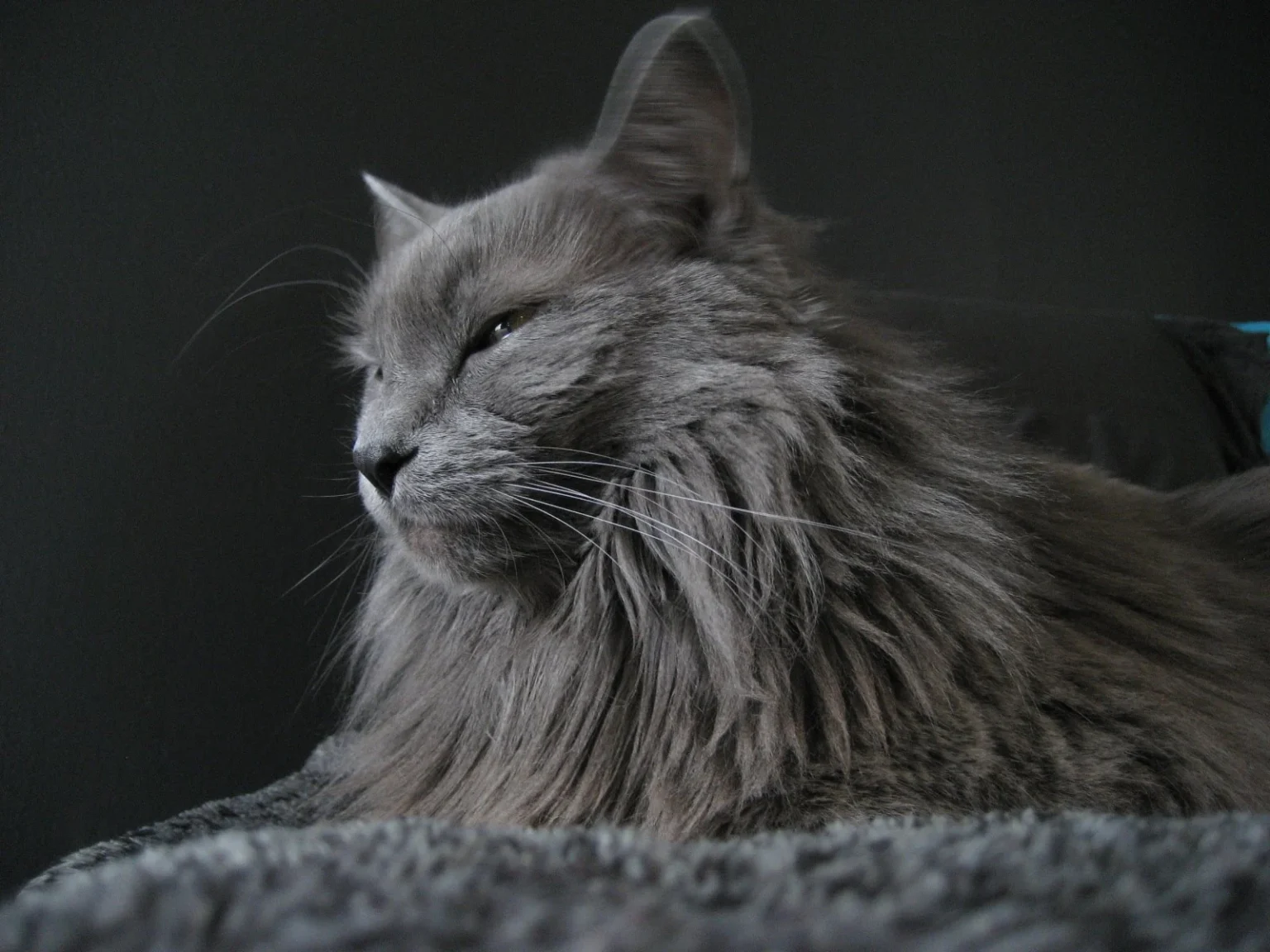
| Weight | 3.5–7 kg |
| Lifespan | 15–18 years |
| Coat | semi-long, blue with silver |
| Recognition | TICA · WCF |
| Origin | USA |
Exact ratings
Common health issues
Nutrition
The Nebelung is a relatively new and rare cat breed that captivates with its elegant appearance and gentle nature. Often referred to as the long-haired cousin of the Russian Blue, this comparison is no surprise, as Russian Blues were instrumental in the breed’s creation. Nebelungs were developed in the United States by selectively breeding kittens with unusually long coats for a Russian Blue. These cats are the true aristocrats of the feline world: calm, affectionate, yet with a high need for human companionship and attention. They make wonderful companions for anyone willing to dedicate time and love to them. You can read more about this enchanting breed right here on Tvaryny.
Members of this breed stand out not only for their long, silky, silvery-blue coat but also for their refined build and piercing green eyes. Their personality is a harmonious blend of gentleness, intelligence, and a certain reserve around strangers. Nebelungs form strong bonds with their owners, often choosing one family member as “their person.” This makes them a less-than-ideal choice for people who spend a lot of time away from home, as prolonged loneliness can negatively affect their well-being.
Nebelung: A Quick Overview of Key Breed Characteristics

| Characteristic | Description |
|---|---|
| Origin | United States of America |
| Year of TICA Recognition | 1987 (preliminary), 1997 (full championship) |
| Lifespan | 12-16 years (sometimes longer) |
| Size | Medium |
| Weight | Males: 9–13 lbs, Females: 7–11 lbs |
| Coat Type | Semi-long, double, silky |
| Color | Even blue with silver tipping (the tips of the guard hairs look like they’re sprinkled with silver) |
| Eye Color | Green (shades may vary, an intense green is preferred) |
| Temperament | Intelligent, calm, gentle, loyal, playful, somewhat reserved with strangers |
| Grooming Needs | Moderate (regular brushing) |
| Activity Level | Moderate |
| Compatibility with Children | Good, if children are gentle and respectful |
| Compatibility with Other Pets | Good, with proper socialization |
The History of the Nebelung Breed: From Serendipity to Recognition
The history of the Nebelung breed is intrinsically linked to the Russian Blue and the dedication of one American breeder, Cora Cobb. It all began in the 1980s in Denver, Colorado. Cora’s son gifted her a black shorthair male cat named Siegfried, who was born to a long-haired mother and a Russian Blue-like father.
In 1984, Siegfried and a black domestic female cat named Brunhilde, who also carried the gene for long hair, produced a kitten with a unique look—a long, blue coat reminiscent of a Russian Blue’s, but with a long, silky texture. This was the first kitten to embody the future Nebelung. He was named Siegfried after his father.
A year later, in 1985, a female kitten with similar characteristics was born in another litter from the same parents. She was named Brunhilde. It was these two cats—Siegfried (1984) and Brunhilde (1985)—who became the founders of the new breed.
Cora Cobb was captivated by the beauty and uniqueness of these cats. She decided they deserved to be recognized as a separate breed. She sought consultation with Dr. Solveig Pflueger, a geneticist from The International Cat Association (TICA). Dr. Pflueger confirmed that the new breed could best be described as a semi-long-haired Russian Blue. With her support, Cora Cobb developed the breed standard, basing it on the Russian Blue’s but with one key difference: coat length.
The name “Nebelung” was chosen for a reason. It comes from the German word “Nebel,” meaning “mist” or “fog,” alluding to their mystical silvery coat that seems to be shrouded in a veil. The name is also a reference to the famous German epic poem “The Song of the Nibelungs” (Nibelungenlied), which adds an aura of mystique and nobility to the breed, connecting it to the names of its founders, Siegfried and Brunhilde.
The selective breeding to solidify the desired traits—long hair and its silvery sheen—did not take long. Thanks to the efforts of Cora Cobb and other enthusiasts, the breed received preliminary recognition from TICA in 1987 and full championship recognition in 1997. Subsequently, Nebelungs were also recognized by other feline organizations, such as the WCF (World Cat Federation), CFF (Cat Fanciers’ Federation), and independent associations in various countries.
It’s worth noting that to maintain genetic diversity and type, the breed standard in some organizations (like TICA) allows Nebelungs to be outcrossed with Russian Blues. Kittens from such pairings are registered according to their coat length.
Today, Nebelungs remain a relatively rare breed, but their popularity is growing thanks to their sophisticated appearance and wonderful temperament. They have won the hearts of many households worldwide. Interestingly, to preserve their unique silvery coat color, especially for show cats, it’s recommended to protect them from prolonged direct sunlight, which can cause a reddish tint to appear.
What Does a Nebelung Look Like? A Detailed Description of Appearance and Breed Standard
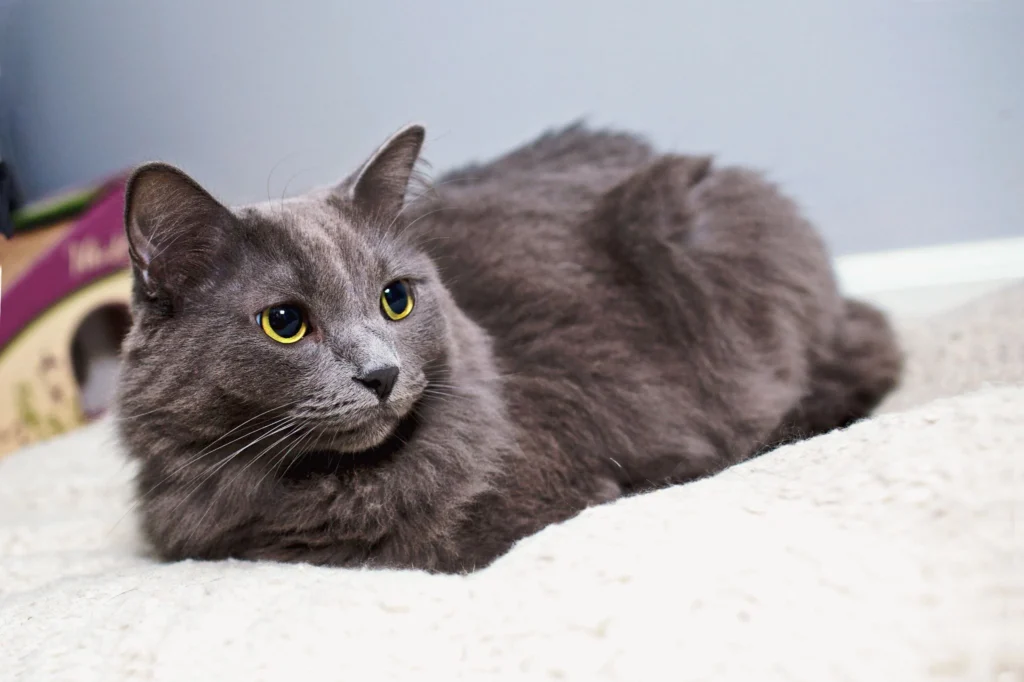
A Nebelung is a medium-sized cat, elegant, with well-developed muscles but not massive. Its appearance harmoniously combines the grace of a Russian Blue with the luxury of a long coat. The overall impression is one of a refined, aristocratic animal.
- Body: Medium length, slender but muscular. Medium bone structure. Should not be overly massive or overly delicate. Body lines are smooth and graceful.
- Head: A modified wedge shape, medium in length, but more long than short. Contours are soft. In profile, the forehead and nose form a straight line or a slight angle at the brow level. The whisker pads are prominent, giving the face the characteristic “smiling” look, just like a Russian Blue’s.
- Ears: Quite large, wide at the base, with slightly rounded tips. Set high on the head, vertically. The outer edge of the ear base is at or slightly above eye level. The fur on the ears is short and soft; it can be slightly longer behind the ears. The ears appear somewhat translucent.
- Eyes: Large, almost round, but with a slightly oval, almond-like shape. Set wide apart. The eye color is a vibrant green. In kittens and young cats (up to 2 years old), the color can be yellowish or amber, but with age, it must change to a rich green. The more intense the green color, the better.
- Limbs and Paws: Legs are long and slender, proportionate to the body. Paws are small and oval-shaped.
- Tail: Long, proportionate to the body. Slightly thicker at the base, gradually tapering to the tip. Covered with a dense, long coat that forms a lush “plume.”
- Coat: The key characteristic of the breed. Semi-long, double-coated. The undercoat is soft and dense, and the guard hairs are fine and silky. The coat should not lie flat against the body but create a light and airy feel. It’s very soft to the touch. The longest hair forms a “ruff” around the neck (especially prominent in males) and “britches” on the hind legs.
- Color: There is only one—a solid blue (gray-blue). A medium shade of blue is desired. The most important feature is the silver tipping—the tips of the guard hairs lack pigment and reflect light, creating the impression that the coat is sprinkled with silver or frost. This effect gives the Nebelung’s coat its characteristic shimmer. The nose leather is charcoal gray, and the paw pads are lilac or pinkish-lilac.
It’s important to note that Nebelung kittens may be born with faint “shadow” stripes (known as “ghost tabby”), which completely disappear with age, giving way to an even blue color. The final development of the coat and the richness of the green eye color can also take up to two years. For comparison, the coat of a Selkirk Rex is known for its curls, and the Sphynx has no coat at all.
The Nebelung Personality: A Gentle Intellectual in a Silvery Coat
The Nebelung’s personality is one of its most appealing traits, beautifully complementing its aristocratic appearance. They are intelligent, gentle, and loyal companions who form a deep bond with their family.
- Loyalty and Affection: Nebelungs tend to choose one or two family members as the object of their special affection, following them from room to room and seeking to be close. However, this doesn’t mean they ignore other household members—they are friendly with everyone who treats them with kindness.
- Reserve with Strangers: Unlike some extroverted breeds, Nebelungs are usually cautious and reserved when first meeting guests. They won’t immediately jump into a stranger’s arms but will instead observe from a distance, assessing the situation. Over time, if the guest acts calmly and non-intrusively, the cat may show interest and approach.
- Calm Temperament: They are mostly quiet and calm cats. Their voice is typically soft and not very loud. They are not prone to destructive behavior if their needs for attention and activity are met. Nebelungs value a calm, stable atmosphere at home.
- Intelligence and Playfulness: Despite their calm nature, Nebelungs are quite smart and playful. They love interactive games with their owner, especially those that mimic hunting (e.g., games with a feather “wand”). They enjoy puzzle toys that stimulate their minds. It’s important to provide them with regular mental and physical activity to prevent boredom.
- Need for Attention: As mentioned, Nebelungs are very people-oriented cats. They handle prolonged solitude poorly and need daily interaction and affection. If you are often away from home for long periods, this breed may not be the best choice, as they can develop separation anxiety.
- Sensitivity: These are quite sensitive animals who are keenly attuned to their owner’s mood and the atmosphere in the home. They dislike loud noises, shouting, and commotion. They need a peaceful and harmonious environment.
- Habits and Routine: Nebelungs often appreciate stability and routine. They like it when feedings, playtimes, and cuddle sessions happen at roughly the same time each day.
Overall, the Nebelung is a great choice for people looking for a calm, loyal, and intelligent friend. They are well-suited for singles, couples, or families with older, calm children who know how to behave respectfully with animals. Unlike the active and curious Russian Blues or the energetic Somali Cats, a Nebelung prefers a more peaceful pace of life, though they won’t turn down a fun game.
Nebelung Care and Maintenance: Keeping Them Healthy and Beautiful
Nebelung Health: Common Issues and Prevention
Nebelung Nutrition: Key Recommendations for Health and Coat Beauty
Nebelungs and Other Pets: The Basics of Coexistence
Due to their calm and peaceable nature, Nebelungs generally get along well with other pets, especially if they grew up together or were properly introduced to each other.
- With Other Cats: Nebelungs often find common ground with other cats, especially those with a similar temperament. They are not prone to dominance or aggression. Having another feline companion can even help a Nebelung cope better with the owner’s temporary absence.
- With Dogs: Coexisting with dogs is entirely possible, especially if the dog is calm, well-behaved, and not aggressive toward cats. The best-case scenario is if the introduction happens when the animals are young. It’s important to provide the cat with a safe place to hide where the dog cannot access (e.g., on a high shelf or in a cat tree).
- With Small Animals: Extreme caution is needed here. Like all cats, Nebelungs have a hunting instinct. Therefore, keeping them in the same house as small rodents (hamsters, guinea pigs, rats), birds, or fish is only possible if these animals are securely isolated in cages or aquariums, and the cat does not have direct access to them. Never leave a Nebelung unsupervised with potential prey.
The key to successful coexistence is a proper and gradual introduction. You shouldn’t just throw the animals into one room together. First, let them get used to each other’s scent (for example, by swapping their blankets), then arrange short, supervised meetings at a safe distance, gradually increasing the time they spend together under your supervision. Always encourage calm and positive interactions.
Nebelungs and Children: Is This Breed Right for a Family?
A Nebelung can become a wonderful family member with children, but there are some nuances related to their sensitive and somewhat reserved nature.
- Ideal Age of Children: Nebelungs get along best with older children (ages 6-7 and up) who already understand how to behave with an animal—gently, kindly, without sudden movements or loud noises. Such children can become great friends for a Nebelung for play and cuddles.
- With Small Children: The situation is more complex with toddlers. Nebelungs are not aggressive, but they do not tolerate rough handling, tail pulling, or loud screams. If the cat feels uncomfortable or threatened, it will most likely simply run away and hide rather than endure it. It’s important to teach small children to respect the cat’s personal space and never leave them alone without adult supervision.
- Need for Peace and Quiet: Nebelungs value a calm atmosphere. If your home is often noisy, with lots of active games and running, a sensitive Nebelung may feel stressed. It’s important that the cat always has a quiet, cozy place where it can rest and hide when it wants to.
So, a Nebelung can be a good choice for a family, but only if the children are taught how to handle the cat properly and the cat has the opportunity to retreat when it needs to. Patience, respect, and adult supervision are the keys to a harmonious relationship between a Nebelung and children.
Pros and Cons of the Nebelung Breed
Like any breed, the Nebelung has its own advantages and disadvantages. It’s important to weigh them before deciding to get one.
| Pros (+) | Cons (-) |
|---|---|
| Elegant Appearance: Unique silvery-blue long coat and green eyes make them extraordinarily beautiful. | High Need for Attention: Very people-oriented, handle loneliness poorly, can suffer from separation anxiety. |
| Gentle and Loyal Personality: Affectionate, calm, and form strong bonds with owners. | Reserved with Strangers: Can be shy and hide from guests. They need time to adapt. |
| Intelligence: Smart, learn quickly, love interactive games. | Grooming Needs: Although the coat isn’t prone to heavy matting, it requires regular brushing (2–3 times a week). |
| Quiet Voice: Usually not very loud cats. | Sensitivity to Stress: React poorly to noise, commotion, and changes in their environment. They need a calm atmosphere. |
| Good Health: the absence of described hereditary disease is not the absence of risk — breeding animals are screened all the same. | Rarity and Price: Finding a Nebelung kitten can be difficult, and the price is usually higher than for more common breeds. |
| Gets Along with Other Pets: Generally peaceable with other cats and calm dogs (with proper socialization). | Not for Very Busy People: They need daily interaction and engagement from their owner. |
| Cleanliness: Very particular about having a clean litter box. | Hunting Instinct: Caution is needed when keeping them with small animals. |
Fun Facts About the Nebelung Breed
- “Creature of the Mist”: The name “Nebelung” comes from the German word “Nebel” (mist, fog) and the epic poem “The Song of the Nibelungs.” This reflects their mystical silvery coat and connects them to the names of the breed’s founders—Siegfried and Brunhilde.
- American Roots with a Russian Accent: Although Nebelungs were developed in the U.S., their direct ancestors are Russian Blue cats. In essence, a Nebelung is a long-haired version of a Russian Blue.
- Slow to Mature: Nebelungs reach their full physical maturity and the final development of their luxurious coat and rich green eye color quite slowly—this process can take up to two years.
- Silver Sheen: The characteristic silvery hue of the coat is due to tipping—the absence of pigment on the very tips of the guard hairs, which reflects light and creates a shimmering effect.
- “A Dog in a Cat’s Body”: Due to their loyalty, tendency to follow their owners, and love for interactive games, Nebelungs are sometimes jokingly called “dogs in a cat’s body.”
- Quiet Intellectuals: They are known for their soft, quiet voice and high intelligence, which makes interacting with them especially pleasant.
- No Sunbathing: Direct sunlight can cause a reddish or brownish tint to appear on a Nebelung’s blue coat, so owners of show cats often protect them from excessive sun exposure.
- A Rare Gem: The breed remains quite rare worldwide, which makes every Nebelung a true gem for enthusiasts.
Frequently Asked Questions About the Nebelung (FAQ)
Are Nebelungs hypoallergenic?
No, no cat breed is 100% hypoallergenic. Allergies are not caused by the fur itself, but by the protein Fel d 1, which is found in a cat’s saliva, dander, and urine. Some people with mild allergies may tolerate Nebelungs (and Russian Blues) better because they are believed to produce slightly less of this protein. However, this is individual. Before getting a cat, people with allergies should spend some time with a member of the breed.
How much do Nebelungs shed?
Nebelungs have a double coat and shed moderately throughout the year, with more intense shedding periods in the spring and fall. Regular brushing (2-3 times a week) helps control the amount of hair in the house and prevents matting.
Do Nebelungs like to be held?
Many Nebelungs enjoy physical contact and can be “lap cats,” but usually on their own terms. They decide when they want affection and cuddles. They are devoted but not pushy.
How vocal are Nebelung cats?
Nebelungs are known for their soft, quiet voices. They are not a “chatty” breed, although they may greet you with a gentle meow or purr when they want attention or food.
How long do Nebelungs live?
The average lifespan of a Nebelung is 12-16 years, but with good care, proper nutrition, and regular veterinary check-ups, they can certainly live for 18 years or longer.
Do Nebelungs need to go outside?
No, Nebelungs do not need to go outside. Furthermore, for their safety, it is recommended to keep them strictly indoors. If you want to give your cat access to fresh air, a protected balcony or a catio can be a safe option.
Are Nebelungs easy to train?
Nebelungs are smart and clever but can be somewhat independent. They respond well to positive reinforcement (treats, praise, play). They can be taught simple commands and how to use a scratching post and a litter box. Patience and consistency are key to their training.
Conclusion
The Nebelung is truly a unique breed, combining the grace of the Russian Blue with the luxury of a long, silvery coat. It’s not just a beautiful animal but also an intelligent, gentle, and loyal companion. They are an ideal fit for people who are looking for a calm yet playful friend, ready to give their love and attention. Owning a Nebelung requires regular coat care and ensuring plenty of social interaction, but the reward is a deep bond and many years of happy coexistence with this wonderful “creature of the mist.”
- Calm, quiet, balanced
- Clever, devoted to its person
- “Healthy” here means no mass syndrome, not no risk
- An elegant blue coat, ideal for an apartment
- Reserved and cautious with strangers
- Dislikes noisy change and clamor
- Bonds mainly with one person
- A tendency to gain weight (a good appetite)
| Russian Blue | Chartreux | British Shorthair | |
|---|---|---|---|
| Weight | 3–5.5 kg | 3–7 kg | 4–8 kg |
| Energy | 3 | 3 | 2.5 |
| Apartment | 5 | 5 | 5 |
| Beginners | 4 | 4 | 4.5 |
How does the Nebelung differ from the Russian Blue?
Is the Nebelung good for a family with children?
How healthy is the Nebelung?
TICA / WCF standards (Nebelung)
For apartments · For kids · For beginners · Most affectionate · Quietest · Hypoallergenic · All rankings →