

The Cesky Terrier is one of the rarest and youngest breeds in the large terrier family, yet it’s quickly winning the hearts of dog lovers worldwide. If you’re lucky enough to become a Cesky owner, you’ll gain more than just a dog—you’ll find a true friend who is intelligent, loyal, and incredibly even-tempered. Unlike many of their terrier relatives, known for their stubborn and fiery personalities, the Cesky is one of the most compliant, calm, and people-oriented breeds. They combine playfulness, energy, and curiosity without the excessive stubbornness or arrogance. To learn more about this unique breed’s history, personality, and care, you’ll find more information on Tvaryny.
These amazing terriers have a huge love for all family members, including seniors and children, which makes them ideal family companions. They generally get along well with other pets, though their hunting instinct might kick in around smaller rodents. When out for a walk, Cesky Terriers rarely start fights, but they can certainly hold their own if needed to protect themselves and their owner. While they have excellent natural hunting and protective instincts, these are balanced by their obedience and desire to please. They are not only excellent working dogs but also outstanding companions for the entire family.
Cesky Terrier: Breed Overview
| Origin | Czech Republic (formerly Czechoslovakia) |
| Year Created | 1948 |
| Official FCI Recognition | 1963 |
| Lifespan | 12-15 years |
| Height (at the withers) | 10-12.5 inches (25-32 cm) |
| Weight | 13-22 lbs (6-10 kg) |
| FCI Group | Group 3 (Terriers), Section 2 (Small Terriers) |
| Other Names | Bohemian Terrier |
History of the Cesky Terrier Breed
The history of the Cesky Terrier is unique because it’s not lost to the mists of time but is precisely known and tied to one man: Czech geneticist and dog breeder František Horák. As a passionate hunter and breeder of Scottish Terriers, Horák dreamed of creating the perfect burrowing dog. He wanted a small, durable dog with a narrow chest to easily navigate fox and badger dens, but with a less aggressive and more manageable temperament than most terriers.
Work on the new breed began in 1948. To achieve his goal, František Horák used two breeds: the Scottish Terrier and the Sealyham Terrier. From the Scottish Terrier, he sought to inherit hunting prowess and a dark coat, while the Sealyham provided a softer temperament, lighter coat shades, and floppy ears. The first litter that launched the new breed was born in 1949, sired by a Scottish Terrier named Donka Lovu zdar and a Sealyham Terrier female named Buganier Urquelle.
It took Horák about ten years of careful selective breeding to achieve his goal and stabilize the desired traits. He kept detailed records of every cross, analyzing the results and selecting only the best representatives for future breeding. In 1959, the Cesky Terrier was first shown at an exhibition in Czechoslovakia, where it immediately attracted attention. Just four years later, in 1963, the breed received official recognition from the Fédération Cynologique Internationale (FCI). The Cesky Terrier became a national source of pride for the Czech Republic and remains one of the few breeds whose creation history is documented with absolute precision.
What Does a Cesky Terrier Look Like? Standard and Appearance
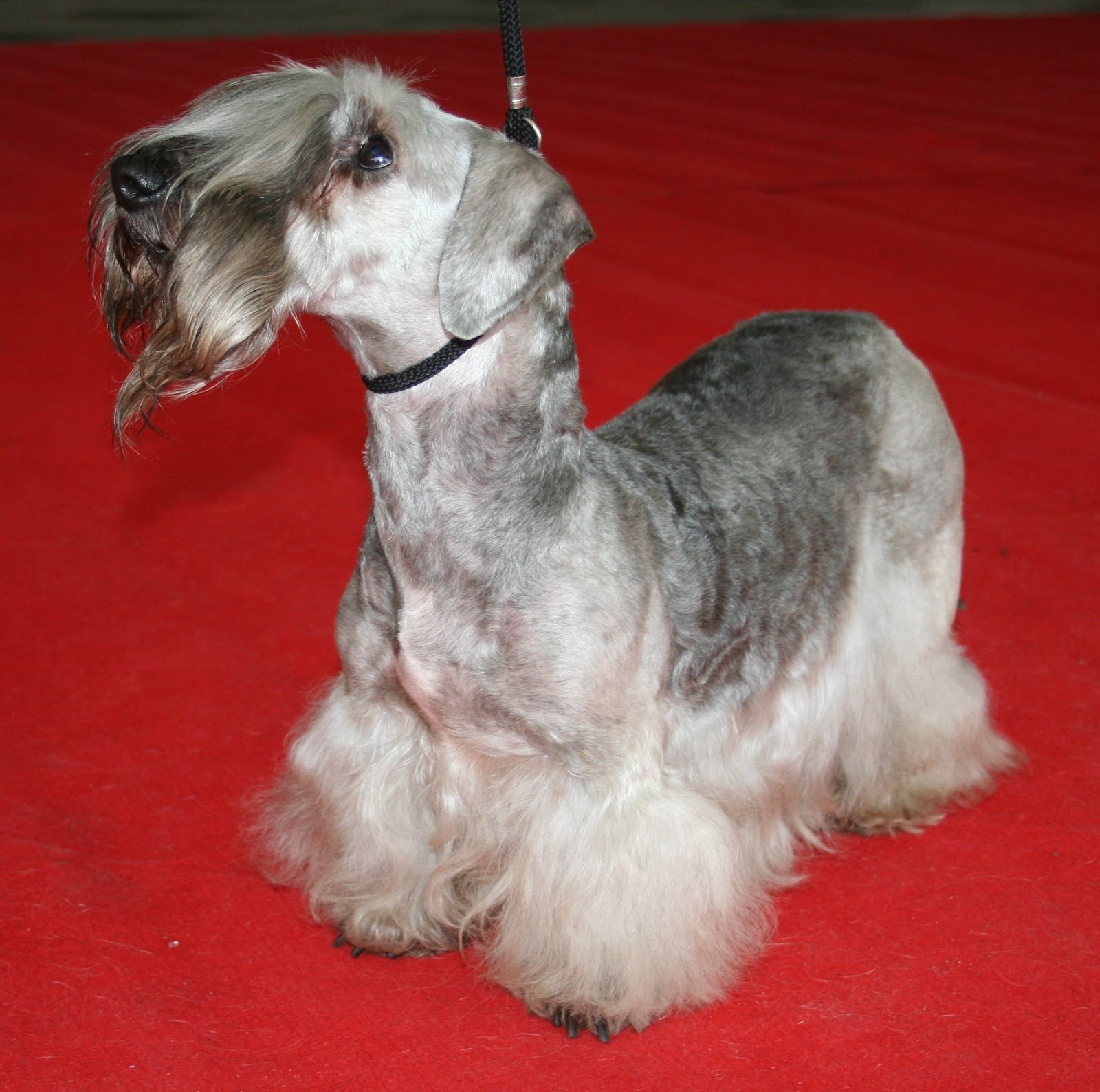
The Cesky Terrier is an elegant, long-haired yet sturdy and muscular dog with a rectangular body and relatively short legs. Their appearance is well-proportioned and lacks extreme features, which positively impacts their health and working ability. The breed standard clearly defines all key characteristics.
- Head: Long, wedge-shaped. A characteristic feature is their bushy eyebrows and a luxurious beard. The stop (the transition from forehead to muzzle) is not abrupt but is noticeable.
- Muzzle: The bridge of the nose is straight. The nose is large and well-developed, black in gray-blue dogs and liver-colored (brown) in coffee-colored dogs.
- Jaws and Teeth: Strong jaws with a scissor or level bite. Teeth are strong and white.
- Eyes: Medium-sized, set deep, with a kind expression. Eye color varies from brown to dark brown, depending on the coat color.
- Ears: Medium-sized, triangular, and set quite high. They hang close to the cheeks.
- Neck: Medium length, strong, and slightly arched.
- Body: Elongated, with a topline that rises slightly toward the loins. The back is strong, and the loins are relatively long and muscular. The chest is cylindrical but not overly deep.
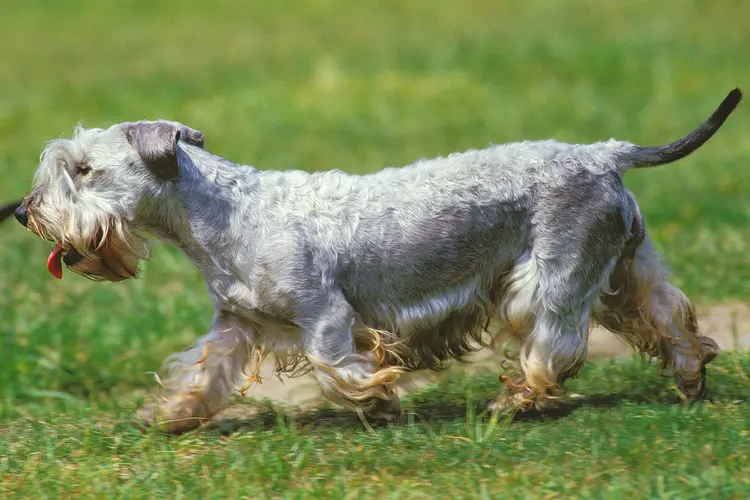
- Tail: Set low, 7-8 inches long. When calm, it hangs down or is slightly curved at the tip. When moving, the dog carries it horizontally or higher in a saber shape.
- Limbs: The front legs are straight, parallel, and strong. The hind legs are also parallel and very muscular. The feet are large with arched toes and strong pads.
- Coat: Long, fine, but strong and slightly wavy, with a silky sheen. It forms characteristic “furnishings” on the face and a “skirt” on the lower part of the body.
Cesky Terrier Coat Colors
The breed standard allows for two main color variations:
- Gray-blue: Puppies are born black, and as they age (typically by 2 years), their coat lightens to shades ranging from charcoal gray to platinum.
- Coffee-brown: Puppies are born chocolate-brown and lighten over time.
In both color variations, yellow, gray, or white markings are allowed on the head (beard, cheeks), neck, chest, belly, and limbs. A white “collar” and a white tail tip are also possible. However, the main color should always be dominant.
Temperament and Behavior

The Cesky Terrier’s temperament is its main advantage and what sets it apart from most other terriers. They are often called “the low-maintenance terrier” because they are intelligent, calm, and not prone to excessive noise or aggression, which makes them wonderful companions.
Loyalty and People-Oriented. The Cesky Terrier is incredibly attached to its family and finds it difficult to be left alone. They love being the center of attention, participating in all family activities, and will do anything for their owner’s praise. This makes them highly obedient and easy to manage.
Attitude Towards Strangers. They are reserved and a bit wary of strangers but are not aggressive. They make good watchdogs, as they will always alert their owners with a loud bark about the arrival of guests or suspicious sounds. However, they are not suited for the role of a vicious guard dog.
Interaction with Children and Other Animals. This is one of the few terrier breeds that can be confidently recommended for families with children. They are patient, gentle, and playful. With other dogs, especially if they grew up together, they get along well and are not prone to dominance. Cats and other household pets can also become their friends with proper socialization. The only exception is small rodents (hamsters, guinea pigs), where their hunting instinct might take over.
Intelligence and Activity. These are very smart dogs who learn quickly. They need not only physical but also mental stimulation. Despite their short legs, Cesky Terriers are quite active and durable. They will happily join you on a long walk, a hike, or a jog. However, unlike many terriers, they know how to “switch off” at home and will rest quietly in their spot without demanding constant attention.
Pros and Cons of the Cesky Terrier Breed
| Pros | Cons |
|---|---|
| Calm and balanced temperament, atypical for a terrier | Requires regular, professional grooming (clipping) |
| High intelligence and easy to train | Rare breed, a puppy can be hard to find and is expensive |
| Strong family bond and loyalty | Prone to weight gain with improper diet |
| Gets along well with children and other pets | Hunting instincts may manifest toward small rodents |
| Not prone to barking without reason | Not suitable for living outdoors or in a kennel |
| Suitable for apartment living | Needs early socialization to avoid shyness |
| Generally good health with a lack of many genetic diseases | Beard and mustache require daily cleaning after meals |
Care and Maintenance of the Cesky Terrier
The Cesky Terrier is perfectly suited for life in a city apartment, provided they get enough physical activity. Their care involves several important aspects that a future owner should be aware of.
Coat Care: Clipping, Not Stripping
The main feature of Cesky Terrier coat care is that it is clipped (or trimmed), not stripped. Their coat is fine and soft, so stripping can damage it. Clipping is done 4-6 times a year. The standard cut involves short hair (around 0.4-0.6 inches) on the back, sides, neck, and tail, and longer hair on the legs, belly (forming the “skirt”), and on the face (eyebrows, beard, mustache).
It’s best to entrust the clipping to a professional groomer who is familiar with the breed’s specific needs. The standard requires that the transitions from short to long hair be smooth and seamless. Between clippings, the coat should be brushed regularly (2-3 times a week) to prevent matting. Special attention should be paid to the beard, which needs to be washed and brushed after every meal. It is also important to regularly trim the hair between the toes and in the ear canals.
Physical Activity and Exercise
Although the Cesky Terrier may look like a lapdog, it remains a true terrier with all the corresponding needs. They require daily walks of at least 1-1.5 hours. They love active games, running, and fetching. They make excellent companions for easy hiking trips. Despite their short legs, they are very durable. It’s important to provide the dog with not only physical but also mental stimulation: search games, learning commands, and training with a dog trainer.
Training and Socialization
Cesky Terriers are among the easiest terriers to train. Their desire to please their owner, high intelligence, and lack of excessive stubbornness make the learning process enjoyable and productive. They typically understand everything almost instantly and quickly pick up new commands. Other breeds with a similarly gentle yet independent character include the Cairn Terrier or the Dandie Dinmont Terrier, which makes them a great choice for newcomers to the world of terriers.
Training should begin at an early age using positive reinforcement methods—praise, treats, and games. Harshness and physical punishment are absolutely unacceptable, as they can frighten the dog and undermine trust. Early socialization is very important. A puppy needs to be introduced to different people, sounds, places, and other animals so it can grow into a self-confident and well-balanced dog. Sometimes Ceskys can be a bit shy, and proper socialization will help prevent this. Attending obedience classes is beneficial not only for the dog but also for the owner, who can better understand their pet’s psychology.
Cesky Terrier Health: Typical Diseases and Prevention
The Cesky Terrier is a breed with robust health, largely because it was created for working qualities rather than extreme looks. However, like any breed, they are prone to certain health conditions.
The most well-known genetic disorder, inherited from Scottish Terriers, is “Scottie Cramp” or muscle spasms. This is a neurological condition that presents as sudden muscle spasms during moments of high excitement or physical exertion. The dog may “freeze” in an unusual pose, arch its back, and its coordination may be affected. An episode lasts for a few minutes and resolves on its own without causing pain. This condition is not life-threatening and is extremely rare in Cesky Terriers. Owners simply need to avoid overly stressful situations for the dog.
Other potential health issues include:
- Patellar Luxation: Common in many small breeds.
- Eye Diseases: Cataracts or lens luxation can sometimes occur.
- Heart Conditions: Problems with heart valves are possible in old age.
To maintain your dog’s health, it’s important to choose a puppy from a responsible breeder who tests their dogs for genetic disorders, and to provide proper nutrition, regular physical activity, and annual preventive check-ups with a veterinarian.
Cesky Terrier Nutrition: Key Recommendations
Cesky Terriers are big eaters and, unfortunately, are prone to gaining excess weight. They are not at all picky about their food and are ready to eat anything they are offered, and even things that are not theirs. Therefore, managing their diet is entirely up to the owner.
Main Feeding Rules:
- Stick to a Schedule: An adult dog should be fed twice a day, in the morning and evening, strictly at the same time. It’s best to feed them after their walk.
- Portion Control: The amount of food should match the dog’s age, weight, and activity level. Do not overfeed!
- High-Quality Food: The basis of the diet can be either high-quality premium or super-premium dry food for small breeds, or a natural diet. For natural feeding, the diet should consist of lean meat (beef, turkey, chicken), organ meats, saltwater fish, dairy products, eggs, grains (rice, buckwheat), and vegetables.
- Forbidden Foods: Absolutely do not give your dog sweets, baked goods, smoked meats, fatty and fried foods, cooked bones, chocolate, or grapes.
- Treats: Use special dog treats for positive reinforcement during training, but remember to account for their calories in the daily diet.
Always ensure your dog has access to fresh, clean drinking water.
Interesting Facts About the Cesky Terrier
- The Cesky Terrier is a national symbol of the Czech Republic and is featured on Czech postage stamps.
- František Horák, the creator of the breed, was not only a dog breeder but also a distinguished geneticist who worked at the Czechoslovak Academy of Sciences. He kept such detailed pedigree books that the lineage of every modern Cesky Terrier can be traced back to the first founding dogs.
- It is one of the six rarest dog breeds in the world, according to some kennel clubs.
- Initially, the breed was called the “Bohemian Terrier,” but it was later renamed the “Cesky Terrier.”
- Unlike most terriers, which were developed by farmers and hunters, this breed is the result of a single person’s deliberate scientific work.
Frequently Asked Questions (FAQ)
| Is the Cesky Terrier good for a first-time owner? | Yes, this is one of the best terrier breeds for novice owners due to their gentle temperament and desire to please. |
| Does the Cesky Terrier shed much? | Their shedding is minimal. Because of their hair-like coat structure, they barely leave any hair on furniture. However, they are not completely hypoallergenic. |
| How much does a Cesky Terrier puppy cost? | Due to the breed’s rarity, the price for a puppy is quite high. The cost can vary significantly depending on the lineage, breeder, and country. Puppies can easily cost a few thousand dollars in the U.S. |
| Do they bark a lot? | No, they are not prone to barking without reason. They usually bark when there’s a good reason, like someone at the door or when they want attention. |
| Can a Cesky Terrier be left alone for long periods? | They do not handle loneliness well due to their strong family bond. If you spend a lot of time away from home, this breed may not be the right fit for you. |