

| Height | 48–55 cm |
| Weight | 25–40 kg |
| Lifespan | 10–14 years |
| FCI group | 6 · scenthounds (tracking) |
| Origin | Germany |
Exact ratings
Common health issues
Nutrition
The Hanover Hound (Hannoverscher Schweisshund) is an ancient and relatively rare breed of specialized hunting dog that originated in Germany. These dogs are not just classic hounds; their main purpose is to follow a blood trail to find large wounded game, such as deer or wild boar. Thanks to their incredible sense of smell, endurance, and calm, balanced temperament, they have become indispensable partners for gamekeepers and professional hunters. However, their narrow specialization and high maintenance demands make them completely unsuitable for city life or the role of a regular companion. Hanover Hounds are working dogs for whom hunting is an absolutely essential condition for a happy and fulfilling existence. Find out more about this unique breed, its history, temperament, and care requirements on Tvaryny.
Hanover Hound: Key Breed Information
| Breed Name | Hanover Hound (Hannoverscher Schweisshund) |
| Origin | Germany |
| Time of Origin | Middle Ages, modern type – 19th Century |
| FCI Group | Group 6. Scent Hounds and Related Breeds. Section 2. Scent Hounds. |
| Lifespan | 10-14 years |
| Height (at the withers) | Males: 50-55 cm, Females: 48-53 cm |
| Weight | Males: 30-40 kg, Females: 25-35 kg |
| Use | Specialized scent hound for blood tracking |
| Temperament | Calm, confident, loyal, sensitive, focused on work |
| Physical Activity Needs | Very high |
| Grooming Difficulty | Low |
| Compatibility with Children | Good, with proper socialization |
| Attitude towards other Animals | Requires early socialization, strong prey drive |
History and Origin of the Hanover Hound
The history of the Hanover Hound is deeply rooted in the Middle Ages, when hunting was not just a sport but a vital necessity. Their ancestors are believed to be the heavy “limers” or “tracking dogs” (Leithunde), which were used by Celtic and Germanic tribes. These dogs had a phenomenal nose and the ability to hold a scent, working on a long leash to track game before the main hunt with packs of hounds began. They were so valuable that their keeping and breeding was an exclusive privilege of the nobility.
With the development of firearms in the 17th and 18th centuries, hunting methods changed. The need arose not so much for tracking a healthy animal, but for finding wounded game. This was important not only from an economic standpoint (to avoid losing the bounty) but also ethically — hunters considered it their duty to find a wounded animal to end its suffering. It was for this purpose that a specialized breed began to be developed. The center of breeding became the Kingdom of Hanover, specifically the gamekeeper’s court in Hanover (Hannoverscher Jägerhof).
In the 19th century, selective breeding became systematic. To lighten the build and improve the working qualities of the ancient hounds, they were crossed with lighter and faster breeds, particularly the red Hanoverian meadow hounds. The result was a dog that perfectly combined calmness, endurance, an incredible sense of smell, and the ability to focus on a “cold” blood trail, ignoring other scents. In 1885, the “Verein Hirschmann” club was founded, which to this day oversees the purity of the breed, maintains studbooks, and conducts working trials. Thanks to the efforts of the club members, the breed has retained its unique qualities and avoided “modernization,” which could have harmed its specialization. Today, the Hanover Hound remains a fairly rare breed, highly valued among professional hunters and foresters throughout Europe.
Breed Standard and Appearance of the Hanover Hound
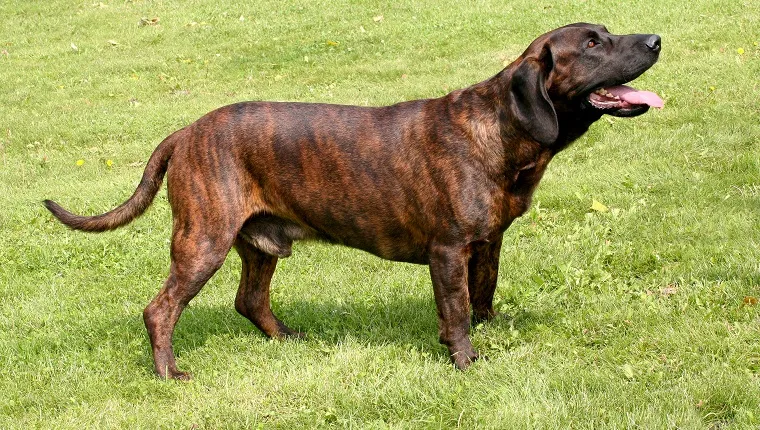
The Hanover Hound is a medium-sized dog with a strong, athletic, yet elongated build. Its appearance fully corresponds to its purpose: every feature indicates strength, endurance, and the ability to work for long periods in a methodical way over difficult terrain.
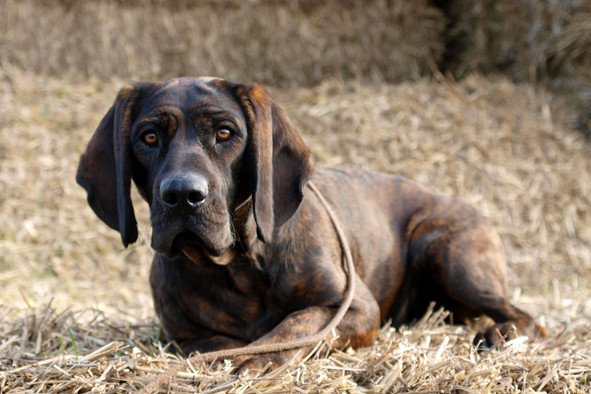
- Head: Broad, with a slightly domed forehead and a distinct stop. A characteristic feature is the wrinkles on the forehead, which give the dog a serious, focused expression. The lips are thick, with pronounced flews.
- Eyes: Dark brown, clear, with a serious look. They should not be prominent or deep-set.
- Ears: Long, broad, set high, hanging smoothly along the cheeks, with rounded tips.
- Body: Powerful, slightly elongated in format. The neck is strong, with a small dewlap. The chest is deep and broad, providing a large volume for the lungs. The back is long, strong, with a well-defined withers. The loin is wide and slightly arched.
- Limbs: Very muscular, with strong bones, allowing the dog to move confidently over rough terrain. The forelimbs are straight, the hindlimbs have well-defined angulation.
- Tail: Long, thick at the base, gradually tapering toward the tip. The dog carries it slightly curved.
- Coat: Short, dense, and coarse to the touch. On the back of the thighs and on the underside of the tail, the hair is slightly longer and stiffer.
- Color: The main color is from light fawn to dark reddish-brown, sometimes with brindle markings. A dark “mask” on the muzzle is acceptable. A small white patch on the chest is not considered a fault.
Temperament and Character Traits
The Hanover Hound’s temperament is a unique blend of calmness and focus. At home, within the family circle, he is a quiet, balanced, and extremely loyal dog. He forms a deep bond with his owner, whom he considers the “pack leader,” and is ready to follow them anywhere. This breed is not prone to pointless barking or fuss. They are sensitive to their owner’s mood and create an atmosphere of tranquility in the home.
However, as soon as they are on the hunt, the dog transforms instantly. Their second nature emerges: incredible persistence, stamina, and concentration. Once on a trail, a Hanover Hound can follow it for hours, without being distracted by other smells or sounds. They are independent decision-makers when hunting, displaying a certain toughness in their work. Towards strangers, they are reserved, without aggression, but also without excessive friendliness. They generally get along well with children if they have grown up with them, but due to their size and strength, they require supervision during playtime. Other dogs in the family are accepted normally if socialization was done early. However, they will always see small animals (cats, rabbits) as potential prey due to their extremely strong hunting instinct. Interestingly, another famous breed for working in mountainous terrain, the Bavarian Mountain Hound, was developed from the Hanover Hound, inheriting many of its ancestor’s character traits but having a lighter build. The Alpine Dachshund Badger Dog is also a great choice for hunters looking for a loyal and fearless hound.
Care and Maintenance: Creating Ideal Conditions
Grooming and Coat Care
Caring for a Hanover Hound is surprisingly simple. Their short and harsh coat does not require complicated procedures. It is sufficient to brush it once a week with a rubber brush or glove to remove dead hair and dirt. Shedding occurs twice a year, and during this period, the procedure can be done more frequently. You should only bathe the dog if he is very dirty, as frequent washing can disrupt the skin’s natural protective layer.
Special attention should be paid to the ears. Their hanging shape creates a favorable environment for the development of infections. It is necessary to regularly check the ear canal for redness, dirt, or an unpleasant odor and gently wipe it with a damp cloth. It is also important to monitor the condition of their nails and trim them in a timely manner if they do not wear down naturally during walks.
Physical Activity and Exercise
This is the most important aspect of owning a Hanover Hound. This dog is categorically not suitable for living in an apartment. He needs space, ideally a country house with a large, securely fenced-in area. But even this is not enough. The main need of a Hanover Hound is work. He requires long walks (at least 2-3 hours a day) over rough terrain, preferably in a forest, where he can use his sense of smell. Simple walks on a leash will not satisfy his need for activity. This high drive is also common in other specialized scent hounds, such as the Bavarian Mountain Hound.
The best way to ensure he has a happy life is through regular participation in hunting. If this is not possible, you need to find an alternative: nose work, long hikes, or running alongside a bicycle. Without sufficient physical and mental stimulation, the dog becomes restless and may display destructive behavior. Similar high demands for activity are characteristic of other specialized breeds, such as the Alpine Dachshund Badger Dog.
Training and Raising a Hanover Hound
Training a Hanover Hound has its own peculiarities. On the one hand, he is an intelligent and calm dog that strives to please his owner. On the other hand, his hunting heritage has given him independence and stubbornness. He is accustomed to making his own decisions while working, so blindly following commands is not his strong suit.
The key to success is patience, consistency, and building a trusting relationship. The owner must become an undisputed authority and partner for the dog. Training sessions should be interesting, short, and based on positive reinforcement (praise, treats). Roughness and physical punishment are absolutely unacceptable — they can destroy trust forever and make the dog withdrawn or even aggressive.
Early socialization is critically important. A puppy needs to be introduced to different people, sounds, places, and other animals so that he grows into a confident and balanced dog. The main focus in training should be on obedience commands, especially recall, as a hound engrossed in a trail in the forest can easily get lost. Like the Alpine Dachshund Badger Dog, the Hanover Hound requires a firm but fair handler.
Health and Typical Breed Diseases
Nutrition: How to Properly Feed a Hanover Hound
Pros and Cons of the Hanover Hound Breed
| Pros | Cons |
|---|---|
| Incredible loyalty to the owner: Forms a very strong bond with one person. | Unsuitable for apartment living: Requires space and a country environment. |
| Calm and balanced nature at home: Not prone to barking or fuss. | Very high physical activity requirements: Needs daily long and intensive exercise. |
| Outstanding working qualities: One of the best scent hounds in the world. | Strong prey drive: Cannot be let off the leash in unsafe areas, may run off on a trail. |
| Robust health and low maintenance: Does not require complicated grooming. | Independent nature: Can be stubborn in training, requires an experienced owner. |
| Gets along well with children in the family: Patient and not aggressive. | Does not handle loneliness well: Requires constant contact with its owner. |
Interesting Facts about Hanover Hounds
- The name “Schweisshund” literally translates from German as “sweat dog,” but in a hunting context, “Schweiss” means “blood,” so the correct translation is “blood tracking dog.”
- The “Verein Hirschmann” club that oversees the breed is one of the oldest and most conservative in Germany. To get a puppy, a potential owner often has to prove they are a practicing hunter or gamekeeper.
- The Hanover Hound is a “one-person” dog. He chooses one owner and remains loyal to them for life. A change of ownership is a huge stress for him.
- The breed has an official working motto: “Ruhig und sicher im Wesen, passioniert bei der Arbeit” — “Calm and confident in nature, passionate in work.”
- Despite their rarity, Hanover Hounds are used by gamekeeper services not only in Germany but also in Austria, France, Scandinavia, and even in some US states for tracking wounded deer.
Frequently Asked Questions about the Breed (FAQ)
Can a Hanover Hound be kept in a city?
No, this is strongly discouraged. This dog needs space, nature, and most importantly, work for its intended purpose. City life with short walks in the park will make him unhappy and can lead to behavioral problems.
Is a Hanover Hound suitable for an inexperienced owner?
No. This breed requires an experienced hand, an understanding of the psychology of hunting dogs, and the ability to provide them with the necessary level of exercise. Their stubbornness and independence can be a serious challenge for a novice.
How much does a Hanover Hound puppy cost?
Due to the rarity of the breed and strict breeding requirements, puppies are expensive. The price can vary significantly, but be prepared for a high price tag. The main difficulty is not the price, but in finding a responsible breeder and convincing them to sell you a puppy by proving you can provide it with the right conditions.
Do they shed much?
Shedding is moderate, increasing seasonally in spring and fall. Regular brushing helps to keep this process under control.
Video about the Breed
- An unrivaled master of the blood trail
- Calm, focused, hardy
- Deeply devoted to its hunter
- Clever, learns the work well
- A narrow specialism — needs hunting practice
- Absolutely not for the city or an apartment
- Reserved and choosy with strangers
- Not for a novice or passive owners
| Bavarian Mountain Hound | Alpine Dachsbracke | Bloodhound | |
|---|---|---|---|
| Height | 44–52 cm | 34–42 cm | 58–69 cm |
| Energy | 4 | 3.5 | 3.5 |
| Apartment | 1.5 | 2.5 | 2 |
| Beginners | 1.5 | 2.5 | 2.5 |
How does the Hanoverian Scenthound differ from ordinary hounds?
Is the breed suitable for the city?
Is the breed suitable for a novice?
FCI Standard No. 213 · Verein Hirschmann
For apartments · For kids · For beginners · Active · Smartest · Hypoallergenic · All rankings →