


| Height | dogs 36–41 cm; bitches slightly smaller |
| Weight | 8–14 kg (AKC standard gives 18–30 lb) |
| Lifespan | about 14 years in the large cohort, 13 in clinical records |
| FCI group | 9 · section 5, Tibetan breeds |
| Origin | Tibet (patronage: Great Britain) |
Exact ratings
Common health issues
Nutrition
The Tibetan Terrier is a breed whose name has misled people for a hundred years. It is not a terrier: these dogs never worked underground, sit in no terrier group in any registry, and genetically stand beside the ancient Asian breeds rather than the European earth dogs. The FCI standard puts it briefly: despite the name, this is a herding dog that also earned its keep guarding traders on the road to China and back. What follows is what a document can support — three registries’ standards and where they contradict one another, recorded history against the monastery legend, five inherited disorders with gene names and named DNA tests, a measured lifespan, and the British registration figures. More breed material is on Tvaryny.
He is a shaggy, square, medium-sized dog with a double coat, large round feet and the temperament of a watchdog that does not make a scene: clever, self-directed, deeply attached to his family and reserved with strangers. The owner’s daily work is the coat, not training; the question for a breeder is not the pedigree but the DNA results of both parents.
Not a terrier: what the registries themselves say
This is not a fine point of terminology but a misclassification all three major registries have conceded. The Kennel Club — the British registry, now trading as the Royal Kennel Club — holds the breed in the Utility group and says so plainly on its breed page: the Tibetan Terrier is not a terrier, and was used as a herding dog for sheep. The FCI places it in Group 9, Companion and Toy Dogs, Section 5 “Tibetan breeds”, without working trial. The AKC put the breed in the Non-Sporting group when it recognised it in 1973 — not among the terriers either.
The bluntest wording belongs not to a critic but to FCI standard No. 209 itself. Its historical brief opens by saying that, in spite of the name, the Tibetan Terrier is not a terrier but a herding dog which also guarded merchants on their journeys. He managed that work, the standard adds, less through size than through the awe in which he was held.
Genetics settled the question separately. The study by Janeš and co-authors in Genetics Selection Evolution (2019) states the conclusion outright: the initial hypothesis that Tibetan Terriers belong to the terrier group of breeds was rejected. Placing the breed among the terriers, the authors note, rested on a superficial phenotypic judgement by a handful of cynologists during the breed’s early formation, and neither the historical nor the genetic evidence supports it. In their analysis Tibetan Terriers sit closer to the other Tibetan breeds than to any terrier.
The breed at a glance: the figures that genuinely appear in the standards

| Origin | Tibet (China), patronage — Great Britain |
| FCI standard | No. 209, current edition of 22 August 2017 |
| FCI recognition | definitive on 18 December 1957 |
| FCI group | 9, Section 5 “Tibetan breeds”, without working trial |
| Purpose under the standard | companion dog |
| Height at the withers (FCI, dogs) | 36–41 cm; bitches slightly smaller, no figure given |
| Weight | not stated in the FCI or Kennel Club standards; the AKC gives 18–30 lb (about 8–14 kg) |
| Lifespan (measured) | median of 13.8 years in a British cohort |
Height deserves its own paragraph, because breed descriptions routinely quote a single “combined” range covering both sexes. No such range exists in any standard. The Kennel Club and the FCI both give 36–41 cm for dogs and the formula “bitches slightly smaller” — with no figure attached. The AKC instead states an average height for dogs of 15–16 inches and faults anything above 17 or below 14 inches; for bitches it uses the same “slightly smaller” wording. The correct thing to say is “dogs 36–41 cm”, not to invent a lower limit for bitches.
Weight works the same way in reverse: neither the FCI nor the British standard mentions it. The only source of a figure is the AKC standard, which names an average of 20–24 lb and an acceptable range of 18–30 lb, while stressing that the ratio of weight to height matters more than the weight itself.
Where the name came from — and the harm it did to the breed
Europeans gave the breed its name, and gave it on size. At the early British shows these dogs were exhibited with the Lhasa Apso under the shared label “Lhasa Terrier” — the Kennel Club says as much in its breed notes. The American breed club puts the reason bluntly: the dogs were not true terriers, but the breed was called one because it came in the size England firmly associated with terriers.
What happened next usually goes untold. The mistaken name did not stay a label. In the 2019 study cited above, the researchers record that because the word “terrier” was used wrongly, breeders of Tibetan Terriers crossed them with some other terrier ancestors. The name began to rewrite the breed to suit itself: first the dog was called a terrier on a surface resemblance, then real terriers were mixed in so the name would fit. A rare and unusually well documented example of a naming error reaching into a gene pool.
The documented history: two Western lines
The entire Western population grew from a very small number of dogs brought out of the border country between Tibet and India in the early twentieth century. Two lines are documented, and both can be named dog by dog.
The Lamleh line traces back to the first two dogs, Bunti and Rajah, which Dr Agnes Greig received in 1922 while working as a physician on the Indo-Tibetan frontier and brought to England in 1930. In 1937 the British Kennel Club recognised the Tibetan Terrier as a separate breed — on dogs from that line, which also became the foundation of the breed in the United States.
The Luneville line is mentioned far less often, although its origin is worth a story of its own. It began with the mating of a bitch called Princess Aureus to a dog called Dusky — a stray John Downey picked up in Liverpool in 1953. The foundling was registered as a Tibetan Terrier under the name Trojan Kynos, and the second Western line descends from him. Both lines converge on a very limited number of founders drawn from the native Tibetan population.
Once the kennel authorities of Europe, the United States and Australia had recognised the breed, the Western population fell into a long and fairly strict isolation from the Tibetan one, broken only by occasional imports of individual dogs. Hence two parallel populations today: the pedigree-controlled Western one, and the native population still in Tibet.
The monastery legend: what is confirmed and what remains a tale
Stories about the monastery “luck dogs” are retold in hundreds of versions, and separating document from tradition is easy — read the wording. The FCI standard, describing the breed as the original “Holy Dog of Tibet”, attaches its own caveat: he is held to be that dog. The registry asserts no fact; it reports a belief.
Tradition, not recorded history, is where the rest belongs: that the dogs were never sold but only given to important guests; the belief that ill-treating such a dog turns luck away; the tale of the “Lost Valley”, sealed off, supposedly, by a fourteenth-century earthquake. The AKC still presents the breed’s nicknames in that register — “luck bringer” and “Holy Dog of Tibet”. All of this is a genuine part of the breed’s cultural wake, and its durability is interesting in itself. But none of these sources rests on a Tibetan document, so tradition is the honest description.
The age of the breed deserves a note. The stock figure of two thousand years drifts from text to text. The peer-reviewed 2019 study, summarising the existing estimates, gives a different order of magnitude: the breed is roughly 500 years old. That fourfold difference is worth bearing in mind whenever you meet the claim that this is “one of the oldest breeds in the world”. Ancient descent from the primitive Asian dogs the breed genuinely has; the specific figure of two thousand years it does not.
Where the breed sits on the canine genetic tree
The 2019 study is the most detailed work devoted to this breed specifically. The authors collected buccal swabs from 64 Tibetan Terriers: 24 Western dogs (20 of the Lamleh line and 4 of the Luneville line) and 22 native Tibetan dogs sampled at 22 locations across Tibet, plus first-generation dogs from native-to-Western crosses and two generations of backcrosses. They genotyped on the Illumina 170K CanineHD chip and, in parallel, at 18 microsatellite loci, then merged them with a public dataset of 5406 dogs from 163 breeds and compared the breed against 33 others and the grey wolf.
The result is unambiguous. Tibetan Terriers cluster with the Asian breeds, while all the terrier breeds gather into a group of their own. The Western lines fall into the cluster of Tibetan companion dogs alongside the Tibetan Spaniel, the Pekingese, the Shih Tzu and the Lhasa Apso. The native Tibetan population branches off nearer to the grey wolf than any other breed group in the analysis — it stands close to the ancient lineages of the domestic dog.
One further detail from the same work explains the family ties between the three lookalike breeds: the native population of Tibetan Terriers contributed to the gene pools of the Lhasa Apso, the Shih Tzu and the Tibetan Spaniel. These are not “the same dog in different sizes” but breeds from a shared source, bred apart in different directions.
The native Tibetan population against the Western one: 0.07 against 0.24
This is the most important figure about the breed, and it rarely reaches the breed descriptions. The researchers calculated genomic inbreeding coefficients from runs of homozygosity — the share of the autosomal genome lying in long stretches identical on both sides. In the Western population that share comes to 0.24; in the native Tibetan population, to 0.07.
Put plainly: almost a quarter of the genome of a Western Tibetan Terrier lies in homozygous blocks, against roughly one fourteenth in his Tibetan relatives. The cause is named outright — the extreme bottleneck the Western population passed through when it was built out of a handful of dogs. Beyond the size of the figure, the distribution of those run lengths is telling too: in the Western population long blocks cover a greater share of the genome, and long blocks mean the loss of diversity happened recently.
The authors spell the consequence out. The Western population went through a severe bottleneck at the beginning of its formation, and this produced a relatively rapid rise in inbreeding and several inherited health problems. The native Tibetan population, by contrast, the same study places among the canine populations with the lowest levels of inbreeding — which is why the authors call it a valuable genetic resource.
It does not follow that every Western Tibetan Terrier is ill: limited genetic diversity is no diagnosis in itself. What follows is practical. In a population with that history, recessive mutations turn up more often than in a diverse one, which is why DNA testing of the parents is no formality in this breed. A historical illustration comes later in this article: every case of lens luxation in British dogs in the 1970s traced back to three breed champions born in the mid-1950s.
Appearance under the FCI standard

The standard describes the general appearance briefly: sturdy, medium-sized, long-coated and generally square in outline. The length from the point of shoulder to the root of the tail equals the height at the withers — hence the impression of a square.
- Skull: of medium length, neither broad nor coarse, tapering slightly from ear to eye; not domed and not absolutely flat between the ears. The stop is marked in front of the eyes but not exaggerated.
- Muzzle and teeth: the muzzle is strong, and the length from eye to tip of nose equals the length from eye to occiput. The lower jaw is well developed, the incisors set in a slight curve and at right angles to the jaw. The bite is a scissor or reverse scissor bite.
- Nose: black. A requirement of the standard, not an observation: the AKC faults any other pigment on the nose leather.
- Eyes: large, round, neither prominent nor sunken, set fairly wide apart, dark brown. The eye rims are black.
- Ears: drop ears, not carried close to the head, V-shaped, not too large, set fairly high on the sides of the skull and heavily feathered.
- Body: well muscled, compact and powerful. The topline is level, the loin short and slightly arched, the croup level, the ribs moderately sprung, and the chest reaches to the elbow.
- Feet: large, round and heavily furnished with hair between the toes and pads; the dog stands well down on his pads, and the foot has no arch. Hair between the toes may be trimmed level with the pads for reasons of health.
- Tail: of medium length, set on fairly high, carried in a gay curl over the back and very well feathered. A kink near the tip occurs often and is permitted by the standard — a detail most other breeds would count a fault.
- Movement: smooth and effortless, with good reach in front and powerful drive behind; at walk and trot the hind legs should track neither inside nor outside the front ones.
The standard’s historical brief adds two more strokes to the character sketch. First, the FCI notes that the breed is held to be livelier than the other Tibetan breeds of the ninth group. Second, the standard compares it directly with a miniature Old English Sheepdog (Bobtail) — with a herding dog, not an earth dog. Both phrases are the registry’s own position, and should be read as such.
Where the AKC parts company with the FCI — and what that means for a buyer
Coat and colour: what is admitted and what is not
The coat is double. The undercoat is fine and woolly; the topcoat is profuse and fine, but neither silky nor woolly; long, straight or wavy, but not curly. That wording is identical in the FCI and Kennel Club texts. The AKC adds two details absent from the European standards: the coat is long but should not reach the ground, and a dog standing on a hard surface should show an impression of daylight under him. A puppy’s coat is shorter, of even length and usually softer than the adult one.
On colour, the European standards list white, golden, cream, grey or smoke, black, along with parti-colour and tricolour dogs, then give the general rule: any colour is admissible except chocolate, liver and merle. The nose leather stays black whatever the coat’s colour.
Temperament: a watchdog that does not sound off every time
The standard describes the temperament tersely and accurately: lively, good-natured, a loyal companion dog with many engaging ways; outgoing, alert, intelligent and keen; neither fierce nor pugnacious; reserved in showing affection towards strangers. That last phrase is the key to the breed — neither timidity nor aggression but a calm distance: his own people get everything, strangers first get a look.
The guarding job grows out of the same disposition. He notices and reports, but does not turn the reporting into a permanent soundtrack. This is not a breed that barks at every noise through the wall — though the inclination to give tongue is there, and early socialisation settles far more of it than later prohibitions ever will. Historically a pair of Tibetan dogs worked that way: the smaller one spotted the stranger and raised the alarm, and the big one came out to deal with it.
Within the family this is an affectionate, playful and persistent dog with a marked sense of his own dignity. He gets on well with school-age children who understand the limits; toddlers need supervision, because the breed will not put up with rough handling in silence. He lives comfortably with other dogs and with cats if he met them young. Solitude he tolerates badly: a dog with this head, left alone for long stretches, finds himself an occupation, and the owner rarely approves of it.
Intelligence, training and how much exercise is really needed
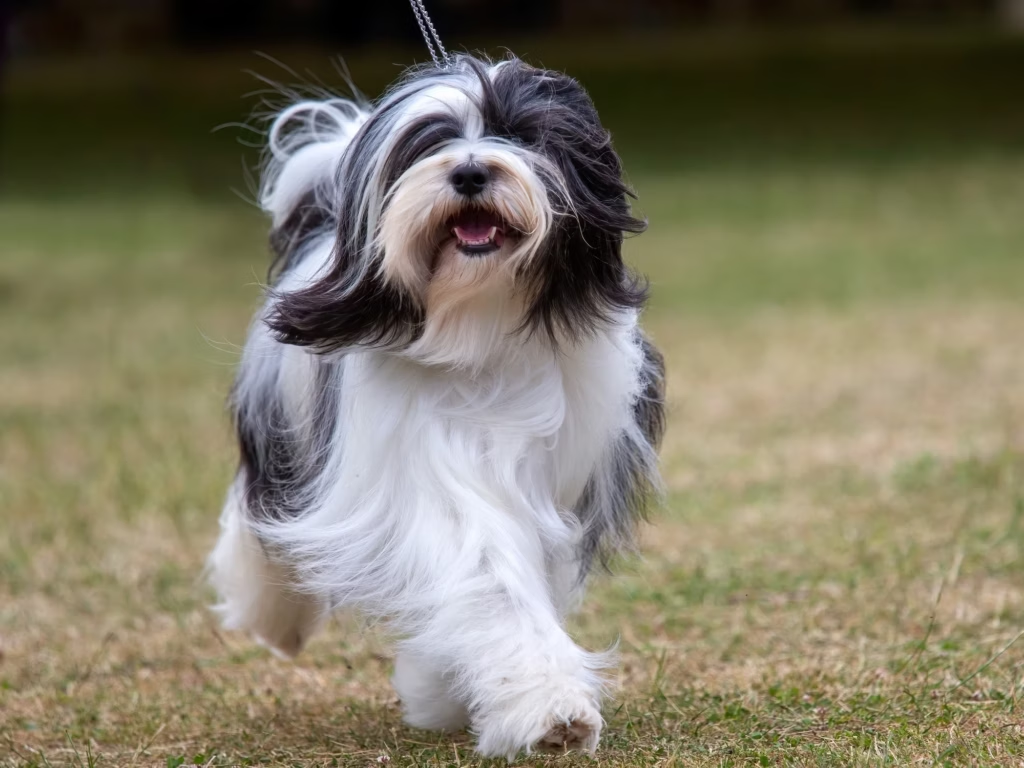
He works out what is wanted of him quickly, and decides just as quickly whether he agrees. This is not a dog for mechanical repetition of commands: he retains well, generalises well, and is superb at finding the way round a task where the handler counted on straightforward compliance. Pressure and raised voices produce the opposite of what they are meant to — the dog either shuts down or starts negotiating. What works instead: short sessions, a reward he understands, consistency about the rules, and patience with his independence.
That same head does well in sport. The breed competes successfully in agility and canine freestyle, disciplines that reward quick thinking and contact rather than blind obedience. The FCI standard, describing the gait, singles out the effortless powerful drive and good reach — a dog built for sustained work on his feet, not for decorative sitting on a lap.
On exercise the benchmark is simple: two proper walks a day with the chance to run, plus regular work for the brain. A long walk through woods or parkland, scent games, elements of obedience taken on the move — all of that meets the need better than an hour of monotonous plodding on the lead. Natural curiosity and a tendency to follow a scent mean the lead is best kept on in unfenced places.
Coat care: technique matters more than frequency
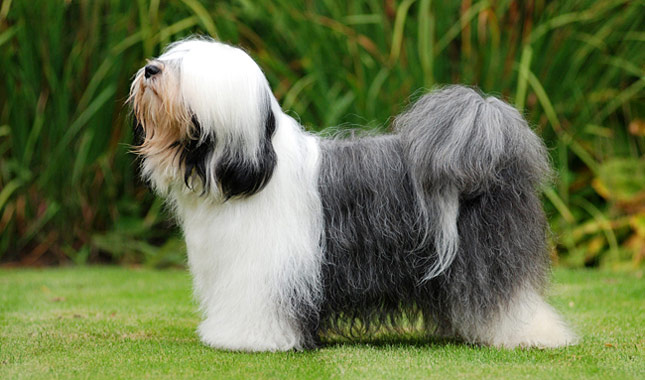
A double coat with a fine woolly undercoat is not simply “a lot of hair”; it mats from underneath, at the skin. The owner’s cardinal mistake is therefore not grooming too seldom but grooming the wrong way: the brush travels across the top, the coat looks immaculate, and a dense felted layer builds up next to the skin.
- Line brushing. The coat is parted and worked in narrow strips from the skin out to the tips. You need a slicker brush with metal pins and no plastic balls on the ends, plus a metal comb for checking: if the comb runs free from the skin, that section is groomed out.
- Never on a dry coat. A brush breaks dry long hair. Mist it first with a conditioning spray or plain water from a sprayer.
- Mats are not brushed straight through. A tight mat is teased apart with the fingers from its edge, not dragged at with a brush: the pull hurts and wrecks the coat around it.
- Bathing and drying. Bath as needed, with conditioner, and always dry the dog while brushing him out: a damp undercoat mats faster than anything else.
- A short clip is a legitimate option. Owners who do not show their dogs often keep them clipped short, which transforms the grooming routine. The one caveat: the AKC standard counts scissoring, stripping and shaving as serious faults — so for a show career that road is closed.
One stretch stands apart: the change from the puppy coat to the adult one. The AKC standard describes the puppy coat as shorter, even in length and softer; when the double adult coat comes through in its place, mats form almost instantly, and for several months the dog has to be brushed out every day. This is the hardest passage in an owner’s life with this breed, and it passes.
Eyes: three different forms of PRA, and why “clear” is not yet a guarantee

Progressive retinal atrophy is not one disease but a family of inherited photoreceptor degenerations ending in loss of sight. At least three different genetic causes have been described in the Tibetan Terrier, which is what makes this section matter: the result of a single test does not close the question.
PRA3 is associated with the insertion of a short interspersed element near the splice acceptor site in an intron of the FAM161A gene. The insertion causes exon skipping, a frameshift and a premature stop codon. Downs and Mellersh found it in a 2014 paper, first in the Tibetan Spaniel: a genome-wide association study on 22 affected spaniels and 10 controls led them to a 3.8 Mb region. The same variant then turned up in Tibetan Terriers. In 23 Lhasa Apsos, 9 of which had PRA, the variant was absent — so PRA3 is confined to the two Tibetan breeds, and the Lhasa Apso, for all the outward resemblance, has nothing to do with it.
The most important part of that paper is the figures for this breed. Researchers examined 76 Tibetan Terriers, 12 of them affected by PRA. Only 4 of those twelve proved homozygous for PRA3. Of the remaining eight, one dog was heterozygous and seven were homozygous wild type — “clear” on this test and affected all the same. Agreement between genotype and clinical status came to 33.3 per cent. More telling still: two of those eight proved homozygous for the mutation behind another form, rcd4. The authors conclude that the PRA in the remaining six cases is caused by a third mutation science has yet to describe.
On the age at which it shows, the same paper is careful. The mean age at diagnosis of PRA3 is 4.89 years, but the authors caution that this is not an estimate of the age of onset. Many owners do not take a dog to an ophthalmologist until they notice obvious trouble with its sight, and by then the degeneration is well advanced — so the true onset is probably a good deal earlier.
rcd4 is the second form described in the breed: a frameshift in the gene formerly called C2orf71 and now PCARE; inheritance is autosomal recessive. The mutation was first described in the Gordon Setter and the Irish Setter, and in 2014 the same variant was found in the Standard Poodle and the Tibetan Terrier. This form begins late, and the late onset lets a dog produce a litter before it becomes clear that something is wrong with his eyes.
The practical conclusion is uncomfortable but has to be said plainly: clear results for rcd4 and PRA3 do not guarantee that a dog will not go blind from PRA. That is why the Kennel Club keeps regular eye examination under the BVA/RKC/ISDS scheme on its list alongside the DNA tests — a specialist’s eye sees what none of the available tests can. For an owner it comes down to a calendar: an annual check with an ophthalmologist, not a one-off certificate from the breeder.
NCL: one mutation, one test and the treachery of late onset
Neuronal ceroid lipofuscinosis is a progressive neurodegenerative disease in which lysosomal storage bodies accumulate in neurons and other cells while the brain and retina atrophy. In the Tibetan Terrier it takes a late-onset form, and the breed has become science’s principal model for late-onset NCL.
The cause was found in 2011 by two groups independently. The paper by Wöhlke and co-authors in PLOS Genetics describes a single-nucleotide deletion, c.1620delG, in exon 16 of the ATP13A2 gene. The deletion destroys an exonic splicing enhancer, exon 16 is skipped, and the protein loses 69 amino acids. Inheritance is autosomal recessive. The Kennel Club calls the test “NCL12”, after the number of the corresponding disease form.
The evidence is worth listing. The authors assembled 24 affected Tibetan Terriers and 1347 dogs of the breed with no clinical signs. The genome-wide association study ran on 12 cases and 7 controls, and linkage was confirmed on 376 dogs. All 24 affected dogs proved homozygous for the deletion, and all 35 obligate carriers heterozygous. In a sample of 144 dogs of 11 other breeds the mutation did not occur at all.
The clinical picture: the first visible signs appear at 5–7 years, on average around six. The commonest first symptom is worsening vision at dusk with disorientation. The dog becomes nervous or anxious, and a growing loss of coordination follows — jumping up and climbing stairs become hard. In the late stages owners describe seizures, from mild to severe. There is no treatment.
The late onset is what makes this disease so dangerous to the breed: a dog lives through several breeding seasons before it becomes obvious that he is affected. The authors say as much — because the signs appear late, some predisposed dogs go into breeding and leave offspring. So the DNA test works less as a diagnostic tool than as a mating-planning one: it identifies a carrier years before the disease announces itself. One unexpected by-product: mutations in the same gene in humans cause Kufor–Rakeb syndrome, and affected Tibetan Terriers have become a valuable model for research into that rare neurodegenerative condition.
Here is a rare chance to show that testing works rather than merely ought to. The German club for Tibetan breeds introduced the DNA test in 2010, and a few years later researchers totted up the result. They analysed samples from 1120 of the 1240 Tibetan Terriers registered with the club — 90.3 per cent — including 405 of 420 breeding dogs, or 96.4 per cent. Before the test, the mutant allele frequency stood at 0.20 in the registered population and 0.28 among breeding dogs; afterwards it had fallen to 0.09 and 0.14. In a few years of organised testing, carrier frequency in the breeding core halved — with no culling of affected lines and no loss of diversity, purely through sensible pairing.
Primary lens luxation (PLL): the case where a carrier is not safe
Primary lens luxation is a painful and potentially blinding disease: the fibres holding the lens in place break down and the lens shifts. It usually goes unnoticed until the lens luxates in one eye; by then the other eye as a rule already shows a partial displacement, which over weeks or months becomes complete. Most often the lens moves forward, blocking the pupil and the drainage of fluid, producing acute glaucoma — a state in which the clock runs in hours rather than days.
The cause is known: the mutation c.1473+1 G>A in the ADAMTS17 gene, destroying the splice donor site in intron 10. Inheritance is autosomal recessive. In 2011 Gould and co-authors tested 121 dogs of 30 breeds with clinical PLL and found the mutation in a further 14 breeds beyond the three described earlier. The Tibetan Terrier is on that list.
Then comes the detail that makes this section worth reading closely. In most autosomal recessive diseases a heterozygote is simply a carrier: it does not fall ill, and risk arises only in combination with another carrier. PLL is not like that. The same paper identified an increased risk of lens luxation associated specifically with heterozygosity for ADAMTS17, and concluded that carriers run a small but real risk themselves. So a “carrier” result in this breed is no reason to relax but a reason to keep the dog under an ophthalmologist’s eye and to know the signs: sudden redness of the eye, cloudiness, pain, a change in behaviour.
The disease also has a documented pedigree history showing how a narrow bottleneck plays out. British researchers worked through 20 cases of lens luxation in British-bred dogs plus another seven from Sweden. The data proved consistent with simple autosomal recessive inheritance, and inbreeding in affected dogs averaged 14.3 per cent. The main finding: every affected dog traced on both sides of the pedigree to one or more of three animals born in the mid-1950s, and all three were breed champions. Repeat matings between probable carriers produced 25 cases in 121 offspring. The age of onset — three to five years — made test matings useless as a check, the authors noted; today the DNA test closes that gap, and in 1979 none existed.
Hypothyroidism: the strongest breed signal in the veterinary data
A great deal is written about this breed’s eyes and its neurodegeneration, and almost nothing about its thyroid. Yet the thyroid carries the most powerful breed signal ever found for the Tibetan Terrier in veterinary statistics — and unlike NCL, this condition responds to treatment.
A British study under the VetCompass programme worked through anonymised first-opinion veterinary records on 905,553 dogs. For 2016 it identified 2105 dogs with diagnosed hypothyroidism — an annual prevalence of 0.23 per cent across the whole population. The authors then compared breeds against crossbreeds and singled out 24 predisposed breeds and nine protected ones. The Tibetan Terrier came second for predisposition: an odds ratio of 11.25, with a 95 per cent confidence interval of 8.27–15.32. Only the standard Dobermann ranked higher, at 17.02. In the raw cohort numbers, 2.78 per cent of Tibetan Terriers carried the diagnosis that year, against 0.17 per cent of crossbreeds.
A telling detail for anyone who treats the three Tibetan breeds as interchangeable: in the same listing the Shih Tzu appears not among the predisposed breeds but among the most protected, with an odds ratio of 0.38. Two outwardly similar breeds of shared origin stand at opposite ends of one risk table.
What to do with that. Hypothyroidism comes on gradually and is easily written off as age: the dog puts on weight without a change of food, becomes sluggish, tolerates cold less well, the coat dulls and thins symmetrically over the flanks and tail, and the skin turns dry or darkens. In a long-coated breed the coat signs are noticed last, because the topcoat hides them. Diagnosis rests on a blood test, not appearance, and the condition is managed with a hormone given daily. If an adult dog of this breed has “aged” faster than it should have, start the conversation with your veterinary surgeon at the thyroid.
Joints, screening and what the clubs require before mating
Hip dysplasia in this breed is tracked systematically, with figures rather than impressions. The British BVA/KC scheme, in its 2024 summary, gives the following for the Tibetan Terrier: 1863 dogs scored over the past fifteen years, 417 over the past five, and 62 in 2024 itself. The median score in both the fifteen-year and the five-year window is 10, and the mean in both windows is 12. The spread, however, is wide: within the five-year window the minimum is 0 and the maximum 81.
In this scheme a lower score is better, and the recommendation runs: breed from dogs scoring around the five-year breed median, and preferably below it. The BVA also cautions that dysplasia is multifactorial — even parents with good scores can produce a dog with a poor one, and selecting for scores below the breed average reduces the incidence without eliminating it.
What a breeder should have in hand before a mating, the Kennel Club sets out explicitly, at two levels.
| Level | Screening |
|---|---|
| Minimum (“Good Practice”) | DNA test for neuronal ceroid lipofuscinosis (NCL12) · DNA test for primary lens luxation (PLL) · DNA test for progressive retinal atrophy, rcd4 form · DNA test for pituitary dwarfism (DP-LHX3) · hip scoring under the BVA/KC scheme |
| In addition (“Best Practice”) | DNA test for progressive retinal atrophy, PRA3 form · eye examination under the BVA/RKC/ISDS scheme |
One item on that list deserves explanation, because it looks unexpected. Pituitary dwarfism is known above all in the German Shepherd Dog, where the cause is a deletion of 7 base pairs in intron 5 of the LHX3 gene. In 2021 the same mutation was described in Tibetan Terriers: three dwarf puppies from three related litters were homozygous and all their parents carriers, confirming autosomal recessive inheritance. The dwarfism is proportionate — the puppy is born normal, then stops growing and gaining weight in step with its littermates, and the soft puppy coat never changes to the adult one. In a double-coated breed that last sign is especially conspicuous, and often the first to alert a breeder.
The list turns a conversation with a breeder into a checklist. The question “are the parents healthy?” has no answer; the question “show me the results of the five screenings on the first row” does. Test results and scores are published in the registry’s open search on its website, so you can verify them yourself instead of taking anyone’s word.
One more marker from the same registry: in Breed Watch, the system alerting judges to breed risks arising from conformation, the Tibetan Terrier sits in Category 1 — no specific points of concern requiring a judge’s particular attention beyond the ordinary requirements of the standard have been identified for the breed.
How long Tibetan Terriers live
Keep two things apart here: the figure a registry publishes, and the figure a measurement produced. On its breed page the AKC gives a life expectancy of 15–16 years. That is a registry’s statement, not the outcome of a study.
The measurement exists, and it is a large one. The paper by McMillan and co-authors, published in Scientific Reports in 2024, is built on a British cohort of 584,734 dogs, 284,734 of them deceased, and covers 155 breeds. For the Tibetan Terrier it records 1947 living dogs and 583 deaths, and puts median lifespan at 13.8 years, 95 per cent confidence interval 13.5–14.2. For comparison, the crossbreed group in the same study has a median of 12.0 years, and the Tibetan Spaniel 15.2.
A second, independent measurement gives a slightly different figure — useful, because it shows how much the counting method matters. An analysis of the British veterinary surveillance network SAVSNET, published in that same year of 2024, reports a median age at death of 12.81 years, confidence interval 12.53–13.09, sample 75 animals. The difference is not an error: the first counts a survival curve across a cohort including living dogs, the second the median age of those recorded as having died in first-opinion practices. Different denominators give different numbers about the same breed, and showing both is more honest than picking the more flattering one.
So the realistic benchmark for an owner is roughly thirteen to fourteen years, not sixteen. That is a long life for a dog in general, and a little shorter than that of the breed’s nearest Tibetan relative. The authors later issued a correction to the British study, but it concerns only the caption to one figure and does not alter the breed’s numbers.
How it differs from the Lhasa Apso and the Shih Tzu
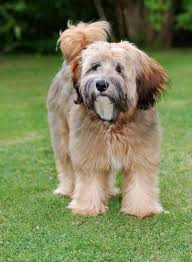
These three breeds are confused with one another constantly, and the confusion is old: at the early British shows the Tibetan Terrier and the Lhasa Apso were exhibited under a single name. Shared ancestry they genuinely have — the native Tibetan population of Tibetan Terriers contributed to the gene pools of the Lhasa Apso, the Shih Tzu and the Tibetan Spaniel. But the differences are not cosmetic either.
- Size and outline. The Tibetan Terrier is a medium-sized dog of square outline, dogs standing 36–41 cm at the withers. The Lhasa Apso and the Shih Tzu are noticeably lower and longer in body.
- Head construction. The most telling difference, and one recorded in the data: in the British lifespan study the Tibetan Terrier and the Tibetan Spaniel are classified as mesocephalic — of normal muzzle length — whereas the Lhasa Apso and the Shih Tzu are brachycephalic. The Tibetan Terrier’s muzzle is “strong” under the standard, and its length from eye to tip of nose equals the length from eye to occiput.
- Lifespan. In that same study the median for the Tibetan Terrier is 13.8 years, and for the Tibetan Spaniel 15.2.
- Eye disease. The PRA3 form has been found in the Tibetan Terrier and the Tibetan Spaniel, but was absent from the examined group of 23 Lhasa Apsos. The DNA test lists for these breeds are therefore not interchangeable, and demanding “the same tests as for a Lhasa Apso” from a breeder makes no sense.
- Exercise requirement. The FCI standard states outright that this breed is livelier than the other Tibetan breeds of the ninth group — more walking and more mental work than anyone expects of a “decorative” dog of that size.
Feeding, weight and the ears under the coat
How rare the breed is today
The British registration statistics give the sharpest picture, because the Kennel Club publishes them yearly for every breed. Over ten years the Tibetan Terrier has lost noticeably in numbers.
| Year | Kennel Club registrations |
|---|---|
| 2016 | 1378 |
| 2017 | 1125 |
| 2018 | 1262 |
| 2019 | 1105 |
| 2020 | 1004 |
| 2021 | 1146 |
| 2022 | 1011 |
| 2023 | 740 |
| 2024 | 702 |
| 2025 | 593 |
Over the decade, then, annual registrations have roughly halved, most of the fall coming after 2022. For comparison, in 2025 the same table gives the Shih Tzu 1124 registrations, the Lhasa Apso 525 and the Tibetan Spaniel 104. In Britain today the Tibetan Terrier is therefore more numerous than the Lhasa Apso and far more numerous than the Tibetan Spaniel.
Despite the decline, the breed does not belong to the British list of vulnerable native breeds, for two independent reasons. First, the list covers only breeds of British and Irish origin, and the Tibetan Terrier comes from Tibet. Second, even on numbers it sits above the thresholds: breeds with 300–450 registrations a year fall into the “at watch” category, and those below 300 into the vulnerable one. The Kennel Club itself answers “no” in the “vulnerable native breed” field on the breed page.
The practical consequence for a buyer is straightforward: there are not many dogs in the breed, the wait for a responsible breeder can be long, and that is normal. Far worse is taking a puppy from somewhere that hands one over immediately and without the results of the screenings the registry lists by name.
Video about the breed
- Devoted to the family, reserved with strangers without aggression
- Watches the house without barking non-stop
- Clever, and works well in agility and canine freestyle
- Long-lived: median 13.8 years
- The inherited risks are known by name and covered by DNA tests
- The double coat mats from the skin outwards — it needs line brushing
- The hardest stretch is the change from puppy coat to adult coat
- Independent-minded: pressure and raised voices achieve the opposite
- Copes badly with long spells alone
- A marked breed predisposition to hypothyroidism
| Lhasa Apso | Tibetan Spaniel | Bearded Collie | |
|---|---|---|---|
| Height | 25–28 cm | about 25 cm | 51–56 cm |
| Energy | 2.5 | 3 | 4.5 |
| Apartment | 4 | 4 | 3 |
| Beginners | 3 | 3.5 | 3 |
Is the Tibetan Terrier a real terrier?
Apart from the eyes, what should be watched first?
Which DNA tests should a puppy's parents have?
If the PRA tests are clear, is the dog safe from blindness?
Is it safe to take a dog with a PLL “carrier” result?
How long do Tibetan Terriers live?
How does the Tibetan Terrier differ from the Lhasa Apso and the Shih Tzu?
Is it true that the coat falls over the eyes in order to protect them?
FCI standard No. 209 (edition of 22.08.2017) · The Kennel Club (standard, pre-breeding screening, registrations) · AKC standard (edition of 10.03.1987) · Janeš et al., Genet Sel Evol 2019;51:79 · Wöhlke et al., PLOS Genetics 2011;7:e1002304 · Kluth et al., Vet J 2014;201 · Downs and Mellersh, PLOS ONE 2014;9:e93990 · Gould et al., Vet Ophthalmol 2011 · Willis et al., Vet Rec 1979;104 · Thaiwong et al., J Vet Diagn Invest 2021;33 · O'Neill et al., Canine Med Genet 2022;9:11 · McMillan et al., Sci Rep 2024 · Farrell et al., Sci Rep 2024 · BVA/KC Hip Dysplasia Scheme, Breed Specific Statistics 2024 · OMIA
For apartments · For kids · For beginners · Active · Smartest · Hypoallergenic · All rankings →