

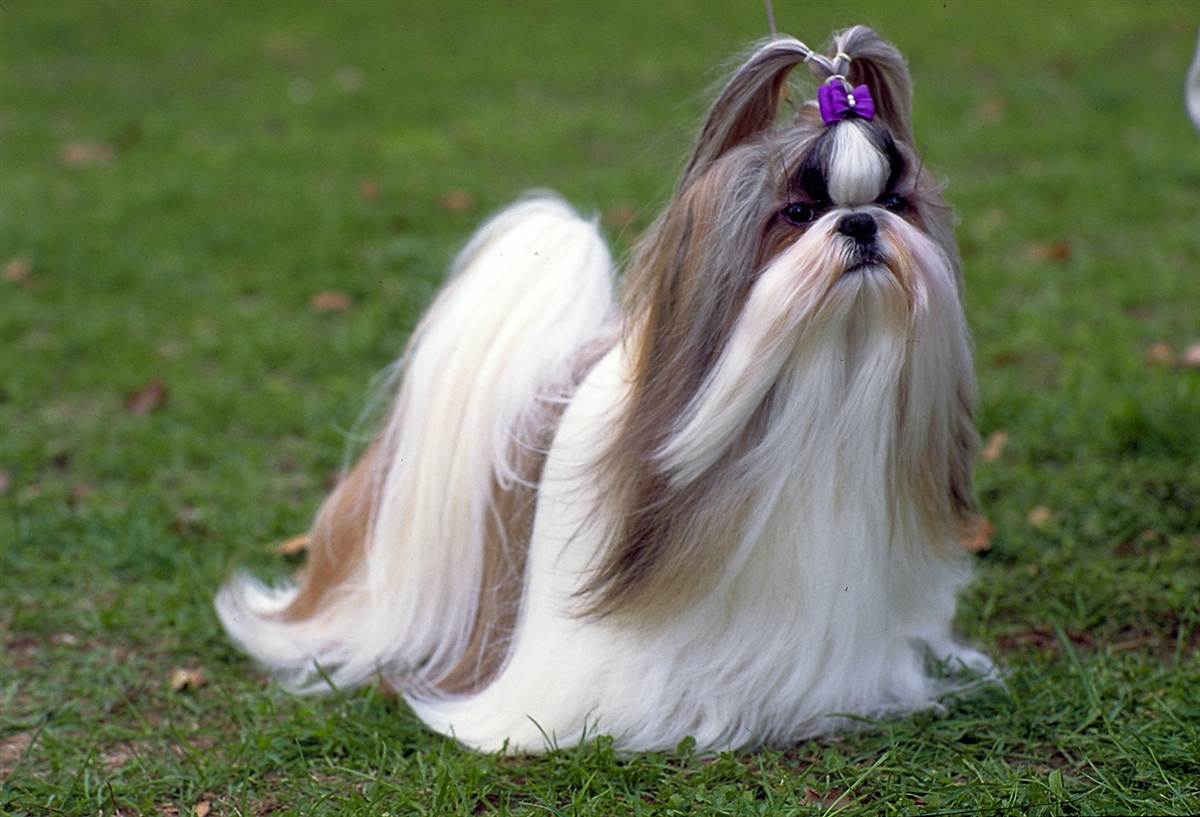
| Height | 20–28 cm |
| Weight | 4–8 kg |
| Lifespan | 12–16 years |
| FCI group | 9 · companion dogs |
| Origin | Tibet / China |
Exact ratings
Common health issues
Nutrition
The Shih Tzu, a delightful little dog of Tibetan origin, is a loyal, joyful, and incredibly charming companion. They’re brilliant at chasing away loneliness and bringing countless happy moments into your life. This breed is often dubbed the “lion dog” or “chrysanthemum dog” due to its distinctive appearance and ancient roots. The name “Shih Tzu” (獅子) itself translates almost literally from Chinese as “lion,” hinting at the noble lineage of these tiny creatures. Their history is woven with legends and deeply intertwined with the imperial palaces of China. Discover more about the fascinating history and unique care requirements of these dogs right here on Tvaryny.
Pinpointing the exact origin of this breed is tricky, as its history spans centuries. Several theories exist. According to the most widely accepted one, the modern Shih Tzu’s ancestors are the Lhasa Apso and the Pekingese, from whom they inherited their thick coat, flat muzzle, good nature, and profound devotion to their owners.
Shih Tzu: A Brief Breed Overview

| Characteristic | Description |
| Origin | Tibet (Patronage – Great Britain, Development – China) |
| Original Name | Shih Tzu (獅子 – “lion”) |
| Other Names | Tibetan Lion Dog, Chrysanthemum Dog, Shitzu, Shi-Tsu |
| FCI Classification | Group 9 (Companion and Toy Dogs), Section 5 (Tibetan Breeds), No. 208 |
| Lifespan | 10-16 years (average 13-14 years) |
| Height at Withers | Ideally 25-27 cm, but not less than 20 cm and not more than 28 cm |
| Weight | 4-8 kg (ideally 4.5-7.5 kg) |
| Temperament | Friendly, independent, intelligent, active, alert, gentle, playful, sometimes stubborn |
| Coat Care | High (daily brushing, regular grooming) |
| Physical Activity | Moderate (short daily walks, indoor games) |
| Health | Prone to certain issues (eyes, breathing, teeth, skin, knees) |
| Purpose | Companion dog |
History of the Shih Tzu Breed: From Tibetan Monasteries to Imperial Palaces
The history of the Shih Tzu stretches back to ancient Tibet, where similar small dogs lived in monasteries. It’s believed they emerged from the crossing of the Lhasa Apso and the Pekingese. According to the most widely accepted version, supported by historical records, in the 17th century (roughly 1643-1653), the Tibetan Dalai Lama gifted several of these prized little dogs to the Chinese Emperor.
In China, these dogs became the darlings of the imperial court and transformed into a “forbidden breed,” whose ownership and breeding were exclusive to members of the imperial family. They were believed to bring good fortune. They lived in luxury within the Forbidden City, and their breeding was meticulously overseen by palace eunuchs. Occasionally, the Emperor might present a Shih Tzu puppy to a high-ranking official as a sign of special favour. Due to the long hair around their muzzles, resembling flower petals, they were nicknamed “chrysanthemum dogs.”
There’s also a beautiful legend linked to Buddha. It tells of a small dog, “ha-pa,” who accompanied Buddha on his journeys and could instantly transform into a giant lion to protect his master or to allow him to ride on its back. Many believe this legendary dog was indeed a Shih Tzu.
After the fall of the empire and the proclamation of the Republic of China in 1912, the breed faced near extinction. A few dogs were smuggled out of the country by enthusiasts. The first official import to Great Britain occurred in the 1930s. It was British and Scandinavian dog fanciers who played a crucial role in preserving and developing the breed. In 1934, the breed was recognised as distinct, and in 1940, it was registered by the British Kennel Club. Championship certificates began to be issued from 1949. Today, the Shih Tzu is one of the most popular toy breeds globally, similar to the Tibetan Terrier.
What Does a Shih Tzu Look Like: Describing the “Chrysanthemum Dog’s” Appearance
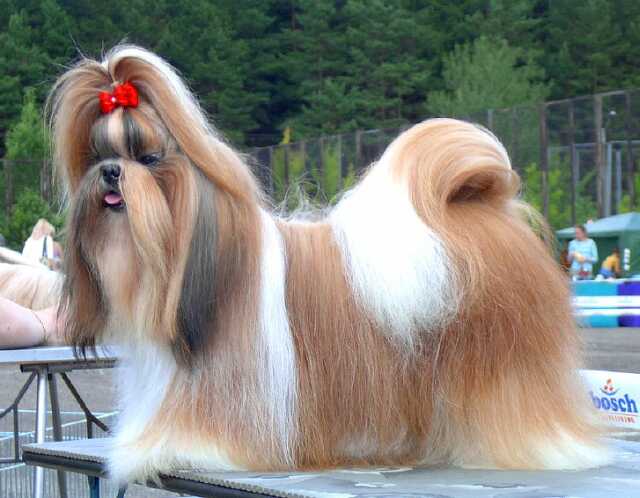
The Shih Tzu is a sturdy, compact dog with luxurious, long hair, which is one of the breed’s main distinguishing features. Despite their small size, Shih Tzus carry themselves with a rather proud and confident demeanour.
Key features of the Shih Tzu’s appearance:
- Head: Broad, rounded, with a wide distance between the eyes. A characteristic feature is that the hair on the bridge of the nose grows upwards, creating a “chrysanthemum” effect. The muzzle is short, square, flat, and wrinkle-free. The stop (transition from forehead to muzzle) is well-defined.
- Eyes: Large, dark, round, not bulging, set wide apart. The expression in their eyes is warm and friendly.
- Ears: Large, long, pendulous, set slightly below the crown of the head, profusely covered with hair that blends with the neck hair.
- Nose: Black (dark liver in liver-coloured dogs), with well-opened nostrils. The top line of the nose is level with or slightly below the lower eyelid.
- Bite: Level or a tight undershot.
- Body: The body is slightly longer than the height at the withers (an important proportion). The back is level. The chest is broad and deep.
- Tail: Set high, heavily plumed, carried gaily curved over the back.
- Coat: Very dense, long, flowing, with a well-developed undercoat, not curly. A slight wave is permissible. The length of the coat should not hinder the dog’s movements. This is one of the leading breeds for coat length relative to body size.
- Colour: All colours are permitted. In particoloured dogs, a white blaze on the forehead (“Buddha’s kiss”) and a white tail tip are desirable. The most common combinations are white with black, red, golden, or brown. Solid colours are rarer.
Overall, the Shih Tzu gives the impression of an elegant yet robust dog with a unique “aristocratic” appearance.
The Shih Tzu Character: Temperament and Behaviour of the Little Lion
The Shih Tzu is the embodiment of positivity and friendliness. Behind their somewhat aloof, aristocratic appearance lies an exceptionally gentle, devoted, and playful nature. These dogs are truly made for human companionship and don’t cope well with being left alone. They absolutely adore being the centre of attention, following their owners around the house, and getting involved in all family affairs.
Key character traits:
- Friendliness: Shih Tzus generally get along well with everyone: family members, children, strangers, and other animals (provided they’re properly socialised). They aren’t prone to aggression and tend to see a friend in everyone. This makes them poor guard dogs, but wonderful companions.
- Devotion: They become very attached to their family and always strive to be close. Loneliness for a Shih Tzu is a genuine ordeal that can lead to stress and destructive behaviour.
- Playfulness and Activity: Despite their small size, Shih Tzus are quite energetic and love to play. They enjoy short walks and indoor games. They retain their playfulness well into old age.
- Intelligence and Cunning: Shih Tzus are intelligent dogs capable of learning. However, they can be quite stubborn and independent, which sometimes complicates the training process. They require a patient and consistent approach.
- Alertness: They’re always attentive to what’s happening around them and may announce the arrival of guests or unusual sounds with a loud bark. While not aggressive, their barking can be quite persistent if not controlled from an early age.
- Affectionate: Shih Tzus absolutely adore cuddles and hugs. They’re perfect for people seeking a gentle and loving friend.
- Adaptability: They adapt well to living in both flats and houses, provided they receive enough attention and moderate physical activity.
Of course, every dog is an individual, but generally, Shih Tzus are known for their balanced, cheerful, and companionable nature. They get on brilliantly with children, seeing them as playmates, but it’s important to teach children how to handle the dog gently due to its small size. They might express displeasure through barking, but biting isn’t typical for them. Unlike some spitz-like companions, such as the energetic Pomeranian or the more independent Yorkshire Terrier, Shih Tzus are more inclined towards a peaceful time spent close to their owner, though they aren’t averse to a good romp.
Shih Tzu Health: Typical Illnesses and Prevention
How to Care for a Shih Tzu’s Coat: Secrets to a Luxurious Mane
The Shih Tzu’s luxurious long coat is the breed’s calling card, but it demands regular and meticulous care. Without proper attention, the hair quickly tangles and forms mats, which can lead to skin irritation and discomfort for your dog. Shih Tzus don’t shed excessively, but dead hairs remain trapped in their coat, contributing to matting, so regular brushing is absolutely key.
Main steps in coat care:
- Daily Brushing: This is the most crucial step. Use a quality brush (a slicker brush with long pins without nubs on the ends, or a metal comb with varying tooth densities). Brush thoroughly, section by section, from roots to tips, gently touching the skin to remove dead hairs and prevent mats. Pay particular attention to areas where the coat tangles most often: under the armpits, on the belly, behind the ears, and on their “trousers.” You can use a special detangling spray to make brushing easier.
- Bathing: It’s recommended to bathe your Shih Tzu approximately once every 3-4 weeks or as needed, using a specialised shampoo and conditioner for long-haired dogs. Before bathing, the dog should be thoroughly brushed. After bathing, gently blot the coat with a towel and dry with a hairdryer (warm, not hot air), brushing simultaneously.
- Grooming/Trimming: Many owners opt for regular trimming to simplify care. There are numerous options:
- Hygienic trim: An essential procedure, including trimming hair around the anal area, genitals, and between the paw pads.
- “Puppy Cut”: The coat all over the body is trimmed to a uniform short or medium length. This is the most practical option.
- Show Cut: This involves maintaining the maximum coat length, which requires significantly more effort in grooming.
- Top-Knot Care: The hair on the top of their head is long and can fall into their eyes, causing irritation. It should be gathered daily into a top-knot using a soft elastic band or a special clip, or trimmed short.
- Eye Care: Daily, wipe the area around the eyes with a damp cloth or a special lotion to remove tear stains and prevent infections.
- Ear Cleaning: Weekly, inspect the ears for redness, dirt, or an unpleasant odour. Clean the ear canal with a special lotion as needed. Hairs inside the ear canal sometimes need to be removed (plucked or trimmed) to ensure ventilation.
- Nail Trimming: Trim their nails every 2-4 weeks to prevent them from interfering with walking and deforming the paw.
- Teeth Cleaning: Brush their teeth daily, or at least several times a week, using dog-specific toothpaste and a brush to prevent dental diseases.
Given the length of their coat, Shih Tzus aren’t suitable for outdoor living, especially in wet or muddy weather. Walks are best taken on clean paths, avoiding bushes and mud. Many Shih Tzus are successfully litter-trained or pee-pad trained, which can be a convenient alternative for walks in bad weather.
Shih Tzu Training and Socialisation: Raising a Little Aristocrat
While the Shih Tzu is a toy breed and a companion dog, rather than a working dog, training and socialisation are vital for shaping a well-behaved and socially adaptable pet. Shih Tzus are intelligent, but their natural stubbornness and independence can pose a challenge for owners.
Key aspects of training and socialisation:
- Early Socialisation: It’s incredibly important to introduce your Shih Tzu puppy to various people, sounds, places, and other (vaccinated and healthy) animals from an early age (after appropriate vaccinations). This will help them grow into a confident and well-adjusted dog who won’t be fearful of new things or display aggression. Much like other small breeds, such as the lively Pomeranian, Shih Tzus thrive on early and positive socialisation.
- Positive Reinforcement: Shih Tzus respond best to training methods based on rewards (treats, praise, toys). Avoid shouting, punishments, and harshness – this can scare the dog or make them even more stubborn. Be patient and consistent.
- Short and Engaging Sessions: Training sessions should be brief (10-15 minutes) and conducted in a playful manner so that the dog doesn’t get bored or lose interest. Focus on one or two commands per session.
- Basic Commands: Teach your Shih Tzu basic commands (“Sit,” “Lie down,” “Come,” “Stay,” “Leave it”). This is crucial for the dog’s safety and control. Responding to their name and the “Come” command are priorities.
- Toilet Training: This can be one of the most challenging aspects of Shih Tzu training. They have small bladders and may need frequent toilet breaks, especially puppies. Consistency, a regular toilet schedule (especially after waking up, eating, and playing), and plenty of praise for success are vital. Toilet training with pads or a litter tray is also a viable option.
- Getting Used to Grooming Procedures: From a young age, accustom your puppy to brushing, bathing, checking their ears, eyes, and teeth, and nail trimming. Do this calmly and reward them for their patience.
- Barking Control: Shih Tzus can be vocal. Teach them the “Quiet” command and don’t encourage unwarranted barking.
- Don’t Indulge Whims: No matter how cute they look, don’t let your Shih Tzu manipulate you. Establish clear rules and boundaries. Don’t feed them from the table, and don’t pick them up at the slightest perceived danger (unless it’s genuine).
Remember that training is an ongoing process. Consistency, patience, and love will help you raise a wonderful companion.
Shih Tzu Nutrition: Key Recommendations for Health and Longevity
Pros and Cons of the Shih Tzu Breed
Like any breed, the Shih Tzu has its advantages and disadvantages. Before getting such a dog, it’s important to weigh all the pros and cons.
| Pros (+) | Cons (-) |
|---|---|
| Gentle and loving companion: Highly people-oriented, adore affection and attention. | High coat care requirements: Need daily brushing and regular grooming. |
| Friendly nature: Generally get along well with children, strangers, and other animals. | Prone to certain health problems: Eyes, breathing, teeth, skin, knees. |
| Suitable for apartment living: Small size and moderate physical activity needs. | Can be stubborn: Training requires patience and consistency. |
| Playful and cheerful: Maintain activity and a positive attitude throughout life. | Don’t tolerate loneliness well: Can suffer from separation anxiety, not suitable for people who are away from home for long periods. |
| Long-lived: With proper care, they live 10–16 years. | Tendency to bark: Can be vocal, especially if bored or anxious. |
| Adaptable: Can adjust to different owner lifestyles (within reason). | Sensitivity to heat: Due to their brachycephalic muzzle structure, they tolerate high temperatures poorly. |
| Don’t require intense physical exercise: Short walks and games are sufficient. | Difficulty with house-training: Requires patience and consistency. |
| Striking appearance: Attract attention with their beauty and unusual look. | Not guard dogs: Overly trusting of strangers. |
Interesting Facts About the Shih Tzu Breed
- “Little Lions”: The name “Shih Tzu” translates from Chinese as “lion.” They were called this not only due to their physical resemblance (a rich mane) but also because of their connection to Buddhist legends about guardian lions.
- Imperial Favourites: For centuries, Shih Tzus were the exclusive property of Chinese emperors and lived in luxury within the Forbidden City. Stealing such a dog was punishable by death.
- “Chrysanthemum Dog”: This nickname was given to the breed because of the distinctive hair growth on their muzzle, which resembles a chrysanthemum flower.
- Close to Wolves: Some DNA studies show that Shih Tzus, along with other ancient Asian breeds, are among the closest relatives of the wolf among modern dogs.
- Breed Rescue: After the communist revolution in China, the breed was almost wiped out. It’s believed that all modern Shih Tzus descend from just 14 dogs (7 females and 7 males) that were brought out of China and used in breeding programmes in the West.
- “Buddha’s Kiss”: A white mark on the head of particoloured Shih Tzus is sometimes called “Buddha’s kiss” and is considered a sign of good luck.
- Not Athletes: Due to their build (short legs, long body, flat muzzle), Shih Tzus aren’t suited for intensive dog sports like agility or flyball, but they can participate in obedience or scent work competitions.
Frequently Asked Questions About the Shih Tzu Breed (FAQ)
Do Shih Tzus shed a lot?
Shih Tzus shed minimally compared to other breeds. However, their long coat requires daily brushing, as dead hairs get tangled in the main mass of the coat, forming mats, rather than falling out onto the floor or furniture.
Are Shih Tzus suitable for families with children?
Yes, Shih Tzus generally get along well with children; they are patient and playful. However, due to their small size, it’s important to teach children how to handle the dog gently to avoid accidental injuries. Always supervise interactions between young children and the dog.
Do Shih Tzus bark a lot?
Shih Tzus can be prone to barking. They are alert and will notify you of guests arriving or unusual sounds. They may also bark out of boredom, anxiety, or if they want attention. Proper training and sufficient stimulation can help control excessive barking.
How much physical activity do Shih Tzus need?
Shih Tzus don’t require intense exercise. One or two short (15-20 minute) walks a day and active indoor games are sufficient for them. It’s important not to over-exercise them, especially in hot weather.
Are Shih Tzus easy to train?
Shih Tzus are intelligent but can be stubborn. Training requires patience, consistency, and the use of positive reinforcement methods. Toilet training may take longer than with some other breeds.
What are the most common health problems in Shih Tzus?
The most common problems encountered are with their eyes (dryness, infections, injuries), breathing (brachycephalic syndrome), teeth (tartar, periodontitis), skin (allergies), and musculoskeletal system (patellar luxation).
Can Shih Tzus be left alone for long periods?
No, Shih Tzus don’t cope well with loneliness. They are very people-oriented and can suffer from separation anxiety if left alone for extended periods. This breed is best suited for people who spend a lot of time at home or can take their dog with them.
Video about Shih Tzus
- Affectionate and sociable
- Ideal for a flat
- A wonderful lap companion
- Long-lived
- Luxurious coat needs grooming
- Flat face — caution in the heat
- Prone to eye disease
- Can be stubborn over small things
| Lhasa Apso | Pekingese | Maltese | |
|---|---|---|---|
| Height | 25–28 cm | 15–23 cm | 20–25 cm |
| Energy | 3 | 2 | 3 |
| Apartment | 4 | 4 | 4 |
| Beginners | 3.5 | 3 | 3.5 |
Does a Shih Tzu need a lot of grooming?
Is a Shih Tzu suitable for a flat?
Does a Shih Tzu breathe with difficulty?
FCI Standard No. 208 · The Kennel Club
For apartments · For kids · For beginners · Active · Smartest · Hypoallergenic · All rankings →