

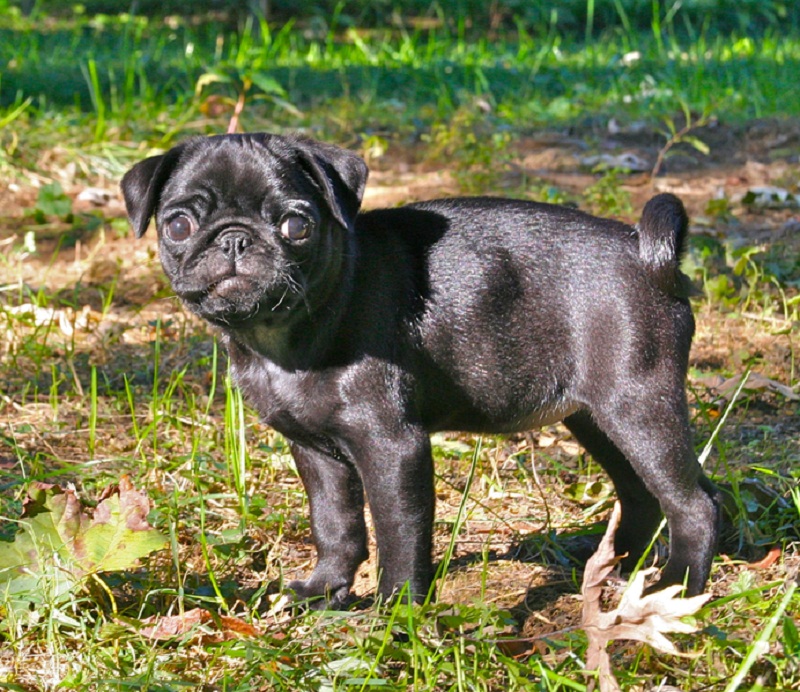
| Height | the standard sets no height |
| Weight | 2.3–6.8 kg |
| Lifespan | 12–15 years |
| FCI group | not recognised by the FCI (companion, USA) |
| Origin | USA |
Exact ratings
Common health issues
Nutrition
The American Lo-Sze Pugg™, also called the American Lo-Sze Pug or the miniature-set pug, is a small short-muzzled companion dog created in the United States towards the end of the twentieth century. Two claims of quite different kinds meet on this breed page, and they are worth separating straight away. The first: what the breeding programme actually does — who runs it, from what year, to what standard, in which registries. That can be checked against documents. The second: what the programme claims about an ancient origin — that it recreates the “Lo-Sze” type kept at the Chinese court centuries before our era. That is a historical thesis, and it has to be tested the way any origin legend is tested: find the earliest appearance in print, read it word for word, and see what changed on the way. We do both below, separately. Read more about breeds on Tvaryny.
American Lo-Sze Pugg: a short overview of the breed
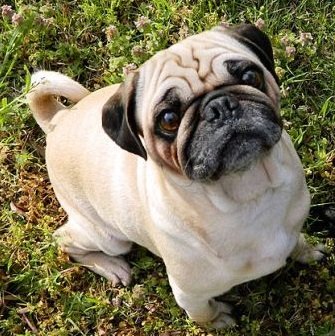
| Parameter | What the documents establish |
|---|---|
| Country | United States |
| Founder | Rebecca Manns, breeder; the breed’s own site calls her “the developer of the breed” |
| Key dates | 1989 — work on the type began; 1998 — the present name appeared and the first dogs were entered in a registry |
| Registries | Rare-breed and private American registries. Neither the FCI nor the AKC recognises the breed |
| Weight in the standard | 2.3–6.8 kg (the standard says 5 to 15 pounds, not split by sex) |
| Height | The breed standard sets no height requirement at all |
| Life expectancy | 12–15 years — as claimed by the breeding programme itself |
| Coat | Two permitted types: short (preferred) and long with feathering (accepted but undesirable) |
| Purpose | Companion; the standard states outright that this is its only purpose |
Who did what, and when: the part that can be checked
The firmest source here is the breed’s own website, live in the early 2000s and preserved in the web archive. It describes itself as “the official site of the American Lo-Sze Pugg™ Dog” and directs every question about the breed to Rebecca Manns, whom it calls the developer of the breed. The site has sections for history, the standard, health, things you might want to know, a breeders’ page and a photo gallery.
The chronology it gives runs like this. In 1989 Rebecca Manns began researching the history of today’s pugs; she concluded that the short-legged, brightly coloured ancestors had been allowed to disappear in favour of taller fawn and black dogs, and set about reconstructing the older type. In 1998 she coined the name American Lo-Sze Pugg™, and the first dogs were entered in a rare-breed registry. After that, the site says, registration proceeded with another American registry, the Animal Research Foundation, which worked “very closely” with her and adapted its paperwork to her needs.
Three things repay careful reading, because they are the first to vanish in retellings.
- The name is a trademark, not a canine classification. The site answers its own question — what does the ™ after the name mean — without ambiguity: the words American Lo-Sze Pugg are registered as a trade mark, violators are to be pursued to the full extent of the law, and breeders are to be “licensed”. What is being controlled is a name, not a breed’s recognition by a kennel federation.
- The composition of the breed is not disclosed — and the site says so openly. Asked directly which breeds were used to create the American Lo-Sze Pugg, it replies that the originator “wishes not to divulge the exact genetics used in her breeding program”, for security reasons: so that the breed is not exploited by unscrupulous breeders. Any statement along the lines of “pug plus pekingese”, or “pug, pekingese and Tibetan spaniel”, therefore comes not from the programme but from reference sites copying one another. We give no such recipes: the programme never published them.
- The word “recognised” has a narrow meaning here. Asked whether this is a recognised breed, the site says yes and immediately explains by whom: the breed is “recognized and registered by the Animal Research Foundation”. That is a private American registry, not a national kennel club. Neither the Fédération Cynologique Internationale nor the American Kennel Club recognises the breed.
One more checkable detail from the health section: the founder reported that her breeding stock was examined by veterinary ophthalmologists, quoted the Canine Eye Registry Foundation certificate numbers issued in 2000 for three breeding animals, and offered puppy buyers an eighteen-month guarantee against hereditary crippling defects. It is a rare case of a small private project leaving behind something verifiable rather than photographs alone.
The breed’s own site stopped being updated in the early 2000s, and its later versions no longer open in the archive. Everything we write about the programme therefore describes the state recorded in archive copies from 2000 to 2002, and it should be read that way.
The breed standard: what it says — and what is missing from it
The American Lo-Sze Pugg™ standard is short, and its text survives in two independent archive copies (2001 and 2002) without a single change between them. Here is what it requires.
- General appearance: a toy dog, intelligent, alert, sturdy, with a thick-set body, showing boldness and self-esteem.
- Head: should not look large for the size of the dog but should show broadness; the skull wide and flat between the ears, wide between the eyes; the stop deep.
- Muzzle: “very short and broad”, not pointed; nose wrinkle preferred.
- Nose: wide, with open nostrils, any colour.
- Eyes: large and round; overly protruding eyes are a fault; any colour.
- Bite: the chin must be undershot with an upward sweep; the incisors of the lower jaw must protrude over the upper ones; neither teeth nor tongue should show when the mouth is closed; a wry mouth is a fault.
- Tail: set high, carried over the back, resting on either side, in a full or loose curl.
- Forelegs: moderately short, with good bone substance, set moderately wide apart — and curved.
- Feet: large, flat, not round; the forefeet slightly turned out.
- Coat and colour: short, soft and smooth, with an undercoat; all colours and patterns permitted.
- Weight: 5 to 15 pounds, that is roughly 2.3–6.8 kg.
And now the blanks, because here they say a great deal.
The standard sets no height. In a document that describes the head, the jaw, the feet and even the placement of the forelegs, there is not one figure for height at the withers. That deserves a mention of its own, because the entire declared idea of the breed is precisely the lower set. So our breed card carries no height figure: the standard has none, and what circulates in reference articles contradicts itself. The most widely copied reference article gives the height as “an average of 10 inches (21 cm)” — but 10 inches is 25.4 cm, so the two numbers on the same line do not agree. We neither pick the more convenient one nor average them: an honest blank is better than an invented range. This is a deliberate departure from our usual rule that every field should carry a number, and we name it so that the next editor does not “repair” it back.
The standard does not split size by sex. Many standards give separate limits for dogs and bitches, and merging them into a single range is a coarse error. Here there is nothing to split: the single weight range of 5 to 15 pounds applies to every dog of the breed.
The weight figures disagree even within the programme’s own material. The standard says 5 to 15 pounds. The “things you might want to know” page on the same site answers the size question differently: “an average of 7 to 10 pounds”. And the reference article the rest of the internet copies offers a third figure — 5 to 12 pounds (2.5–5.5 kg). This is the classic trap: all three come “from official material”, and none of them looks foreign. We take the standard, because that is the document defining the breed, and we name the rest as a divergence.
The second coat is a trace from an old book. The reference article mentions a second, “undesirable but accepted” coat type: long, with feathering on the ears, legs, tail and toes. That is almost word for word the description of the “loong chua lo-sze”, the dragon-claw pug, in the classic 1921 work on the dogs of China and Japan, which says the variety was the most admired and the rarest and that it had died out about half a century before the book was written. The modern standard therefore carries inside it a textual quotation from the very book on which the whole origin legend rests.
The legend of an ancient origin: how to test it
The history section of the breed site — and every reference page that copied it — rests on a handful of sentences worth going through one at a time. The method is simple: find the earliest appearance of a claim in print, read it word for word, and see what has been added along the way.
The source of the whole construction is a single book from 1921. Dogs of China and Japan in Nature and Art by V. W. F. Collier is where the word “lo-sze” first appears in English canine literature as the Chinese name for the pug, and it is the origin of the three load-bearing details: the “pai” dog, the dictionary of the Kangxi emperor, and the link between the name and the district of Lo-chiang. Everything else is later retelling.
The date “in the time of Confucius” drifts from author to author. Collier writes in 1921 that Chinese records prove the existence of “short-mouthed” dogs “in the time of Confucius, 700 B.C.”, and of similar dogs used for sport in Shansi in 500 B.C. A 1996 pug book names a different boundary — “there is no record of them until 663 BC”. The history on the breed site gives a third figure: “mention of short-mouthed animals by Confucius in 551 B.C.” Dates that drift around one and the same undated claim are the classic sign that no document lies behind it. Besides, 551 B.C. is the year Confucius was born, not the date of anything he said.
The most conspicuous error is in the date of the dictionary. The breed history says: “In the dictionary of Chinese characters commissioned by Emperor Kang Hsi around 950 A.D., references to dogs with short legs and dogs with a short head are included.” Collier, from whom this ultimately descends, says something quite different in a footnote and supplies the dates himself: the famous dictionary compiled under the Emperor K’ang Hsi (1662–1723) quotes two old encyclopaedias on the word “pai” — the Shuo Wen of the Han dynasty, about 150 A.D. (“a dog with short legs”), and the Kwang Yun of the Sung dynasty, about 1000 A.D. (“a dog with a short head” and “an under-table dog”). One date in the retelling is therefore fused out of three: the era of the dictionary’s compilation, the era of the sources it quotes, and a separate date “around 950” which in pug literature belongs to an entirely different story — the naming of the Ssuchuan dog. The gap between “around 950” and “1662–1723” is some seven centuries.
Where the “950” came from can be traced with a finger. The New Pug by Shirley Thomas (1990) writes: “The Ssuchuan Pai dog from A.D. 950 was called Lo-Chaing-Sze, Lo-Chaing or Lo-Sze.” The spelling “Lo-Chaing”, with its transposed letters, occurs in literally two canine works — this 1990 book and one later European title that retells it. The breed history uses exactly the same spelling. The chain of transmission can therefore be followed by name, and the date travelled along it together with the spelling.
The explanation of the name is younger than the name, and it contradicts the primary source. The breed site glosses the name like this: “Lo-Sze is a shortened version of Lo-Chaing-Sze. Lo-Chaing was a region of China where the earliest pug-like dogs are said to have originated. ‘Sze’ is normally used to indicate a diminutive size.” Collier in 1921 says something else, and more cautiously: since “-sze” is a common suffix in Ssuchuan place names, “it appears possible” that an old name, Lo-chiang-sze, was contracted into “lo-sze”. In the primary source “-sze” is part of a place name rather than a diminutive, and the statement is offered as a possibility, not as a fact. A further pug title from 1998 offers a third gloss: “lo-sze” carries the non-literal sense of “short-coated”. Explanations that disagree with one another and appear later than the name itself have almost always been reasoned backwards out of the name.
The sentence about execution is a travelling cliché, not a fact about this breed. “Breeding of these dogs was permitted only within the imperial palaces, and any person found in unlawful possession of one met with execution” — the same wording travels across the pages of the pekingese, the shih tzu and the lhasa apso. In the 1921 book from which the rest of the Chinese material is taken, the claim does not appear at all. A cliché that moves from breed to breed, and every time without a source, belongs to none of them.
And the author of the primary source warned against exactly what was made of him. Collier states plainly that knowledge of the existence of “short” and “square” dogs a thousand or more years B.C. is “scarcely evidence definite enough to justify a positive statement” that small dogs existed in China at so remote a period. The use of the word “pai” at the end of the first century A.D., by contrast, he regards as evidence “which speaks for itself”. The author’s caution was the first thing to disappear from the retellings — which is exactly how “possibly” turned into “existed half a millennium before our era”.
What survives all this? An honest and rather interesting statement survives: small short-muzzled dogs are indeed documented in China from an early date, and “lo-sze” is indeed recorded in nineteenth-century Chinese as an everyday name for the pug. But there is no straight line from them to a particular American programme begun in 1989 — and the programme itself never documented one. Reconstructing a type from its external features and inheriting a lineage are two different things.
What the old literature said about the lo-sze — and where the modern retelling reverses it
The most interesting part is that the 1921 book describes the lo-sze very concretely, and that these details, unlike the legend, barely make it into modern texts.
- The point most sought after by Chinese breeders was the “Prince” mark: three wrinkles on the forehead with a vertical bar, forming the Chinese character for “Prince”. The Chinese saw the same character in the stripes on a tiger’s forehead. The white “button” blaze on the forehead was encouraged too, but counted for less than the wrinkles. All that survives of this in the modern American Lo-Sze Pugg standard is the dry line “nose wrinkle is preferred”.
- The second point was elasticity of skin, present, according to Collier, to a far greater degree than in the pekingese.
- The ears are described as small, likened to a dried half apricot, set with the outer face against the head and pointing slightly backwards; the “horn ear” was also admissible.
- The Chinese docked the tail for the sake of symmetry, though the curl and the double curl were both known.
- The most admired and rarest variety was the “loong chua lo-sze”, the dragon-claw pug: short-coated everywhere except the ears, the toes, the backs of the legs and the chrysanthemum tail, all of which were well feathered. Collier writes that this appears to have been a distinct race, extinct about half a century before the book appeared.
And now the central mismatch, which is not a small one. The whole idea of the modern programme rests on the claim that the “original” lo-sze was low and short-legged and that European breeding made the Pug taller and longer in the leg. The old literature itself contrasts the lo-sze with the Pekingese the other way round: a formulation that has travelled through English-language pug works since at least the middle of the twentieth century distinguishes “the longer-legged, short-coated lo-sze” from “the short-legged, long-coated pekingese”. Collier notes in the same direction that the lo-sze’s legs are “but slightly bent at the elbow”. The modern American Lo-Sze Pugg standard asks for the opposite: forelegs “moderately short… curved”, feet “large, flat, not round”, the forefeet turned out.
This is not a reason to call the programme dishonest. It is a reason to name things accurately: the modern American miniature pug is a new type assembled in the 1990s under an old name, not a restored ancient one. The feature chosen as its defining one — short, curved legs — was not what distinguished the lo-sze in the earliest detailed description of it.
A separate word on the doubled “g” in Pugg. The breed site explains it thus: “This spelling is taken from the Old English term for endearment.” English etymological reference works date pug as a general term of endearment to the 1560s, and the sense “small dog” to 1749; the form puggy did exist. But the 1560s belong to early modern English, not to Old English, which ended some four hundred years earlier. The explanation rests on a correct observation and the wrong era.
What the American Lo-Sze Pugg looks like
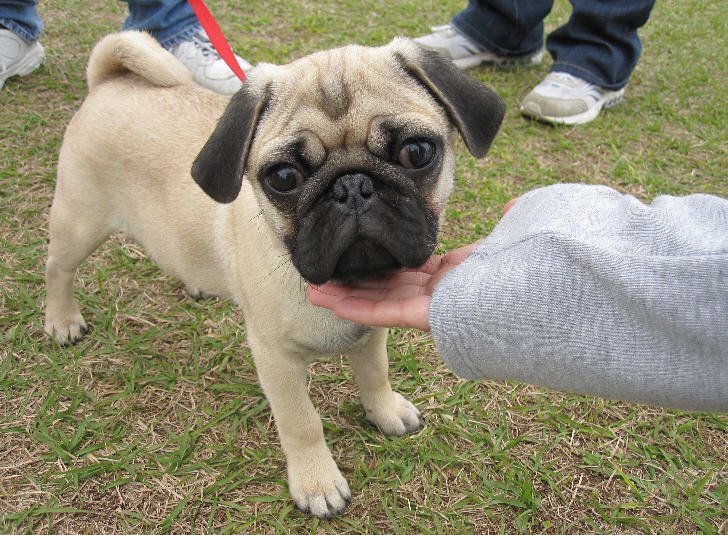
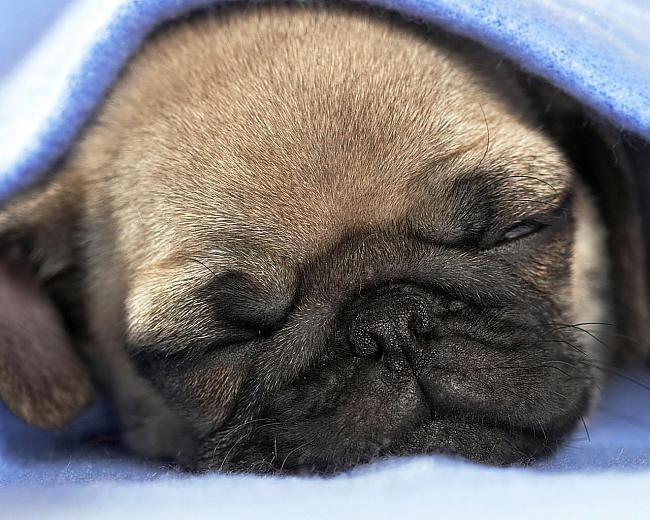
A small, thick-set dog of 2.3 to 6.8 kg with a compact, almost square body in profile and a low stance. The head is broad and flat between the ears, the stop deep, the muzzle “very short and broad” by the standard. The eyes are large and round, and the standard treats overly protruding eyes as a fault — a rare instance of a document warning explicitly against an extreme that toy-breed writing usually praises.
Head and bite
The bite is described in more detail than anything else in the standard: the undershot jaw is compulsory, the lower incisors must protrude over the upper ones, the lower jaw is broad and strong, the incisors stand in a straight row, neither bunched nor tilted, and neither teeth nor tongue should show when the mouth is closed. A wry mouth is a fault. The nose is wide, with open nostrils; unlike many toy-breed standards, this one says “open nostrils” explicitly, and that is not a cosmetic requirement — narrowed nostrils in short-muzzled dogs bear directly on breathing.
Body, legs, tail
The body is “rather long”, the chest broad, the topline level, the neck short and moderately thick. The forelegs are moderately short, with good bone, set wide and curved; the hind legs may be slightly lighter in bone but must be firm. The feet are large, flat and not round, the front ones turned out. The tail is set high and lies over the back in a full or loose curl on either side. It is precisely this combination — a short curved foreleg with a large flat foot — that produces the rolling gait breed descriptions call charming.
Coat and colour
The standard asks for a short, soft, smooth coat with an undercoat and permits all colours and patterns without exception. That is noticeably wider than in the modern pug, and here the declared idea of “returning to a parti-coloured ancestor” really is visible in the document and not merely in the retelling: parti-coloured and white dogs are not excluded. The second coat type — long, with feathering on the ears, legs, tail and toes — reference works describe as “undesirable but accepted”.
Brachycephaly: a question for the table, not for the impression
This breed is often described as one whose breeders “deliberately avoid extreme brachycephaly”. Nothing of the sort appears in the programme’s documents. The standard asks for a muzzle “very short and broad”. The health section of the breed site opens by saying that most of these dogs’ problems involve the head, as in the pug and the pekingese, and speaks separately of “the extreme shortness of the nose” of the breed, because of which the dog overheats quickly. It is the breed’s own material, not its critics, that calls it brachycephalic.
This matters, because a conformation label is not a property of a name but the result of measuring a particular dog. Veterinary science works here in numbers, and the numbers are worth knowing.
- There is a threshold figure. The Finnish Food Authority recommends a craniofacial ratio — muzzle length to cranial length — of no less than 0.33. Reviewing the results of Finnish breeding tests from 2017 to 2022, the researchers note that only 13 dogs in the entire sample would have reached that limit, mainly English bulldogs.
- Within a single short-muzzled breed the ratio discriminates poorly. A Cambridge study from 2017 on 604 dogs, 189 of them pugs, asked which measurements were associated with obstructed breathing in each breed separately. In pugs the significant ones were eye width relative to skull width and the skull index, not the craniofacial ratio; the authors also questioned how reproducibly that ratio could be measured between two observers.
- Nostrils are the most reliable predictor. In the same study, stenotic nostrils were associated with obstructed breathing in all three breeds examined. And in the Finnish data 71 % of the pugs examined had moderate or severe nostril stenosis — the highest figure of any breed tested.
The practical conclusion for a buyer is simple and checkable: look at the nostrils and the breathing of the particular dog, not at the name on the paperwork. A standard that permits a “very short and broad” muzzle guarantees nothing in either direction — within such a standard a dog may be born with open nostrils and equally with nearly closed ones.
It is worth knowing how this is handled where the matter is already being measured. According to the review by the Finnish researchers, Finland has run a breeding test since 2017 that combines a one-kilometre walk with recovery and temperature checks, a veterinary grading of respiratory signs and an assessment of the nostrils; for pugs it became compulsory before mating in 2021, and for both parents from 2024. The same review records that in Germany an exercise test has been compulsory for breeding pugs since 2009, and that the Swedish and Norwegian kennel clubs have forbidden the mating of brachycephalic dogs with moderate and severe respiratory signs. Note what kind of rules these are: several of them are kennel-club requirements rather than state prohibitions, and the two levels should not be blurred. None of them mentions the American miniature pug — nor need they: they work on a measured dog, not on a breed name.
And one more number that shows the direction of travel: in Finland pug registrations fell from 346 in 2017, which placed the breed 36th among the hundred most popular, to 135 in 2022, which placed it 92nd.
Health: two different lists on one page
How long does a lo-sze pug live: three different answers
The figure of 12 to 15 years that circulates through every reference page comes from the breeding programme’s own material: that is how the “things you might want to know” page answers, and that is what the most widely copied reference article gives. No independent data on the longevity of this breed have been published, so we keep the figure in the card as the programme’s claim rather than as a measurement.
For the pug, however, there are data — and they show how much the answer depends on the method.
- British life tables published in 2022 (built on 30,563 canine deaths between 2016 and 2020) give the pug a life expectancy at birth of 7.65 years (confidence interval 6.99–8.20) against 11.23 years for dogs as a whole. The authors themselves warn that the sample for several breeds, the pug among them, was small (197 dogs), so those tables should be read with reserve. They also quote a Japanese estimate for the pug — 12.8 years — and explain the gap by differences in sampling.
- A British study of breed longevity published in 2024 gives the pug a median of 11.6 years, against 12.0 for crossbreds.
Two peer-reviewed British sources, two very different figures for one breed. We do not choose the more convenient one and we do not average them: the difference lies not in the data but in what is being counted — life expectancy at birth from a life table, or the median age at death. Those are two different questions, and they are entitled to different answers.
Temperament: what the standard records and what has been measured
The standard puts temperament briefly: a sensitive and intelligent dog “whose only purpose is to serve man as a companion”, responsive and affectionate with those it knows and loves, but capable of reserve with strangers, who need time to be accepted. The breed material adds that the dog is sociable, tolerant of cats and birds, responds well to both obedience and social tricks, is good with children, barks as an alert rather than at random, and cannot act as a watchdog because of its size and temperament.
This is a breeder’s description, and it should be read as a breeder’s description. Nothing independently measured exists for this breed. One adjacent figure does exist, though: in the British comparison of 40 common diagnoses, pugs were less likely than other dogs to have a record of aggression — an odds ratio of 0.31. That is not “a breed without aggression”; it is a statistic drawn from veterinary consultations, in which the pug does appear less often than the average dog.
The breed material warns separately about the behavioural trap of small dogs: allow a small dog what you would not allow a large one, and it starts behaving as though it were in charge. The advice here is old and dull but it works — the same rules whatever the size, consistency, and early socialisation.
It is worth comparing this project with other American breeds and breeding schemes. The American Staghound took shape as a working type for a specific job — speed and hunting — and its form was dictated by the work. The American Tundra Shepherd is also a modern American project, created for a need: a dog for a harsh climate. The American miniature pug belongs to a third class: its form is dictated not by work but by an image of an ancient dog reconstructed from books. That is a legitimate way to breed dogs, but it means that appearance here is the goal rather than the consequence.
Coat care and hygiene
Grooming a short-coated dog of this size is uncomplicated, and the breed material puts it in a line: a weekly brushing and an occasional bath are all that is necessary. Shedding is a natural process, and a weekly brush keeps it manageable.
- Brushing: once a week with a firm brush or a rubber grooming mitt; more often when shedding is heavier.
- Bathing: as needed, with no fixed schedule. A dog this size rarely gets dirty enough to require frequent washing.
- Facial folds: the single most important point for any short-muzzled dog with skin folds — keep them dry and clean, wipe them out, and always dry them afterwards.
- Eyes: with the shallow orbits and inadequate blinking that the breed material lists among the conditions known in it, a vet may prescribe artificial tears. Tear staining on a light face is a reason to have the tear ducts checked, not merely a cosmetic detail.
- Nails and ears: in a dog that walks little on hard ground the nails do not wear down on their own and need regular trimming; check the ears weekly.
Training and socialisation
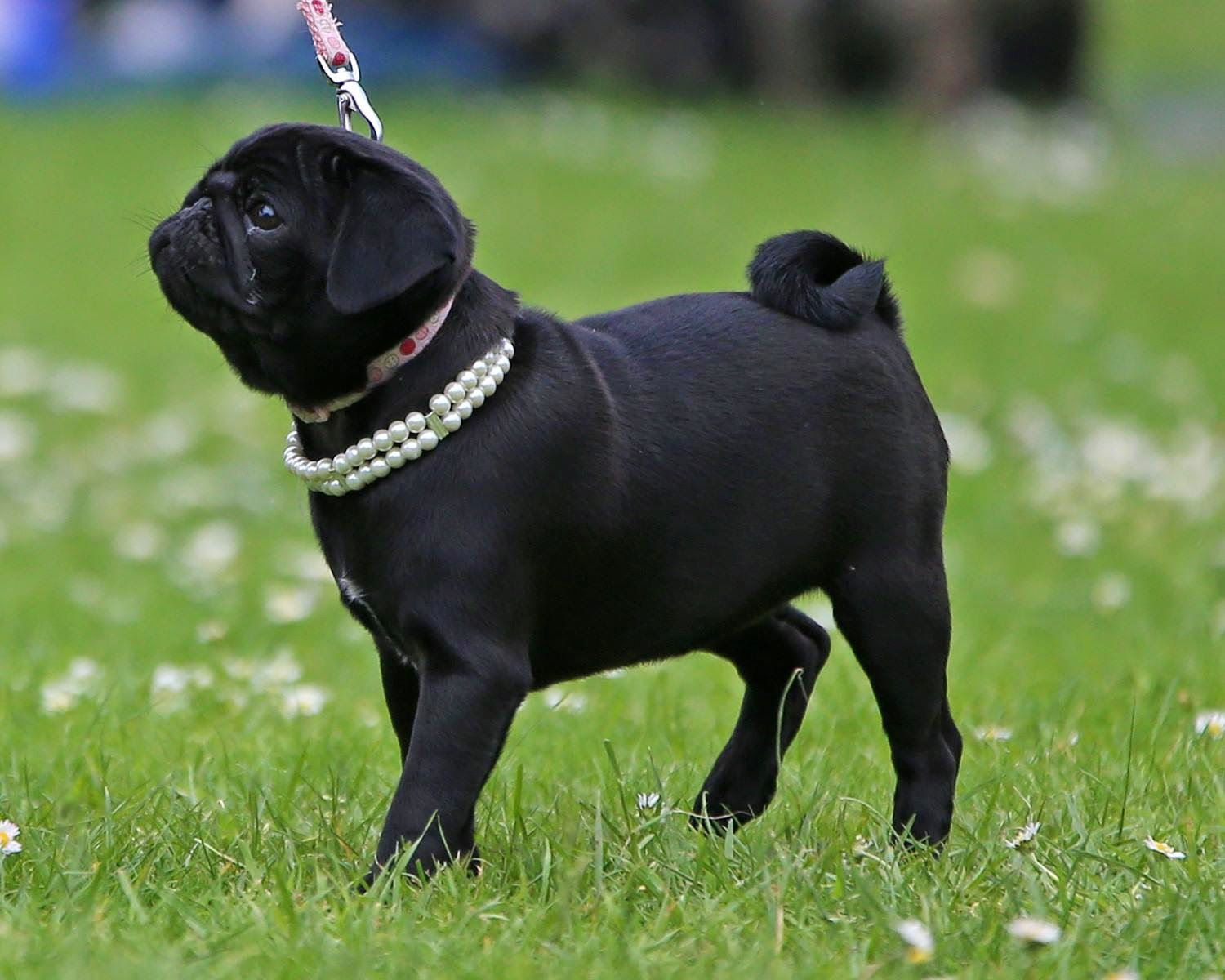
The breed material describes these dogs as showing “a relatively high level of intelligence” and as responding well to both obedience and social tricks, with training to begin early and be presented in stages. That is the standard formulation for a companion dog, and no objective tests of cognition have been published for this breed in particular, so nothing more should be squeezed out of it.
Two things are more useful in practice. First, in a short-muzzled dog training is planned around breathing: short sessions, no overheating, no excitement to the point of breathlessness; the breed material explicitly advises watching that the dog does not overheat during activity. Second, socialisation matters precisely because the standard builds in reserve towards strangers — that is not a fault but a described trait, and calm early work on it produces an adult dog that is not alarmed by visitors.
The breed does not need long exertion: on the programme’s own description these dogs keep fit through ordinary household activity, though they still need a daily walk. A game of fetch is a favourite — and it is precisely during one that overheating is easiest to miss.
Feeding and weight: the one lever that really has been measured
Pros and cons of the breed
| Pros | Cons |
|---|---|
| A small companion for whom a flat and ordinary household activity are enough. | A short-muzzled dog with all that follows: heat, exertion and breathlessness are permanent themes. |
| The standard permits all colours and patterns — parti-coloured and white dogs are not excluded. | The standard sets no height, and the figures in reference works contradict one another. |
| The standard calls overly protruding eyes a fault and requires open nostrils. | The composition of the breed is undisclosed, so hereditary risk can only be judged from related breeds. |
| On the programme’s description, a sociable dog, tolerant of cats and birds. | The breed is few in number, is essentially absent outside the United States, and its own site has long gone unmaintained. |
| Minimal coat care: a weekly brush and a bath when needed. | The claimed ancient origin is not supported by documents — it is a reconstruction from books. |
Things worth knowing about the American miniature pug
- The breed’s name is a registered trade mark. That is not a figure of speech: the breed site writes explicitly about registering the mark and about “licensed” breeders. Kennel federations have nothing to do with it — the name is protected by trade-mark law, not by a stud book.
- The standard describes the bite in more detail than everything else put together. Five separate requirements are devoted to it; to height, not one.
- The “Prince” mark. The 1921 book records that the most sought-after feature of the Chinese lo-sze was three wrinkles on the forehead with a vertical bar, forming the character for “Prince” — the same character the Chinese saw in the stripes on a tiger’s forehead.
- The dragon-claw pug. The second, long-coated variety of the lo-sze, with feathering on the ears, toes and tail, was considered the most valuable — and, by the same book, died out about half a century before 1921. Its description matches almost word for word the “undesirable but accepted” second coat type in today’s reference works on the breed.
- The word “lo-sze” is most probably a place name rather than “little one”. The 1921 author suggested that the name was contracted from an older form, “lo-chiang-sze”, in which “-sze” is a common suffix in Ssuchuan place names.
- A curled tail is not a screw tail. In the 2018 study that found the screw-tail mutation in bulldogs, all 29 pugs tested were clear of it, and their tails proved on radiographs to be of full length and free of vertebral malformations.
Frequently asked questions about the breed (FAQ)
How does the lo-sze pug differ from an ordinary pug?
In its declared aim: an attempt to assemble a more compact, lower-set dog with shorter, curved forelegs, large flat feet and any colour, including parti-colour and white. The standard nonetheless requires a muzzle “very short and broad” — no longer than a pug’s.
Is it healthier than the modern pug?
Nobody has shown that. No clinical studies of this breed in particular have been published, and its own material calls it brachycephalic and speaks of the extreme shortness of the nose. We claim neither that the breed is sounder nor that it is sicker: there are no data for the first and none for the second.
Which breeds were used to create it?
The breeding programme declined to disclose that and gave its reason — so that the breed would not be copied. The recipes circulating in reference works do not come from it.
Did this breed really exist in ancient China?
Small short-muzzled dogs are documented in China from an early date, and “lo-sze” is recorded as an everyday Chinese name for the pug. But no line from them to the American programme of 1989 has been documented, and the specific dates of the popular retelling — about Confucius, about a dictionary “around 950” — do not survive comparison with the primary source.
How long does it live?
The breeding programme claims 12 to 15 years. No independent measurements exist for this breed. For comparison, two British studies give the pug 7.65 years by life table and 11.6 years by median age at death — a difference of method, not of data.
What should you look at when choosing a puppy?
The nostrils and the breathing: nostril stenosis is the most reliable of the simple predictors of obstructed breathing in short-muzzled dogs, and in the Finnish examinations 71 % of pugs had moderate or severe stenosis. After that, the weight of the parents and whether the breeder is willing to show how the dogs breathe after exercise.
- A small companion for whom a flat is enough
- The standard permits all colours and patterns
- The standard requires open nostrils and calls protruding eyes a fault
- Minimal coat care
- A short-muzzled dog: caution in heat and under exertion
- The standard sets no height; reference figures contradict one another
- Composition undisclosed — hereditary risk judged only from related breeds
- Few in number, essentially absent outside the United States
- The claimed ancient origin is not supported by documents
| Pug | Pekingese | Shih Tzu | |
|---|---|---|---|
| Height | 25–33 cm | 15–23 cm | 20–28 cm |
| Energy | 2.5 | 2.5 | 3 |
| Apartment | 4.5 | 4.5 | 4.5 |
| Beginners | 4 | 3.5 | 4 |
How does the lo-sze pug differ from an ordinary pug?
Is it healthier than the modern pug?
Which breeds were used to create it?
Did the breed really exist in ancient China?
How long does it live?
What should you look at when choosing a puppy?
The American Lo-Sze Pugg™ standard and breed material (archive copies of the official breed site, 2001–2002) · V. W. F. Collier, Dogs of China and Japan in Nature and Art, 1921 · O’Neill et al., Canine Medicine and Genetics, 2022 (VetCompass, pug) · Liu et al., PLOS ONE, 2017 · Lilja-Maula et al., Acta Veterinaria Scandinavica, 2024 · Mansour et al., PLOS Genetics, 2018 · Teng et al., Scientific Reports, 2022 · McMillan et al., Scientific Reports, 2024
For apartments · For kids · For beginners · Active · Smartest · Hypoallergenic · All rankings →