

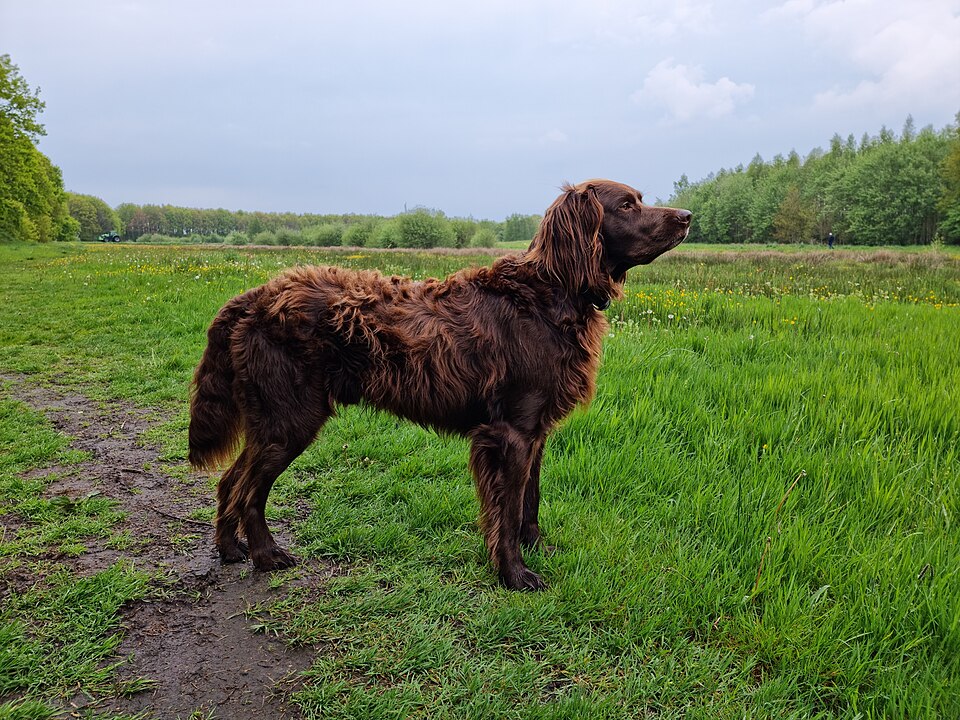
| Height | 58–70 cm |
| Weight | 27–32 kg |
| Lifespan | 12–14 years |
| FCI group | 7 · pointing dogs |
| Origin | Germany |
Exact ratings
Common health issues
Nutrition
The German Longhaired Pointer (Deutsch Langhaar) is not just a dog; it’s the embodiment of German hunting tradition, wrapped in an elegant, long-haired “coat”. This breed, belonging to the continental pointer group, is one of Germany’s oldest and most versatile gundogs. They combine the qualities of bird dogs, hawk dogs, water retrievers, and even scent hounds. This is an intelligent, calm, and incredibly loyal companion who, however, demands a serious approach to training and, most importantly, the opportunity to fulfil its powerful hunting potential. It is a rare breed of natural-born hunter with high intelligence, a friendly nature, and an obedient demeanour.
The German Longhaired Pointer possesses an excellent set of hunting skills, and its reserved attitude towards strangers makes it a vigilant watchdog. Affectionate with its owners, the Langhaar will happily play with children, yet nothing can replace its beloved hunt. In this article, we will take a detailed look at the history, standard, character, and care requirements for this noble dog. More on this on Tvaryny.
German Longhaired Pointer: Breed Snapshot
| Characteristic | Description |
| Origin | Germany |
| Time of origin | Late 19th century (standard 1897) |
| FCI classification | Group 7 (Pointers), Section 1.2 (Continental Pointers, “Spaniel” type). With working trial. |
| Lifespan | 12-14 years |
| Height (males) | 60-70 cm (ideal 63-66 cm) |
| Height (females) | 58-66 cm (ideal 60-63 cm) |
| Weight | Approximately 27-32 kg |
| Temperament | Balanced, calm, friendly, easily trained, devoted. |
| Use | Versatile gundog (field, forest, water), companion dog for active people. |
| Activity level | Very high |
| Grooming needs | Medium (regular brushing) |
History and Origin of the German Longhaired Pointer
The history of the German Longhaired Pointer is a story of purposeful German breeding, aimed at creating the ideal, all-round hunting assistant. Unlike many breeds whose origins are lost to time, the Langhaar’s journey is clearly documented.
The breed’s formation took place in the late 19th century. Before this, Germany had numerous types of long-haired gundogs (Ger. “Wachtelhund” – quail dog, “Habichtshund” – hawk dog) used for various types of hunting. Their bloodlines formed the foundation of the future breed. The primary goal of the breeders was to combine the abilities for work in the field (searching and pointing birds), in the forest (tracking), and on the water (retrieving game) into a single dog.
The first examples of the breed were quite powerful, solidly built, somewhat heavy, and even “bear-like”, with a harsh and tough temperament. They were excellent workers, but they lacked elegance and speed.
A turning point in the breed’s history was the decision to “refine” it. In the 1920s, breeders began to cross the Langhaar with English breeds, particularly with Gordon Setters and Irish Setters. This infusion of new blood radically changed the dog’s appearance: it became lighter, more refined, and acquired a characteristic elegance in movement and a more noble look. The rough “bear” was transformed into an elegant athlete.
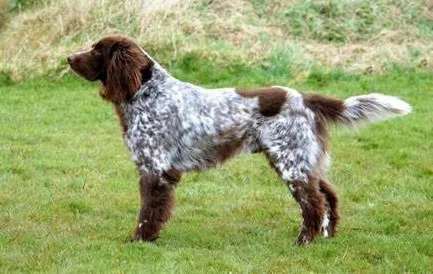
The official date for the start of purebred breeding is considered to be 1879. In 1897, Baron von Schorlemer compiled the first detailed standard for the German Longhaired Pointer, laying the foundation for modern breeding. Interestingly, at that time, the breed was divided by colour. Brown and brown-with-white dogs were registered as Deutsch Langhaar, while the black-and-white ones formed the basis of another, albeit very closely related, breed – the Large Munsterlander.
Modern breeders continue to focus primarily on the working qualities of the Langhaar, striving to preserve them as versatile gundogs capable of adapting to any conditions.
What Does the German Longhaired Pointer Look Like: Breed Standard
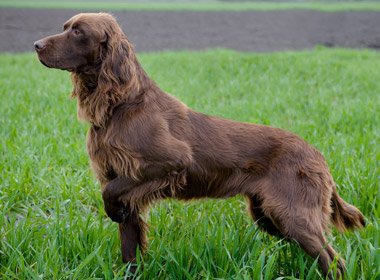
The German Longhaired Pointer is a strong, muscular, yet elegant dog with flowing lines. It should be neither too massive nor too light. Its appearance radiates power, stamina, and nobility.
- Head: Noble and elongated. The skull is slightly domed. The stop (transition from forehead to muzzle) is gentle, not abrupt. The muzzle and skull should be of roughly equal length.
- Eyes: Brown, preferably as dark as possible. Eyelids fit snugly. The expression is intelligent and calm.
- Ears: Dropped, set not too low, and turned slightly forward. They are broad at the base and rounded at the tips, covered with long, wavy hair (feathering) that falls in strands.
- Body: Strong. The back is straight, firm, and not too long. The withers are pronounced. The loin is very muscular. The chest is deep (reaching the elbows or slightly below) and spacious, but not barrel-shaped.
- Tail: Set high, carried straight or slightly sabre-shaped. When calm, it is held horizontally or slightly lowered. It is covered with long hair, forming a beautiful “flag” or “plume”.
- Limbs: Straight, parallel, with strong bones and well-developed muscles. Paws are compact, tight, with dense hair between the toes.
Coat and Colour
The breed’s crowning glory is, of course, its coat. It should be sleek, close-fitting, with a good undercoat that protects the dog from bad weather and cold water. The coat must not be overly curly or shaggy.
On the back and sides, the hair length is 3-5 cm. On the neck, chest, and belly, it can be longer, forming a “frill” and “skirt”. On the head, the hair is much shorter, but still longer than that of shorthaired pointers. The ears are covered with long feathering. The back of the limbs also has “feathering”, and the tail boasts a full plume.
The FCI standard permits several main colours:
- Solid Brown: A rich, deep colour.
- Brown with White Markings: White patches on the chest (“star”) and paws are possible.
- Dark Roan (Dunkelschimmel): The main colour is brown, but the coat is densely mixed with white hairs.
- Light Roan (Hellschimmel): The main colour is white, with dense brown ticking and patches.
- Trout Roan: Numerous small brown spots on a white background.
Character: A Balanced Athlete and Loyal Friend
The German Longhaired Pointer has an exceptionally balanced temperament. This is one of the key breed traits, enshrined in the standard. It is calm, composed, friendly, and easy to handle. Aggression or nervousness are completely alien to the Langhaar. This is a dog with a steady psyche, confident but not arrogant.
They form strong bonds with all members of their family. This is not a one-person dog; it gives its love to everyone it considers “its pack”. Langhaars are known for their gentleness with children; they are patient and gladly join in games. However, as with any large dog, interactions with very young children should be supervised.
At the same time, the Langhaar is an excellent watchdog. It is not aggressive, but always alert and wary of strangers. Its clear bark will certainly alert you to visitors or anything unusual on its territory. But it is not a guard dog in the sense that it is not prone to attack.
The most important aspect of the Langhaar’s character is its need for human contact. They do not tolerate loneliness and are not suitable for being kenneled. Left alone for long periods, a Langhaar will pine, which can lead to destructive behaviour. This is a partner dog that wants to be by your side, whether on the sofa or in the field.
The Langhaar as a Hunter: The All-Rounder
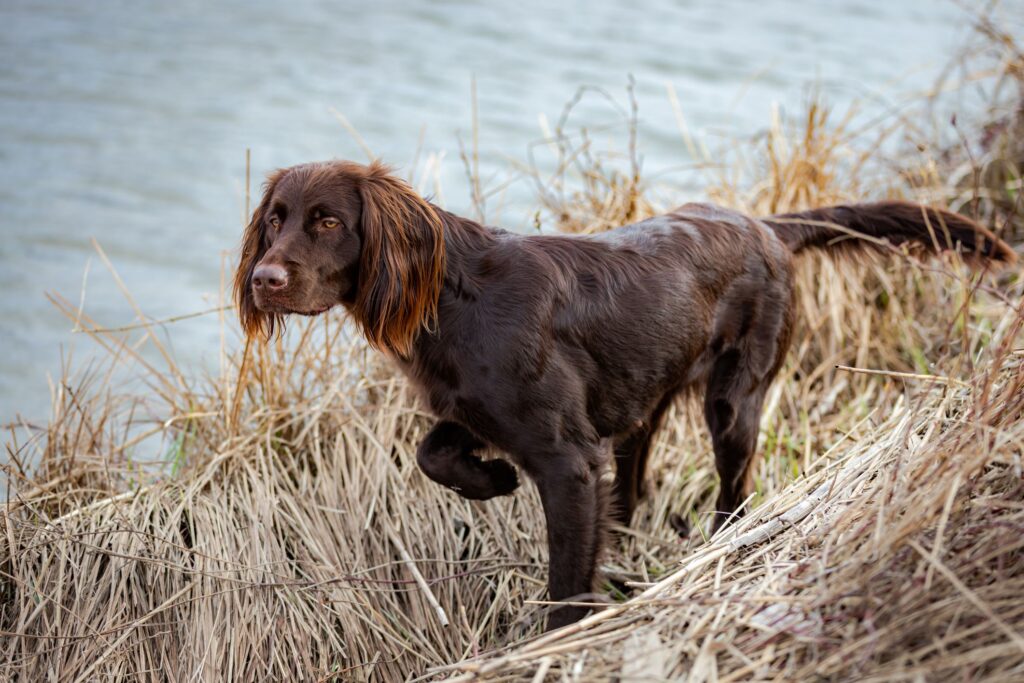
It is impossible to talk about this breed without mentioning its primary purpose. The German Longhaired Pointer is hunting elite. It belongs to the “versatile” gundog group, meaning it is capable of working in all conditions and with all types of game.
- Work in the field (before the shot): The dog uses its nose, methodically quartering the field in search of birds. Upon finding game, it performs the classic point – freezing to indicate the hunter’s direction.
- Tracking (forest): Thanks to its scent hound (Bracken) ancestry, the Langhaar excels at blood-trailing, locating wounded game (deer, boar, fox).
- Water work (after the shot): This is one of the breed’s greatest strengths. Langhaars adore water. Their coat, with its dense undercoat, provides excellent protection from the cold, allowing them to retrieve ducks even from icy water in late autumn.
- Retrieving: They have a natural inclination to retrieve game, doing so with a soft mouth, without damaging the quarry.
Because of this tendency towards meticulous work and thorough searching, some consider it somewhat slow when hunting compared to other pointers. But this “slowness” is actually thoroughness. The Langhaar will not miss a single patch of ground. It is the ideal assistant for a thoughtful, unhurried hunt.
The breed shares many similarities with other versatile gundogs, such as the Drentse Partridge Dog, but differs with its longer coat. Its work in the field is somewhat reminiscent of spaniels, which is why it was assigned to the “Spaniel type” in the FCI classification, although it is not truly a spaniel in the same way as, for example, the Blue Picardy Spaniel.
Pros and Cons of the German Longhaired Pointer
Like any breed, the German Longhaired Pointer has its advantages and disadvantages. It is important to assess them soberly before deciding on such a dog.
| Pros (Advantages) | Cons (Disadvantages) |
|---|---|
| ✅ Exceptionally balanced temperament: Calm, non-aggressive, with a steady psyche. | ❌ Very high exercise needs: Requires 2+ hours of intense activity daily. |
| ✅ High intelligence: Learns easily and willingly, picks up commands quickly. | ❌ Not for flat living: Ideally suited to a house with a fenced garden. |
| ✅ Family-oriented: Gets on wonderfully with children and is a devoted companion. | ❌ Strong hunting instinct: May chase cats, squirrels, birds. A danger to small household pets. |
| ✅ Versatility: An excellent hunter, but also a great partner for sports (agility, obedience). | ❌ Does not tolerate being alone: Prone to separation anxiety and destructive behaviour if left for long periods. |
| ✅ Loves water: The perfect companion for swimming and holidays by the water. | ❌ Grooming needs: The coat must be brushed regularly to prevent matting. |
| ✅ Good watchdog: Will always warn of strangers without showing undue aggression. | ❌ Prone to shedding: Especially during seasonal coat changes. |
| ✅ Relatively robust health: Does not suffer from widespread genetic problems with proper care. | ❌ Risk of specific diseases: Prone to bloat (GDV) and ear infections. |
Care and Upkeep: What Owners Need to Know
Keeping a German Longhaired Pointer is, first and foremost, about satisfying its need for exercise. Everything else is secondary. This dog is emphatically not suited for life in a small flat or for people with a sedentary lifestyle.
Exercise and Activity Requirements
This is not a dog that is satisfied with a 15-minute walk around the block. A Langhaar needs a minimum of 1.5-2 hours of active physical exercise every day. And that doesn’t just mean walking on a lead.
- Free running: The dog needs the opportunity to run off-lead in a safe area (woods, fields, a large park).
- Swimming: This is their element. If there is a lake or river nearby, the Langhaar will be the happiest dog alive.
- Games and retrieving: They love to fetch items and search for hidden toys.
- Mental stimulation: Just running is not enough. Their intelligence demands tasks. This could be learning tricks, scent work, or hunting-related training.
If a Langhaar does not get enough stimulation, its pent-up energy will find an outlet in destructive behaviour: chewing furniture, barking, or digging holes in the garden.
Grooming the German Longhaired Pointer’s Coat
The Langhaar’s coat length (around 3-5 cm) does not require complex professional grooming, but it does demand regular maintenance from the owner. The main goal is to prevent matting and maintain healthy skin.
| Task | Frequency | Tips and Recommendations |
|---|---|---|
| Brushing | 1-2 times a week | Use a wide-toothed comb and a slicker brush. Pay special attention to the longer feathered areas: behind the ears, on the neck, the “trousers” on the legs, and the tail. |
| Seasonal Shedding | Daily (in spring and autumn) | During the moult, the undercoat falls out heavily. Daily brushing will help control the amount of hair in the house and prevent matts. |
| Bathing | As needed (1-2 times a year or if very dirty) | Don’t bathe the dog too often, as this can strip the natural protective oils. Use only specialised dog shampoos. |
| Ear Care | Weekly (and after every swim) | Critically important! The dropped ear shape and love of water create the perfect environment for infections. Regularly inspect and clean the ear canal. After swimming, always dry the inside of the ears thoroughly. |
| Nails | 1-2 times a month | If the dog runs a lot on hard surfaces, the nails may wear down naturally. Otherwise, they need to be trimmed with clippers. |
| Paws | After every walk | Check the pads for cuts or thorns. In winter, rinse off salt and grit. It’s also wise to trim the hair between the toes to stop snow and mud from balling up. |
Breed Health: Common Conditions and Prevention
Training and Socialising Your Langhaar
Intelligent and bright, German Longhaired Pointers are easy to train. They are practically built for human interaction and are eager to please their owner. Typically, they are obedient hunting partners who happily follow commands.
However, their intelligence means they get bored quickly with mindless drills. Training must be:
- Consistent: Rules, once established, must not change.
- Positive: Langhaars respond brilliantly to praise, treats, and play. They are sensitive to tone of voice and react poorly to shouting or physical punishment.
- Early: Socialisation needs to begin as early as possible. Introduce the puppy to different people, sounds, places, and other (well-behaved) dogs.
Special attention must be paid to controlling the hunting instinct. Even if you are not a hunter, the dog will point pigeons in the park. It is vital to teach the “Come!” command from a young age and make its execution non-negotiable. This is the key to safety during off-lead walks.
Feeding Your German Longhaired Pointer: Key Recommendations
Interesting Facts About the Breed
- The name says it all: “Deutsch Langhaar” literally translates from German as “German Longhair”.
- Four-in-one: This is one of the few breeds that officially has the blood of four different types of hunting dogs in its veins: bird dogs, hawk dogs (for falconry), water dogs, and scent hounds (Bracken).
- Masters of silent commands: Experienced hunters note that Langhaars are superbly trained to react to quiet commands – gestures and whistles. This allows for silence to be maintained in the field.
- From bear to athlete: The breed transformed from a heavy, “bear-like” dog into an elegant and refined pointer, thanks to the infusion of English Setter blood.
- The colour divide: In the past, black-and-white Langhaar puppies were not recognised and were split off into a seperate breed – the Large Munsterlander.
Frequently Asked Questions (FAQ)
Is the German Longhaired Pointer suitable for living in a flat?
No, this is highly discouraged. Teh breed needs space. The ideal conditions are a house with a well-fenced garden where the dog can spend time (but not live permanently), and daily long walks outside the property.
How does the Langhaar get on with children and other animals?
They are known for their gentleness and patience with children, making them excellent family dogs. They usually get along well with other dogs, especially with early socialisation. However, things are complicated with small animals (cats, rabbits, domestic birds). They have an extremely strong hunting instinct. If a Langhaar has not grown up with a cat from puppyhood, it will most likely view it as prey.
Can I get a Langhaar if I am not a hunter?
Yes, but only if you are prepared to replace hunting with other intensive activities. This could be canine sports (e.g., canicross – running with your dog), long (2-3 hour) hikes in the woods or hills, regular scent-work sessions, or simply a very active lifestyle. If the dog is just left to lie on the sofa, it will become unhappy and problematic.
Does the German Longhaired Pointer shed a lot?
Yes, they do shed, especially seasonally (in spring and autumn) when they change their thick undercoat. Regular brushing (1-2 times a week, and daily during the moult) will help keep the situation under control.
Videos of the Breed
- Calmer than the shorthaired/wirehaired
- Clever, devoted, level-headed
- A reliable working hunter
- A silky, striking coat
- Needs plenty of exercise
- Care of the long coat and ears
- Dislikes solitude
- A strong hunting instinct
| German Shorthaired Pointer | German Wirehaired Pointer | Large Munsterlander | |
|---|---|---|---|
| Height | 53–64 cm | 57–68 cm | 58–65 cm |
| Energy | 5 | 5 | 4.5 |
| Apartment | 2 | 2 | 2.5 |
| Beginners | 2.5 | 2 | 3 |
How does the Longhaired differ from the Shorthaired and Wirehaired?
Is the German Longhaired Pointer good for a family?
How much exercise does the Longhaired need?
FCI Standard No. 117 · The Kennel Club
For apartments · For kids · For beginners · Active · Smartest · Hypoallergenic · All rankings →