

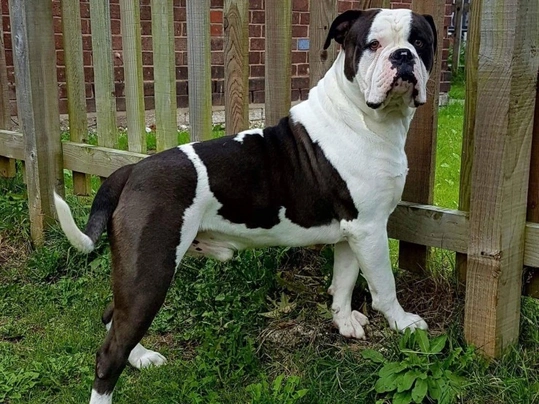
| Height | 46–61 cm |
| Weight | 25–45 kg |
| Lifespan | 12–15 years |
| FCI group | not recognised by the FCI (American) |
| Origin | USA (Georgia) |
Exact ratings
Common health issues
Nutrition
The Alapaha Blue Blood Bulldog, also known as the Otto Bulldog, is a unique blend of family loyalty and uncompromising guard instincts. This isn’t just a dog; it’s living history, miraculously preserved through the efforts of a single family in Georgia. Alapaha Blue Blood Bulldogs are natural-born protectors, livestock guardians, and incorruptible farm watchdogs. They are strong, courageous, and intelligent dogs with an independant character that demands respect and a firm hand. Read more on Tvaryny.
Alapaha Blue Blood Bulldog: A Brief Breed Overview
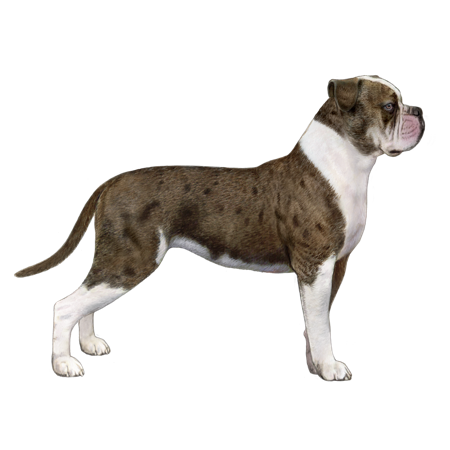
| Country of Origin | United States of America (Alapaha River region, Georgia) |
| First Mentioned | Around the 1800s (line officially recorded in 1979, origins trace to 1879) |
| Group | Molossers, guard dogs, companion dogs |
| Lifespan | 12-15 years (quite long for a dog of this size) |
| Height at Withers | Males: 56-64 cm; Females: 48-58 cm |
| Weight | Males: 34-47 kg (sometimes up to 59 kg); Females: 25-34 kg |
| Coat Type | Short, stiff, close-lying |
| Purpose | Property guarding, cattle work, companion dog |
History: From Georgia Plantations to the Modern Day
The history of the Alapaha Blue Blood Bulldog reads like a gripping novel. Unlike many breeds created by kennel clubs, the Alapaha is the result of “folk breeding” and the dedication of one family – the Lanes. It is believed that the ancestors of these dogs were the now-extinct old-type “Mountain Bulldogs” and English Bulldogs brought to America by early settlers in the 18th century. They were used as “catch dogs” – employed to catch escaped cattle and semi-wild hogs in the dense forests of the American South.
For 200 years, the breed developed in isolation around the Alapaha River, allowing it to retain unique traits lost by other bulldogs. The key figure in saving the breed was Buck Lane. He began a breeding programme to save the “plantation dog” from extinction. His most famous dog was named Otto. Legends say that Otto was so loyal that after Buck Lane died in 1943, the dog visited his master’s grave daily to stand guard. In honour of this remarkable animal, the breed is often referred to as the “Otto Bulldog”.
The grandfather’s work was continued by his granddaughter, Lana Lou Lane. She officially registered the breed and founded the Alapaha Blue Blood Bulldog Association (ABBA). She strove to preserve the dog exactly as it was 100 years ago: functional, healthy, and capable of work, unlike the modern show English Bulldog, which often suffers from excessive exaggeration of features. Today, there is a small number of these dogs in the world (estimates range from a few hundred to a thousand), so the future of the breed lies entirely in the hands of responsible breeders.
Appearance: Detailed Description
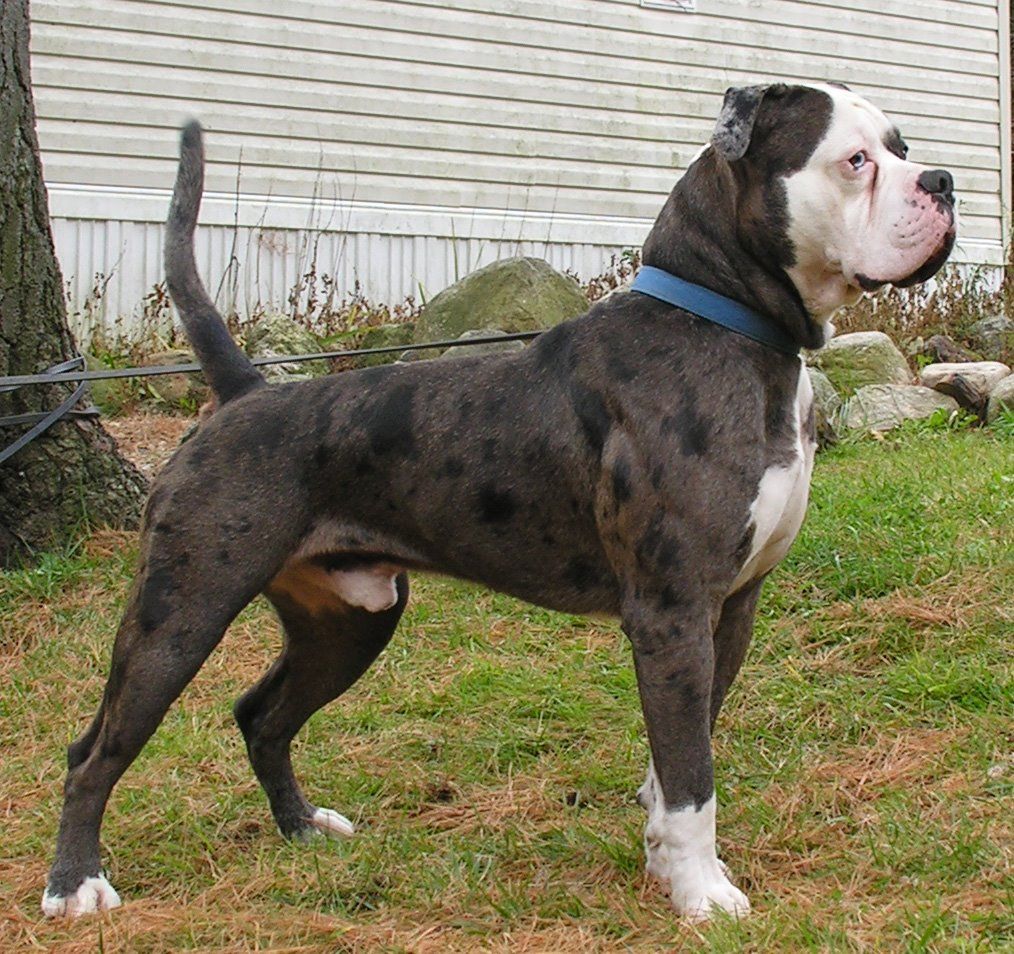
The Alapaha Blue Blood Bulldog is the embodiment of power without excess weight. This is an athlete, not a powerlifter. At first glance, it becomes clear: you are facing a serious working dog. The breed is characterised by pronounced sexual dimorphism: males are significantly more massive and powerful than females, who look more elegant but no less formidable.
Head and Muzzle
The head of the Alapaha is square, broad, and flat-topped. This is one of the main distinguishing features. The cheekbones are prominent, and the jaw muscles are extremely developed. The transition from forehead to muzzle (the stop) is deep and abrupt.
- Eyes: This is the breed’s “calling card”. They are set wide apart and are of medium size. The colour can be anything, but “glass” (blue) eyes or heterochromia (different coloured eyes), often found in merle dogs, are particularly prized and striking.
- Ears: V-shaped and high-set. They hang on the cartilage, drawing attention to the broad skull. Cropping is not welcomed by the standard, as this is a working breed, and the natural ear shape protects the ear canal from debris.
- Jaws: The bite is usually undershot (the lower jaw protrudes), allowing the dog to securely hold prey or an intruder. The lips are full but should not be excessively pendulous.
Body and Limbs
The dog’s body has a rectangular format. The chest is deep and broad, with well-sprung ribs, providing ample lung capacity for prolonged running. The back is straight, the loin slightly arched and very powerful. The limbs have strong bone and are straight. Paws are tight (“cat feet”), with thick, rough pads. The tail is long, tapering to the end, and carried low when at rest. It is important to note that unlike many other Molossers, the Alapaha’s tail is never docked – it serves as a “rudder” for sharp turns while running.
Coat and Colour
The coat is short, quite stiff to the touch, and lies close to the body. The undercoat is poorly developed, making the dog sensitive to severe frost. The palette of colours is impressively diverse:
- Blue-merle (blue marble) – one of the most desirable coats.
- Chocolate and red-merle.
- White with patches of any colour (black, red, brindle).
- Solid white (permitted, but requires a hearing test).
- Brindle, fawn, black.
It is interesting to compare the exterior of the Alapaha with other Molossers. For instance, it is more mobile and “dry” than its close relative, the American Bulldog, although an inexperienced eye might confuse them.
Character: Temperament and Behaviour of a True Guardian
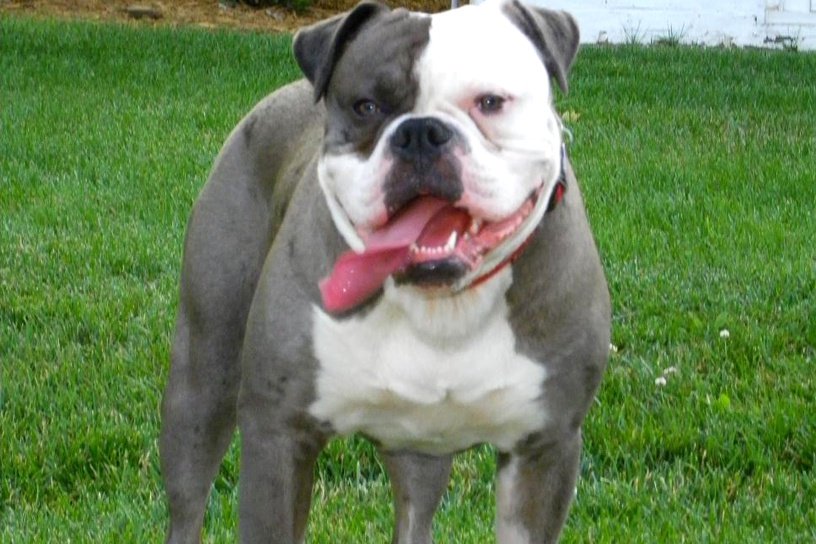
The character of the Alapaha Bulldog is a complex mix of contradictions. It is simultaneously gentle with family and ruthless towards enemies. This is not a dog that will happily greet every guest with a wagging tail. The Alapaha Blue Blood Bulldog is, first and foremost, a territorial guardian.
Attitude towards Owner and Family
The Otto Bulldog usually selects one “leader” whom it obeys implicitly (provided the upbringing is correct). It treats other family members with love and guardianship. They love to be near people, literally following their master on their heels. At home, they behave calmly, even phlegmatically, saving their energy for work or walks.
Guarding Instincts and Aggression
These dogs have an extremely developed protective instinct. They do not need to be specially trained to guard – it is encoded in their DNA. An Alapaha attacks without warning if it senses a real threat to the owner’s life. However, a properly socialised dog can distinguish between situations and will not lunge at the postman if no aggression is shown. It is vital to understand: the Alapaha shows aggression only in danger, but interference with its own toys or food bowl by strangers may be perceived consistently as a hostile act.
The Alapaha and Children
Historically, these dogs lived on farms in large families, so they are generally patient with children. They can play and tolerate childish antics. However, given the size and strength of the dog, never leave them alone with small children unsupervised. The dog could accidentally knock a child over during play.
Training and Socialisation: How Not to Raise a Monster
Educating an Alapaha Bulldog is not just about teaching commands like “sit” or “down”. It is a process of establishing hierarchy. If you do not become the leader for this dog, it will assume that role itself, and the consequences could be dire.
Early Socialisation
It is critically important to start socialisation at 2-3 months. The puppy needs to be introduced to different people, smells, traffic sounds, and other animals. If an Alapaha is isolated during puppyhood, it will grow up to be overly suspicious and potentially dangerous to those around it.
Training Methods
Natural intelligence and wit turn this bulldog into a capable student. However, the handler should bear in mind the pet’s independent nature and potential stubbornness. An Alapaha will not work “for the sake of it” like a Shepherd. It needs motivation.
- Positive Reinforcement: Treats and praise work better than punishment.
- Firmness without Cruelty: If you use brute physical force and humiliation, prepare for the worst – the dog will shut down or respond with aggression.
- Variety: They quickly get bored with monotonous repetition. Change training locations and the order of commands.
When training this serious dog, it can be useful to study the experience of working with other similiar breeds. For example, the methodologies applied to the Spanish Alano (Spanish Bulldog) overlap significantly with the approach needed for the Alapaha. Even small but brave dogs like the Alopekis have their own nuances in upbringing, although the scale of the challenges is, of course, different.
Health and Genetics: Weak Points of the “Iron” Dog
Nutrition: Fuel for Muscles
Care and Housing: Space and Hygiene
The Alapaha Blue Blood Bulldog is the ideal resident for a spacious enclosure or a private house with a high fence and large garden. Keeping such an active dog in a flat is torture for both the animal and the owners. Confine him within four walls without work, and the dog will be overcome by apathy or destructive behaviour (chewing furniture). Put him on a chain, and the Otto Bulldog will fill with uncontrollable aggression.
Hygiene Procedures
Caring for an Alapaha does not take much time:
- Coat: Its short coat is cleaned with a rubber mitt or brush once a week (not once a month, as is sometimes written, to remove dead hair and massage the skin). Bathe only when necessary (3-4 times a year).
- Claws: If the dog runs a lot on hard ground, the claws wear down naturally. If not, they need trimming every 2-3 weeks.
- Folds: If the dog has pronounced folds on the muzzle, they should be wiped with a damp cotton pad and dried thoroughly to avoid nappy rash or infection.
Pros and Cons of the Breed
| Pros (+) | Cons (-) |
| Exclusivity and rarity of the breed. | Tendency towards dominance; not for novices. |
| Excellent health (compared to other bulldogs). | Requires serious socialisation from an early age. |
| Minimal coat care. | Can be aggressive towards other dogs. |
| Unsurpassed property guardian and bodyguard. | High activity level; unsuitable for flats. |
| Almost never barks without reason. | Salivation (though less than Boxers, it is present). |
Interesting Facts about the Alapaha Blue Blood Bulldog
- The “Glass Eye” Effect: The Alapaha is one of the few bulldog breeds where the “merle” eye colour is genetically fixed. This makes their gaze piercing and unforgettable.
- Kennel Club Recognition: The breed is still not recognised by the most popular world kennel organisations (FCI or AKC) as a separate breed, which complicates a show career but helps preserve working qualities.
- Versatility: In the past, these dogs not only guarded but also helped drive cattle into pens, working in tandem with herdsmen.
Frequently Asked Questions (FAQ)
Is the Alapaha suitable as a first dog?
Categorically no. This breed requires an experienced owner who understands Molosser psychology and knows how to assert leadership without violence.
How much does a puppy cost?
The range is wide and turns on class (pet, breeding or show), on the titles and health screening of the parents, on how unusual the colour is and on the reputation of the kennel. Good litters normally carry a waiting list running to several months. One often has to wait months for puppies from abroad.
Can they be kept outside in winter?
In the British climate, only if there is an insulated kennel with heating. In severe frosts (below -5…-10°C), the dog is best brought indoors, as the short coat provides little warmth.
How do they get on with cats?
If the puppy grows up with a cat, they will be friends. However, the Alapaha may perceive stray cats as prey.
Video about the Breed
- Devoted, an excellent guardian and protector
- More athletic and healthier than many bulldogs
- Loves its family's children
- Longer-lived than other bulldog breeds
- Strong guarding and hunting instinct
- Wary of strangers; powerful — needs a firm hand
- A danger to small animals (prey drive)
- Needs early socialisation
| American Bulldog | English Bulldog | Cane Corso | |
|---|---|---|---|
| Height | 50–71 cm | 31–40 cm | 60–70 cm |
| Energy | 4 | 2 | 3.5 |
| Apartment | 2.5 | 4 | 2 |
| Beginners | 2.5 | 3 | 2 |
Why is the breed called the "Otto bulldog"?
Is the Alapaha bulldog healthier than the English one?
Is the breed suitable for a novice?
American breed (the Lane family, Georgia) · ABBA
For apartments · For kids · For beginners · Active · Smartest · Hypoallergenic · All rankings →