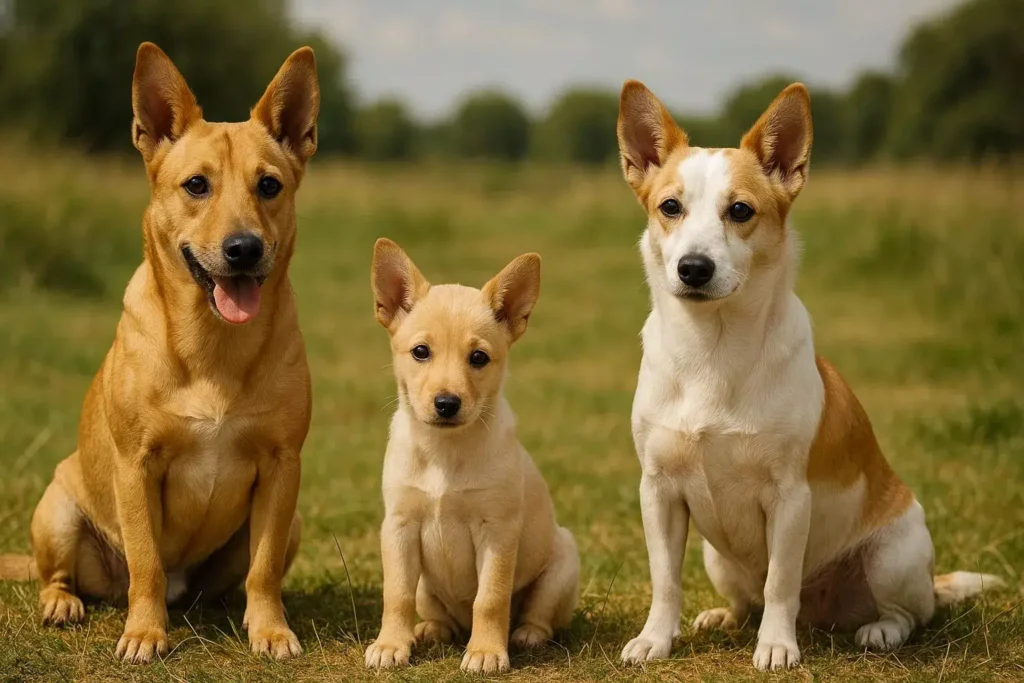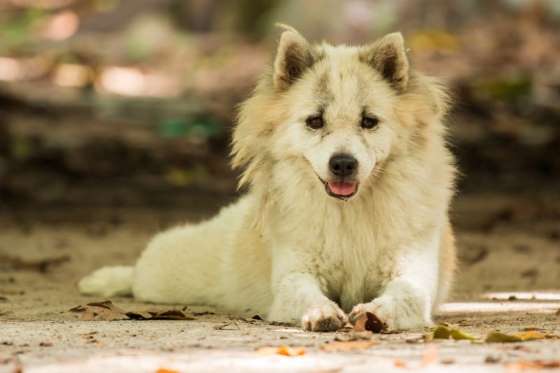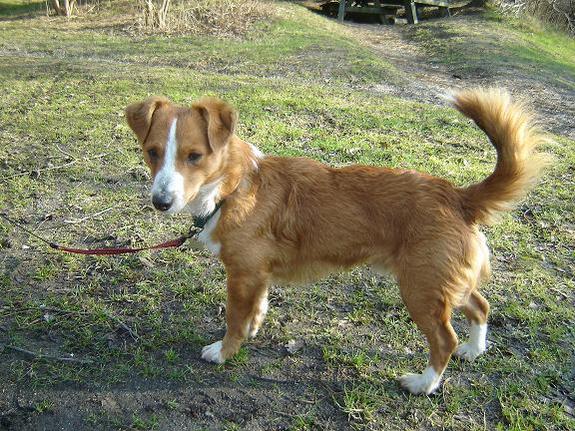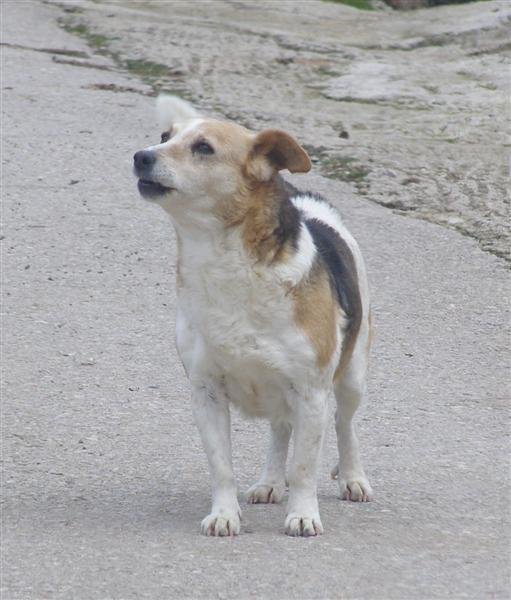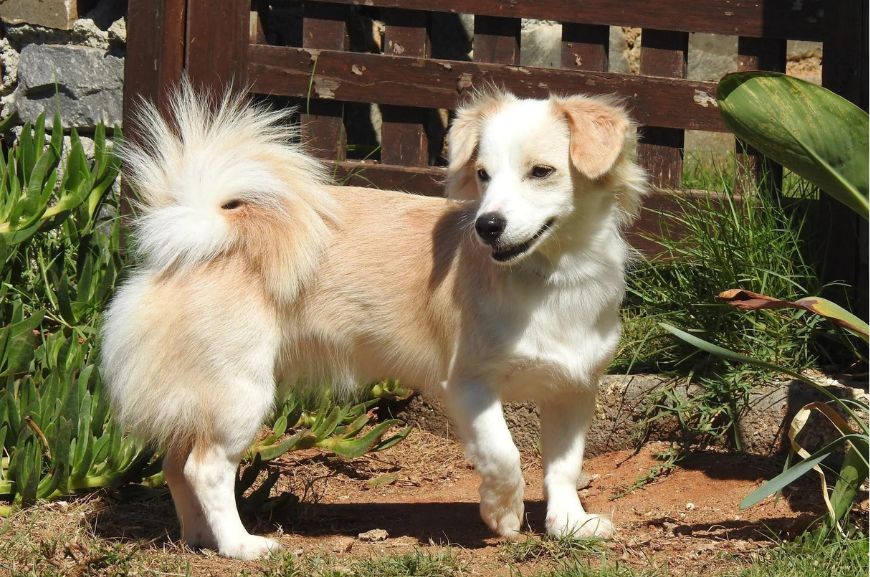
The Alopekis (Greek Αλωπεκίς) is a small Greek village dog with a fox-like head, erect ears and a sickle tail. Its name literally means “fox-like”, and it is around that name that most of the confusion in the whole breed literature has gathered. The Alopekis is recognised by no canine organisation — neither by the Kennel Club of Greece (ΚΟΕ) nor by the FCI — and that is not a minor formality but the central fact that determines everything else: how a puppy is looked for, why the breed is so hard to count, and why not one large study of its health exists. Below we separate what can be shown in a document from what is Greek breed tradition. Read more on Tvaryny.
Alopekis: detailed overview and breed characteristics
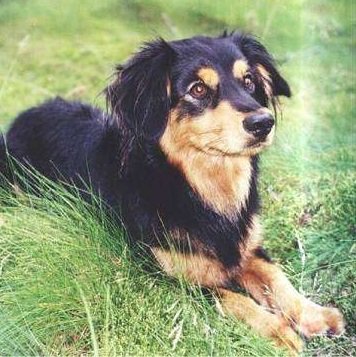
The figures in the table below are taken from the text of the Greek breed standard published by breed enthusiasts (dogpark.gr, “Πρότυπο Φυλής Αλωπεκίς”) and from Greek breed reference literature. One thing must be understood: the standard exists as a document and can be read, but it is not approved by any official registry. It therefore describes a desired dog, not an extract from a stud book.
Alopekis: detailed overview and breed characteristics · 8
| Origin | Greece |
|---|---|
| Classification under the proposed standard | Group 5 (primitive dogs), section 7 (domestic dogs) |
| Official recognition | none — neither ΚΟΕ nor FCI |
| Height at the withers | up to 30 cm (a +2 cm tolerance for outstanding specimens), not below 20 cm |
| Weight | 3.5–7.5 kg |
| Coat type | double, guard hair no longer than 5 cm; three varieties |
| Life expectancy | roughly 12–15 years and more (breed-literature estimate) |
| Activity | high for its size; needs work for the head |
Note how the height is worded. The standard gives no separate ranges for dogs and bitches — it sets a ceiling (30 cm plus tolerance) and a floor (20 cm), and it explains separately what the floor is for: to keep signs of dwarfism out of the breed. Popular descriptions, by contrast, very often circulate “male” and “female” ranges that are not in the text of the standard at all. We quote what the document says.
Breed status: what is recognised and what is not
The Kennel Club of Greece keeps a list of Greek breeds. It has seven entries: the Hellenikos Ichnilatis (Greek hound), the Greek shepherd dog, the Kokoni, the Cretan hound, the Greek white shepherd dog, the Molossus of Epirus and the Rhodes hound. The Alopekis is not on that list. The Greek breed reference states it plainly: the breed is so far recognised by no canine organisation, either nationally or internationally.
Its closest relative by fate is the Kokoni. In 2004 the ΚΟΕ recognised it first among the small Greek dogs, and since then an official document of origin can be obtained for a Kokoni. For the Alopekis no such procedure yet exists. The difference between the two breeds lies not in the quality of the dogs but in the fact that one group of enthusiasts carried the procedure through and the other has not yet.
The procedure itself explains why this takes so long. Since 1991 the ΚΟΕ has allowed dogs without papers but with the right phenotype to be entered in the register: such a dog receives a BEA1 mark after examination by a morphology judge. Its offspring then pass BEA2 and BEA3 under the club’s supervision, and only when five or more generations of registered animals have accumulated does the line move into the full register (BEK). Recognition of a breed, in other words, is neither a vote nor one person’s decision but a multi-year chain of examinations and matings that somebody has to run and document. For a breed whose carriers are scattered across villages and farms, that is the hardest part.
The practical conclusion for a buyer is simple and unpleasant: no document attesting that an Alopekis is an Alopekis exists. Any advert offering an “Alopekis pedigree” therefore deserves very careful reading — no official registry issues such papers. The only things to lean on are the reputation of particular Greek enthusiasts and an assessment of the phenotype against the text of the standard.
The ancient word and today’s dog: what the texts actually say
It is customary to write that the Alopekis was described by Xenophon, Aristotle and Aristophanes. That claim deserves to be taken apart piece by piece, because each piece behaves differently — and this is exactly where the main trap of the breed literature is hidden.
Xenophon is a genuine citation. In the treatise Cynegeticus (III, 1) he writes that there are two kinds of hunting dog: the Castorian and the ἀλωπεκίδες, the “foxy” ones. And he explains the name at once: the second kind supposedly descends from the dog and the fox, whose natures have mingled over the ages. The word does exist in the ancient text, it stands in a properly canine context, and it can be read in any edition of Xenophon.
But the dog described there is not this one. The academic lexicon of ancient Greek (Liddell–Scott–Jones) gives ἀλωπεκίς three senses: a cross of fox and dog (synonym of κυναλώπηξ) — and the sole reference here is precisely Xenophon, Cynegeticus 3.1; a cap of fox fur — Xenophon, Anabasis 7.4.4; and a grape variety so named for its colour, in Pliny the Elder. The Spanish dictionary of ancient Greek (DGE) adds a decisive detail to the first sense: the ἀλωπεκίς is a variety of Laconian dog. And the Laconian dog of antiquity is a hound for hare hunting — the very dog Xenophon teaches you to lay on the line in that same treatise — not a small 25 cm yard watchdog.
Aristotle speaks of Laconian dogs, not of the Alopekis. In the History of Animals, among his examples of crossings between species, he states that in Cyrenaica wolves mate with dogs and produce offspring, and that Laconian dogs are born of a dog and a fox. The word ἀλωπεκίς does not appear in that passage: what appears is the same legend of fox blood, attached to the Laconian hound.
Aristophanes, for his part, uses the word as an insult. The lexicon records κυναλώπηξ (“dog-fox”) in him twice, and both times as a nickname aimed at a man: in Lysistrata a procurer, in the Knights the politician Cleon. Later Lucian would fling the same word at the Cynic philosophers. In comedy, then, “dog-fox” denotes a cunning and shameless creature, not a canine breed. Reading that line as a mention of the Alopekis is like taking a modern “what a fox!” for a cynological record.
And a word about the legend itself. A cross between dog and fox is biologically impossible: their chromosome sets differ, and such a union produces no viable offspring. The ancient authors believed in it sincerely and used the name to explain an outward resemblance; we should read their words as evidence of what the Greeks imagined, not of the dog’s genealogy.
What is left? Something solid and honest is left: the word ἀλωπεκίς really is ancient, it really did denote a dog, and the Greeks really did see a fox in a small reddish dog. But identifying the ancient ἀλωπεκίς with the modern breed is Greek breed tradition, not an established fact. That is exactly how we present it.
What the archaeological finds give
Material evidence is scarcer than textual evidence, but more concrete. The Greek breed reference rests on three things.
- An incised pithos from Thessaly, about 3000 BC. The silhouette of a dog is scratched into the large jar; the piece is kept in the National Archaeological Museum in Athens and is considered the oldest image of a dog from Greek lands.
- A comparable find at Askitario near Rafina, dated to the Early Bronze Age — 2500–2100 BC.
- Dog bones in the lower layers of the Neolithic settlements of Sitagroi and Sesklo. They are described as close to the Central European finds of the “peat dog” (Canis familiaris palustris), the small domestic dog of the lake settlements.
Interpretation begins after that. The fact that small domestic dogs lived on Greek soil in the Neolithic does not automatically mean that today’s Alopekis descends from them in a straight line: between a silhouette on a jar and a living dog in a village near Serres lie several thousand years, during which populations mixed, vanished and returned. Tellingly, having listed these finds, the Greek breed reference itself presents the comparison of DNA from Neolithic bones with modern dogs as a task still to be carried out. Continuity “from the Neolithic to the present day” is therefore a hypothesis the breed considers plausible and wants to test, not the result of a test.
One more detail is worth keeping in mind: all small dogs in the world — from the Prague ratter to the Alopekis — carry a shared genetic trace of size reduction. A study published in Science in 2007 showed that one haplotype of the IGF1 gene is present in practically every small breed and almost absent in giant ones. That explains why “miniaturisation” took similar routes in different corners of the world. But it is a conclusion about small dogs in general; the Alopekis was not genotyped in that study, and we will not credit the breed with a result that does not name it.
Its role in the Greek village, on the other hand, is well documented without any archaeology. Alopekis destroyed rats and mice, guarded poultry from foxes and martens, worked alongside the big shepherd dogs and, in some districts — the prefecture of Serres in particular — accompanied herds of buffalo and cattle. That is a rare specialisation: dogs used with cattle are usually large, of molossoid build. Unlike a narrow specialist such as the Hellenic Hound, the Alopekis remained an all-rounder that does a bit of everything.
Breeding, and why the breed is so rare
The rarity of the Alopekis is not a marketing epithet but the result of several factors that came together.
Biology. The Greek breed reference describes a trait untypical of modern breeds: Alopekis bitches come into season once a year rather than twice, and usually whelp 3–4 puppies, 5 at most. This is an observation from the breed literature, not the result of a controlled study — but it is consistent with the small size and the semi-primitive type. The arithmetic is simple: with an equal number of bitches, such a breed restores its numbers two or three times more slowly than an ordinary one.
Geography. The breed’s carriers are scattered across villages and population density is low. In practice this means an owner has nowhere to take a bitch — and mates her with whichever dog is nearby. Every such mating dilutes the type.
Social change. From the late 1970s and early 1980s foreign small breeds were imported into Greece in quantity and fashion moved to them. At the same time villages and livestock farming were contracting — that is, the very holdings where the Alopekis had work were disappearing.
Neutering campaigns. This is the sharpest and most paradoxical factor. Veterinary teams studying the breed point it out: mass neutering programmes for stray dogs also catch animals of a clean breed phenotype — because to an outsider a semi-free village Alopekis looks like an ordinary yard dog. A breed with no papers also has no way of proving that it is a breed.
How many are there? No exact figure has been published. The most concrete known number belongs to a veterinary team led by Spyros Chliounakis: from February 2005 to September 2012 they surveyed the prefecture of Serres in northern Greece and documented 58 dogs there matching the morphological type of the breed. In February 2013 the researchers made their results public and warned openly of the threat of extinction. That number describes one district and one period, not the whole of Greece — but it is the only one resting on fieldwork rather than on an estimate.
Conservation of the breed is carried by Greek enthusiasts — notably the society for the protection of indigenous domestic breeds “Amalthia” and the cynologists who earlier took the Kokoni through to recognition. Their task today is less about shows than about a census: finding and describing the dogs still left in the villages.
Alopekis and Kokoni: how not to confuse them
These two small Greek dogs are constantly mixed up — above all when a long-coated individual is involved. Yet the difference is clear and visible even in a photograph.
- Ears. The most reliable sign. In the Alopekis the ears are large and erect. In the Kokoni they are moderate, set high, but drop.
- Tail. In the Alopekis a long sickle with an elegant curve, carried fairly high but not laid on the back. In the Kokoni the tail is heavily furnished, forms a plume and is carried high in a half-circle over the back, with the hair falling to one side.
- Coat. In the Alopekis the guard hair is even over the body and no longer than 5 cm. In the Kokoni it is short on the face and forelegs, noticeably longer on the body and neck, and longest on the tail and hindquarters.
- Height. By its standard the Kokoni is smaller — 23–28 cm; the Alopekis goes up to 30 cm with tolerance.
- Papers. The most practical difference: the Kokoni has been recognised by the ΚΟΕ since 2004 and an official document of origin can be obtained for it. For the Alopekis, not yet.
It is precisely because of that last point that adverts deserve particular attention. A very long-coated individual sold as a “rare long-haired Alopekis” should, Greek specialists advise, be considered first within the Kokoni group — or as a crossbreed.
Interesting facts about the Alopekis
- The name comes from the ancient Greek ἀλώπηξ, “fox”. The other ancient name for the same type of dog is κυναλώπηξ, “dog-fox”.
- In Aristophanes “dog-fox” is not a breed but an insult: it is what Cleon is called in the Knights and a procurer in Lysistrata.
- The same Greek word ἀλωπεκίς also meant a cap of fox fur (Xenophon mentions one in the Anabasis) and even a grape variety, so named for its colour.
- Ancient authors sincerely believed these dogs descended from the fox. That is biologically impossible: dog and fox have different chromosome sets.
- The local names for the breed in Greece are descriptive and affectionate: alepouditsa (“little vixen”), venetaki on Crete, zacharoskylo on Skiathos, bobis and bouboudi in the Serres area.
- The Alopekis is one of the few small European breeds used with livestock; in the prefecture of Serres dogs of this type were described alongside herds of buffalo.
- The breed standard excludes timid and aggressive dogs from breeding — the requirement on the psyche stands here on a par with the requirements on anatomy.
- For a long time these dogs were not distinguished as a breed and passed for ordinary mongrels — which nearly made them disappear through interbreeding.