

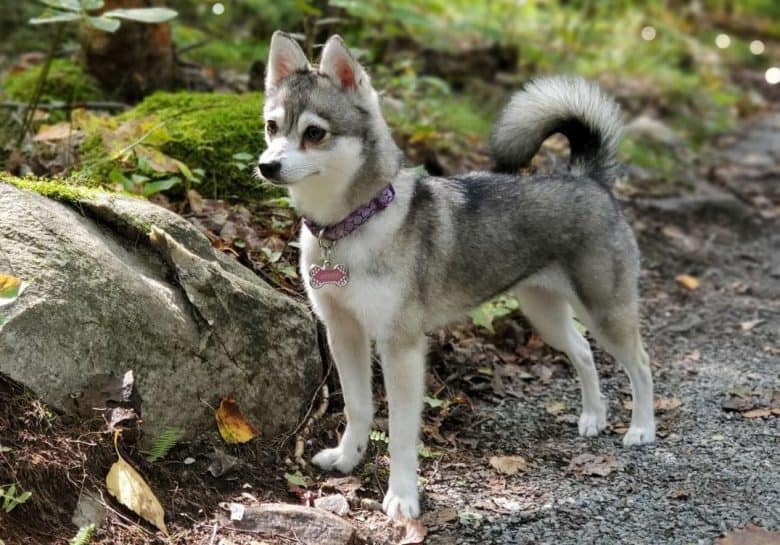
| Height | 30–43 cm |
| Weight | 4–11 kg |
| Lifespan | 13–16 years |
| FCI group | not recognised by the FCI (UKC; AKC Misc.) |
| Origin | USA |
Exact ratings
Common health issues
Nutrition
The Alaskan Klee Kai looks like a Siberian husky scaled down to fit a flat: the same mask, the same pricked ears, the same searching stare. The breed’s entire popularity rests on that resemblance — and that is exactly where the misunderstanding lives. The Klee Kai is not “a friendly little husky”. Both registries that frame the breed today describe it explicitly as a dog reserved and cautious with strangers; that is written into the standard, and it is not a failure of upbringing. The second thing worth knowing before you buy a puppy concerns its origins: the breed is young, it was created in Alaska from a very small group of dogs, and the consequences of that narrow base are now being measured in a laboratory. Here are both subjects without varnish. More breed articles at Tvaryny.
Alaskan Klee Kai (Mini Husky): a brief breed overview
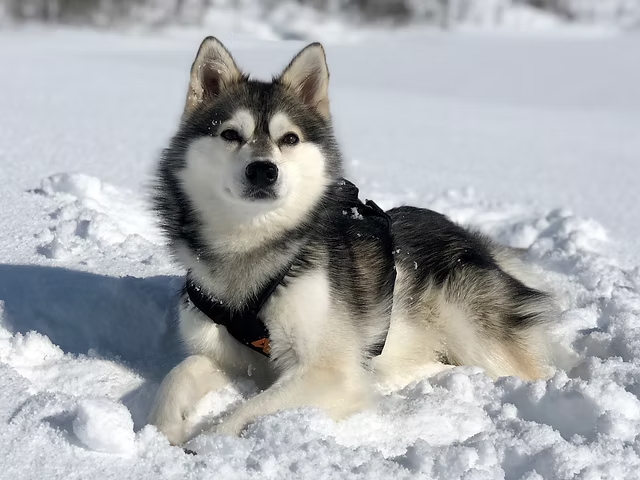
| Country of origin | United States (Alaska) |
| Period of creation | From the early 1970s to 1988; first public presentation in 1988 |
| Purpose under the standard | Companion dog only, not a working sled dog |
| Life expectancy | Sources usually give 13 to 16 years |
| Size varieties | Three: Toy, Miniature, Standard (under the UKC) |
| Recognition | UKC since 1997; AKC — Foundation Stock Service since 2020, Miscellaneous Class since 2025; ARBA since 1995 |
| FCI | Not recognised |
The shortest route to understanding the Klee Kai runs through three points. First, it is a companion dog by design and by standard: the breed was never created for work in harness, and no registry describes it as a sledding breed. Second, the breed is very young — less than half a century — and every one of its representatives descends from a single breeding programme. Third, its looks and its temperament pull in different directions: the body of a northern spitz, the behaviour of a cautious observer.
History of the breed: how the miniature version was made
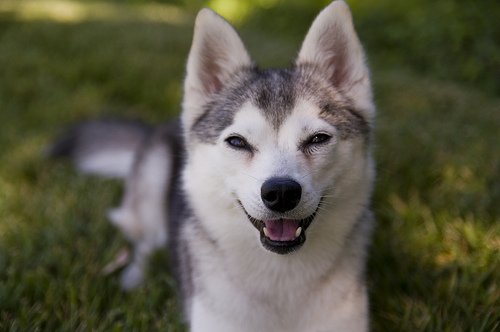
The breed was created by Linda Spurlin and her family in Alaska. According to the account published by the veterinary genetics laboratory of the University of California, Davis (UC Davis VGL), the work ran from the early 1970s to 1988 and was carried out by that family alone. It is a rare case in which a breed can be traced not to a region or a century, but to one household and one generation of breeders.
The trigger, according to that same source, was a particular dog: a crossbred named Curious, acquired during a stay with a brother-in-law in Oklahoma. He looked like a small Alaskan husky and was most likely the result of a mating between a purebred Alaskan husky and a small dog of unknown ancestry. The enthusiastic reception the dog met back in Alaska decided Linda Spurlin to breed more like him. Her brother-in-law had the same idea for a while and then, when he stopped, sold her his best stock. Spurlin thereafter kept only the individuals that met her requirements for appearance, temperament and health. When she retired, her remaining dogs were bought by Eileen Gregory, who played the decisive part in the breed’s later recognition.
The key figure in the whole story is the size of the starting group. UC Davis puts it cautiously: the breed is probably the product of a limited number of crosses among as few as nine dogs. That group comprised:
- Alaskan huskies — not a breed in the registry sense but a type of working sled dog; this is what supplied the base.
- Siberian huskies — a few individuals, the source of the recognisable type and of the facial markings. For comparison, see the article on the Siberian Husky.
- The American Eskimo Dog — a contribution towards reducing size.
- The Schipperke — a small Belgian dog, also pulling in the direction of compactness.
What is not on that list is the Alaskan Malamute. It is often named among the Klee Kai’s ancestors, but the UC Davis account does not mention it: the northern look comes from the huskies, not from the malamute. If that giant of the north interests you in its own right, it has a separate article — the Alaskan Malamute; it has no share in the Klee Kai’s pedigree.
The name itself, by contrast, has no simple answer. Every version renders “klee kai” the same way — “little dog” — but they part company over the language it comes from: the breed club’s founding account traces it to Eskimo words, while a version widespread in breed descriptions assigns it to the Athabascan language group. We leave the question open and endorse neither. The chronology then runs as follows: 1988, first public presentation under the name Klee Kai; 1995, recognition by the American Rare Breed Association (ARBA) and, in the same year, a split into two names, Alaskan Klee Kai and Klee Kai; 1 January 1997, recognition by the United Kennel Club; 2002, reunification of the two branches under the single name Alaskan Klee Kai. More recently the breed has cleared two further steps at the American Kennel Club: October 2020, entry into the Foundation Stock Service, the AKC’s preparatory register, and June 2025, admission to the Miscellaneous Class, the last stage before full recognition.
By contrast, the Fédération Cynologique Internationale (FCI) does not recognise the breed: it does not appear in the FCI nomenclature to date, and no FCI standard exists for it. The same goes for the Kennel Club in Britain. In practical terms this means the Alaskan Klee Kai cannot be shown under FCI auspices, and that every description of the breed currently in force comes from the UKC and the AKC.
Appearance and standards: the three sizes of the “wolf cub”
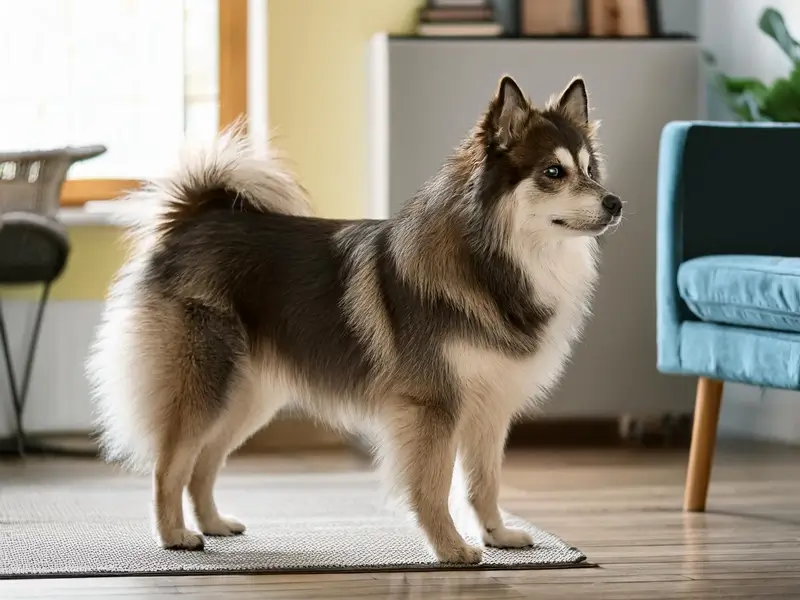
The Klee Kai is not a dwarf husky marked by degeneracy but a harmoniously built dog of northern spitz type. The UKC states the aim of the breed directly: to be a companion-sized version of a northern spitz-type dog. The head is wedge-shaped, the ears erect and triangular and densely furred; the tail is carried over the back. What sets the breed apart above all is its official division into three size varieties.
The varieties by size (UKC)
The UKC standard thinks in inches and sets its limits inclusively; they should therefore not be reproduced “approximately”, because it is precisely at those boundaries that a dog’s placement in one variety or another is settled. The centimetre values below are a conversion, not a separate norm.
| Variety | Height (at the withers) under the UKC standard | Approximate conversion |
|---|---|---|
| Toy | Up to and including 13 inches | up to ~33 cm |
| Miniature | Over 13 and up to and including 15 inches | ~33–38 cm |
| Standard | Over 15 and up to and including 17 inches | ~38–43 cm |
The standard then distinguishes two consequences of different severity for dogs that exceed those limits, and the two should not be confused. A height over 17 and up to and including 17.5 inches (~43–44.5 cm) is for the UKC a serious fault: the dog stays in competition but is heavily penalised. A height over 17.5 inches (~44.5 cm) is graver still — the UKC treats it as an eliminating fault, serious enough that the dog can take no award at a conformation show. The widespread formula that “anything over 43 cm is a breeding fault” is therefore imprecise: nearly a centimetre and a half separates a serious fault from elimination.
The registries diverge here, and it is worth knowing that. The AKC describes height differently: as a single band of 12 to 17 inches at the withers (~30–43 cm), with disqualification above 17.5 inches, and without reproducing the three-variety division in the form the UKC uses. In other words, “the height of the Klee Kai” has no single answer: there is the UKC’s formulation and the AKC’s, and merging them into an averaged band would be wrong.
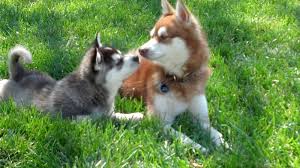
One peculiarity is easily missed: puppies of different size varieties can be born in the same litter. Adult size is not fixed in advance by a “line” — a Toy and a Miniature can come out of the same whelping. For a buyer this means something simple: quoting a precise adult size for a two-month-old puppy is a forecast, not a guarantee.
Eyes and mask
The eyes may be brown, blue, amber or green; heterochromia (eyes of different colours) occurs, as does the so-called “parti-coloured” variant, in which two colours share a single eye. A clear, contrasting mask is compulsory: it must be symmetrical and must not “drown” the eyes. It is precisely this mask that gives the breed the look it was created for.
Coat and colour
The coat is double: a dense, soft undercoat and a straight outer coat. Two types are recognised, standard and full coat, on condition that the hair does not hide the outlines of the body. The main recognised colours are:
- black and white;
- grey and white — every shade, from silver to dark grey;
- red and white, from light to dark.
White is always present on the legs, the chest and the underside of the body. Entirely white dogs are born, but they are not judged in the show ring under the standard in force — which changes absolutely nothing about their qualities as companions. If you are considering the breed chiefly for its compactness, a comparison with another small spitz is useful: the Pomeranian, close in size to the Toy variety of the Klee Kai but very different in both coat and character.
Character and behaviour: how the Klee Kai differs from the husky
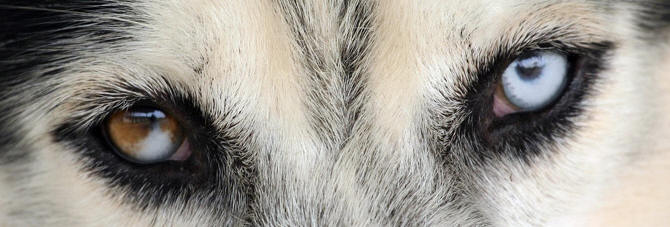
This is the most important section on the page, because this is where buyers’ expectations part company with reality most often. The breed is sold as “a miniature husky”, and the husky, in the popular imagination, is a happy-go-lucky sort ready to follow anyone who strokes it. The Klee Kai works differently, and that is written into the standards themselves.
The UKC standard puts it this way: while affectionate with members of its family, the Alaskan Klee Kai is reserved and cautious with strangers and in unfamiliar situations. Elsewhere the standard notes that these dogs may be aloof with strangers, and that loyalty and alertness make them good watch dogs, readily territorial despite their small size. The AKC describes the breed as alert, energetic and curious, but reserved with unfamiliar people and in unfamiliar situations, and specifies that this sensitive and reserved nature makes positive reinforcement and early socialisation indispensable.
Reserve, then, is neither a training failure nor a “bad character”: it is a characteristic the standard expects and describes. But the standard also draws a firm line: viciousness or extreme shyness is a disqualification — the UKC’s own wording, and a heavier category than a fault. The distinction matters enormously. A dog that keeps its distance from a visitor, watches calmly and does not seek contact is a normal Klee Kai. A dog that panics, bolts, trembles or lunges forward falls outside what the standard considers acceptable, and a temperament of that kind has no place in breeding.
The practical conclusion for a family is simple. The Klee Kai is not the breed for someone who wants a dog that greets every visitor warmly. It will sooner go and study the newcomer from a distance, and save its lap for its own people. If you often have strangers in the house — tradespeople, delivery drivers — that is something to prepare for in advance and methodically, not something to leave in the hope that “it will pass with age”.
The UC Davis account adds several traits that should be read as warnings about daily life: these are extremely active dogs, highly intelligent and easy to train, but inclined to have their own way; they require good socialisation with people and with dogs alike, and a clear, consistent position from their owner. The same text says Klee Kai are likely to be accomplished chewers, diggers and jumpers, and that keeping them contained in a house or garden is not always straightforward.
What that means day to day:
- The voice. The Klee Kai barks little in the monotonous sense: it “talks”, howls, grumbles and produces drawn-out sounds. For neighbours on the same landing that can be more noticeable than ordinary barking.
- Fence and lead. The tendency to dig, jump and look for a way out calls for a genuinely enclosed garden and for lead walks outside it.
- Mental load. Unoccupied intelligence turns into destructive ingenuity. Scent games, puzzles and trick training are not a luxury here.
- Visitors. The right tactic is to leave the dog its space without forcing contact; with a cautious dog, coercion produces the opposite effect.
If you were after a dog of an entirely different register — a working herder with a very different relationship to people — see the article on the Savoy Shepherd. And for admirers of powerful breeds there is a separate piece on the Alapaha Blue Blood Bulldog.
A narrow founder base: what the genetic testing showed
Texts about the Klee Kai frequently invoke a “limited gene pool”, almost always in general terms. Yet the figures exist: the veterinary genetics laboratory at UC Davis, with Niels Pedersen, runs a dedicated genetic diversity assessment programme for this breed, and its report finally makes it possible to discuss the consequences of that narrow base in concrete terms.
The method is as follows: 33 microsatellite (STR) markers spread across 25 chromosomes are used to measure diversity at genome scale, and to these are added markers linked to the DLA regions (dog leukocyte antigen), which are responsible for the immune system’s recognition of self and non-self. The first assessments covered 370 dogs; some tables in the report have since been updated on larger numbers.
What the genome markers show. The mean number of alleles per locus in the Klee Kai is 4.788, while the mean number of “effective” alleles — those that actually contribute to diversity — stands at 2.620. In plain terms: close to half of the variants present across the 33 loci are idling. Depending on the locus, the number of alleles ranges from 2 to 10, and several loci carry only two or three — a minute fraction of what is known in dogs generally. The report’s conclusion is direct: for diversity at each locus, the Klee Kai sits well behind breeds that started from far larger numbers of founders.
And here is the most interesting point — the one most retellings miss. Low diversity does not in itself imply inbreeding here and now. Observed heterozygosity in the population is 0.573, and expected heterozygosity is 0.573 as well. The gap is nil, the F coefficient therefore comes to zero, and the population sits at Hardy–Weinberg equilibrium. The report reads this without ambiguity: breeders of the breed are doing a very good job of avoiding inbreeding and are pairing dogs in a practically random fashion, with no “popular sire” effect. The value of 0.573 remains modest in itself and comparable with that of the Akita, likewise a breed raised from a small group of founders.
At the level of the individual. For each dog an index of internal relatedness (IR) is calculated: the lower it is, the less related the parents. In the Klee Kai the peak of the distribution sits around −0.1, and very few dogs exceed 0.20. For scale: 0.25 is the average value expected in puppies born to full brother and sister in an ordinary population. Within the breed, then, the breeding pairs really are genetically distinct from one another.
But change the point of reference and the picture changes. The same index is recalculated against the village dogs of the Near East, South-East Asia and the Pacific islands — the most diverse population ever studied, the closest to the state of dogs before directed selection. In that frame (IRVD) the Klee Kai’s mean value approaches 0.30, with a spread from 0.00 to 0.50. The report draws a very vivid image from this: measured against village dogs, the bulk of Klee Kai would look like the offspring of full brother-and-sister matings. The breed has lost a considerable share of its diversity since its ancestors — without that loss being exceptional: it is comparable to that of other breeds with small founder numbers, such as the Akita or the Black Russian Terrier.
The immune region. Across 365 dogs examined, 11 DLA class I haplotypes and 8 class II were identified. All of them are shared with other breeds: the Klee Kai possesses none of its own. That is few by the standards of large breeds, though of the same order as in breeds with small founder groups. The distribution is skewed: two class I haplotypes and three class II haplotypes between them account for 50 to 70% of cases. The report attributes this imbalance to the level of the original founders, at a period when inbreeding was unavoidable; subsequently the choice of pairs within that base became largely random. That said, the expected heterozygosity of the DLA region itself reaches 0.680, which leads the report to call it reasonably heterogeneous.
The conclusion deserves careful reading. The UC Davis report holds that the breed set out from a low level of diversity, but that the diligence of its breeders has preserved the existing diversity well through random pairing. The difficulty lies elsewhere: that low level, on the genome and in the DLA regions alike, is precisely what makes any increase in diversity from inside the breed difficult. The ceiling is low, and raising it without going outside the existing stock is hard.
Finally, a caution the laboratory states explicitly, and one that should be set against the two usual excesses whenever rare breeds come up: limited genetic diversity is not the same thing as poor health, even though it does make hereditary disorders harder to manage once they reach a worrying level. A breed can be founded on a small group, provided the founders are free of hereditary defects. The difficulty is that most hereditary traits in dogs are complex in nature and present even in unselected populations: they pass into the new breed “by inheritance”, and it is subsequent inbreeding that turns them from an isolated case into the rule.
Health: the weak points
Care and grooming: simpler than it looks
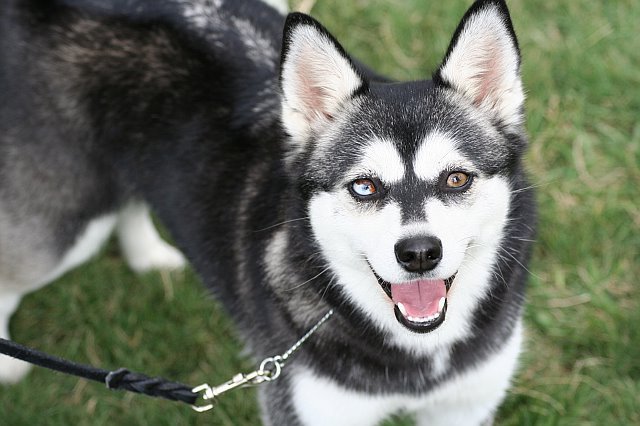
For all its spectacular looks, the Klee Kai belongs among the relatively undemanding breeds to maintain. The northern double coat cleans itself: dirt dries and falls away, so that frequent baths are unnecessary and rather harmful, since they strip away the natural protective layer. Wash the dog as the need arises, not by the calendar.
Moulting is the main call on your time. Twice a year, in spring and autumn, the dog renews its undercoat; through those weeks brushing becomes a daily job, with a slicker brush and a metal comb. For the rest of the year one thorough brushing a week is enough. This seasonal storm is what most surprises owners who chose a compact dog in the expectation of a compact quantity of hair.
What not to do: clip. The double coat insulates in both directions — it protects against cold as much as against overheating — and after clipping, outer coat and undercoat often grow back unevenly. If the summer is hot, it is stripping out the undercoat that helps, not the clippers.
Teeth and claws. Small breeds are prone to tartar: tooth brushing should become a routine carried out several times a week. Claws are trimmed about once a month if they are not worn down on hard surfaces. The ears are inspected regularly; being erect they ventilate well, and problems there are rarer than in breeds with drop ears.
Feeding: how to keep the waistline
Training and socialisation: a challenge for the intellect
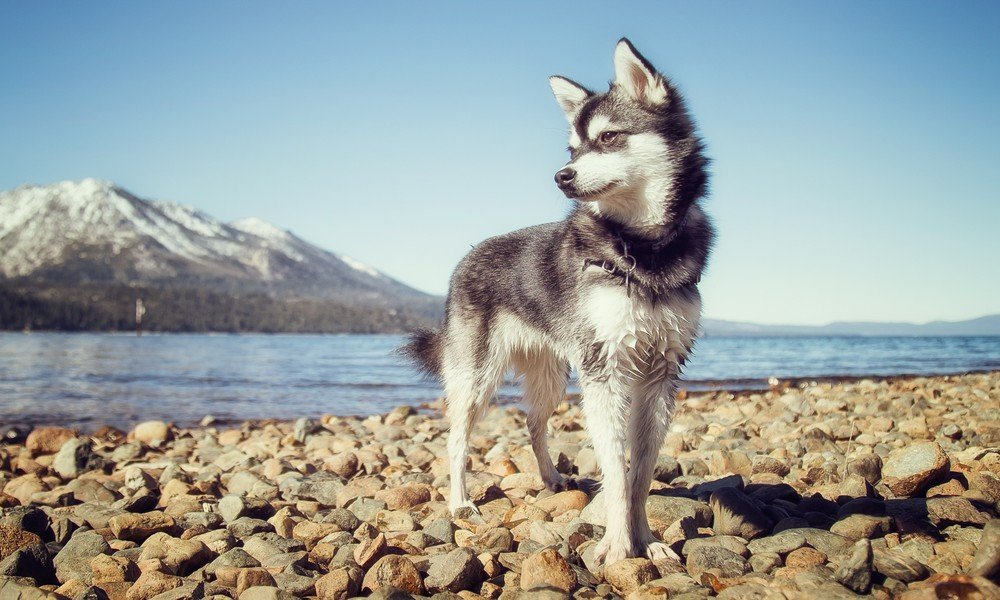
The Klee Kai learns fast: the question is not whether it will understand the exercise, but whether it will judge the exercise worth performing. The UC Davis account calls the breed highly intelligent and easy to train, but inclined to have its own way. That combination means mechanical repetition and coercion do not work, while short, motivating, rewarded sessions work very well indeed.
Here socialisation is not optional: it is part of what defines the breed. Since reserve towards strangers is written into the standard, the owner’s task is not to “convert” the dog into a party animal, but to teach it to be at ease around new people and new situations. The AKC says so plainly: a sensitive and reserved nature makes positive reinforcement and good socialisation from the earliest age indispensable. The practical rule is simple: the puppy should meet new experiences in measured doses and in a safe setting — at its own distance, with no forced introductions, and with the option of moving away. A dog that has withdrawn and is watching must not be hauled towards the visitor “to say hello”: that coercion is exactly what turns normal caution into fear.
Security deserves particular attention. The propensity to dig, to jump and to hunt for the weak point in a fence, noted by the same synthesis, calls for a genuinely enclosed garden, with the gaps under the fence controlled and the height sufficient. Letting a Klee Kai off the lead on unfamiliar open ground is inadvisable: caution towards people implies nothing whatever about caution when a cat or a squirrel is worth chasing.
The breed thrives on activities that call for speed, thought and rapport with the handler: agility, trick training, scent work. For a dog whose principal domestic failing is boredom, these are not entertainment but prevention.
Strengths and weaknesses of the breed
| Strengths | Weaknesses and limits |
|---|---|
| A compact northern dog that genuinely fits into city life | Reserved and cautious with strangers: a characteristic of the breed, not a mistake in upbringing |
| Three size varieties offer a choice to suit your living conditions | Adult size is not guaranteed: different varieties are born in the same litter |
| Learns quickly, excels at agility and trick work | Has a mind of its own; drilling does not work |
| Coat care is simple for most of the year | Twice a year, heavy moulting and daily brushing |
| An attentive watch dog | “Talks”, howls and grumbles — which can weigh on the neighbours |
| Breeders have a factor VII DNA test and a programme of examinations available | A narrow founder base: diversity is low and hard to widen from within |
In short: this is a breed for someone who accepts a dog with the temperament of an observer, invests in socialisation and gets through two moulting seasons a year. If the expectation is “a husky, but small and friendly to everybody”, disappointment is very likely.
Interesting facts about the Alaskan Klee Kai
- The breed split in two and then reformed. In 1995 it divided into two names — Alaskan Klee Kai and Klee Kai — before the two branches were reunited in 2002 under the single name Alaskan Klee Kai.
- The origin of the name is an open question. “Klee kai” means “little dog”, but the sources disagree about the language it came from: the club’s founding account names Eskimo words, the widespread version the Athabascan language group. We do not choose between them.
- A Toy and a Miniature can be born in the same litter. The size variety is not a separate line: it is the outcome of how the dog grows.
- The Klee Kai is not a Pomsky. The Pomsky is a cross between a Pomeranian and a husky, with an unpredictable result. The Klee Kai is a breed in its own right, with a traced pedigree and a standard of its own. The two should not be confused, either on origin or on expectations.
- The entire population descends from a single family programme. The breed never went through a “popular” phase: between the first dog and the first public presentation there is one family and some two decades of selection.
Questions owners ask
Is the Klee Kai a small husky?
No. The outward resemblance makes it a miniature husky neither by origin nor by character. It is a distinct American breed, created as a companion, and the standards describe it as reserved with strangers — the opposite of the Siberian husky’s reputation for universal sociability.
Is it suitable for a family with young children?
It is not the most convenient choice in a house with toddlers. The breed is sensitive and puts up badly with rough handling, and its caution towards strangers extends to invited playmates. In a family with school-age children, able to respect the dog’s distance, it is markedly more comfortable.
Can it be kept outdoors, in a kennel?
No. For all its warm coat, this is a companion dog that needs constant contact with its family; isolation is destructive to it. Its small size also makes it vulnerable outdoors.
What must I ask the breeder for?
The examination results for both parents — thyroid, heart, patellae, eyes — and whether they are published in an open database. Ask separately for the parents’ DNA status for factor VII: that particular test is not replaced by an ordinary blood sample.
Will my puppy really be a Toy?
That cannot be guaranteed. The variety is settled on the size of the adult dog, and dogs of different varieties are born in the same litter: at the puppy stage it is a forecast.
Does the Klee Kai bark a lot?
It barks little, but it “talks”: it howls, grumbles and modulates drawn-out sounds. In a flat that can be more noticeable than ordinary barking, and the question is worth thinking through in advance.
Video about the breed
- Compact, a "pocket husky"
- Clever and energetic
- Clean, long-lived
- Devoted to its family
- Very wary of strangers
- Heavy seasonal shedding
- Needs activity and exercise
- Can be "talkative"
| Siberian Husky | Pomeranian | Alaskan Malamute | |
|---|---|---|---|
| Height | 50–60 cm | 18–22 cm | 58–64 cm |
| Energy | 5 | 3 | 4.5 |
| Apartment | 2 | 4 | 2 |
| Beginners | 2.5 | 3.5 | 2 |
Is the Klee Kai a small husky?
Does the Klee Kai shed a lot?
What is special about factor VII deficiency?
UKC and AKC (Miscellaneous) · UC Davis VGL · Kaae et al., JVIM 2007 · USA
For apartments · For kids · For beginners · Active · Smartest · Hypoallergenic · All rankings →