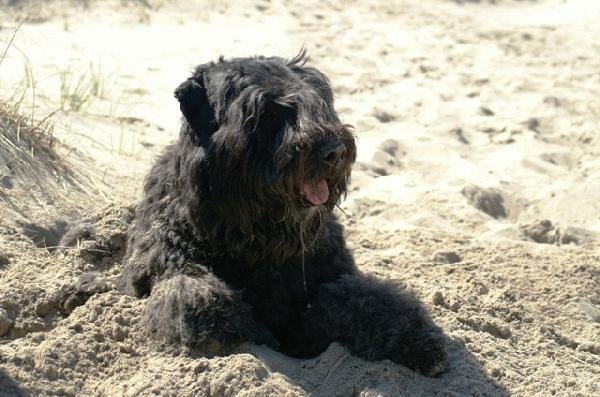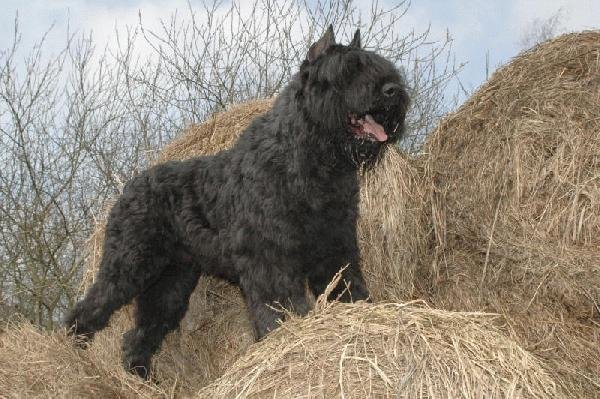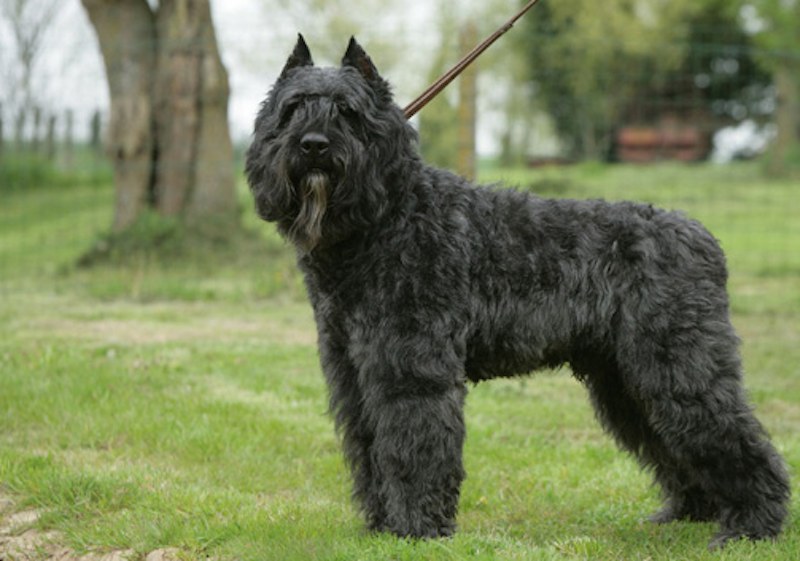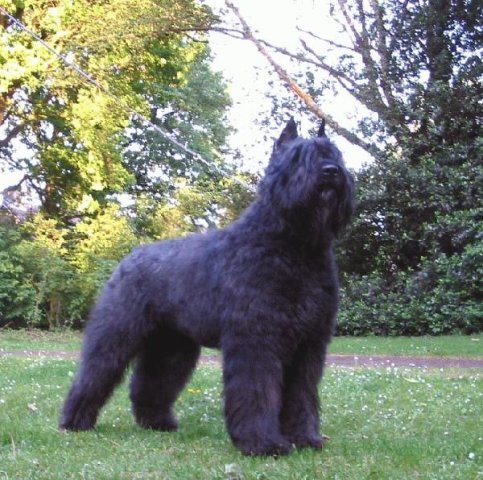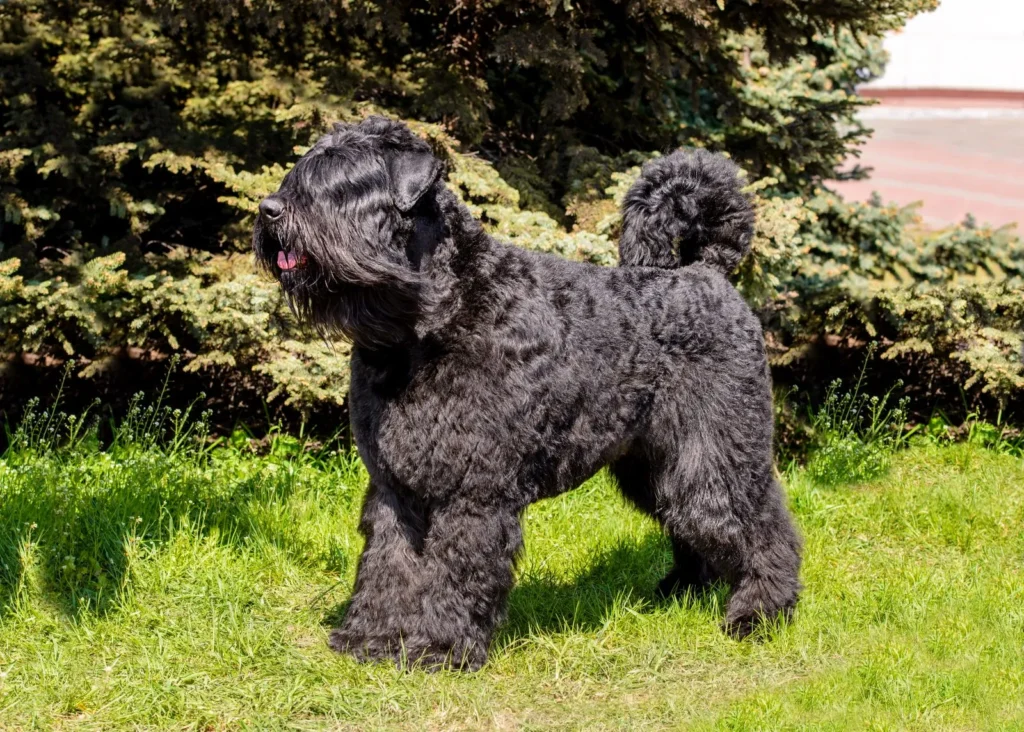
The Bouvier des Flandres is a Belgian-French cattle dog with a harsh coat, a beard and a mustache, kept for centuries not for its looks but for work with livestock. Today it is first of all a guardian and a service dog, and the silhouette everyone recognizes turns out to be the result of a procedure most of Europe has outlawed. More about the breed on Tvaryny.
Bouvier des Flandres: the breed at a glance
Bouvier des Flandres: the breed at a glance · 9
| Parameter | What the source says |
|---|---|
| Country of origin | Belgium and France (per the FCI standard) |
| FCI group | Group 1, Section 2 — cattle dogs, with a working trial |
| Standard number | FCI No. 191 |
| FCI recognition | definitive — November 1, 1955 |
| Current edition of the standard | published October 25, 2000 |
| Height at the withers | males 62–68 cm, females 59–65 cm (tolerance ±1 cm) |
| Weight | males 35–40 kg, females 27–35 kg |
| Lifespan | 10–12 years; median 11.3 years in a British study from 2024 |
| Coat | double, harsh, roughly 6 cm long |
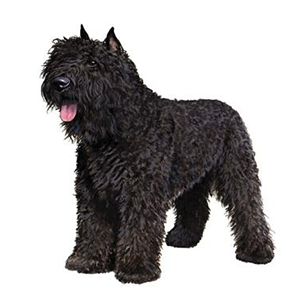
The Bouvier is easy to confuse with other big bearded or black dogs, so here is the quick orientation. It is more compact and squarer than the Giant Schnauzer, and substantially smaller than the Black Russian Terrier. Among cattle-driving breeds it is the heavyweight: the Australian Stumpy Tail Cattle Dog is lighter and quicker, while the Finnish Lapphund is a spitz-type herder on an entirely different frame.
Where the breed comes from: Flanders, not "Belgium in general"
The FCI standard names two countries of origin at once — Belgium and France, and it does so deliberately. Historic Flanders lies on both sides of the modern border, and the standard says outright that its Belgian and French halves are separated by no natural frontier. The breed took shape in a region, not in a country.
The historical sketch in the standard is remarkably modest, and that is what makes it useful. It says nothing about monasteries or exotic ancestors. It describes ordinary farm selection: herdsmen and cattle drovers in Flanders needed good dogs, so from the local stock they kept the ones with the physical and behavioral qualities the job demanded. The modern Bouvier, in the standard's own phrasing, inherited precisely those qualities.
The name is a job description too: bouvier in French means "ox drover." In the German edition of the standard the breed also appears under its Dutch name, Vlaamse Koehond — "Flemish cow dog" — and in the FCI's German nomenclature it is listed as Flandrischer Treibhund. This double naming is not an accident of translation: Flemish catalogs still present the breed first and foremost as the Vlaamse Koehond.
The list of original occupations deserves its own attention. The Bouvier worked as a herding dog, as a draft dog that pulled carts, and as a churn dog: it walked a treadwheel that turned the butter churn. Farm machinery retired all three jobs, and the standard records the change plainly — the breed is now used above all as a guardian of farm and homestead, as a protection and police dog, and, thanks to its nose, initiative and intelligence, as a tracking, messenger and gamekeeper's dog.
The familiar tale about the monks of Ter Duinen Abbey, who supposedly crossed local dogs with imported Irish Wolfhounds and Deerhounds, is best read as exactly that — a tale. The Belgian Royal Saint-Hubert Society, which keeps the LOSH stud book, says itself that little is known about how the breed formed before the 1900s. And the story collides with its own chronology: the first Irish Wolfhound standard was written in 1885, and that breed is a late reconstruction, so a medieval abbey could not have imported "Irish Wolfhounds" as a breed.
What is solidly documented is the set of working names the dog carried in Flanders: vuilbaard ("dirty beard"), koehond ("cow dog"), and the French toucheur de bœufs ("ox drover"). Those words appear in hundreds of items in the Belgian press from the late nineteenth century through the first half of the twentieth — real rural practice, not a legend assembled at a desk.
Nick: the foundation dog who never carried that name
Almost every profile of the breed mentions a dog called Nick de Sottegem, shown in 1920 at the "Olympic show" in Antwerp. Both halves of that sentence need adjusting.
The dog himself is real and has a stud-book entry: Nick, LOSH 10266, born in 1916, a Belgian champion, owned by N. Barbry of the town of Sottegem. Both parents are recorded as unknown, ordinary enough for postwar stock. But "de Sottegem" is the name of the owner's town, attached by later writers; under that name he does not appear in the stud book at all.
As for the "Olympic" show, the accurate version is simpler: the show took place in Antwerp in 1920, the year the Olympic Games were held there, and that is how people remembered it. The canine part of the program was not part of the Olympic program.
The breed and World War I: what is documented and what is not
Flanders became the ground for the heaviest fighting, and the breed's numbers really were shattered: the Belgian Saint-Hubert Society writes plainly that by 1918 the Bouvier population had been wiped out. That part is documented.
Past that point the retellings and the period sources part company. Paul Mégnin's Dogs of France: Soldiers of the Great War, published in 1919, does mention the Bouvier des Flandres among dogs with a "temperament of steel" and a harsh coat that carries them through bad weather — but in the chapter on the desirable type, not in any procurement record, and about French service. Mégnin actually names three at once: the Bouvier of Flanders, of the North of France, and of the Ardennes. Later retellings narrow the phrase to one breed — which is exactly how a neighboring breed’s fact migrates to the better-known one.
And the most repeated story of all — Bouviers hauling machine-gun carts — is contradicted outright by that same source: for that work Mégnin names the matin belge, the Belgian Mastiff, a different breed. The 1920 book by Edwin Richardson, commandant of the British War Dog School, names no breed at all in its chapter on the Belgian army. The heroic figures and roles that travel from one Bouvier article to the next are, in the period sources themselves, assigned to somebody else.
Legal status: why ratifying a convention explains nothing
Color: the one question where the registries openly disagree
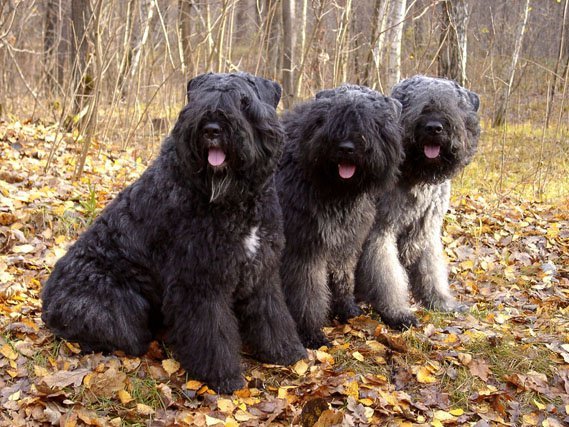
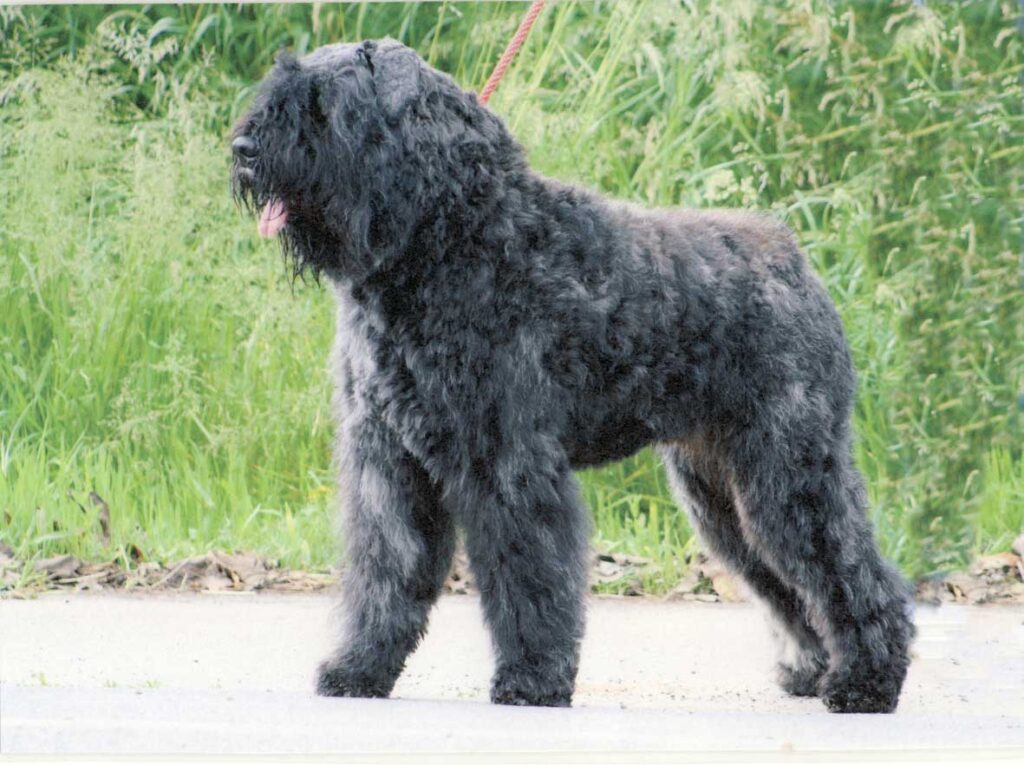
The FCI describes the Bouvier's coat as "usually gray, brindle or with a black overlay." A completely uniform black is admitted as well, but without preference. Washed-out, light colors are not acceptable, and a white star on the chest is allowed.
The AKC and the UKC word it differently and more broadly: "from fawn to black, passing through salt and pepper, gray and brindle." Fawn and salt-and-pepper are named outright there, whereas the FCI list does not contain them. The Kennel Club takes a middle position: "from fawn to black, including brindle," while listing an excess of white, chocolate brown and pale washed-out shades as undesirable.
In practice the same dog can be flawless under the American standard and run into trouble in an FCI ring. So "the standard color of the Bouvier," stated without naming whose standard, is a phrase with no content in it.
Bouvier des Flandres myopathy
This is the only condition on the list that carries the breed's own name, and the best described. In a study from Utrecht University published in 1991 in The Veterinary Quarterly, 24 Bouviers with swallowing disorders were examined. Tissue was available from 10 of them, and in nine the investigators found progressive degeneration of the pharyngeal and esophageal muscles resembling a muscular dystrophy; in two, the same changes also involved the masticatory muscles and the intrinsic muscles of the larynx. Nervous tissue showed no changes — the problem is muscular.
The authors stated directly that muscular dystrophy is hereditary, but that the mode of inheritance in these Bouviers was unknown at the time. A later paper by the same group, working from pedigrees, showed the risk rising with inbreeding. There is no DNA test for this condition: in the consolidated table of genetic variants for canine muscular dystrophies there is no row for the Bouvier.
The practical side is plainer than the name. The disease shows up as regurgitation, difficulty swallowing, reduced stamina and quick fatigue — signs easy to write off as laziness or age. That is why persistent regurgitation, or a change in the way the dog moves, deserves a veterinary visit rather than a wait-and-see.
Laryngeal paralysis, a condition the Bouvier helped define
This entry deserves more attention than it usually gets. Congenital laryngeal paralysis was described in the Bouvier as early as 1975, and in 1982 a Dutch veterinary journal ran a paper whose title says it all: "Laryngeal paralysis in Belgian Bouviers des Flandres and breeding advice to prevent this condition." The breed does not merely "carry a risk" — it is one of the breeds on which the condition was characterized.
The signs: hoarse, noisy breathing, a change in the voice or the bark, labored breathing, and poor tolerance of heat and exertion. That last one matters most — a dog with laryngeal paralysis overheats faster, because it cannot pant normally.
Eyes: glaucoma and goniodysgenesis
After the myopathy, this is the best-supported direction. The European College of Veterinary Ophthalmologists, in its breed list, names for the Bouvier glaucoma associated with an abnormality of the pectinate ligament, with onset from 3.5 months to 14 years, and notes that the mode of inheritance is unknown and that there is no genetic test.
Dutch work gives the scale of it. As far back as 1987, when 80 Bouviers with no signs of eye disease were examined, pectinate ligament dysplasia was found in 75% of eyes with normal pressure. A 1996 study on 72 dogs found goniodysgenesis in 37.5% and, from pedigree analysis, pointed to recessive inheritance. A prospective study from 2017 in JAVMA followed 98 Bouviers over 7–9 years: primary closed-angle glaucoma developed in nine dogs out of 92, and every affected dog shared a father or grandfather. The 92 are the dogs that completed follow-up.
Two conclusions follow. First, gonioscopy is a separate examination that a routine eye exam does not replace, and it is what the Dutch breed clubs require. Second, a high frequency of the angle abnormality does not mean all those dogs will fall ill — the trait is widespread in the breed, while glaucoma develops in a smaller share of it. That is why gonioscopy makes sense as a breeding tool.
For an owner the rule is short: glaucoma is a condition measured in hours. A red eye, visible clouding, sharp pain that has the dog hiding its head or rubbing its face — seek care immediately.
The heart: subaortic stenosis and the limit of the evidence
Here some honesty about the level of confirmation is in order, because it is lower than the club lists would lead you to believe.
A review of the genetics of subaortic stenosis published in 2021 in Canine Medicine and Genetics does name the Bouvier des Flandres in its text, among breeds with a described mode of inheritance. But in that same review's own tables — neither in the list of breeds with the highest reported frequency nor in the list of breeds with a described mode of inheritance — the Bouvier does not appear. The source contradicts itself, and the table carries more weight than the sentence in the running text.
That does not cancel the practical conclusion: subaortic stenosis remains one of the most common congenital heart defects of large breeds, the cardiac examination belongs to the recommended panel, and it makes sense to do it not in early puppyhood — the same review notes that for a conclusive assessment animals are examined at at least 9–12 months. But presenting the Bouvier's predisposition as proven by numbers would be an overstatement.
The thyroid: a case where the data did not back the list
Hypothyroidism sits on the club's list of conditions to screen for, and that is precisely why it deserves a separate mention: a large study did not confirm it.
A 2025 paper in Frontiers in Veterinary Science, built on repeated thyroid function assessments, looked at breeds with at least a hundred repeatedly tested dogs. The Bouvier entered that sample with 108 animals — and ended up among the eight breeds in which not a single dog was classified as having autoimmune thyroiditis. The share with a normal assessment in the breed came out essentially the same as the average across the whole cohort.
None of this is a reason to skip a test your veterinarian has ordered on clinical grounds. But these data do not let anyone present hypothyroidism as a characteristic breed disease of the Bouvier, and that is exactly why it is absent from our breed card.
Joints, the stomach, and the bowl you should not lift
Hip dysplasia and elbow dysplasia appear on the screening list as separate lines, and both examinations belong to the recommended panel. For a large breed that grows fast, that is the standard requirement placed on breeding animals.
Gastric dilatation and volvulus is mentioned by the American club with an important qualification — as a risk shared by all large, deep-chested breeds, not a peculiarity of the Bouvier. That phrasing is worth keeping: the large epidemiological studies of bloat do not list this breed among the most predisposed, and turning a general risk into a breed-specific one would be a stretch.
One widely repeated piece of advice, on the other hand, is frankly harmful here. A raised bowl does not lower the risk. A large prospective cohort study linked the raised bowl to an increased risk of bloat in large and giant breeds, and no study has shown the opposite. So "lift the bowl so the dog is more comfortable" is not neutral advice for a deep-chested breed.
What does help: dividing the daily ration into at least two meals, avoiding heavy exertion immediately before and after eating, and knowing the signs — unproductive retching, a distended abdomen, restlessness, drooling. Bloat is an emergency, and the time it takes to reach the operating table decides the outcome.
How long the Bouvier des Flandres lives
Here we can lean on research instead of on reference-book estimates. The paper Longevity of companion dog breeds: those at risk from early death, published in 2024 in Scientific Reports by a team from Dogs Trust and Liverpool John Moores University, covered 584,734 dogs in the United Kingdom, 284,734 of them deceased, and produced estimates for 155 breeds.
For the Bouvier des Flandres the sample came to 151 dogs, 79 of them deceased, and the median lifespan was 11.3 years with a 95% confidence interval running from 10.4 to 11.9 years. Reference sources usually quote a range of 10–12 years, and the research median falls inside it.
One detail from the same table is worth naming. The hazard ratio for the Bouvier against crossbred dogs was 1.07 with a p value of 0.52 — the difference is not statistically significant. On these data the breed stands out neither for better nor for worse. A sample of 151 dogs is small, which is why it belongs beside the figure: a median given without its sample size says nothing.
Bouvier, Giant Schnauzer, Briard and Dutch Shepherd: telling them apart
The confusion here is not harmless: along with the outward resemblance, facts about health and origin migrate from one breed to another.
- The Giant Schnauzer is the easiest case: it is not even in the same FCI group. The Bouvier belongs to Group 1, the Giant Schnauzer to Group 2. The German breed has a longer silhouette, a close-lying coat and only two permitted colors.
- The Briard is a French sheepdog of Group 1, but of Section 1 — a sheepdog, not a cattle dog. Its coat is long and soft, of a completely different structure than the harsh, dry outer coat of the Bouvier.
- The Dutch Shepherd is also Section 1, noticeably lighter, and its brindle on a golden or silver ground is something the Bouvier does not have.
- The Bouvier des Ardennes is the most dangerous source of confusion, because the name is nearly identical. It is a separate breed with its own FCI standard number, and the hereditary conditions described for it belong to it.
That last point is worth underlining: the similarity between the names of the Bouvier des Ardennes and the Bouvier des Flandres regularly leads to data about one breed being presented as data about the other.
Who the breed suits, and who it does not
The Bouvier does well where it has a job it understands and a consistent owner. This is a breed for someone ready to work the dog every day and to put time into the coat regularly — not now and then, but as a permanent part of the household routine.
It will be hard going for anyone counting on a decorative big dog: the guarding instinct surfaces by itself, and the mass and strength call for a dog under control from the first months. The inconveniences worth knowing in advance are thoroughly domestic — a beard wet after every drink, the dirt a harsh coat carries in from outdoors, and slow maturation.
Lesser-known things about the Bouvier des Flandres
- The dog at the butter churn. Among the breed's original occupations the FCI standard names work as a churn dog — the animal turned the mechanism that churned the butter. That is a line in an official document, not folklore.
- Two countries in the origin field. The Bouvier is one of the few breeds for which the FCI lists two states at once as the country of origin.
- A breed with an exam. In the FCI nomenclature the Bouvier is listed with a working-trial requirement — conformation alone is not enough for the full title.
- A dog in the White House. A Bouvier named Lucky lived with Ronald Reagan's family. According to the presidential library, she was given to Nancy Reagan on December 6, 1984, named after the first lady's mother, and in the fall of 1985 moved from the White House to the ranch — she had simply grown too large for the residence.
- A rare breed in the United States. The AKC recognized the Bouvier in 1931, but in popularity among registered breeds it hovers around hundredth place: 83rd in 2015 and 100th in 2025.