A white-and-orange Istrian tracker with a gentle nature — hardy and devoted: calm, patient, slightly stubborn and attached to the family. The Istrian Shorthaired Hound is an ancient Balkan breed from Istria that combines exceptional working qualities with a surprisingly gentle character; at home it is calm and tolerant of everyone, but it needs an active lifestyle.
Apartment · not suitableKidsCats · not suitableOther dogsBeginners · with caveats
The Istrian Shorthaired Hound is more than just a dog; it's a living piece of history embodied in a graceful and powerful form. This ancient breed of Yugoslavian hunting dogs combines exceptional working qualities with a surprisingly gentle and affectionate nature, making them wonderful family pets. While their natural stubbornness can be a challenge for owners, the right training and a deep understanding of the breed's needs transform this hound into a loyal friend and a true member of the family. They are known for getting along brilliantly with everyone in the household, showing immense patience and devotion. The breed is low-maintenance when it comes to grooming and diet, but their primary need is an active lifestyle and regular, vigorous exercise. We’ll delve into all the unique characteristics, pros, and cons of this remarkable hunter in more detail. You can read more about this and other breeds on Tvaryny.
The Istrian Shorthaired Hound: A Brief Breed Overview
The Istrian Shorthaired Hound: A Brief Breed Overview · 9
Middle Ages, first written mentions from the 14th century
FCI Classification
Group 6 (Scenthounds and Related Breeds), Section 1.2 (Medium-sized Hounds). Working trial is mandatory.
Height at Withers
18.5–23.2 inches (47–59 cm) (dogs and bitches)
Weight
35–53 pounds (16–24 kg)
Lifespan
12–15 years
Purpose
Hunting small game (hare, fox), companion dog
Temperament
Energetic, devoted, stubborn, gentle with family, vocal
The Istrian Shorthaired Hound in Hunting
Hunting is the element for which this dog was created. The Istrian is a classic tracking hound. Its main specialization is hunting hares and foxes, but it also works successfully on wild boar and other game. Its main advantage is its passion for work, endurance, and incredible voice. The dog is capable of chasing prey for hours through rough terrain without losing the scent, and it will notify the hunter of its location with a melodious and loud bark. They can work both alone and in a pack. Even if you're not a hunter, it is important to understand that this instinct never disappears and will manifest in everyday life.
Interesting Facts About the Breed
Artistic Heritage: The depictions of these dogs on 15th-century frescoes are one of the oldest documentary proofs of the existence of a European hound breed.
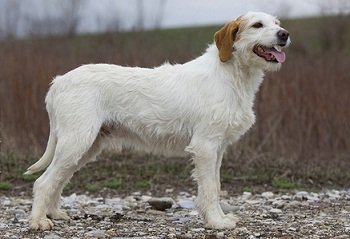
The Two 'Faces' of Istria: There are two varieties of the Istrian Hound—the shorthaired and the coarse-haired. While they are very similar, the coarse-haired version is slightly more robust in build and has a calmer temperament.
Melodious Voice: The voice of the Istrian Hound isn't just a bark. Hunters describe it as a loud, melodious, and very expressive sound. An experienced owner can tell what stage of the chase the dog is at just by the tone of its voice.
National Treasure: In Croatia, Istrian hounds are considered a national treasure and a part of the country's cultural heritage.
Not a Guard Dog: Despite their loud voice, Istrians are usually very friendly towards strangers, which makes them poor guard dogs. They are more likely to "lick a burglar to death" than to show aggression.
History and Origins of the Istrian Shorthaired Hound
The Istrian Shorthaired Hound is one of the oldest hound breeds on the Balkan Peninsula, with a history that stretches back centuries. It is believed that these dogs are direct descendants of ancient hounds brought to the Adriatic coast by Phoenician traders. These dogs were then crossed with local European breeds, which laid the foundation for the formation of a unique hound type, perfectly adapted to hunting in the rocky and hilly terrain of Istria.
The first visual evidence of the breed's existence can be found in old frescoes. The most famous depiction is in the Chapel of St Mary in the town of Beram, Croatia, dating back to 1474. These frescoes clearly show dogs that are virtually identical in their appearance to the modern Istrian hounds. The first written mentions of the breed date even earlier, to 1337, while more detailed descriptions appear in the chronicles of Bishop Petar Bakić from Đakovo in 1719.
Despite this long history, official recognition for the breed came much later. The first entry into the Croatian studbook was made in 1924. The Fédération Cynologique Internationale (FCI) gave the breed preliminary recognition in 1929, but a full standard was only published in 1948. For decades, these dogs were indispensable helpers for local hunters, who valued them for their incredible stamina, keen sense of smell, ability to follow a blood trail, and, of course, their characteristic loud and melodious voice, which they use to announce the found game.
Breed Standard and Appearance
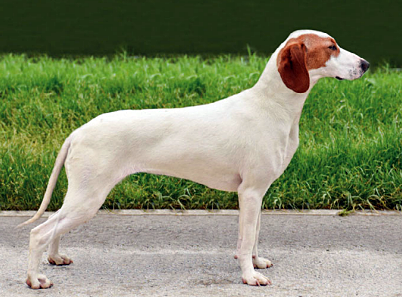
The Istrian Shorthaired Hound is a dog of noble appearance with a strong but not heavy build. Its look gives an impression of speed and endurance. The body is well-balanced, with well-developed musculature, which reflects its purpose as a hunting dog.
Head and Muzzle
The Istrian’s head is long and wedge-shaped, but without excessive leanness. The skull is slightly convex, and the occipital protuberance is well-defined. The stop is smooth, not abrupt. The muzzle is long, strong, and rectangular in shape. The nose is always black or dark brown, with well-open nostrils. The lips are thin and tight-fitting. The bite is a scissor bite, and the teeth are strong and white.
Eyes and Ears
The eyes are oval, small, and dark in color (from amber to dark chestnut), with a lively and intelligent expression. Their gaze is calm but attentive. The ears are one of the breed's characteristic features. They are thin, wide, set slightly above the eye line and hang down, fitting closely to the cheeks. The tips of the ears are rounded, and they should not be too long.
Body and Limbs
The neck is strong, muscular, without a dewlap. The withers are well-defined. The back is straight and broad, the loin is short and muscular. The croup is slightly sloping and broad. The chest is deep but not too wide, providing ample space for the lungs and heart. The ribs are well-sprung. The belly is slightly tucked up. The tail is a continuation of the topline, thick at the base and tapering towards the tip. When in motion, the dog holds it slightly curved upwards, but never curled over the back. The limbs are straight and parallel, with strong bone structure and well-developed muscles, which provide powerful drive and stamina during a run.
Coat and Color
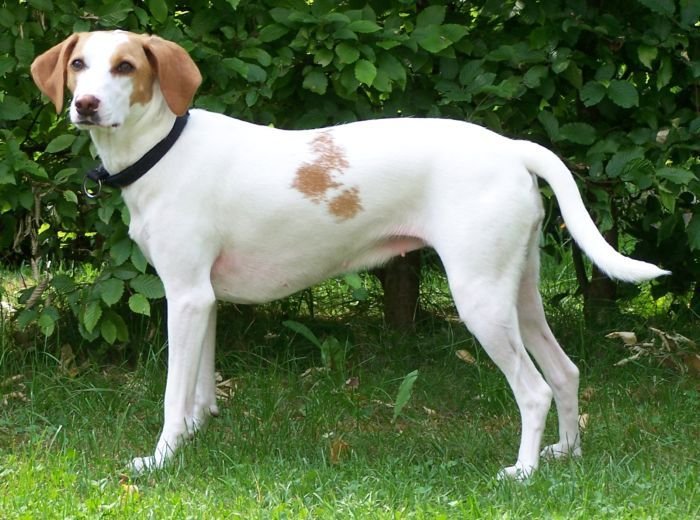
The coat is a key distinction of this breed. Unlike its close relative, the Istrian Coarse-Haired Hound, its coat is short, fine, dense, and shiny. It lies tight to the body, providing good protection from the weather, but it doesn't hide the muscle definition. The primary color is snow white. On this background, there are patches and/or speckles of yellow-orange color. The patches can be of various sizes and are usually located on the ears, head, and body. The ears are always colored orange. Speckles may be present over the whole body, but they should not dominate the white background so much that the dog appears mottled. The Italian Shorthaired Hound (Segugio Italiano), a similar breed from the region, also has a short coat but with different markings.
Character and Temperament
The character of the Istrian Shorthaired Hound is an amazing blend of two worlds. On the hunt, they are keen, passionate, and relentless workers, while at home, they are calm, gentle, and devoted companions. This duality makes them unique but also requires the owner to have a deep understanding of the dog's needs. They become very attached to their families and get on famously with children, showing patience and tenderness. They usually live well with other dogs, especially if they were raised together. However, their hunting instinct can be a problem with small pets like cats, rodents, or birds. Early and proper socialization is critically important.
One of the main character traits is stubbornness and independence. These qualities were cultivated over centuries for solitary work in the field, so don't expect blind obedience from an Istrian. They always have their own opinion and require a handler with a firm but fair hand. Roughness and physical punishment are absolutely unacceptable—they will only intensify their stubbornness and can destroy trust. Another important trait is their vocal nature. Their loud, melodious bark is the pride of hunters but can become a problem in a city environment. They bark when they are excited, when they see prey, or simply when they are bored.
Pros and Cons of the Breed
Advantages
Disadvantages
Family devotion and gentleness: Very gentle and attached to their people, patient with children.
High need for activity: Not suitable for sedentary people; requires daily long walks and exercise.
Excellent health: Rarely suffers from hereditary diseases, has a strong immune system.
Stubbornness and independence: Can be difficult to train, requires an experienced owner.
Low-maintenance grooming: The short coat doesn't require complex grooming.
Strong hunting instinct: Prone to running away; should not be let off the leash in unsafe places.
Endurance and work ethic: An ideal partner for hunting, trekking, and active recreation.
Vocal nature: Prone to frequent and loud barking, which can be an issue for neighbors.
Striking appearance: The noble look and bright coloring attract attention.
Needs space: Doesn't cope well with being kept in a small apartment without sufficient exercise.
Training and Socialization
Training an Istrian Hound is a challenge that requires patience, consistency, and an understanding of a hunting dog's psychology. Due to their natural stubbornness and independence, they are not inclined to blindly obey commands. The key to success is positive reinforcement. Use treats, praise, and games as rewards for correct behavior. Training sessions should be short, engaging, and varied so the dog doesn't lose interest. Early socialization is absolutely essential. From puppyhood, introduce the dog to different people, sounds, places, and other animals. Special attention should be paid to the "Come!" command. Due to their strong hunting instinct, it can be extremely difficult to recall a hound that has picked up a scent. Therefore, this command must be practiced constantly, starting from a young age.
Care and Management of the Istrian Hound
Grooming and Coat Care
Caring for the Istrian Shorthaired Hound is straightforward. Their short, smooth coat only needs to be brushed 1–2 times a week with a special rubber brush or mitt. This helps to remove dead hair, stimulate blood circulation, and keep the coat in a shiny condition. During the seasonal shedding periods (spring and fall), you can do this more often. You should only bathe the dog when necessary, using a mild shampoo for short-haired breeds. Frequent washing can disrupt the skin's natural protective layer. Far more important is the regular inspection and cleaning of the ears. Their pendulous shape creates a favorable environment for the growth of bacteria and fungi, so the ear canals should be checked weekly and cleaned with a special lotion. Don't forget about trimming their claws (if they don't wear down naturally) and dental care.
Physical Exercise and Activity
This is the most important aspect of owning this breed. The Istrian Hound is an energy powerhouse. They desperately need daily, long, and intense physical activity. Normal walks on a leash around the block will be catastrophically insufficient. The ideal option is a minimum of 1.5–2 hours of activity per day. This could be:
Long walks or runs in a park or forest (on a long leash or in a secure area).
Accompanying the owner on bicycle rides.
Playing games with a ball or frisbee in a fenced-in area.
Participating in dog sports such as coursing or agility.
Without sufficient exercise, their pent-up energy will be channeled into destructive behavior: the dog may chew furniture, howl, bark continuously, and display disobedience.
Living Conditions
The Istrian Hound will feel most at home in a private house with a large, securely fenced yard where they can run freely throughout the day. The fence must be high and strong, as these dogs are prone to digging and escaping if they catch an interesting scent. Keeping one in a city apartment is possible, but only if the owner is willing to dedicate a lot of time to daily, active walks in all weather conditions.
Nutrition
Diet: What to Feed an Istrian Shorthaired Hound
Health and risks
Health and Typical Breed Diseases
Frequently Asked Questions (FAQ) · 5
Is the Istrian Shorthaired Hound suitable for inexperienced owners?
No, it is generally not recommended. Due to their stubbornness, high energy, and strong hunting instincts, this breed requires an experienced owner who can provide proper training and sufficient exercise.
Can they live in an apartment?
Yes, but it is very difficult. Living in an apartment is only possible if the owner is prepared to dedicate 2–3 hours daily to active walks, games, and training outdoors, regardless of the weather.
How do they get along with cats and other animals?
It's complicated. Their strong hunting instinct compels them to chase small animals. Living with a cat is only possible if they were raised together from a very young age, and even then, constant supervision is needed.
Do they shed a lot?
Shedding is moderate but increases twice a year (in spring and fall). Regular brushing helps to keep this process under control.
Can you let them off the leash?
It is highly unrecommended to do this in unfenced and dangerous places (near roads, etc.). If the dog picks up a scent, it will be almost impossible to recall them with a command. They should only be let off the leash in well-fenced areas.
Video About the Breed
FAQ
Is the Istrian Shorthaired Hound good for a family?
Yes — at home a calm, gentle and patient dog that treats everyone in the household wonderfully; because of its stubbornness it needs consistent training, and because of its hunting instinct cats are tricky.
How does it differ from the Istrian Coarse-haired Hound?
The main difference is the coat: the shorthaired has a smooth coat and is a little smaller; the coarse-haired has a rough coat with a “beard”. Both are white-and-orange from the same Istria.
Is the breed suited to an apartment?
Poorly — a hardy working hound whose main need is an active lifestyle and regular exercise.