

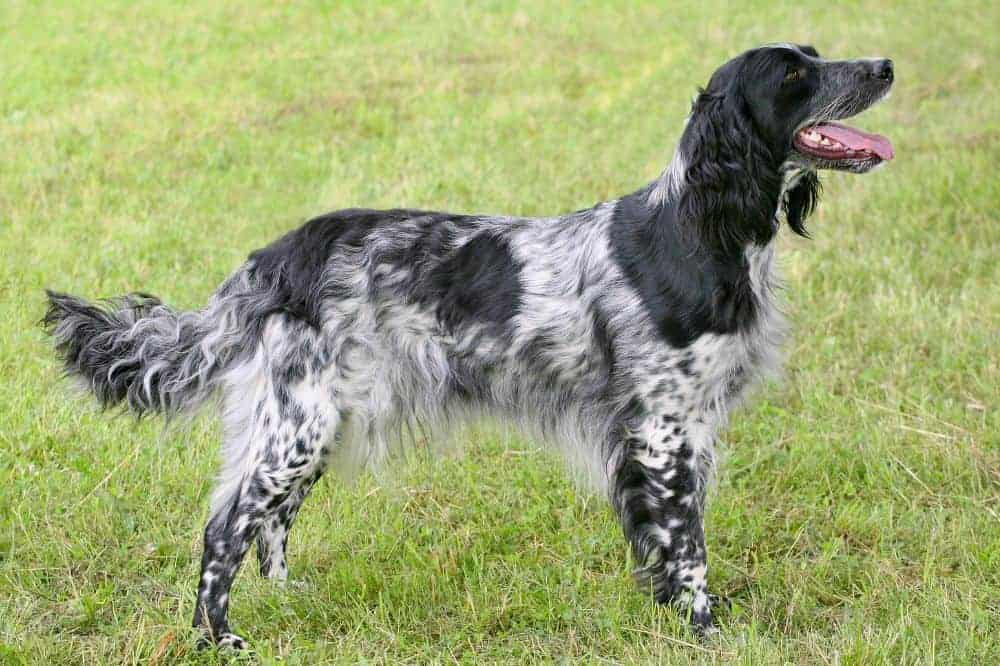
| Height | 58–65 cm |
| Weight | 25–32 kg |
| Lifespan | 11–13 years |
| FCI group | 7 · pointing dogs |
| Origin | Germany (Münsterland) |
Exact ratings
Common health issues
Nutrition
The Large Münsterländer (Großer Münsterländer) is an elegant, intelligent, and versatile hunting dog that originates from Germany. Known for its loyalty and impressive working abilities, this breed is one of the few German pointers whose standard officially includes a black and white coat. The Large Münsterländer isn’t just a helper on the hunt; it’s also a wonderful companion for active people and families, fully capable of becoming a cherished member of the family. Its passion, endurance, and ability to work in any conditions-whether in the field, forest, or water-make it a true all-rounder in the world of gundogs. We’ll cover more about this unique breed on Tvaryny.
Large Münsterländer: Key Breed Information
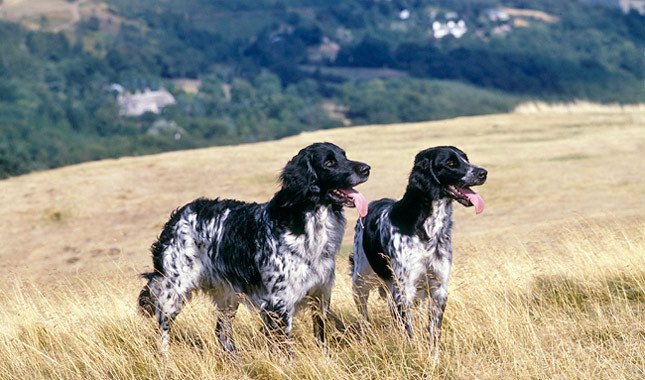
| Characteristic | Details |
| Origin | Germany (Münsterland region) |
| FCI Classification | Group 7 (Pointing Dogs), Section 1.2 (Continental Pointing Dogs, “Spaniel” Type) |
| Year of Recognition | 1919 (club formation), 1922 (standard approval) |
| Lifespan | 11-13 years |
| Height at Withers | Males: 60-65 cm, Females: 58-63 cm |
| Weight | Approximately 25-32 kg |
| Temperment | Intelligent, obedient, lively, devoted, well-balanced |
| Use | Versatile hunting dog, companion dog |
History of the Large Münsterländer
The history of the Large Münsterländer is closely intertwined with that of another German breed-the German Longhaired Pointer. For centuries, German hunters bred long-coated pointing dogs that were excellent partners in hunting game birds. These dogs came in two primary colors: brown and white, and black and white. Both varieties were considered part of the same breed and were valued exclusively for their working abilities.
The situation changed in the late 19th and early 20th centuries as breed standardization began. In 1909, the German Longhaired Pointer club made a pivotal decision: to exclude the black-and-white color from the breed standard. From that moment on, only brown and brown-and-white dogs were officially recognized. However, enthusiasts who prized the black-and-white dogs for their exceptional hunting skills and elegant appearance refused to accept this. They primarily lived in the Munsterland region of Westphalia, where black-and-white pointers were especially common.
In 1919, these breeders came together to form their own club, the “Verein für die Reinzucht des schwarz-weißen Münsterländer Vorstehhundes” (Club for the Pure Breeding of the Black and White Münsterland Pointing Dog). They gathered the surviving representatives of the black-and-white line, which became the foundation for the new breed-the Large Münsterländer. By 1922, the first official standard was developed and approved. It’s important to note that the Large Münsterländer is not simply a black-and-white version of the Longhaired Pointer; it developed as an independent breed with its own priorities. It also shouldn’t be confused with the Small Münsterländer, which is a completely seperate, though related, breed.
Breed Standard and Appearance
The Large Münsterländer is a strong, athletic, yet elegant dog. Its appearance reflects the power, endurance, and speed necessary for work in the field. The body should be well-balanced with well-developed musculature.
- Head: Elongated and noble, with a gentle slope from the forehead to the muzzle. The skull is not too broad. The muzzle is strong and long with a straight nasal bridge. The lips are tight, and the nose is black.
- Eyes: Dark and medium-sized. The expression is intelligent, lively, and friendly. The eyelids are close-fitting.
- Ears: Set high, broad, and hanging close to the head. The tips are rounded. The long hair on the ears creates beautiful feathering.
- Body: Almost square in proportion. The back is short, strong, and straight. The chest is deep and broad, providing ample room for the heart and lungs.
- Tail: A continuation of the backline, carried horizontally or slightly raised. The dense, long hair on the underside forms a handsome flag.
- Coat: Long, dense, and smooth, but not curly. The hair on the head is short. There is distinct feathering on the back of the front and hind legs, as well as on the ears and tail.
- Color: The main color is white with black patches of various sizes, or black and roan (a mixture of black and white hairs). The head is predominantly black, with a white blaze or patch on the muzzle being permissible.
In terms of build, the Large Münsterländer might somewhat resemble an English Setter, but it has a more powerful and muscular appearance that highlights its German origins and versatility in the field.
Character and Temperament
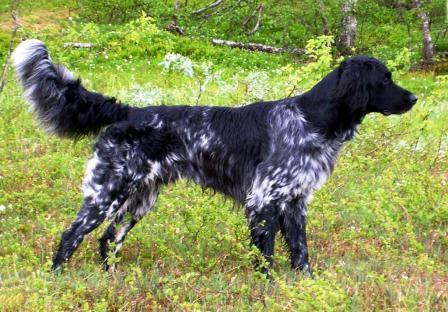
The character of the Large Münsterländer is a harmonious blend of hunting drive and family devotion. It is a dog with a well-balanced psyche that clearly distinguishes between work and rest.
In the Field: This dog is a true professional. It is courageous, has great stamina, an excellent sense of smell, and a solid point. The Münsterländer works methodically, maintaining constant contact with its handler. It is passionate when pursuing game but remains controllable. Its versatility allows it to be used for work on land and in water for finding and retrieving wounded game. The dog has a natural keenness on predators, an important quality for a hunting breed, similar to that of the Finnish Spitz.
At Home: Away from the hunt, the Large Münsterländer transforms into a gentle and friendly companion. It becomes very attached to its family and finds it difficult to be alone. Gets along well with children, treating them with patience and care. It can be wary of strangers but without aggression, making it a decent watchdog that will always announce visitors with a loud bark. This is a very intelligent dog that learns quickly and is eager to please its owner.
Pros and Cons of the Breed
| Pros | Cons |
|---|---|
| High intelligence and trainability: Easily masters commands and tricks. | Requires high levels of physical exercise: Not suitable for inactive people or apartment life. |
| Versatile hunter: Works in the field, forest, and water. | Strong hunting instinct: May chase small animals (cats, birds). |
| Devoted and gentle family dog: Excellent with children. | Prone to shedding: Needs regular brushing. |
| Striking appearance: An elegant dog that turns heads. | Dislikes being alone: Can suffer from separation anxiety. |
| Well-balanced temperament: Calm at home, energetic on walks. | Needs an experienced owner: Novices may struggle with its energy and intelligence. |
Care and Grooming
Caring for a LargeMünsterländer isn’t overly complicated, but it does require consistency. The main focus should be on its long coat and ears.
- Coat Care: The Münsterländer’s long coat needs brushing 2-3 times a week with a brush or de-shedding tool to prevent mats and remove dead hair. During the shedding seasons (spring and fall), this will need to be done daily. The dog does not require frequent bathing; washing it when dirty with a special shampoo for long-haired breeds is sufficient.
- Ear Care: The breed’s drop ears are a weak spot. Due to poor ventilation, infections and inflammation (otitis) can develop. You must regularly inspect the ears once a week, cleaning them of dirt and wax with a special lotion. Always dry the dog’s ears thoroughly after every bath or swim.
- Nail Care: If the nails do not wear down naturally during walks, they should be trimmed every 3-4 weeks with special nail clippers.
- Dental Care: To prevent tartar buildup, it’s recommended to regularly brush the dog’s teeth with a special toothpaste or provide dental chews.
Activity and Exercise Needs
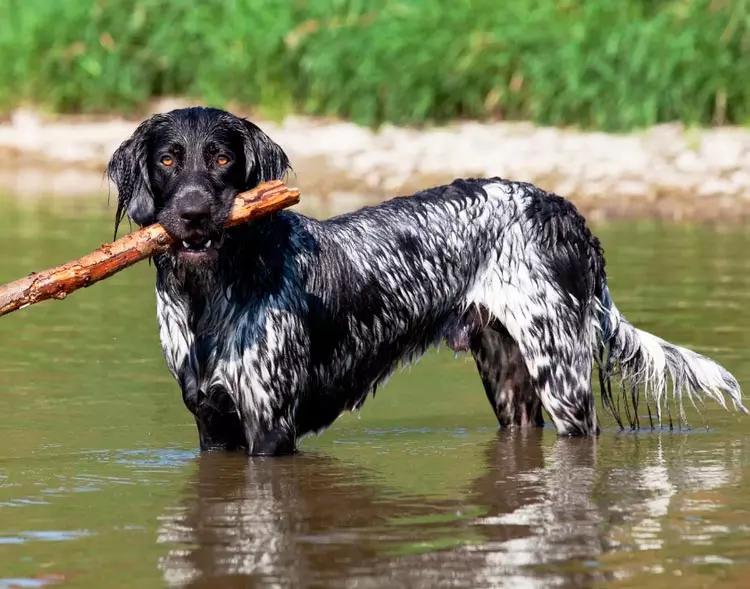
The Large Münsterländer is an extremely energetic breed, built for movement and work. A “couch potato” lifestyle is completely unsuitable for it. An insufficient amount of physical and mental stimulation can lead to destructive behavior: chewing furniture, excessive barking, and disobedience.
An adult dog needs at least 2-3 hours of active walks daily. This shouldn’t just be a slow stroll on a leash, but an opportunity to run free (in a safe area), swim, and play fetch. The ideal owner for a Münsterländer would be a hunter, an athlete, or simply a very active person who enjoys long hikes, running, or cycling. Unlike purely working breeds such as the Greenland Dog, the Münsterländer needs more than just monotonous running; it also requires mental challenges. Activities like agility, obedience, and scent work are perfect for this.
Training and Socialization
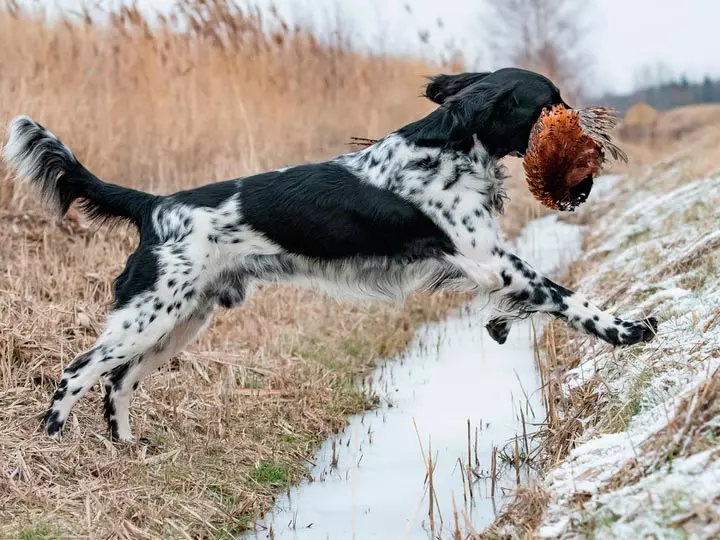
Thanks to their high intelligence and desire to cooperate, Large Münsterländers are generally easy to train. However, their cleverness can also work against the owner-if the dog is bored, it will find its own entertainment. Therefore, training sessions must be consistent, interesting, and varied.
The cornerstone of training should be positive reinforcement-praise, treats, and play. Harsh methods and physical punishment are unacceptable for this breed as they can lead to a loss of trust and stubbornness. It is vital to establish clear rules and boundaries from a very young age. Early socialization is key to developing a well-balanced character. The puppy needs to be introduced to different people, animals, sounds, and situations. This will help prevent the development of fears and aggression later in life.
Health and Common Conditions
Dietary Needs
Interesting Facts About the Large Münsterländer
- “Black and White Longhair”: Before its official recognition, the breed was simply called the “black and white version of the German Longhaired Pointer.”
- Rare Outside Germany: Although the breed is gaining popularity, it remains quite rare outside its homeland and neighboring European countries.
- Not Just for Birds: Despite being a pointing dog, the Münsterländer is successfully used for hunting small game like foxes and hares, as well as for tracking wounded game.
- Different Breeds: Despite their similar names, the Large and Small Münsterländers are two completely different breeds with different origins. The Small Münsterländer is related to the Epagneul Breton.
Frequently Asked Questions (FAQ)
Is the Large Münsterländer suitable for apartment living?
Absolutely not. This is a very active dog that needs space to move. The ideal living situation for it would be a house with a large, securely fenced yard and the opportunity for regular, long walks in nature.
Do Münsterländers get along with other animals?
With proper and early socialization, they can live with other dogs. However, their strong hunting instinct makes cohabiting with cats, rodents, and birds risky. Any small, fast-moving object can be seen as prey.
Do they shed a lot?
Yes, Large Münsterländers have a seasonal shed (spring and fall) during which they lose a lot of hair. Regular brushing helps to keep this under control. Outside of these seasons, shedding is moderate.
Can this breed be a good choice for a first-time owner?
It is not recommended. The Large Münsterländer needs an experienced owner who can provide it with the right level of physical exercise, mental stimulation, and consistent training. A novice may struggle to handle this dog’s energy and intelligence.
Video of the Breed
- A versatile pointer: field, forest, water
- Clever, handler-focused
- A hardy, keen worker
- Devoted, good with children
- A very high energy level — not for an apartment
- Needs scent work or hunting
- The long coat needs care
- Grows bored without a workload
| Small Munsterlander | German Longhaired Pointer | Gordon Setter | |
|---|---|---|---|
| Height | 50–56 cm | 60–70 cm | 58–69 cm |
| Energy | 4.5 | 4 | 4 |
| Apartment | 2 | 2 | 2 |
| Beginners | 3.5 | 3 | 3 |
Where does the Large Munsterlander come from?
How does the Large Munsterlander differ from the Small?
Is the breed suitable for a family?
FCI Standard No. 118 · Verband Große Münsterländer
For apartments · For kids · For beginners · Active · Smartest · Hypoallergenic · All rankings →