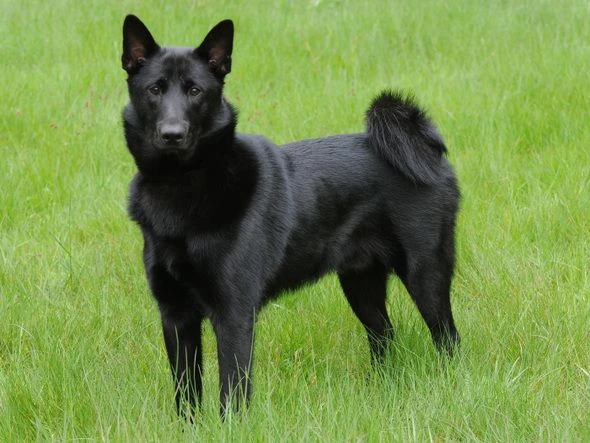
A Norwegian elk-hunter in a black coat — hardy, devoted and fearless: an energetic athlete, a reliable protector and a cheerful friend of children. The Black Norwegian Elkhound is a national treasure of Norway and a splendid elk hunter with a phenomenal nose; deeply attached to the family, it is good with children, but keeps its spitz-like stubbornness and needs early socialization.
Apartment · not suitableKidsCats · with caveatsOther dogs · with caveatsBeginners · with caveats
The Black Norwegian Elkhound (Norsk Elghund Sort) embodies Scandinavian endurance and hunting passion, clad in a striking black coat. This dog, a national treasure of Norway, is far more than just a moose hunter. It’s a loyal companion, an energetic athlete, and a dependable guard dog. With an exceptional sense of smell, it can detect game from several miles away. These dogs are hardy, agile, tireless in their work, yet deeply attached to their families. They are cheerful and playful with children, making them superb family pets for active individuals. Learn more about this unique breed, its character, history, and specific care requirements further on Tvaryny.
While the Elkhound is known for its bravery and independence, it also craves close human contact. Training and raising them should start from an early age, as the stubbornness and self-reliance typical of Spitz-type breeds can emerge later. This dog isn't the best choice for apartment living, as it needs space and intensive, long walks. Elkhounds can be excellent guard dogs: though they lack unwarranted aggression towards people, their loud barking will always alert owners to approaching strangers.
Black Norwegian Elkhound: A Brief Breed Overview
Black Norwegian Elkhound: A Brief Breed Overview · 10
Breed Name
Black Norwegian Elkhound (Norsk Elghund Sort)
Country of Origin
Norway
FCI Classification
Group 5 (Spitz and Primitive Types), Section 2 (Nordic Hunting Dogs). Standard No. 268.
More massive, heavier, and stockier. Has a characteristic grey (zonal grey) coat color. Considered somewhat calmer and less "reactive" than the black variant.
Significantly larger and more powerful than both Norwegian Elkhounds. Has a lighter grey coat with distinctive light markings on the muzzle, chest, and paws. Used for hunting large game, including bears.
More elongated body format, more diverse coat colors (including black, white, red). Considered a more versatile hunter, oriented towards both large and fur-bearing game.
Interesting Facts about the Breed
A Misleading Name: The word "Elghund" literally translates to "elk dog". However, "elk" in European languages refers to a moose, not a wapiti, as in North America. So, it's more accurate to call it a "Norwegian Moose Dog."
Viking Dog: It's believed that the ancestors of modern Elkhounds accompanied Vikings on their campaigns, serving as guards and hunters.
Unique Hunting Tactic: An Elkhound does not kill the moose. Its task is to find the animal, hold it in place with loud, continuous barking, and evade attacks until the hunter arrives.
Mountain Rescuers: Thanks to their endurance and keen sense of smell, Elkhounds in Norway are sometimes involved in mountain search and rescue operations.
"Black Lightning": For its speed, agility, and black coloring, the breed earned the nickname "black lightning of the forest."
History of the Black Norwegian Elkhound Breed
The history of the Black Norwegian Elkhound is closely intertwined with the culture and daily life of the Scandinavian peoples. Dogs of the "Elghund" type (meaning "elk dog") have existed in these lands for millennia, as evidenced by archaeological finds, including dog skeletons dated 4000–5000 BCE. These ancient Spitz-type dogs were indispensable helpers in hunting large game such as moose, bear, and wolverine.
Initially, there was no clear distinction between Elkhounds by color. However, over time, hunters began to notice that smaller, black-colored dogs were more agile and less conspicuous in dense forests, giving them an advantage during hunts. They could approach prey more quietly and were more maneuverable. Despite mentions of black "elk dogs" appearing as early as the 16th-17th centuries, targeted breeding began much later.
Official recognition of the breed occurred at the turn of the 19th and 20th centuries. In 1877, a gray variant of the breed was presented at Norway's first dog show, quickly gaining popularity. The Black Elkhound remained in the shadow of its gray relative and by the early 20th century was on the verge of extinction. It was considered merely a color variation, not a separate breed.
The breed's savior was the enthusiastic breeder Johannes Finnen. He made incredible efforts to preserve and popularize the Black Elkhounds. Thanks to his persistent work and that of other breeders, the population began to recover by the mid-20th century. Despite this, the Black Norwegian Elkhound remains significantly less common today than its gray counterpart, such as the Gray Norwegian Elkhound or the Jämthund (Swedish Elkhound). Outside of Scandinavia, this breed is a true rarity, but in Norway, it is still highly valued as a national symbol and an unsurpassed hunting dog.
Appearance of the Black Norwegian Elkhound: Breed Standard
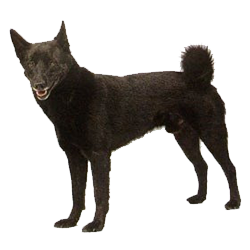
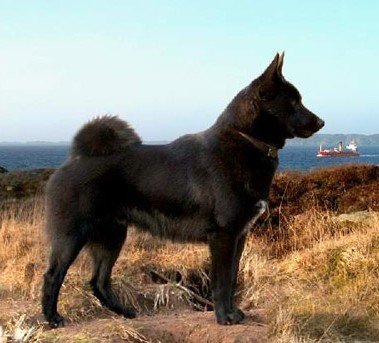
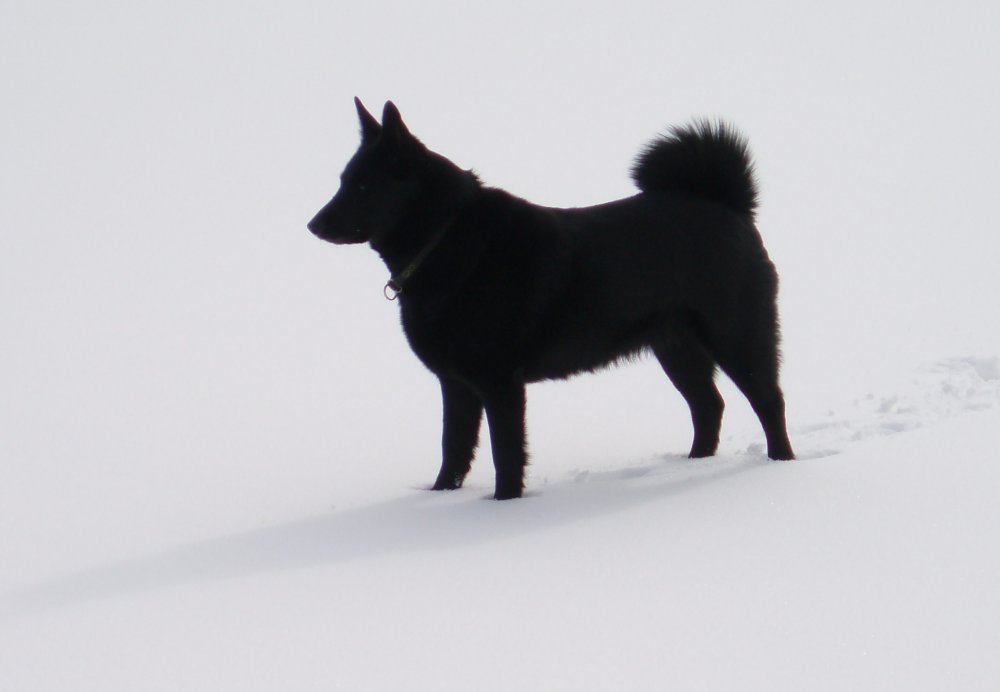
The Black Norwegian Elkhound is a typical representative of northern Spitz breeds: compact, square-shaped, with a proudly carried head and a tail tightly curled over its back. It is somewhat lighter and more elegant than its gray relative.
Head: Wedge-shaped, clean, relatively broad between the ears. The skull is slightly rounded, with a well-defined but not abrupt stop. The muzzle gradually tapers towards the nose.
Eyes: Not prominent, oval in shape, dark brown in color. The gaze is lively, attentive, and fearless.
Ears: Set high, erect, pointed at the tips. Very mobile, indicating the dog's keen hearing.
Body: Compact, square-shaped (body length equals height at the withers). The back is short, straight, and strong. The chest is deep, with well-sprung ribs.
Tail: Set high, tightly curled into a ring and carried over the center of the back. Covered with dense hair.
Limbs: Strong, straight, with sturdy bone structure. Paws are small, oval, with tightly knit toes.
Coat: Thick, dense, weather-resistant. Consists of a short, soft, black undercoat and longer, harsh guard hairs. The coat is short on the head and forelegs, and longer on the neck, chest, and hindquarters.
Color:Exclusively glossy black. A small white patch on the chest or white "socks" on the paws are permissible.
Character: Temperament and Behavior
The Black Elkhound is a dog with a dual nature. In the hunt, it's an irrepressible, brave, and independent tracker, capable of working for hours in challenging conditions. At home, however, it transforms into a devoted, affectionate, and playful family member. Unlike many other hunting Laikas, such as the West Siberian Laika or the East Siberian Laika, the Elkhound is more people-oriented and struggles with loneliness.
Key Character Traits:
Energy: This is a highly active breed that requires daily intensive physical exercise. A simple walk on a leash is just a warm-up for them. Ideal options include long hikes, running alongside a bicycle, agility training, or flyball.
Intelligence and Independence: Elkhounds are extremely intelligent, but their intellect is combined with a natural tendency for independent decision-making. This is a legacy of their hunting past, where the dog had to act at a distance from its owner. Therefore, patience, consistency, and ingenuity are needed in their upbringing.
Loyalty: They form a strong bond with their family and are ready to protect them. They get along well with children, especially if they grow up together, perceiving them as part of their "pack."
Guarding Qualities: Elkhounds are very vigilant and will always warn with loud barking about the approach of strangers. They are not prone to causeless aggression but are reliable protectors of their territory.
Attitude Towards Other Animals: Due to their strong hunting instinct, they may perceive small animals (cats, rodents) as prey. Early and proper socialization is critically important. With other dogs, they may try to dominate, especially males.
Pros and Cons of the Black Norwegian Elkhound Breed
Before getting such a serious dog, it's worth weighing all the pros and cons.
Pros and Cons of the Black Norwegian Elkhound Breed · 6
Pros
Cons
✅ Exceptional loyalty to family
❌ Requires a very high level of physical activity
✅ High intelligence and quick wit
❌ Tendency towards independence and stubbornness in training
✅ Excellent guarding qualities
❌ Very loud and frequent barking
✅ Robust health and endurance
❌ Heavy seasonal shedding, requires frequent brushing
✅ Adapts well to cold climates
❌ Can be aggressive towards other dogs and chase small animals
✅ Playful and good with children in its family
❌ Not suitable for apartment living or inexperienced owners
Training and Socialization
Raising a Black Elkhound is a task that demands consistency, patience, and an understanding of Spitz psychology. These dogs are intelligent but don't strive to please humans in the way, for example, sheepdogs do. They always ask themselves, "What's in it for me?".
Key Aspects of Training:
Early Start: Socialization and basic training should commence from the puppy's first days at home. Introduce them to various people, sounds, places, and other animals (under supervision).
Positive Reinforcement: Elkhounds respond well to methods based on praise, treats, and games. Harshness and physical punishment can lead to a loss of trust and open resistance.
Short and Engaging Sessions: Due to their independence, they quickly tire of monotonous repetitions. It's better to conduct several short training sessions (10–15 minutes) per day rather than one long one.
Bark Control: Teach the dog the "Quiet!" command from a young age, as barking is their natural mode of communication.
Mental Stimulation: These dogs require not only physical but also mental exertion. Use puzzle toys, teach new tricks, and engage in scent work games.
Thanks to their versatility, Norwegian Elkhounds can excel in various canine sports such as agility, obedience, and nose work. This is an excellent way to channel their energy constructively and strengthen the bond with their owner.
How to Care for the Black Norwegian Elkhound's Coat
The Elkhound's double coat is naturally designed to protect it from harsh Scandinavian winters. It doesn't require complicated care but has its peculiarities.
Main Procedures:
Brushing: In normal times, it's sufficient to brush the dog 1–2 times a week with a metal comb or a slicker brush to remove dead hairs and prevent matting.
Seasonal Shedding: Twice a year (spring and autumn), Elkhounds shed intensely, losing their dense undercoat. During this period, they need to be brushed daily, otherwise, your entire home will be covered in black fur.
Bathing: The coat has a natural oily layer that repels water and dirt. Therefore, Elkhounds should only be bathed when absolutely necessary, 2–3 times a year, using special dog shampoos. Frequent washing can damage the protective layer of the skin.
Claws, Ears, Eyes: Regularly inspect and clean the ears to prevent infections. Trim claws every 3–4 weeks if they don't wear down naturally. Eyes can be simply rinsed with chamomile infusion as needed.
Nutrition
Nutrition: Key Recommendations
Health and risks
Health: Typical Diseases and Prevention
Frequently Asked Questions about the Breed (FAQ) · 5
Is the Black Norwegian Elkhound suitable for beginners? No, this breed is not recommended for inexperienced owners. Its independent nature, high demands for physical activity, and tendency to dominate require an experienced and confident hand.
Can an Elkhound live in an apartment? Strongly discouraged. This dog needs space, ideally a private house with a large, securely fenced area. Life within four walls can lead to destructive behavior and psychological problems.
How much physical activity does this breed need? A great deal. A minimum of 2 hours of intensive exercise per day. This isn't just walks, but running, games, and training. Without sufficient activity, an Elkhound becomes unruly.
Do they bark a lot? Yes, this is one of the more "vocal" breeds. Barking is their primary working tool. They bark when they see strangers, when they play, and when they are bored. This is worth considering if you have sensitive neighbors.
Do they get along with cats and other animals? With great caution. Their strong hunting instinct compels them to chase anything that moves. Chances of peaceful coexistence exist only if they grew up with a kitten from a very early age, but even that doesn't guarantee success.
Video about the Breed
FAQ
How does the Black Norwegian Elkhound differ from the Gray?
It is a separate variety/breed under the FCI: the Black Elkhound is a little smaller, lighter and of course black; the Gray is larger and older. Both are Norwegian elk hunters.
Is the Black Elkhound good for a family with children?
Yes — it is cheerful, playful and deeply attached to the family, gets on splendidly with children; but it needs early socialization, as spitz-like stubbornness shows with age.
Is the breed suitable for an apartment?
Poorly — it is a hardy working hunter with a high need for exercise; without a workload and space it grows bored.