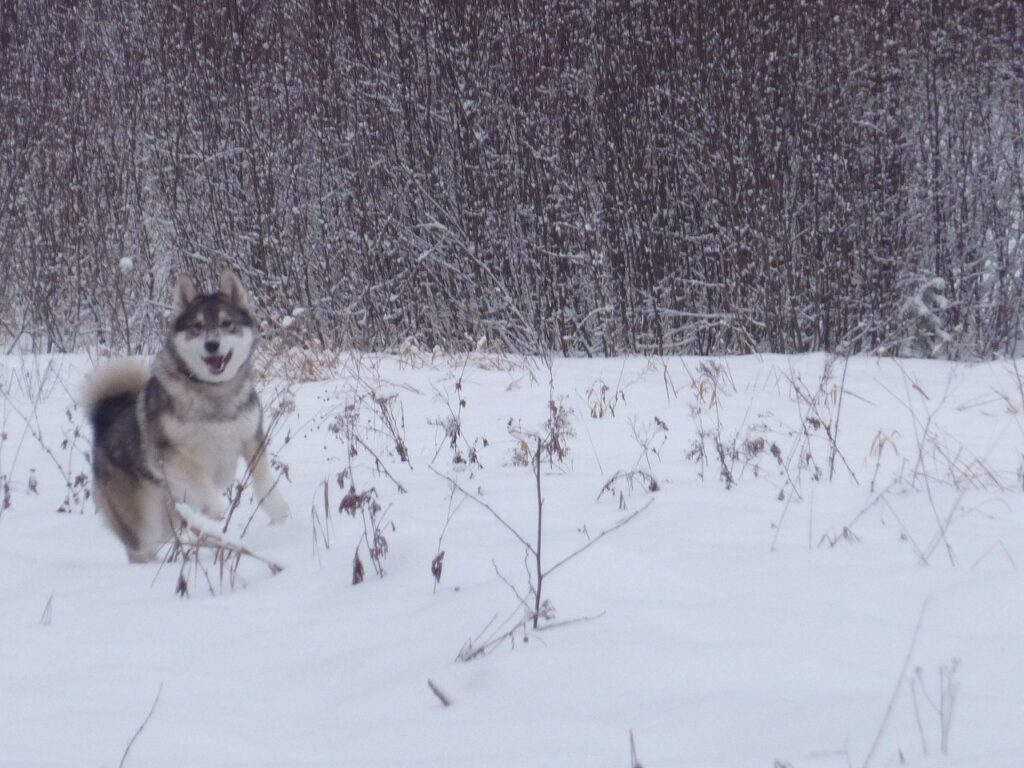
Group 5 · spitz and primitive · Russia (Urals, Western Siberia)
West Siberian Laika
A symbol of the Ural and Siberian taiga — a graceful, clever hunter with an independent nature: hardy, sensitive, devoted and tireless. The West Siberian Laika is one of the most popular Russian hunting laikas; it combines a phenomenal sense of smell, sight and hearing with a passion for hunting fur and big game, and at home remains a devoted friend, but needs forest, space and work.
A very strong hunting instinct (dangerous to cats)
Not for an apartment or a novice
Independent, needs work and space
Inclined to run off after prey
Size
ToySmallMediumLargeGiant
Compatibility
Apartment · not suitableKids · with caveatsCats · not suitableOther dogs · with caveatsBeginners · not suitable
The West Siberian Laika isn't just a dog; it's a true symbol of the taiga, embodying natural grace, keen intelligence, and unmatched hunting prowess. This breed, developed in the harsh conditions of the Ural Mountains and West Siberia, is an ideal partner for experienced hunters and active individuals who value independence and natural beauty. These dogs boast a phenomenal sense of smell, sharp eyesight, and exceptional hearing, making them indispensable for hunting fur-bearing animals like sable and marten, as well as large game. However, prospective owners should understand that this isn't a couch potato; its natural element is the forest, wide-open spaces, and work. Find out more about all aspects of this unique breed on Tvaryny.
These dogs aren't the best choice for city apartment living. They thrive in a spacious outdoor enclosure on private property, where they have ample room to move around. Due to an exceptionally strong hunting instinct, which can prompt them to embark on independent adventures, unsupervised off-leash exercise is strictly not recommended. If you're a hunter dreaming of a strong, resilient, and intelligent assistant, the West Siberian Laika will be your ideal companion. This breed isn't suited as a pet for a quiet family life, as it demands a specific approach and significant physical activity.
West Siberian Laika: A Quick Breed Overview
West Siberian Laika: A Quick Breed Overview · 10
Breed Name
West Siberian Laika
Country of Origin
Russia (Ural Mountains, West Siberia)
FCI Classification
Group 5 (Spitz and Primitive Types), Section 2 (Nordic Hunting Dogs)
Year of Recognition
Provisional Standard - 1949, Permanent - 1952
Lifespan
12–15 years
Height at Withers
Males: 55–60 cm (21.5–23.5 inches); Females: 51–58 cm (20–23 inches)
Weight
18–23 kg (40–50 lbs)
Use
Versatile hunting dog, sled dog
Temperament
Balanced, active, brave, independent, devoted to its owner
Exercise Needs
Very High
Comparison with Other Russian Laikas
The West Siberian Laika is part of the group of Russian hunting Laikas, which also includes its closest relatives. Although they are similar in purpose, there are significant differences between them. For example, the East Siberian Laika is usually larger, more massive, and has a more elongated body, making it better adapted for working in deep snow. It is also known for its calmer and more balanced temperament. On the other hand, the Russo-European Laika is the smallest of the three, very ardent and energetic, with a strong orientation toward its owner, but can be more excitable and "barky." The West Siberian Laika is considered the most versatile and balanced in its characteristics.
Interesting Facts about the West Siberian Laika
"Laika" - from the word "to bark." The breed's name comes from its characteristic working manner — the dog finds an animal or bird and holds it in place with loud barking, attracting the hunter's attention.
Universal Hunter. Unlike many highly specialized hunting breeds, the West Siberian Laika can work with almost any game — from small squirrels to large bears.
Minimal Human Involvement in Formation. The breed was largely formed through natural selection, which provided it with robust health and excellent adaptability for survival.
Cosmonaut Dogs. Although the most famous cosmonaut dogs were mongrels, Laikas also participated in the USSR's space program. Dogs named Belka and Strelka, who made an orbital flight, had phenotypic traits similar to Laikas.
Resemblance to a Wolf. The West Siberian Laika is one of the breeds genetically closest to the wolf, which is manifested not only in appearance but also in behavior and independent character. Some owners note that their dogs sometimes howl like wolves.
The independent character and strong hunting instinct demand a special approach and responsibility from the owner. These are traits also inherent in many other strong breeds, such as bull-type terriers. Although their purpose is entirely different, dogs like the Miniature Bull Terrier also require a firm hand and consistent upbringing.
History of the West Siberian Laika Breed
The history of the West Siberian Laika is deeply interwoven with the lives of the indigenous peoples of the Urals and West Siberia – the Khanty and Mansi. For centuries, these communities relied on local aboriginal dogs for hunting, which were crucial for survival in the harsh taiga. These dogs, known as Khanty and Mansi (Vogul) Laikas, became the genetic foundation for the modern breed. They were renowned for their endurance, versatility, and ability to hunt diverse game – from small squirrels to large bears.
Dedicated breeding efforts for the West Siberian Laika began in the 1920s. Soviet cynologists took note of the outstanding working qualities of these local Laikas and aimed to create a universal hunting dog. A pivotal figure in popularizing the breed was the hunter-cynologist Fedor Krestnikov, who meticulously described the advantages of the Ural Laikas in his articles. Initial attempts at standardization were made in the late 19th century, but systematic selection started later.
One of the first outstanding representatives of the breed, who significantly influenced its development, was a dog named Grozny, born in 1930. He belonged to the Sverdlovsk Dog Breeding Club and served as a benchmark for many breeders. After World War II, work with the breed intensified, and in 1949, a provisional standard was adopted, followed by a permanent one in 1952. Today, the West Siberian Laika is one of the most widespread hunting breeds in Russia and is popular in many other countries, particularly in Scandinavia, due to its exceptional working qualities.
What a West Siberian Laika Looks Like: Appearance Description
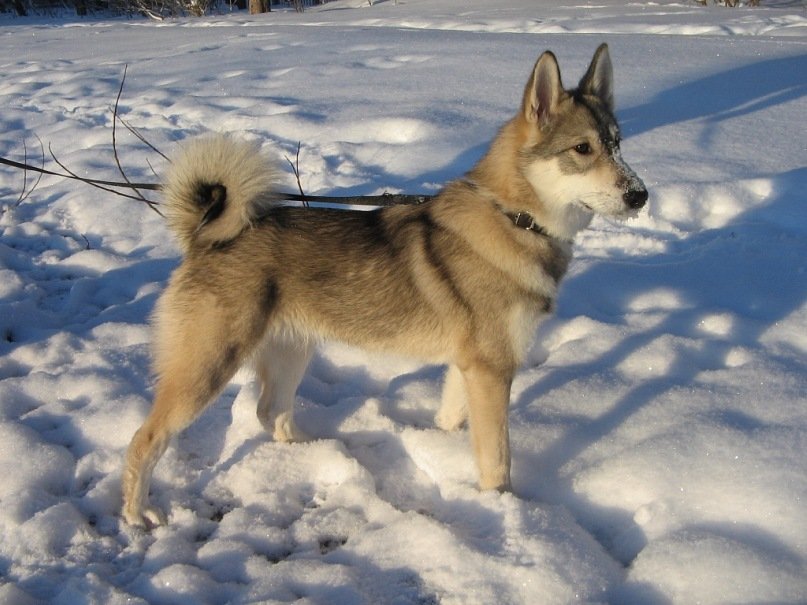
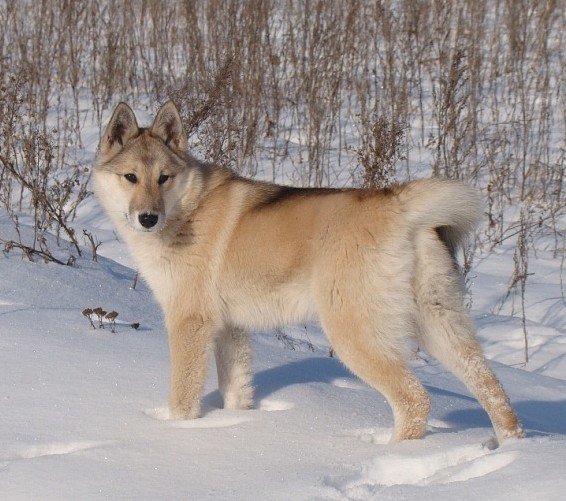
The West Siberian Laika is a medium-sized dog with a lean, robust build, a well-developed bone structure, and well-defined musculature. Its appearance is harmonious, combining features of a wild animal, akin to a wolf, with elegance and power. The dog's movements are quick, light, and energetic.
Head and Muzzle
When viewed from above, the head forms a sharp wedge, resembling an isosceles triangle. The skull is moderately broad. The transition from forehead to muzzle is smooth, barely perceptible. The muzzle is long, pointed, but not narrow. The lips are dry and tight-fitting. The nose is typically black, but brown is permissible in white dogs.
Eyes: Small, oval, with an oblique set, dark brown in color. The gaze is lively, intelligent, and expressive.
Ears: Erect, set high, shaped like an elongated triangle with pointed tips. Very mobile, indicating acute hearing.
Bite: Scissor bite, with a complete set of teeth.
Body and Limbs
The body is slightly elongated. The neck is muscular, lean, approximately the same length as the head. The withers are well-developed, rising above the topline. The back is straight, strong, and broad. The loin is short and muscular. The chest is deep and wide. The tail is typically curled into a ring and lies on the back or thigh, which is a characteristic feature of Laikas. The limbs are straight, parallel, and muscular. The paws are compact and oval-shaped.
Coat and Color
The coat is the Laika's main protection against harsh weather conditions. It consists of harsh, straight outer hair and a very dense, soft undercoat that resembles cotton wool. This coat structure allows the dog to withstand severe frosts and remain dry. On the neck and shoulders, the coat forms a lush "collar," and on the hind limbs, it creates "trousers."
Permissible Colors
Description
Zonal Grey
The most common, "wolf-like" coloring. May have a reddish tint.
Pied (Patched)
White with patches of any permissible color (grey, red).
White
Pure white.
Red and Fawn
All shades of red, from light fawn to rich red.
Black
Rare, but permissible.
Character: Temperament and Behavior
The West Siberian Laika's character is a balanced mix of hunting passion, independence, and deep devotion to its owner. This is an active, agile, brave, and intelligent dog. It possesses many positive qualities necessary for working in challenging conditions. Laikas are incredibly resilient, capable of working for hours without fatigue. Their character largely resembles the behavior of their wild ancestors, making them some of the best hunters.
Hunting Instincts and Working Qualities
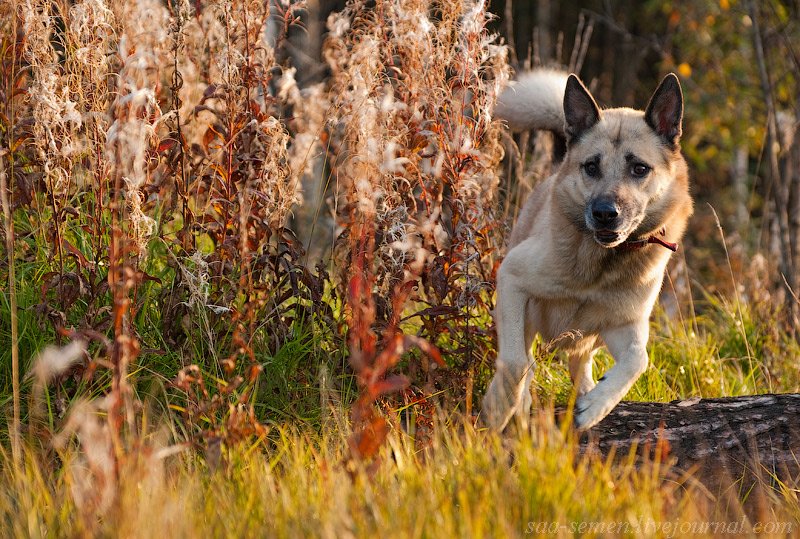
This is the primary trait of the breed. The hunting instinct in the West Siberian Laika is exceptionally strong. The dog is oriented toward independently searching for prey; it is ardent, persistent (tenaciously pursuing the animal), and has a loud, clear voice with which it alerts the hunter to found game. Their working style is versatile: they successfully hunt squirrels, martens, capercaillies, wild boars, bears, and moose. The Laika has an excellent sense of direction in the forest and will always find its way home.
Attitude Towards Family and Children
A West Siberian Laika usually chooses one owner, whom it considers the "pack leader." It is endlessly devoted to them and ready to obey. Towards other family members, it is friendly but may maintain a certain distance. With children it has grown up with, it behaves patiently and can be a good playmate, provided the child respects its personal space. However, it's never advisable to leave small children alone with any dog.
Relationships with Other Animals
Due to its strong hunting instinct, the West Siberian Laika may perceive small animals (cats, rodents, birds) as prey. Early socialization can help, but instincts often prevail. With other dogs, Laikas usually behave confidently but not aggressively, unless provoked. Males may display dominance towards other males. They are wary of strangers, without excessive aggression, which makes them good watchdogs who will always alert to the arrival of outsiders.
Pros and Cons of the Breed
Before getting a West Siberian Laika, it's crucial to realistically assess all its advantages and disadvantages to understand if this dog is right for you.
Pros and Cons of the Breed · 6
Pros (+)
Cons (-)
Outstanding Hunting Qualities. A versatile hunter with excellent instinct.
Requires High Physical Exertion. Not suitable for inactive people.
Devotion to Owner. Strongly attaches to one person.
Prone to Escaping. Due to hunting instinct, may go "hunting" independently.
Robust Health and Endurance. A breed shaped by harsh conditions, with a strong immune system.
Not Suitable for Apartment Living. Requires space and an enclosure.
Low Maintenance Grooming. Coat is self-cleaning and doesn't require frequent washing.
Independent Character. Can be stubborn and challenging to train for a novice.
High Intelligence and Cleverness. Capable of making independent decisions.
May Show Aggression Towards Small Animals. Strong prey drive.
Good Watchdog Qualities. Will always alert to strangers.
Heavy Seasonal Shedding. Requires intensive brushing in spring and autumn.
Training and Raising a West Siberian Laika
Training a West Siberian Laika is a task that demands patience, consistency, and an understanding of the breed's psychology. This is not a service dog that will unquestioningly obey every command. A Laika is a partner with whom you need to build a relationship based on mutual respect. Harshness and physical punishment are unacceptable – they will only destroy trust.
Training should begin at an early age. It's crucial to establish clear rules and boundaries. Laikas are very intelligent and quickly understand what is expected of them, but their independence can lead them to "test" their owner's resolve. The main focus in training should be on commands that ensure control: "Come!", "Stay!", "Leave it!". It is especially important to practice the recall command, as a Laika engrossed in a scent trail in the forest may ignore calls. Training is best conducted through play, using positive reinforcement.
Early socialization is critically important. A puppy needs to be introduced to various people, sounds, places, and other calm dogs. This will help to raise a well-balanced and self-assured dog that will react appropriately to new situations.
Care and Maintenance
Living Conditions
The ideal conditions for a West Siberian Laika are a country home with a large, securely fenced yard and a spacious outdoor kennel. Apartment living is only possible with daily, long (at least 3–4 hours) and intensive walks in a forest or park where the dog can run freely. This is a breed that does not tolerate confined spaces and inactivity. Without sufficient exercise, a Laika can become destructive, chew on belongings, and bark incessantly.
Grooming and Coat Care
The West Siberian Laika's coat has a unique structure that repels dirt and water, so the dog doesn't require frequent bathing (1–2 times a year or when heavily soiled). The primary care involves brushing. During normal times, brushing the Laika once a week is sufficient. However, twice a year, during seasonal shedding, the undercoat falls out in enormous quantities. During this period, the dog needs to be brushed daily, using specialized tools (slicker brushes, deshedding tools) to prevent matting and alleviate the animal's discomfort.
Ears: Regularly check for dirt and inflammation, clean as necessary.
Claws: If the dog runs a lot on hard ground, its claws will wear down naturally. Otherwise, they need to be trimmed.
Eyes: Keep the eyes clean. Small discharges can be wiped away with a cotton pad moistened with chamomile infusion.
Physical Exertion and Activity
This is a key aspect of maintaining the breed. The West Siberian Laika needs more than just walks on a leash; it requires full-fledged training. Ideally, the owner is a hunter and regularly takes the dog to the forest. If not, alternative activities must be provided: long runs (including alongside a bicycle), swimming, retrieving games, and dog sports like canicross or bikejoring. Without work and physical activity, the Laika becomes unhappy.
Nutrition
Nutrition: What to Feed a West Siberian Laika?
Health and risks
Health of the West Siberian Laika: Typical Ailments and Prevention
Frequently Asked Questions about the Breed (FAQ) · 5
Can a West Siberian Laika live in an apartment? Theoretically yes, but it is highly undesirable. For this, the owner would have to dedicate 3–4 hours a day to active walks with training elements. Without sufficient exercise, the dog will suffer and may become destructive.
Does the West Siberian Laika get along with children? Yes, they are usually patient with children from their "pack," especially if they have grown up together. However, this is not a nanny dog, and their interaction should always be supervised.
Do they shed a lot? Yes, very heavily twice a year (spring, autumn) when the undercoat changes. Daily brushing is required during this period. At other times, shedding is moderate.
Can a Laika be kept on a chain? Absolutely not. Chaining spoils the psyche of this freedom-loving dog, making it nervous and aggressive. The best option is a spacious outdoor kennel with a doghouse.
Can the West Siberian Laika be used as a guard dog? A Laika will be a good watchdog — it will always warn of strangers' arrival. However, it is not a protection breed oriented toward attacking and restraining people. Its aggression is directed towards animals, not people. Some dogs may display guarding qualities, but this is not typical for the breed, unlike, for example, the Staffordshire Bull Terrier, which, despite its friendly nature towards people, has stronger protective instincts regarding its family.
Video about the Breed
FAQ
What does the West Siberian Laika hunt?
It is an all-rounder: it masterfully hunts fur game (sable, marten, squirrel) and forest birds and also works big and dangerous game; especially valuable is its work on quarry that hides in trees.
Is the breed suitable for an apartment?
Poorly — it is a working taiga hunter that needs space, forest and work; it is happiest in a kennel on private grounds with an active hunter.
Does the Laika get on with cats?
Poorly — the strong hunting instinct makes cohabiting with cats and small animals very risky.