Group 6: Scent Hounds and Related Breeds. Section 1.3: Small Scent Hounds. · Sweden
Drever
A Swedish short-legged hound — a national pride with a calm heart: hardy, persistent in the field and affectionate by the fireside. The Drever is a young but recognized Swedish breed with an elongated body on short legs; an unrivaled tracker that moves confidently through the thickest undergrowth, and at the same time a level-headed, devoted family companion.
Height
30–38 cm
Weight
31–40 lbs
Lifespan
12–15 years
FCI group
Group 6: Scent Hounds and Related Breeds. Section 1.3: Small Scent Hounds.
Apartment · with caveatsKidsCats · not suitableOther dogsBeginners · with caveats
The Drever, also known as the Swedish Dachsbracke, is a relatively new, yet well-established breed of hunting dog that serves as a national source of pride for Sweden. These low-set, sturdy, and resilient hounds have won the hearts of hunters and families across Scandinavia thanks to their exceptional sense of smell, tenacity in the field, and a wonderfully calm demeanor at home. The Drever is a perfect example of a dog that combines a hunter's drive with a family's loyalty, capable of being both a tireless tracker in the woods and a gentle companion by the fireplace. They are easily recognizable by their elongated, powerful body on short legs, which allows them to move confidently through the densest undergrowth. Learn more about the features of this unique breed on Tvaryny.
This dog makes for a reliable watchdog, jealously protecting its territory without being overly aggressive. Balanced and patient, the Drever gets along great with children, making it a wonderful choice for active families. It doesn't require complicated care and is easy to train, but for complete happiness, it needs space, so it will feel best in a country home with opportunities for regular, long walks.
Group 6: Scent Hounds and Related Breeds. Section 1.3: Small Scent Hounds.
Purpose
Hunting deer, roe deer, fox; companion dog
Temperament
Alert, balanced, energetic, never aggressive or shy
The Drever in Hunting
Hunting is the Drever's element. Its main task is to find the scent of game (most often a roe deer, red deer, or fox), flush it out, and slowly, with a continuous bark, drive it toward the hunter. Its low stature is an advantage: it doesn't scare the animal, so it doesn't run away at full speed, but instead moves at a leisurely pace, allowing the hunter to get into a convenient position for a shot. The Drever's loud, melodic voice allows the hunter to constantly monitor the dog's location and the direction of the game. A similar hunting style, though with a different specialization, is demonstrated by breeds like the Basset Bleu de Gascogne or the Grand Basset Griffon Vendéen.
Interesting Facts About the Drever Breed
The name "Drever" comes from the Swedish word "driva," which describes the hunting method of a dog slowly "driving" the game.
The Drever is one of the most popular breeds in Sweden but is almost unknown outside of the country.
Despite its short stature, the Drever is considered an extremely resilient dog, capable of working in snow and difficult terrain for hours.
The characteristic loud bark of the Drever has different intonations, which an experienced hunter can use to determine what kind of animal the dog is pursuing.
In 2016, the Swedish Post issued a series of stamps dedicated to national dog breeds, and the Drever was honored to be on one of them.
History of the Drever Breed
The Drever's history doesn't stretch back for centuries like many other hunting breeds, but it is a prime example of targeted breeding for specific conditions. It all began in the late 19th and early 20th centuries. Swedish hunters needed a dog that was low enough to avoid startling large game (especially roe deer), but also had the stamina, an excellent nose, and the loud voice of a large hound. This dog turned out to be the Westphalian Dachsbracke, imported from Germany in the 1910s.
These German dogs became the foundation for a new breed. They were actively crossed with local Swedish hounds in an effort to cement the desired traits: short stature, a sturdy frame, and tireless energy. Initially, these dogs were simply called "Dachsbracke," which translates from German as "Dachshund-like hound." However, over time, the Swedish line became so different from its German ancestors that there was a need for its own name.
In 1947, the name "Drever" was proposed, which comes from the Swedish word "driva," describing a specific hunting tactic of slowly flushing out game toward the hunter with a continuous bark. This name perfectly reflected the essence of the dog's work. In 1949, the first breed club was founded in Sweden, and in 1953, the Fédération Cynologique Internationale (FCI) officially recognized the Drever as an independent Swedish breed. Today, the Drever is one of the most popular hunting breeds in Sweden, Norway, and Finland, but remains quite rare outside of Scandinavia.
What the Drever Looks Like: Standard and Appearance
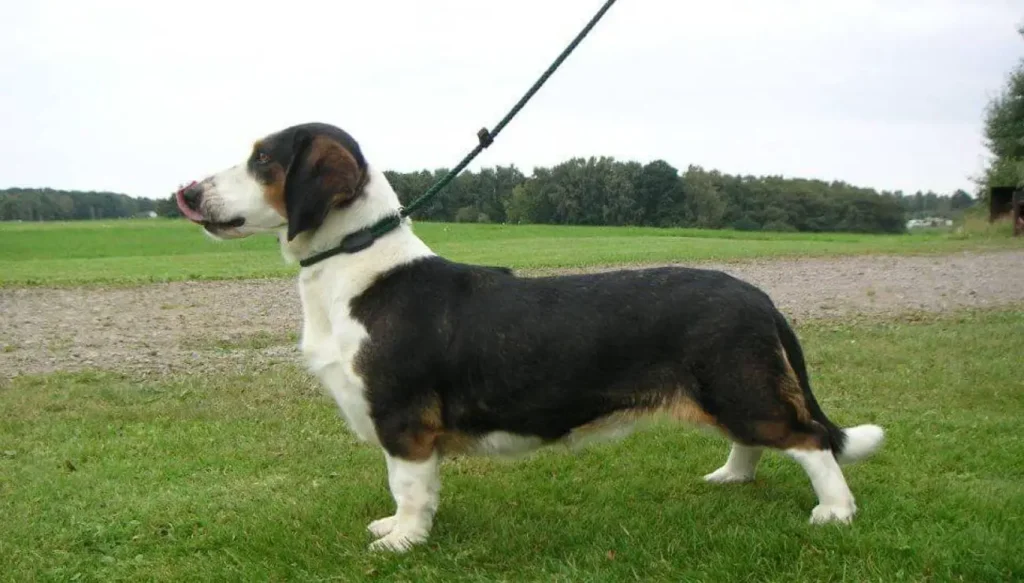
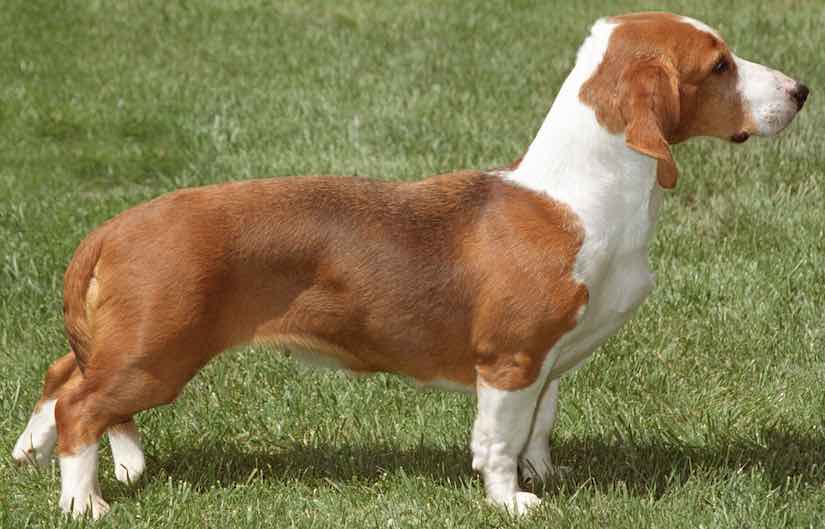
The Drever's appearance is the embodiment of functionality. It looks like a strong, long-bodied dog with a powerful frame on short legs. Its appearance gives an impression of strength and endurance, not elegance. The ratio of height at the withers to body length is approximately 1 to 1.6.
Head: Quite large and long, narrowing slightly toward the nose. The skull is slightly domed. The transition from the forehead to the muzzle (stop) is barely noticeable.
Muzzle: Well-developed, not pointed. The nose has a large black tip with well-open nostrils.
Eyes: Oval-shaped, dark brown. The gaze is calm, expressive, and intelligent.
Ears: Set relatively low, of medium length, and wide. They hang down, lying close to the cheeks, and their tips are rounded.
Body: Very elongated. The neck is long and muscular, without a dewlap. The back is straight and strong, the loins are broad. The chest is well-developed, oval, and its lowest point is significantly below the elbows. The abdomen is slightly tucked up.
Tail: Long and thick at the base. When the dog is calm, it holds the tail low, and when in motion, it does not raise it above the backline.
Limbs: Short, strong, with a powerful bone structure. The front legs are perfectly straight when viewed from the front. The paws are strong and compact, with dense pads.
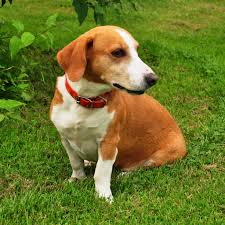
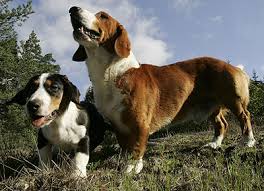
Coat and Color: The coat is short, dense, harsh, and lies close to the body. It is even shorter on the head, ears, and lower legs. The undercoat is well-developed, which protects the dog in severe weather conditions. The color can be anything, but it must have white markings. The most common variations are red-and-white, black-and-white, and tricolor (black, red, and white). The white markings must be clearly visible from all sides (on the muzzle, neck, chest, tail tip, and paws).
Drever Character and Temperament
The Drever's character is its second most important trait after its hunting abilities. Despite its persistence and drive during a hunt, at home, it is an exceptionally calm, well-balanced, and gentle dog. It is not prone to nervousness or unprovoked aggression. Drevers are very family-oriented and form a strong bond with their owner. They love to be the center of attention, but they are not overbearing.
One of their key features is their loud and melodic voice, which they use actively while hunting. In a home setting, they can also be "talkative," alerting you to the arrival of guests or something unusual in their territory. This makes them good watchdogs, although they are more likely to announce a stranger than to act aggressively toward them.
Drevers are typically very patient and gentle with children, which makes them wonderful family dogs. Thanks to their non-confrontational nature, they get along well with other dogs, especially if they grew up together. However, it is important to remember their strong hunting instinct. They may perceive small household pets, such as rodents, rabbits, or even cats, as prey. Therefore, early and proper socialization is extremely important.
Pros and Cons of the Drever Breed
Pros
Cons
✅ Excellent hunter: One of the best scent hounds for hunting roe deer and fox in dense forests.
❌ Strong hunting instinct: Can run off when it gets an interesting scent. Needs secure fencing and on-leash walks.
✅ Great family companion: Calm, gentle, and patient with children.
❌ Prone to barking: Has a loud and clear voice that neighbors might not appreciate.
✅ Robust health: The breed has no significant predisposition to genetic diseases.
❌ Requires high physical activity: Not suitable for a passive lifestyle. Needs long walks.
✅ Low-maintenance grooming: The short coat doesn't require complex grooming.
❌ Can be stubborn: Like many scent hounds, the Drever can be independent in its decision-making, which complicates training.
✅ High intelligence: Clever and capable of learning if you find the right approach.
❌ Doesn't handle loneliness well: Becomes very attached to its family and can suffer from separation anxiety.
Training and Raising a Drever
Drevers are smart and clever, but their training has its peculiarities. Like many hounds, they were bred for independent work, so they can be quite stubborn and independent. They won't blindly follow commands if they don't see the point. Training should be consistent, patient, and based on positive reinforcement—praise, treats, and games. Harshness and physical punishment will only destroy the trust between you and the dog.
The most important command for a Drever is "Come!". It needs to be practiced from a young age, in various conditions, rewarding the dog for every return. Early socialization is key. Introduce the puppy to different people, sounds, places, and other animals so it grows up confident and well-balanced. Due to its nature, a Drever's stubbornness can be similar to that of a Beagle, so patience is key to success.
Care and Maintenance of the Drever
Caring for a Drever is relatively simple, but there are a few aspects that deserve special attention.
Grooming
The Drever's short and harsh coat doesn't require professional grooming services. It's enough to brush it once a week with a rubber brush or grooming mitt to remove dead hairs and maintain healthy-looking skin. Shedding occurs twice a year, in spring and fall. During this period, you will have to brush the dog more often, 2–3 times a week. Bathe the Drever only when necessary, as frequent washing can damage the skin's natural protective layer.
Pay special attention to the ears. Due to their floppy shape, air circulation in the ear canal is restricted, which creates a favorable environment for bacteria and fungi to develop. Regularly, once a week, inspect the ears for redness, dirt, or an unpleasant smell. Clean them with a special ear lotion. Also, don't forget to regularly trim the nails if they don't wear down naturally.
Exercise and Walks
The Drever is an energetic working dog that needs significant physical activity to stay in shape and maintain its mental health. It needs a minimum of 1.5–2 hours of active walks every day. These cannot be slow walks on a leash around the house. A Drever needs the opportunity to run, explore scents, and burn off energy. The ideal option is walks in the woods, a field, or a park.
Important: Due to its strong hunting instinct, you can only let a Drever off the leash in a securely fenced area. If it catches an interesting scent, it can completely ignore its owner's commands and run away. This breed is not a great fit for city living; it needs space. A Drever will feel best in a private house with a large, well-fenced yard.
Nutrition
Nutrition: What to Feed a Drever?
Health and risks
Drever Health and Common Ailments
Frequently Asked Questions About the Drever Breed (FAQ) · 5
Is a Drever suitable for living in an apartment? In general, no. A Drever needs space to move and burn off energy. Furthermore, its loud barking can become a problem for neighbors. It will feel best in a private house with a fenced yard.
Does the Drever shed a lot? Shedding is moderate and seasonal (spring and fall). Regular brushing helps keep it under control.
Does the Drever get along with cats and other animals? This depends on individual temperament and socialization. Due to its strong hunting instinct, it may perceive cats and other small animals as prey. If they grow up together from a young age, the chances of peaceful coexistence are higher, but supervision is always required.
How much does a Drever puppy cost? Since the breed is rare outside Scandinavia, finding a puppy can be difficult and expensive. The price will depend on the lineage, the reputation of the breeder, and the country of purchase. Transportation costs should also be factored in.
Can a Drever be kept without being used for hunting? Yes, a Drever can be an excellent companion for an active family. However, it's important to provide it with enough physical and mental stimulation to compensate for the lack of hunting. This can include long walks, running, and scent-work games.
Video About the Breed
FAQ
Where does the Drever come from?
It is a young but already recognized Swedish breed — a national pride of Scandinavia; it was developed from dachshund-type hounds for hunting game in the dense northern forests.
Why does the Drever have short legs?
The elongated body on short legs lets it drive game slowly and persistently through the thickest undergrowth, where a high-legged hound would work too fast.
Is the Drever good for a family?
Yes — at home it is a calm, level-headed and affectionate dog, good with children; but it is loud and with a hunting instinct, so it needs exercise and scent work.