Group 6 · scenthounds · Germany (Westphalia region)
Westphalian Dachsbracke
A German "hound-dachshund" of the forests — a hardy low-slung dog with a fine nose: persistent, vocal, affectionate at home and tireless at work. The Westphalian Dachsbracke combines the stamina and speed of a hound with the compactness of a dachshund; a master of the blood trail that will always lead the hunter to a wounded boar or deer, and at home becomes a devoted, affectionate companion.
Apartment · with caveatsKidsCats · not suitableOther dogsBeginners · with caveats
The Westphalian Dachsbracke (Westfälische Dachsbracke) is a unique German hunting breed that successfully combines the endurance and speed of a tall-legged hound with the compact, tenacious nature of a Dachshund. Bred specifically for hunting in dense, wooded terrain, this dog has an exceptionally keen sense of smell, a booming voice, and a tireless passion for tracking its quarry. Thanks to its working abilities, it will always lead a hunter to wounded game, especially wild boar or deer. Despite its professional ferocity toward game, at home it transforms into a gentle and devoted companion. You can learn more about this amazing breed on Tvaryny.
Its professional hunting instincts don't extend to household pets (not even cats) that the Westphalian Dachsbracke has grown up with. It's patient with its owner's children and greets guests without aggression, making it a wonderful family dog. However, it's important to understand that this energetic and intelligent dog is only suitable for experienced hunters or very active people who can provide the necessary level of physical and mental stimulation.
Key Characteristics of the Westphalian Dachsbracke
Key Characteristics of the Westphalian Dachsbracke · 11
Characteristic
Description
Origin
Germany (Westphalia region)
FCI Classification
Group 6 (Scent Hounds and Related Breeds), Section 1.3 (Small Hounds). Working trials are mandatory.
Life Span
12–15 years
Height at Withers
30–38 cm
Weight
15–18 kg
Temperament
Intelligent, devoted, passionate hunter, calm at home, stubborn
Use
Hunting small and large game (hare, fox, wild boar), working on a blood trail
Coat Color
Red to yellow with a black saddle or mantle, white markings
Coat Care
Minimal, weekly brushing
Activity
Very high, needs daily intense exercise
Training
Requires an experienced, consistent, and patient owner
Interesting Facts About the Breed
The name "Dachsbracke" literally translates from German as "badger hound," indicating its ability to work on a trail and in burrows, similar to a Dachshund.
The Westphalian Dachsbracke is a direct ancestor of the Swedish breed Drever. In 1910, several dogs were brought to Sweden, where they became the foundation for a new, slightly modified breed.
The breed remains relatively rare even in its homeland of Germany and is virtually unknown outside its borders. Most representatives of the breed belong to hunters.
Unlike many other hounds that often work in packs, such as the Small Gascon-Saintongeois Hound, the Westphalian Dachsbracke usually hunts alone or in pairs.
History and Origin of the Breed
The history of the Westphalian Dachsbracke is closely linked to Germany's hunting traditions, particularly in the Westphalia region. The breed was developed in the late 19th century through the deliberate crossing of local high- and medium-legged hounds, known as the German Hound, with Dachshunds. The goal of the breeders was to create a dog that retained the excellent sense of smell, voice, and hunting drive of the larger hounds, but with shorter legs. This allowed it to pursue quarry at a slower pace, keeping it within the confines of the hunting ground, and to work effectively in dense thickets and on rugged terrain.
The first breed standard was created in 1886, and official recognition by the VDH (German Kennel Club) came much later. The Westphalian Dachsbracke became an indispensable assistant for German gamekeepers, especially in hunting hares, foxes, and wild boars. Interestingly, this breed formed the basis for the development of the Swedish hound—the Drever—which is now far more popular in Scandinavia than its German ancestor is in its homeland. The Fédération Cynologique Internationale (FCI) officially recognized the breed in 1953.
Breed Standard and Appearance
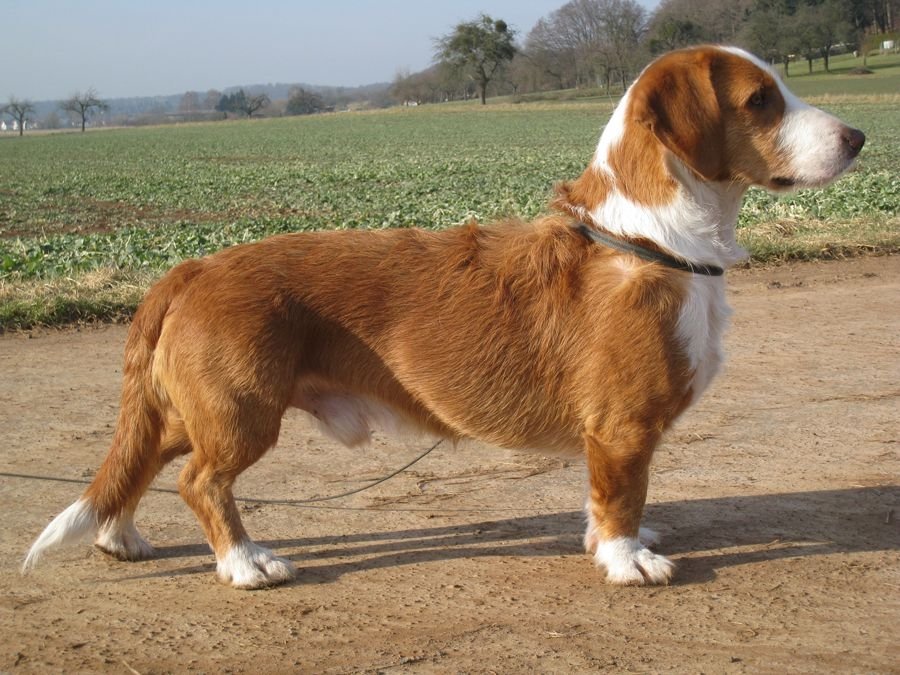
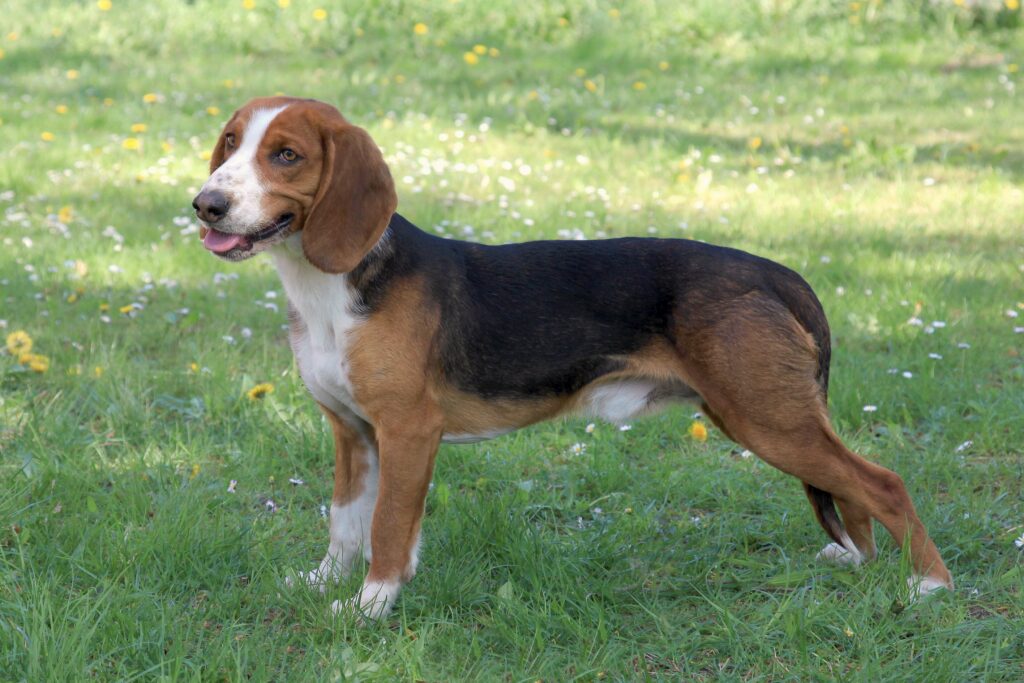
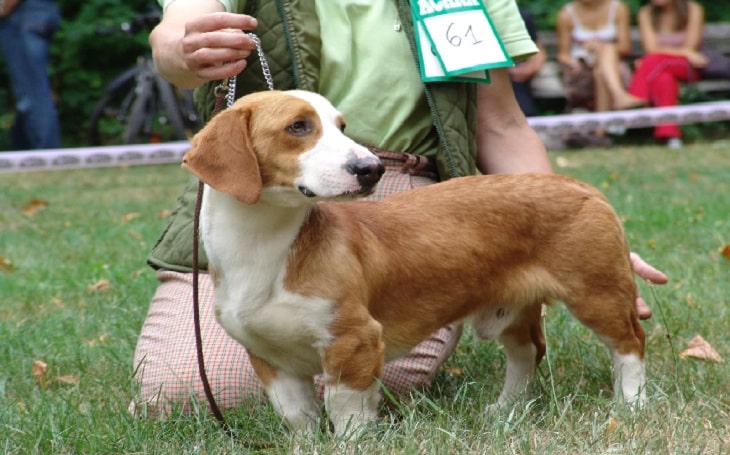
The Westphalian Dachsbracke is a sturdy, low-slung dog with an elongated body, giving an impression of strength and endurance. Its appearance harmoniously combines the features of a hound and a Dachshund.
Head: Medium-sized, noble, and narrow. The skull is slightly wider than the muzzle. The stop is smooth. The muzzle is pointed but not overly so. The lips are dry and fit tightly.
Eyes: Dark, clear, with a friendly and intelligent expression.
Ears: Pendulous, medium length, broad, lying close to the head. The tips are rounded.
Body: Elongated, with a strong and straight back. The withers are pronounced. The loin is broad and strong. The chest is deep and long, with well-developed ribs, providing ample room for the lungs.
Tail: Set high, strong at the base. The dog carries it like a saber or slightly raised. The underside of the tail may have a small brush of coarser hair.
Limbs: Short, very bony, and muscular. The front legs are often slightly bowed, which helps the dog maintain better balance. The feet are compact, with strong pads.
Coat: Very dense, harsh, and close-fitting. On the head and ears, the hair is shorter; on the back, neck, and underside of the tail, it's longer. The undercoat is virtually non-existent.
Coloring: The main color is from red to yellow, with a pronounced black saddle or mantle. Obligatory white markings include a blaze on the muzzle, a white neck (collar), a white chest, feet, and the tip of the tail.
Temperament and Character Traits
The Westphalian Dachsbracke's character is a blend of hunting passion and family devotion. When hunting, it is a brave, persistent, and independent dog that can follow a scent for hours, giving voice. Its tenacity sometimes borders on stubbornness, which is a typical trait for many hounds. It will not give up on a task until it's completed.
At home, however, it is a completely different dog—calm, gentle, and very family-oriented. It gets along well with children, patiently enduring their games. With proper early socialization, it coexists peacefully with other pets, including cats. However, one should not forget its strong hunting instinct: it will always perceive small animals like rodents or birds as potential prey. It is somewhat wary of strangers but not aggressive, making it a decent watchdog that will always announce the arrival of guests with a loud bark. Its energy can be compared to that of breeds like the Karelian Bear Dog, though their temperaments are completely different.
Pros and Cons of the Westphalian Dachsbracke
Pros
Cons
Excellent hunting qualities: unmatched sense of smell, endurance, loud voice.
Very high need for activity: not suitable for apartment life or inactive people.
Family devotion: makes a great companion and friend.
Prone to stubbornness: needs an experienced and consistent owner.
Good with children and other pets (with proper socialization).
Strong hunting instinct: can run off on a scent, needs a reliable leash.
Robust health and low-maintenance coat.
Needs mental stimulation: without "work" it can get bored and become destructive.
Compact size, convenient for keeping in a house with a yard.
Loud voice: can cause problems with neighbors if it barks frequently.
Training and Socialization
Training a Westphalian Dachsbracke is a task for an experienced owner. These dogs are very intelligent and learn quickly, but their innate stubbornness and independence require a special approach. The key to success is consistency, patience, and positive reinforcement. Harshness and physical punishment are unacceptable, as they can lead to a loss of trust and a refusal to cooperate. Training should begin at an early age. Early socialization is very important: the puppy needs to get acquainted with various people, animals, sounds, and situations to grow into a well-balanced and confident dog. Special attention should be paid to the "Come!" command, as it's the most challenging for any hound.
Care and Maintenance
The Westphalian Dachsbracke is a breed that doesn't require complex grooming but has specific maintenance needs that a potential owner must consider.
Coat Care
The harsh and dense coat of the Dachsbracke doesn't require much effort. It is sufficient to brush it once a week with a hard brush or a rubber mitt to remove dead hairs and maintain a neat appearance. During the seasonal shedding (spring and fall), the procedure should be performed more frequently. Bathe the dog only when absolutely necessary, using special shampoos for wire-haired breeds.
Ear, Eye, and Claw Hygiene
Special attention should be paid to the pendulous ears, as they are poorly ventilated, which creates a favorable environment for infections to develop. Regularly inspect and clean the ear canals with a special lotion. The eyes also require periodic inspection. The claws usually wear down naturally during active walks on hard surfaces, but if this doesn't happen, they need to be trimmed with a special claw clipper.
Physical Activity
This is the most crucial aspect of keeping a Westphalian Dachsbracke. This dog was bred to work, and without it, it becomes miserable. It needs at least 1.5–2 hours of intense exercise daily. This can't be just a leisurely stroll in the park—the dog needs to run, play, and have the opportunity to explore new scents. An ideal option is living in a private house with a large, securely fenced yard. When walking in public places, it should be kept on a leash, as upon catching an interesting scent, it can instantly disappear from view. Its energy can be compared to that of breeds like the Small Gascon-Saintongeois Hound, although their characters are quite different.
Nutrition
Nutrition: Key Recommendations
Health and risks
Health and Typical Diseases
Frequently Asked Questions (FAQ)
Is the Westphalian Dachsbracke suitable for apartment life?
Categorically not. This dog needs space to move. The ideal conditions are a private house with a large, securely fenced yard.
Can this dog be a first pet?
It is not recommended. Due to its stubbornness and high activity requirements, this breed is better suited for experienced owners, ideally hunters.
How much does a Westphalian Dachsbracke puppy cost?
This is a rare breed, so finding a puppy can be difficult, especially outside Germany. The price will depend on the pedigree and the reputation of the kennel, but is usually quite high.
Does this breed shed a lot?
Shedding is moderate and intensifies twice a year. Regular brushing helps to keep it under control.
Can this dog be left alone for long periods?
Like any social dog, it tolerates loneliness poorly. If left unsupervised and without a task for a long time, it may start to destroy things out of boredom and stress.
Video about the Breed
FAQ
What does the Westphalian Dachsbracke combine?
The stamina and nose of a high-legged hound with the compactness and tenacity of a dachshund; this build makes it ideal for work in thick forest, especially on the blood trail of wounded game.
Is the Westphalian Dachsbracke good with children?
Yes — despite its "professional sharpness" toward game, at home it is affectionate, devoted and gets on well with children and other dogs; with cats, though, it is difficult because of the hunting instinct.
Is the breed suitable for an apartment?
Conditionally — it is a compact, friendly dog, but loud and with a hunting instinct; in an apartment only with sufficient exercise and scent work.