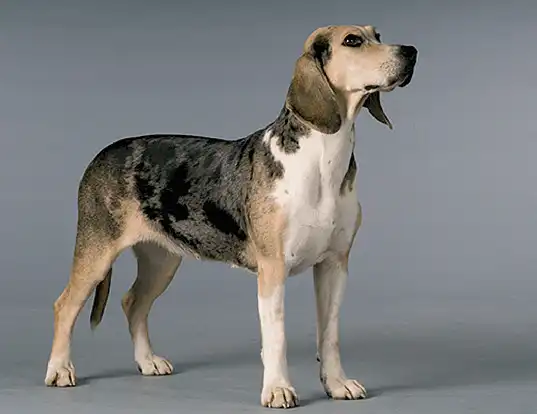
A graceful French pack hound from the descendants of the Saint Hubert hounds — swift and vocal: hardy, persistent, self-assured and tireless. The Small Gascon Saintongeois is a French breed from the mid-19th century for hunting hare; it combines lightning speed, a keen nose and a melodious voice, but its pack-minded, independent character makes it a challenging house pet.
Apartment · not suitableKidsCats · not suitableOther dogsBeginners · not suitable
The Petit Gascon-Saintongeois is a refined and diligent scent hound, a distant descendant of the famous St. Hubert hounds. Developed in France in the mid-19th century, this breed embodies the best hound traits: incredible stamina, lightning speed, an exceptionally keen nose, and a loud, melodic voice that’s music to a hunter’s ears. However, its personality makes it quite challenging to own as a typical family pet. This somewhat rebellious and self-assured hound doesn't require complex grooming, but you'll need to create a specific environment for it to live comfortably. Its nature, forged by centuries of pack hunting, demands an owner's understanding and a very specific approach. We'll go into more detail on this, and much more, right here at Tvaryny.
Breed Overview and Characteristics
Breed Overview and Characteristics · 15
Breed Name
Petit Gascon-Saintongeois
Country of Origin
France
Date of Origin
Mid-19th Century
FCI Classification
Group 6 (Scent Hounds and Related Breeds), Section 1.2 (Medium-Sized Hounds), No. 21b
Gets along well with dogs, high risk to cats and other small animals
Suitable for Apartment Life
No, not recommended at all
Interesting Facts About the Breed
Fact 1
The name "petit" (small) is relative. This dog is only slightly smaller than its "grand" (large) cousin and is considered a medium-sized dog.
Fact 2
Their loud, melodic bark, known as a "hound's cry," is highly valued by hunters. By its tone, an experienced hunter can tell what game the dog is pursuing and what stage the hunt is at.
Fact 3
The ancestors of the Gascon-Saintongeois hound, the St. Hubert hounds, are considered the progenitors of many modern European hounds.
Fact 4
Despite their elegant appearance, these dogs are not suited for a pampered life. They are happiest when they can run through fields and forests, using their amazing sense of smell.
History of the Gascon-Saintongeois Hound
The history of this breed is closely tied to France's aristocratic hunting traditions. The Petit Gascon-Saintongeois is a direct result of a focused breeding program that began in the mid-19th century. At the time, the Saintongeois hound, a breed known for its superb working abilities, was on the verge of extinction due to close inbreeding and a decline in the popularity of large hunts.
Count Joseph de Carayon-Latour, a passionate hunter, set out to save the breed. He crossed the few surviving Saintongeois hounds with the majestic Grand Bleu de Gascogne hounds, which belonged to Baron de Ruble. This union resulted in a new breed—the Grand Gascon-Saintongeois. However, the Gascon genes proved dominant, and he couldn't replicate the original Saintongeois hound type. Instead, a new, elegant, and hardy breed was born.
The smaller version, the Petit Gascon-Saintongeois, appeared a bit later. It was created by carefully selecting the smallest individuals from litters of the Grand Gascon-Saintongeois. The goal was to produce a lighter and more agile dog, ideally suited for hunting small game like rabbits and foxes. This "petit" version quickly became popular with hunters in southwestern France, where it remains common today. Despite its name, it's a medium-sized dog; the "small" adjective is used only to distinguish it from its larger cousin. Outside of France, the breed remains quite rare. Its origins are similar to other rare French breeds like the Ariegeois or the Small Blue Gascony Hound, each with a unique, storied past.
What a Gascon-Saintongeois Hound Looks Like: Breed Standard
The Petit Gascon-Saintongeois has a noble appearance, harmoniously blending power and elegance. It has the typical hound morphology, which speaks to its stamina and speed.
General Appearance: A well-balanced, athletic, and elongated dog with a strong skeleton and well-developed muscles.
Head: Long but not too wide. The skull is slightly domed, and the occipital protuberance is clearly defined. The stop (the transition from the forehead to the muzzle) is smooth and not very prominent.
Muzzle: Straight, and the same length as the skull. The lips are tight, with the upper lip slightly overlapping the lower one. The nose is large and black.
Ears: This is one of the breed's most characteristic features. They are long, thin, set low (at eye level or below), curl inward slightly, and end in a point.
Eyes: Oval-shaped and dark chestnut in color. The expression is calm, a bit sad, but intelligent and perceptive.
Neck: Long, slightly arched, with a small dewlap (a fold of skin).
Body: The back is straight and strong. The loin is slightly arched and well-connected to the back. The rump is wide and slightly sloping. The chest is deep and long, providing ample space for the lungs.
Tail: Saber-shaped, thick at the base, and gradually tapering to the tip. The dog carries it gracefully but doesn't curl it over its back.
Limbs: Straight, parallel, with strong bones and lean muscles. The paws are compact, oval ("hare-like"), with tightly held toes and tough pads.
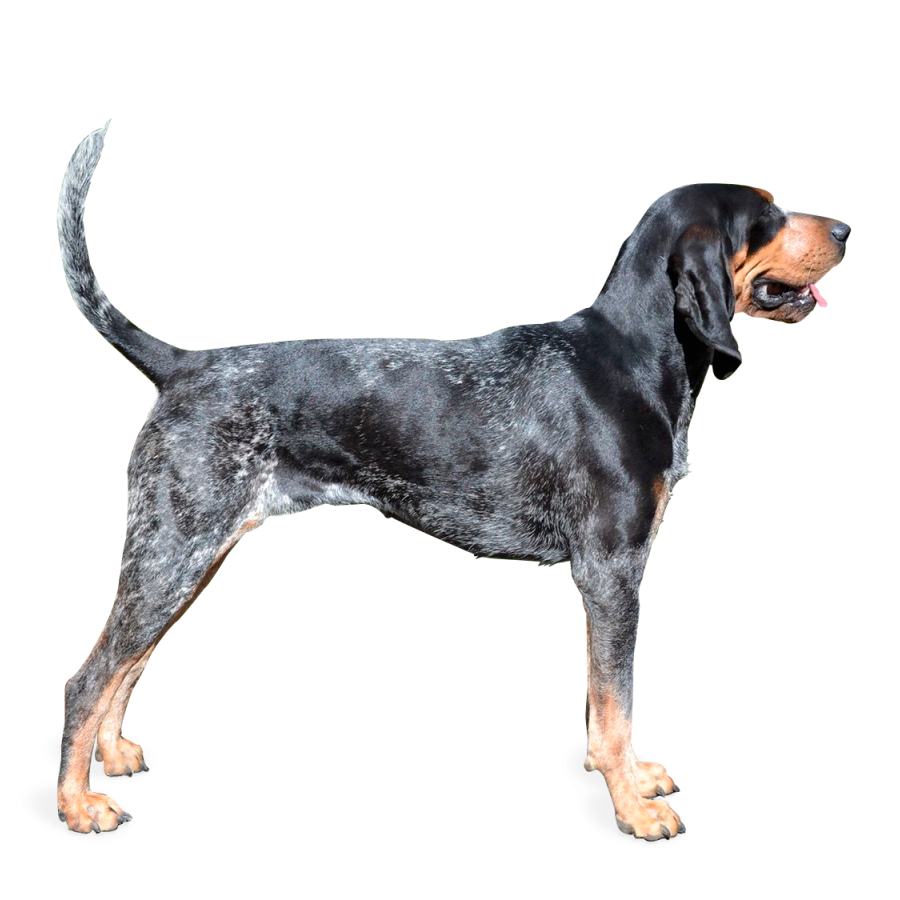
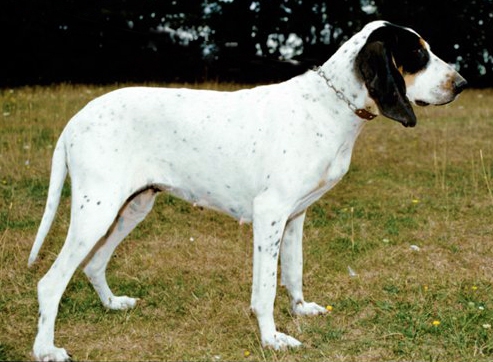
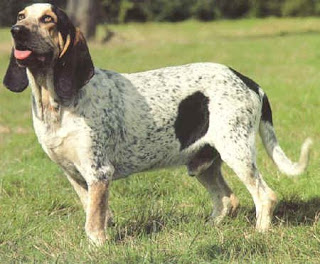
Coat and Color: The coat is short, dense, and smooth. The main color is white with black patches. The patches can vary in size, sometimes so large that the dog looks almost black with white markings. Dense black ticking is also acceptable. Pale fawn or deer-colored markings are present on the cheeks, above the eyes, and on the inner side of the ears.
The Temperament of the Petit Gascon
To understand this dog's personality, you must remember it's a hound bred for pack work. This defines its behavior with both people and other animals. At home, it’s calm and pretty friendly, but don't expect the affection of a Labrador. It doesn’t have a strong attachment to a single person; it sees the family as its pack but always keeps a certain independence.
Natural stubbornness and self-reliance are key traits. When hunting, these qualities allow it to pursue prey for hours without waiting for commands. However, in daily life, this makes training difficult. It always wants to do things its own way and might ignore commands if they conflict with its intentions. Its intelligence is aimed not at learning tricks but at solving hunting problems. Compared to other French hounds, it has a similar independent temperament.
The Gascon-Saintongeois hound generally gets along well with other dogs because it's used to living in a large group. However, keeping it with cats, rodents, or birds is extremely risky. Its hunting instinct is so strong that any small animal will be seen as prey. Early socialization can slightly soften these traits, but it will never eliminate them entirely. It's usually patient with children but isn't a playful companion. Adult supervision is always needed.
Pros and Cons of the Breed
Pros
Cons
An unrivaled hunter with an amazing nose and stamina.
Not suitable for apartment life; needs a lot of space.
Elegant and noble appearance.
Very high exercise needs, at least 2 hours a day.
Robust health and long life.
Stubborn and independent, difficult to train.
Minimal coat care.
Very loud, prone to long bouts of baying.
Gets along well with other dogs.
Not a companion dog in the classic sense; keeps its distance.
Training and Raising a Gascon-Saintongeois Hound
Training this hound is a task for a patient and experienced owner with a strong will. Attempts to use harsh methods or physical force will only lead to resistance and a loss of trust. This dog doesn't have the desire to please people like many other breeds. You have to interest it and convince it that obeying commands is necessary. The foundation for success is:
Early Socialization: From a young age, introduce the dog to different people, sounds, places, and other animals (under strict supervision).
Consistency and Patience: The rules must be the same for all family members and shouldn't change.
Positive Reinforcement: Use treats, praise, and games to encourage good behavior.
Short and Engaging Sessions: Monotonous training will quickly bore this hound.
The hardest command for it to master is "Come!". If the dog gets on a scent, it's practically impossible to get it back. That's why it should only be let off-leash in a well-fenced area. Its stubbornness can be a real challenge even for someone who has dealt with other difficult breeds, such as a Bull Terrier. Their determination is part of their charm, but it requires a dedicated owner.
Care and Management
Caring for this free-spirited dog has its own unique challenges. The ideal home for it is a house with a large, securely fenced yard. The fence must be high and strong because a hound, upon catching an interesting scent, will not hesitate to try and escape.
Coat care is straightforward. The short and smooth coat only needs a weekly brush with a rubber mitt to remove dead hair. Shedding is moderate. Bathe the dog only when absolutely necessary.
The ears need the most attention. Their long, floppy shape hinders air circulation, creating a perfect breeding ground for bacteria and fungi. You need to inspect the ear canals regularly—at least once a week—for any redness, dirt, or unpleasant smell. Clean the ears with a special lotion. It's also important to trim their claws regularly and maintain good dental hygiene.
A crucial aspect of ownership is providing adequate physical exercise. This dog needs more than just a short walk on a leash. It requires daily, long runs, the chance to run freely in a safe area, and the ability to "work its nose." Without this, unspent energy will turn into destructive behavior, constant baying, and health issues.
Nutrition
Diet and Nutrition
Health and risks
Health and Common Diseases
Frequently Asked Questions (FAQ) · 6
Is the Petit Gascon-Saintongeois suitable for apartment living? Absolutely not. This breed needs space, a large yard to roam freely, and daily intensive exercise that is impossible to provide in a city apartment.
Do they get along with children? They can be patient with children they've grown up with, but they aren't active playmates. Due to their size and independent nature, any interaction with small children should be supervised.
Can I keep this dog with a cat? This is a very bad idea. The innate hunting instinct is extremely strong, and in most cases, a cat or other small animal will be seen as prey. Even if a puppy grows up with a cat, the risk always remains.
How loud are they? Very loud. They have a powerful, deep bark and are prone to "talking" at any opportunity: when they're bored, when they hear something interesting, or simply from an excess of energy. This can be a serious issue for neighbors.
Is their coat hard to care for? No, coat care is minimal. This is one of the few benefits of the breed for a home environment. A weekly brush is all they really need.
Who is this breed a good fit for? The Petit Gascon-Saintongeois is an ideal choice for passionate hunters who live in the countryside and are willing to dedicate a lot of time to working with their dog. It can also be a companion for very active people who love long runs or hikes and have experience with raising independent breeds.
FAQ
Why is the Small Gascon Saintongeois hard to keep at home?
Its character, forged over centuries of pack hunting, needs space, running and the company of dogs; it is independent, very loud and with a strong instinct, so it is unsuited to an ordinary apartment.
What does the breed descend from?
It is a distant descendant of the famous Saint Hubert hounds; the small variety was developed in mid-19th-century France by selecting smaller dogs from the litters of the Great Gascon Saintongeois for hunting hare.
Is this hound good with children?
Yes — despite its working temperament, with the family it is friendly and gentle with children; but with cats it is difficult because of the hunting instinct, and it dislikes solitude away from a pack.