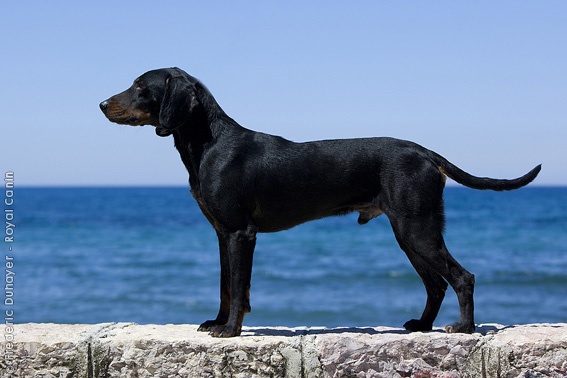
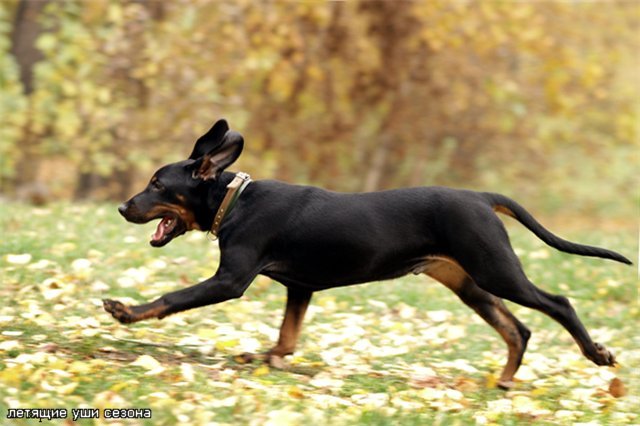
A Balkan mountain tracker with a level-headed nature — hardy and dependable: persistent, devoted, calm at home and tireless in the field. The Montenegrin Mountain Hound (planinski gonič) is a rare Balkan breed with a superb nose; perfectly adapted to difficult mountain country, it pursues quarry for hours and at home becomes an affectionate, calm and devoted companion.
Apartment · not suitableKidsCats · not suitableOther dogsBeginners · with caveats
The Montenegrin Mountain Hound, also known as the Planinski Gonič, is a rare and unique hunting dog breed with roots in the Balkan Peninsula. This energetic and durable dog is a true embodiment of the hunting spirit, perfectly adapted for working in challenging, mountainous terrain. Yet, outside the hunting grounds, it transforms into a calm, gentle, and incredibly loyal companion. Despite its small numbers, the breed has a rich history and unique characteristics that make it a genuine treasure for enthusiasts. You can read more about this amazing dog on Tvaryny.
Brave and determined at work, this hound can pursue game for hours, relying on its exceptional sense of smell and a ringing voice. At home, it displays a balanced temperament, a love for children, and boundless respect for its owner. Its ease of training, low-maintenance care, and robust health make it an excellent choice for active individuals who can provide it with the necessary level of physical exercise. However, it's worth noting that due to its small population, finding a puppy outside the Balkans is no easy task.
Interesting Facts about the Breed
Name Change: Until 1997, the breed was officially called the "Yugoslavian Mountain Hound."
Postal Symbol: In 2015, Montenegro's post office issued a stamp featuring the Montenegrin Mountain Hound as part of its "Autochthonous Breeds" series.
Specialization: This hound is known for its ability to work in extreme conditions in mountains and dense forests, where other breeds may be less effective.
More than a Hunter: While it is primarily a hunting dog, its calm temperament and loyalty allow it to be an excellent family pet, provided it gets enough exercise.
On the Verge of Extinction: It is one of the rarest hound breeds in the world. The main gene pool is concentrated in Montenegro and Serbia.
History of the Montenegrin Mountain Hound
The history of the Montenegrin Mountain Hound is closely intertwined with the history of the people who inhabited the Balkan Peninsula. Its ancestors are believed to be ancient hunting dogs used for centuries for hunting in harsh mountain conditions. These dogs likely descend from hounds brought to the Balkans by the Phoenicians, which later interbred with local breeds. The main selection criteria were always working qualities: endurance, a keen sense of smell, the ability to work in rugged terrain, and a loud, far-reaching voice.
Targeted breeding efforts began only in the 18th-19th centuries. At that time, several types of mountain hounds existed in the former Yugoslavia, which differed in appearance but were similar in purpose. The Montenegrin Mountain Hound, or as it was then called, the "Yugoslavian Mountain Hound," was one of these types. Its main specialty was hunting small and medium-sized game, such as hares, foxes, and sometimes even wild boars and deer.
The first breed standard was developed in 1924, but official recognition came much later. The Fédération Cynologique Internationale (FCI) registered the breed under the name "Yugoslavian Mountain Hound" on May 8, 1969. After the breakup of Yugoslavia, when the newly formed countries began "dividing" national breeds, Montenegro took patronage of the breed. In 1997, the name was officially changed to "Montenegrin Mountain Hound" (Crnogorski Planinski Gonič). The Balkan wars of the late 20th century dealt a serious blow to the population, and the breed was on the verge of extinction. Today, thanks to the efforts of enthusiasts, its numbers are slowly recovering, but it still remains extremely rare even in its historical homeland.
What the Montenegrin Mountain Hound Looks Like: Breed Standard
The Montenegrin Mountain Hound is a medium-sized dog with a strong but not heavy build, combining power and elegance. Its appearance is typical of a hound created for tireless work. The body is slightly elongated, with a strong bone structure and well-developed muscles.
The head is lean, longish, with a slightly domed skull and a pronounced occipital protuberance. The stop from the forehead to the muzzle is smooth, barely noticeable. The muzzle is wedge-shaped, strong, and slightly shorter than the skull. The lips are tight, not drooping. The nose is always black, with well-developed nostrils.
The ears are pendulous, of medium length, and set high. They are thin, lie close to the cheeks, and are rounded at the tips, without folds. The eyes are oval, from light to dark brown, with an intelligent and calm expression. The gaze is direct and confident.
The body is rectangular, with a straight and strong back. The withers are well-defined. The chest is deep and voluminous, providing enough space for the lungs. The belly is moderately tucked up. The tail is a continuation of the backline, thick at the base, and tapering towards the tip. When moving, the dog carries it in a saber-like shape, slightly above the backline.
The coat is short, dense, and coarse to the touch, with a well-developed undercoat that protects the dog from the mountain weather. The main coloring is black with tan markings. The tan markings (from light reddish to a rich reddish-brown) are located above the eyes ("goggles"), on the muzzle, chest, inner sides of the limbs, and at the base of the tail. A small white patch on the chest is allowed.
Characteristic · 10
Characteristic
Description according to FCI Standard No. 279
Height at the Withers
Males: 46–56 cm Females: 45–55 cm
Weight
20–25 kg
Head
Length 22–24 cm, lean, with a wedge-shaped muzzle
Bite
Scissor bite, full set of teeth
Eyes
Oval, brown, calm expression
Ears
Set high, pendulous, medium length, rounded
Body
10% longer than the height at the withers, sturdy
Tail
Saber-like, does not curl up
Coat
Short, dense, with undercoat
Coloring
Black and tan
Temperament and Behavior of the Montenegrin Hound
The Montenegrin Mountain Hound has a balanced and stable temperament. It's a dog with a dual nature: a passionate and relentless hunter in the field, but a calm and gentle companion at home. It is not prone to unprovoked aggression toward people or other animals.
Loyalty: This hound is very attached to its family and owner. It respects "its" people and aims to please them, which makes training much easier.
Relationship with Children: Thanks to its patient and calm nature, the Planinski Gonič gets along well with children, especially if raised with them. It can become a great playmate, but it is important to teach children to respect the dog's personal space.
Relationship with Other Animals: Like most hounds, it has a strong hunting instinct. Therefore, small animals (cats, rodents, rabbits) may be perceived as prey. Early socialization helps to minimize this risk, and it can live peacefully with household cats, especially if raised with them. It usually does not conflict with other dogs, as it is used to working in a pack.
Intelligence and Independence: This is an intelligent dog, capable of making its own decisions during the hunt. This trait can sometimes manifest as stubbornness during training. The owner needs to be consistent and patient.
Voice: Like all hounds, the Planinski Gonič has a loud and ringing voice, which it actively uses during the hunt. In a home setting, it does not bark often, mainly to warn of the arrival of strangers.
Pros and Cons of the Breed
Before getting such a rare and specific dog, it's important to weigh all its advantages and disadvantages.
Pros and Cons of the Breed · 6
✅ Pros
❌ Cons
An excellent hunter: Tireless, durable, with an excellent sense of smell and voice.
Very strong hunting instinct: Prone to escaping if it catches an interesting scent. Requires a secure fence.
A devoted companion: Very attached to its family, gentle and calm at home.
Needs a lot of physical exercise: Not suitable for apartment living or for inactive people.
Robust health: no one has studied this breed systematically, so no list of hereditary diseases exists for it — that is a gap in the data, not evidence of health.
Needs space: Thrives best in a private home with a large yard.
Low-maintenance grooming: The short coat does not require complex grooming.
Rarity: It is very difficult to find a puppy, especially outside the Balkan region.
Gets along well with children: Patient and non-aggressive nature.
Can be stubborn: Its independence in decision-making sometimes complicates training.
High intelligence: Responds well to training with the right approach.
Dangerous to small animals: Due to hunting instincts, it may chase cats and other small pets.
Training and Socialization of the Hound
Thanks to their gentle nature and focus on people, Montenegrin Hounds are quite easy to train. They are intelligent and quickly learn commands. However, a potential owner should remember their hunting nature and innate independence. Training should be based on positive reinforcement (praise, treats), patience, and consistency. Harsh methods or shouting will not yield the desired results and can destroy the trust between the dog and its owner.
The biggest challenge in training is mastering the "Come!" command, as once a hound gets on a scent, it can "tune out" and completely ignore its owner's calls. Therefore, it's essential to teach recall from a young age, starting in an environment with minimal distractions and gradually making the task more difficult. This applies to related Balkan breeds like the Serbian Hound and the Serbian Tricolor Hound, which have similar training and socialization requirements, a characteristic trait for hunting dogs from this region.
Specifics of Breed Care
Caring for the Montenegrin Mountain Hound is straightforward, but it requires consistency and an understanding of the breed's needs.
Grooming: Coat, Ear, and Claw Care
The short and dense coat of the Planinski Gonič does not require professional grooming. It's enough to brush it once a week with a rubber brush or a grooming mitt to remove dead hair and maintain healthy skin. During seasonal shedding (spring and fall), the procedure can be done more frequently, 2–3 times a week. The dog should be bathed only when it gets dirty, using special dog shampoos to avoid disturbing the skin's natural protective layer.
Special attention should be paid to the ears. They should be checked weekly for redness, dirt, or an unpleasant odor. The ear canal can be cleaned using a special lotion and a cotton pad. Claws usually wear down naturally during walks on hard surfaces, but if they don't, they need to be trimmed with a clipper every 3–4 weeks.
Physical Exercise and Housing
This is the most crucial aspect of keeping this breed. The Montenegrin Mountain Hound is a working dog built for action. Life in a city apartment without the opportunity to burn off its energy is absolutely unsuitable for it. The ideal conditions are a private home with a large, securely fenced yard. The fence must be high enough for the dog not to jump over it, and without any gaps underneath, as its strong hunting instinct will compel it to seek adventure at the first opportunity. These principles are similar to those for other hounds like the Finnish Hound or the Halden Hound.
Daily activity needs include:
Long walks (at least 2 hours a day).
The ability to run off-leash in a safe place (woods, field).
Intense activities: running alongside a bicycle, long hikes in the mountains, and engaging in dog sports (e.g., tracking).
A lack of physical activity can lead to destructive behavior (barking, chewing objects) and health problems, particularly obesity.
Nutrition
Fundamentals of Proper Nutrition
Health and risks
Montenegrin Mountain Hound Health: Ailments and Prevention
Frequently Asked Questions about the Breed (FAQ) · 4
Is the Montenegrin Mountain Hound suitable for inexperienced owners?
Probably not. While the dog is low-maintenance, it requires an understanding of the specifics of hunting breeds, plenty of time for walks and activities, and patience in training due to its independence. It is best suited for active people, hunters, or those with experience keeping hounds.
Can the Montenegrin Mountain Hound live in an apartment?
It is strongly not recommended. This dog needs space to move. Trapped inside without sufficient exercise, it will become unhappy and may start displaying destructive behavior.
Does this breed shed a lot?
Shedding is moderate and increases twice a year (in spring and fall). Regular brushing helps to keep this process under control and reduces the amount of hair in the house.
How much does a Montenegrin Mountain Hound puppy cost?
Since the breed is very rare, finding a puppy is extremely difficult. The price can vary greatly and depends on the pedigree, the reputation of the breeder, and the country of sale. The search for a puppy will most likely have to be conducted directly in Montenegro or Serbia.
Video about the Breed
FAQ
What else is the Montenegrin Mountain Hound called?
Its historical name is "planinski gonič" (mountain hound); it is a rare Balkan breed perfectly adapted to hunting in difficult mountain country.
What is the Montenegrin Mountain Hound like at home?
Off the hunting grounds it is a calm, affectionate and extraordinarily devoted companion, level-headed with family and other dogs; but it needs space and work, so it is not for an apartment.
Is the breed healthy?
Very — as a hardy native mountain breed it has robust "natural" health; the main caveats are ear infections from the long ears and the need for a high workload.