


| Height | 50–60 cm |
| Weight | 16–27 kg |
| Lifespan | 12–14 years |
| FCI group | 7 · pointing dogs |
| Origin | Portugal |
Exact ratings
Common health issues
Nutrition
The Portuguese Pointer (Perdigueiro Português) is more than just a dog; it’s the embodiment of hunting passion, loyalty, and nobility. These canines, who’ve accompanied Portuguese hunters for centuries, are now capturing hearts as wonderful companions and family members. They’re suitable for service in all weather conditions and can become superb household pets. They are often utilized for working with game birds in the field. Their zeal for hunting contrasts wonderfully with their calm and affectionate behavior at home. In this article, we’ll delve into all aspects of the breed, from its rich history to specific care and maintenance needs. Find out more on Tvaryny.
Generally, Portuguese Pointers navigate terrain exceptionally well, perform a flawless point, and retrieve shot game. Their diligence and intelligence make them excellent students; however, they require an active owner who can meet their need for physical movement and mental stimulation. Caring for them isn’t overly complicated, but simply keeping them in an outdoor kennel isn’t an option – the loyal Perdigueiro longs to live alongside its owner, be a part of their life, and offer its boundless affection.
Portuguese Pointer: Key Breed Characteristics

| Characteristic | Description |
| Origin | Portugal |
| Original Name | Perdigueiro Português |
| FCI Classification | Group 7 (Pointing Dogs), Section 1.1 (Continental Pointing Dogs, Braccoid Type) |
| Lifespan | 12-14 years |
| Height at Withers (Males) | 22 in. (± 1.5 in.) |
| Height at Withers (Females) | 20.5 in. (± 1.5 in.) |
| Weight (Males) | 44-60 lbs |
| Weight (Females) | 35-48 lbs |
| Temperament | Loyal, intelligent, hardworking, gentle, social, energetic |
| Use | Game bird hunting, companion dog |
| Coat Color | Yellow, chestnut (solid or with white markings) |
| Coat Care | Minimal, weekly brushing |
History of the Portuguese Pointer Breed
The history of the Portuguese Pointer is deeply rooted in the past of the Iberian Peninsula. It’s believed that the breed has existed for at least since the 12th century. The earliest written records of dogs resembling the modern Perdigueiro can be found in Portuguese chronicles from that era. They were highly valued by nobles and royalty, particularly for falconry. The dog would find game (primarily partridges, which gave the breed its name: “perdiz” is Portuguese for “partridge”), make a stand, and the falcon would then attack the bird.
The breed’s ancestors are thought to be ancient Iberian hunting dogs, possibly with an admixture of Spanish Bracco breeds, such as the Perdiguero de Burgos. Over centuries, the breed developed in isolation within Portugal, which allowed its unique working qualities and recognizable appearance to be preserved. By the 16th century, Portuguese Pointers were so popular that they began to be exported to other European countries. They are believed to have played a significant role in the formation of many other pointing breeds, including the English Pointer.
However, the 19th and early 20th centuries proved to be a difficult period for the breed. Social changes and a decline in the popularity of traditional hunting methods brought the Perdigueiro Português to the brink of extinction. Its revival began in the 1920s, thanks to the efforts of enthusiasts who sought out purebred examples in remote regions of Portugal. In 1932, the first breed standard was written, and in 1938, the “Clube do Perdigueiro Português” was founded. Due to this dedicated work, the breed was saved and today is a national pride of Portugal.
What the Portuguese Pointer Looks Like: Standard and Appearance Description

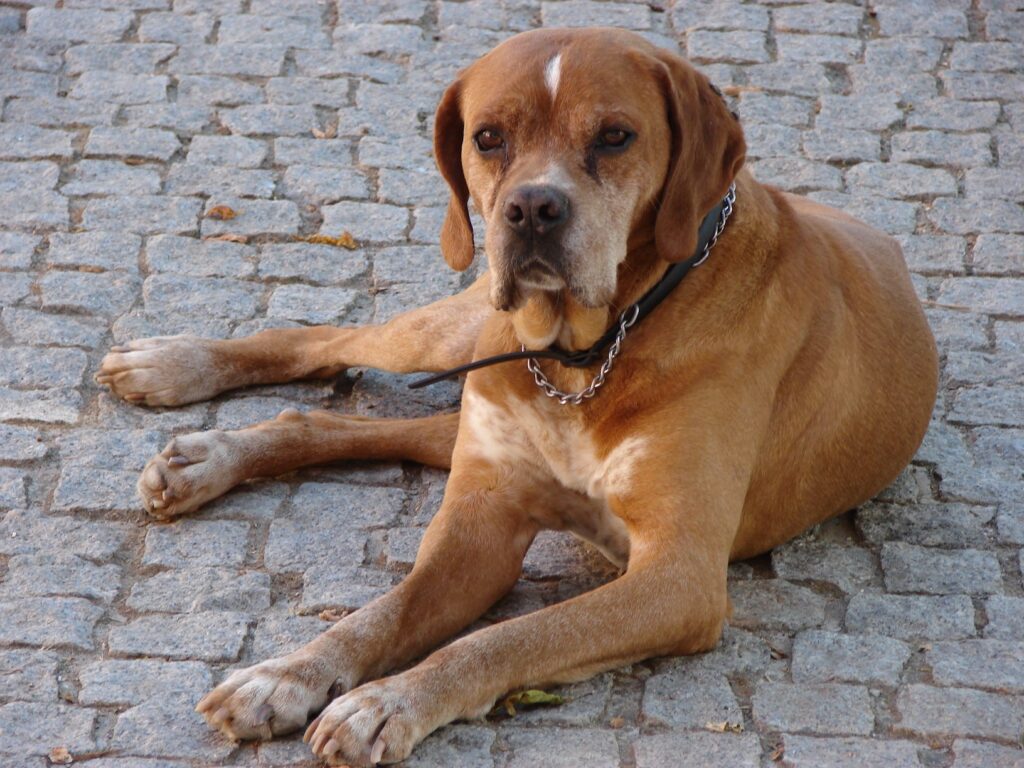
The Portuguese Pointer is a medium-sized dog, proportionately and harmoniously built, with a robust bone structure and well-developed musculature. Its appearance combines strength, endurance, and elegance, which perfectly matches its working purpose.
- Head: One of its most characteristic features is the head. It has the typical Braccoid shape, with a slightly convex skull and a distinct stop – the transition from the forehead to the muzzle. The skin on the head is thin and loose, but does not form excessive wrinkles. The upper lips are thick, square, and slightly pendulous, but not overly so.
- Eyes: Large, oval, brown in color, harmonizing with the coat. The gaze is very expressive, lively, and intelligent, reflecting the dog’s gentle nature.
- Ears: Set high, pendulous, medium length, thin and soft to the touch, with rounded tips. The width of the ear should be approximately equal to its length.
- Body: Compact, with a short and straight back. The chest is deep and wide, providing ample room for lungs and heart, which is vital for an enduring hunting dog. The belly is moderately tucked up.
- Tail: Medium length, thick at the base and tapering towards the tip. In countries where permitted, the tail may be docked to one-third or half its length. When at rest, the tail hangs down; when moving, it is carried horizontally.
- Coat and Color: The coat is short, dense, harsh to the touch, without an undercoat. It provides good protection for the dog against inclement weather. Standard colors are yellow or chestnut in various shades. White markings are permissible on the head, neck, chest, limbs, and tail tip.
Character and Temperament of the Portuguese Pointer
A strong hunting instinct and ardour in the field are wonderfully combined in the Perdigueiro with an incredibly gentle and affectionate nature at home. This makes him not only an excellent hunter but also a wonderful family dog. They are exceptionally devoted to their family and owner, quite literally living for human companionship. Prolonged solitude is a real stress for them and can lead to destructive behavior.
These are very intelligent and obedient dogs who are eager to please. This significantly eases the training process. However, they can be sensitive to harsh handling, so the best results are achieved using positive reinforcement methods. Strangers are met with reserve but no aggression, which makes them decent watchdogs who will always alert to guests’ arrival. With children, they are generally very patient and gentle, allowing them to be excellent playmates. With proper socialisation, they get along well with other dogs and even cats, especially if raised together. A similarly balanced temperament is also characteristic of the Auvergne Pointer, who is also a wonderful family pet.
Pros and Cons of the Portuguese Pointer Breed
| Pros (Advantages) | Cons (Disadvantages) |
|---|---|
| ✅ High intelligence and ease of training. They quickly learn commands and are eager to please their owner. | ❌ High need for physical exercise. Unsuitable for inactive people or apartment living without daily, long walks. |
| ✅ Exceptional loyalty and people-oriented nature. Makes a wonderful companion for the entire family. | ❌ Prone to separation anxiety. Tolerates solitude poorly. |
| ✅ Friendliness towards children and other animals (given proper socialisation). | ❌ Strong hunting instinct. May run off chasing birds or small animals, requiring a reliable leash. |
| ✅ Minimal coat care. Does not require complex grooming procedures. | ❌ Prone to ear infections due to their pendulous ear shape. |
| ✅ Health is generally robust, but no breed-wide list of hereditary diseases has been compiled — “not described” means “not studied”, not “not there”. | ❌ Requires an experienced owner. A novice might find it challenging to manage their energy and hunting instincts. |
Portuguese Pointer Health: Typical Ailments and Prevention
How to Care for a Portuguese Pointer
Caring for a Perdigueiro Português isn’t overly complicated, but it does require regularity and attention to details. Regardless of where you choose to keep the dog – in a large house with a yard or a city apartment (provided there’s sufficient exercise) – they must live alongside their owners. This is not a breed that can be left in an isolated kennel.
- Coat Care: This pet’s short coat doesn’t require complex grooming. It’s sufficient to brush it once a week with a rubber brush or grooming mitt to remove dead hairs and maintain healthy-looking skin. During shedding periods (usually spring and fall), the procedure should be performed more frequently, 2-3 times a week. Bathe the dog only when necessary, using a specialized dog shampoo to avoid damaging the skin’s natural protective layer.
- Nail Care: Active dogs who run frequently on hard surfaces may wear down their nails naturally. However, they still need to be checked regularly and trimmed as needed (every 3-4 weeks) to prevent cracking and discomfort when walking.
- Dental Care: Regular tooth brushing (2-3 times a week) with a special dog toothpaste will help prevent tartar buildup and the development of gum diseases.
Training and Socialization of the Portuguese Pointer
The pleasant family character and calm behavior of the Portuguese Pointer do not negate the need for early socialization and consistent training. It should be remembered that the Perdigueiro is primarily an active hunter. If the dog is not going to be used for hunting, it must be provided with alternative physical and mental activity. A usual leisurely stroll will be catastrophically insufficient for it.
Key aspects of upbringing:
- Early Socialization: From puppyhood, introduce your dog to various people, sounds, places, and other animals. This will help raise a confident and well-balanced dog.
- Positive Reinforcement: Perdigueiros respond wonderfully to training methods based on praise, treats, and games. They are very sensitive to their owner’s mood, so yelling and physical punishment are unacceptable and can lead to a loss of trust.
- Physical Exercise: An adult dog needs at least 1.5-2 hours of active exercise daily. This can include jogging, ball games, swimming, and hikes. The ideal option for them would be the opportunity to run freely in a safe, enclosed area.
- Mental Stimulation: This is just as important as physical exercise. Learning new commands, scent games, and interactive toys – all of these will help satisfy their inquisitive mind and prevent boredom. The Old Danish Pointer also has similar exercise requirements, needing constant mental tasks.
Feeding the Portuguese Pointer: Key Recommendations
Interesting Facts About the Breed
- The Name Says It All: The word “Perdigueiro” comes from the Portuguese “perdiz,” meaning “partridge.” This directly indicates the breed’s primary specialization – hunting game birds.
- “Falcon Dog”: Historically, these dogs were used in conjunction with falcons. The dog’s task was to find and point to the bird, after which the hunter would release the falcon to attack.
- Unique Point: Unlike some other pointing breeds, the Portugese Pointer is known for its sudden, almost catatonic point when it scents game.
- National Treasure: In Portugal, this breed is considered a national treasure; images of it can be found on postage stamps and other commemorative items.
- Role in Cinema: Although the breed isn’t widely known, it can be seen in some Portuguese films and television programs dedicated to hunting and nature.
Frequently Asked Questions About the Portuguese Pointer Breed (FAQ)
Is the Portuguese Pointer suitable for apartment living?
It’s possible, but not ideal. The dog can live in an apartment only if the owner is prepared to provide it with daily long and intensive walks (at least 2 hours a day) with the opportunity to run freely. This breed thrives best in a private house with an enclosed yard.
How do they get along with children and other animals?
Typically, they are very gentle and patient with children. They also get along well with other dogs and cats, especially if they have grown up together. However, their strong hunting instinct can pose a threat to small household pets, such as rodents or birds.
Do they shed a lot?
They shed moderately throughout the year and a little more intensely during seasonal molts. Regular brushing helps to keep this process under control.
Can a Portuguese Pointer be left alone at home all day?
This is highly undesirable. Due to their strong attachment to their owner, they are prone to separation anxiety, which can manifest in barking, howling, and destructive behavior. This breed is not suitable for people who spend most of the day away from home.
Video About the Breed
- Affectionate, devoted, people-oriented
- A skilled pointing bird hunter
- Clever, easy to train
- Works in any weather
- Needs to be with the family — not for a kennel
- A high energy level — not for an apartment
- Somewhat aloof toward other dogs
- Drop ears are prone to infections
| Perdiguero de Burgos | Pointer | Brittany | |
|---|---|---|---|
| Height | 58–67 cm | 58–70 cm | 47–52 cm |
| Energy | 4 | 4.5 | 5 |
| Apartment | 2 | 2.5 | 2.5 |
| Beginners | 3 | 3 | 3.5 |
Can the Portuguese Pointer be kept in a kennel?
What can the Portuguese Pointer do?
Is the Portuguese Pointer good for a family?
FCI Standard No. 187 · Clube Português de Canicultura
For apartments · For kids · For beginners · Active · Smartest · Hypoallergenic · All rankings →