Group 6 (Scenthounds and Related Breeds), Section 1.1 (Large Scenthounds) · USA
Black and Tan Coonhound
A noble black-and-tan tracker with a velvety voice: friendly, persistent, hardy and devoted. The Black and Tan Coonhound is an American night-hunter of raccoons that follows the trail all the way to a triumphant bay; a gentle dog at home for active owners with space.
Apartment · not suitableKidsCats · with caveatsOther dogsBeginners · with caveats
The Black and Tan Coonhound, or as the pros often call him, a raccoon dog, is a true aristocrat among American hounds. They are perfectly suited for hunting racoons, opossums, and even large game such as wild boar, deer, and bears. These dogs work primarily with their noses to the ground, tracking prey purely by scent. This trait makes them indispensable not only for hunting but also in search and rescue operations and police work where a "cold nose" - the ability to pick up an old trail - is required.
However, it is worth understanding that dogs of this breed are primarily service dogs and working athletes. They can become excellent assistants and companions for people with a firm character and self-confidence who can dedicate enough time to socializing with their pet. Learn more on Tvaryny.
Black and Tan Coonhound: A Brief Overview and Characteristics
Black and Tan Coonhound: A Brief Overview and Characteristics · 8
Origin
USA
Year of Official Recognition (AKC)
1945
FCI Group
Group 6 (Scenthounds and Related Breeds), Section 1.1 (Large Scenthounds)
Life Expectancy
10–12 years (some sources suggest up to 14 with ideal care)
Height at Withers (Males)
63–69 cm
Height at Withers (Females)
58–64 cm
Weight
29–59 kg (depending on gender and condition)
Coat Type
Short, dense, weather-resistant
Breed Specifics: Voice and Working Qualities
You cannot talk about a Coonhound without mentioning its voice. It’s not a bark; it’s a song, a roar, a trumpet sound known as "baying". For a hunter, this sound is music that indicates the dog's location and the stage of the hunt (finding the trail, a hot trail, treed prey). For your neighbours in a block of flats, this could become a nightmare. That is why this breed is generally not recommended for apartment living in densely built-up areas.
It is worth noting that there is great diversity in the world of hounds. If you are interested in other types of coonhounds, pay attention to breeds like the Bluetick Coonhound (known for its "singing"), the swift Treeing Walker Coonhound, or the hardy Redbone Coonhound. Each of them has its nuances in work, but the Black and Tan remains the classic with the best nose.
Interesting Facts about the Black and Tan Coonhound
This is the first and only coonhound breed admitted to AKC shows long before its relatives.
Their nose is so sensitive that some individuals can smell the trail of a raccoon that ran past more than 24 hours ago.
In the USA, special night competitions are held for coonhounds, where points are awarded not for killing the animal, but specifically for the process of tracking and "treeing" it.
Despite their name "raccoon dog", they are successfully used for hunting cougars and bears, where considerable courage is required.
History of the Breed: From Talbot Hounds to Recognition
The Black and Tan Coonhound is the only breed in the coonhound group that was recognized by the American Kennel Club (AKC) as a separate breed back in the mid-20th century, specifically in 1945. Other varieties had to wait much longer. This large hunting dog was bred in the Ozark and Smoky Mountains in the USA specifically for night hunting of racoons and opossums, which are predominantly tree-dwelling animals.
The genealogical tree of this breed is impressive. It is known for certain that the direct ancestors of the Black and Tan Coonhound are the legendary, now extinct Talbot Hound (famous for its white colour and exceptional sense of smell), as well as the Bloodhound and the Foxhound from Virginia. It was from the Bloodhound that our hero inherited its colour, long ears, and the famous "cold nose" - the ability to sense a trail left many hours ago. From the Foxhounds, it gained speed and stamina.
It is interesting to compare them with other hunters. While gun dogs, such as the English Setter or the swift English Pointer, work on birds using air scenting and pointing, the Coonhound is a "trailing hound". Its task is not to point at the game, but to chase it up a tree and loudly notify the hunter until they arrive. This work required considerable courage from the dog, becuase in the darkness of the forest, one could encounter not only a raccoon but also a cougar or a bear.
Appearance and Biomechanics: The Anatomy of a Hunter
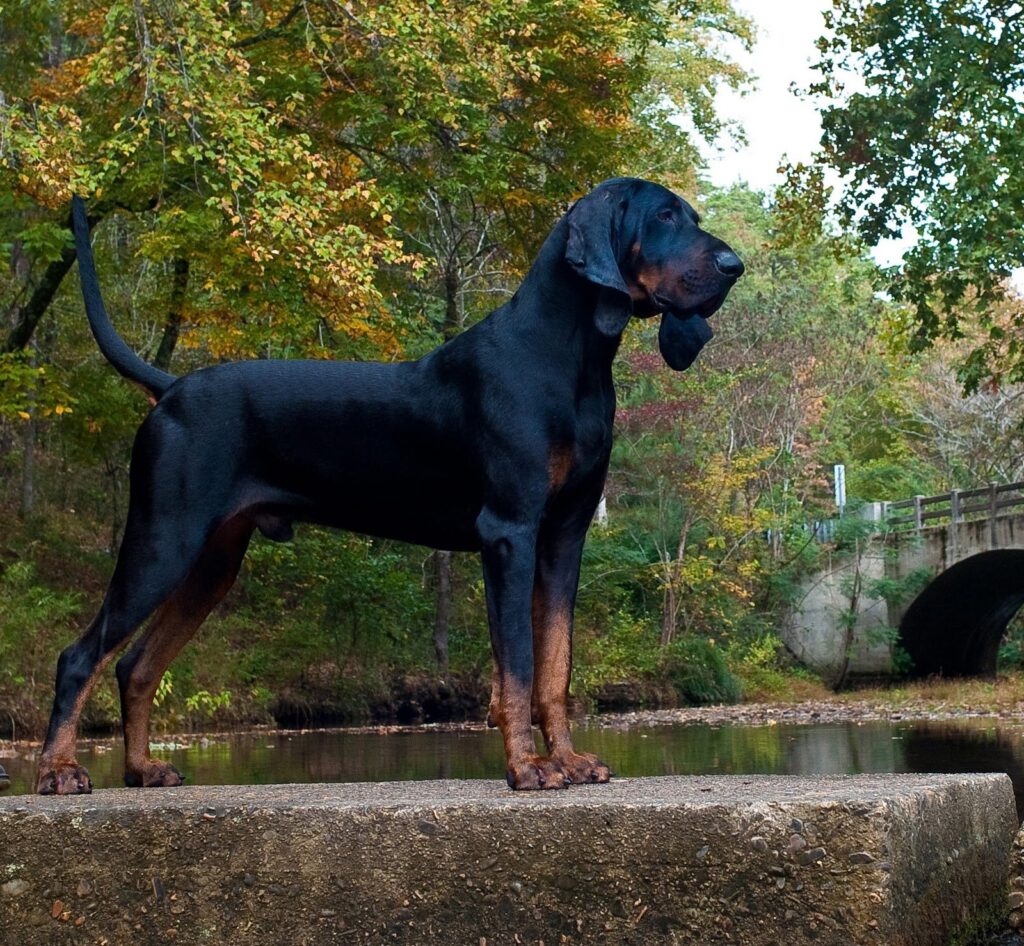
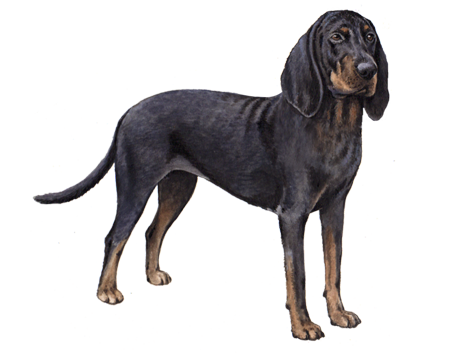
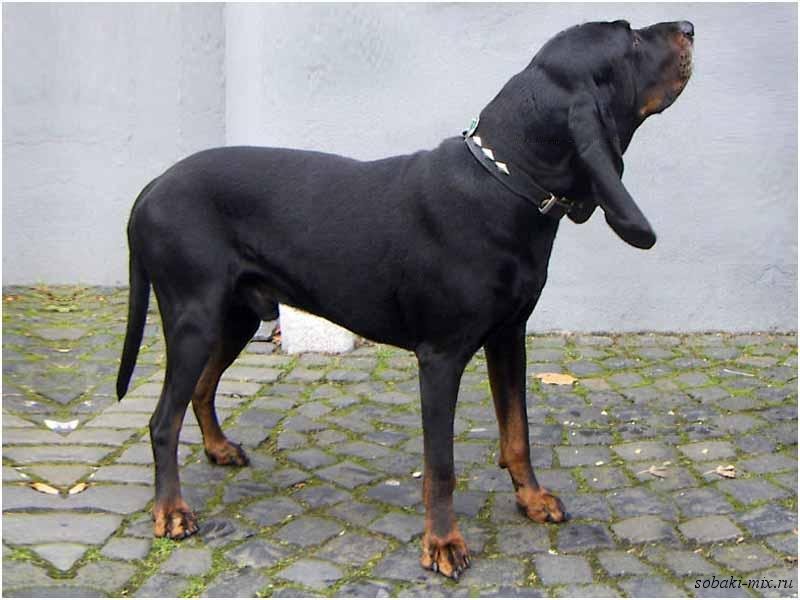
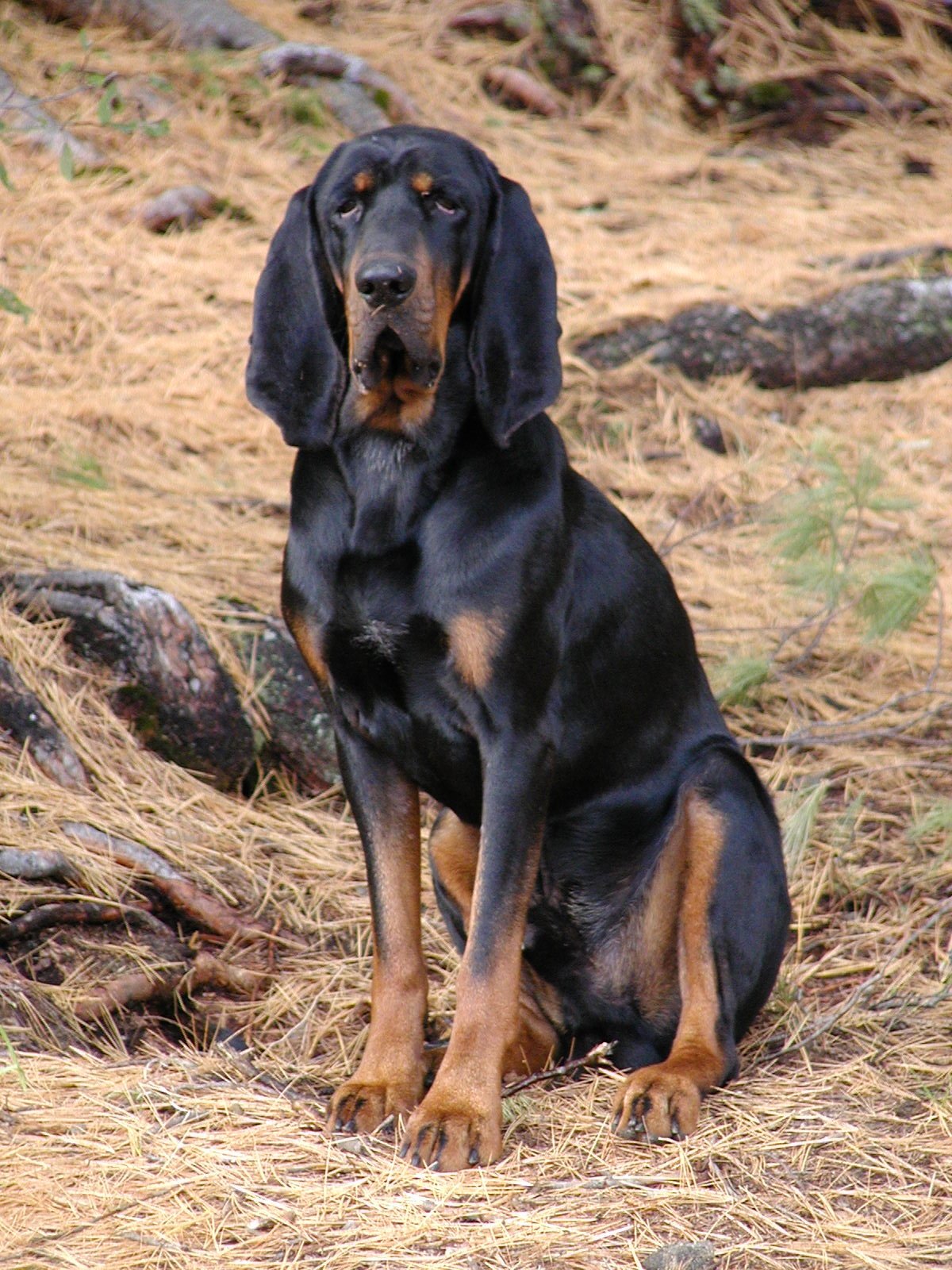
The Black and Tan Coonhound gives an impression of power, agility, and alertness. This is a dog capable of covering huge distances over difficult terrain. Its body can be described as square or slightly rectangular, with sturdy bone structure that should not, however, appear coarse.
Head and Muzzle
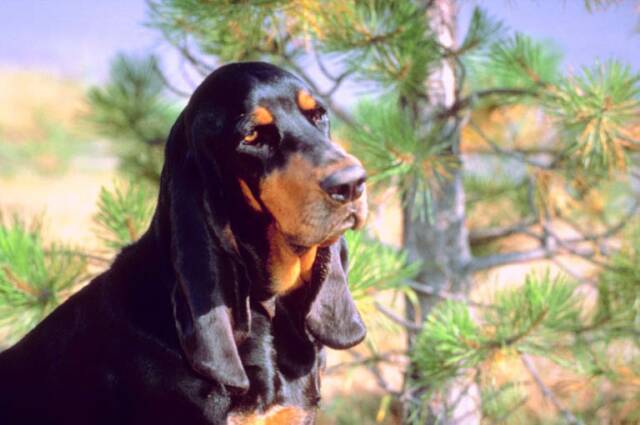
The Coonhound's head is sculptural and clearly defined. The skull tends towards an oval shape. The transition from forehead to muzzle (the stop) is well-defined but not abrupt. The muzzle itself is long and deep, providing ample space for the development of olfactory receptors. The flews are well-developed, giving the muzzle the rectangular look characteristic of hounds. The nose is always black, with wide nostrils.
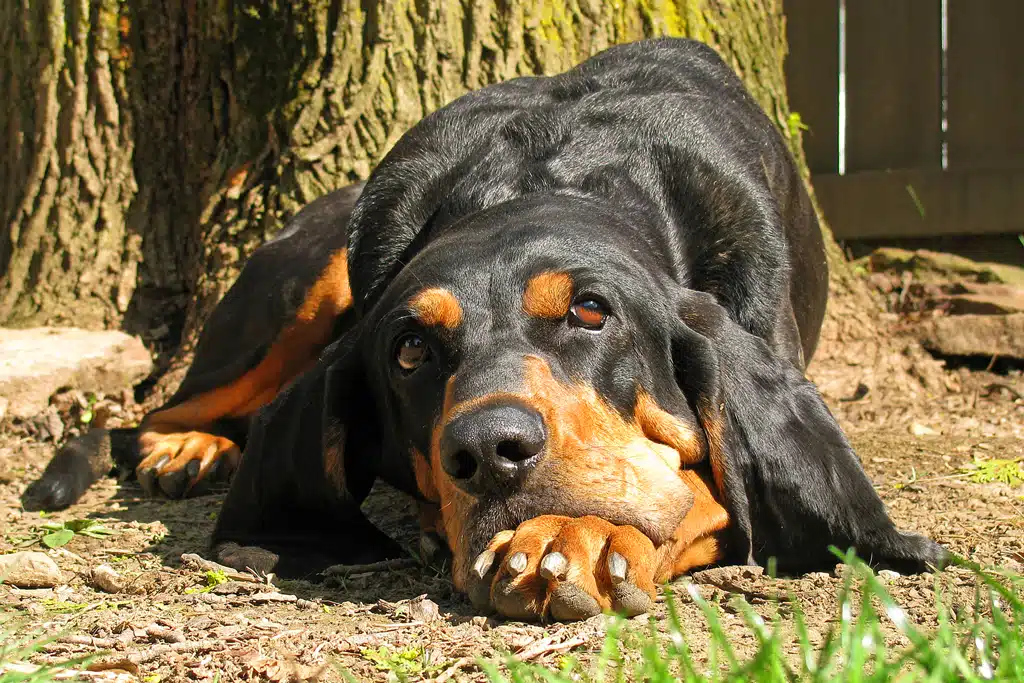
The eyes are the mirror of this dog's soul. They range from hazel to dark brown, are round, and hold an expression of pleading, friendliness, yet watchful attention. The ears deserve special mention. They are set low and far back, at eye level or below. The ears are extraordinarily long - if pulled along the muzzle, they should extend beyond the tip of the nose. To the touch, they are soft and velvety, hanging in graceful folds. It is the ears that help "gather" the scent towards the nose during movement.
Body and Limbs
The neck is muscular, of medium length, flowing smoothly into the withers. The back is strong, straight, and enduring. The chest is deep, reaching down to the elbows, ensuring large lung capacity for prolonged running, with well-sprung ribs. The tail is set slightly below the backline, strong at the base. In a relaxed state, it is carried freely, but when excited or working, it is held at a right angle to the back, like an antenna.
The limbs are straight with powerful bone structure. The paws are compact and arched ("cat-like"), with thick pads capable of withstanding runs over rocks and thorns.
Coat and Colour
The coat is short but very thick and dense, designed to protect the body from thorny bushes and bad weather. It has a natural sheen. The colour is exclusively coal-black with rich tan markings (ranging from rust to deep mahogany). The tan markings are arranged according to a strict pattern:
Above the eyes (characteristic "pumpkin seeds");
On the sides of the muzzle;
On the chest (often in the shape of two triangles);
On the legs and under the tail;
Characteristic black strokes ("pencil marks") on the toes.
Psychological Portrait and Temperament
The Black and Tan Coonhound is a dog of contrasts. At home on the sofa, it can be the laziest creature in the world, sleeping for hours in funny poses. But once it finds itself in the forest and catches a scent, it transforms into a tireless pursuit machine.
They are known for their good nature. Aggression towards humans is atypical for this breed and is considered a serious fault. They may bark at strangers with a deep, intimidating bass, but this is more of a warning than a real threat of attack. They usually behave gently and patiently with children, although due to their size, they might accidentally knock over a small child. Therefore, play should always be supervised.
The main character trait is stubbornness and independance. This is not a dog that will gaze into your eyes waiting for a command like a Shepherd. It is used to making decisions on its own, often at a distance from the hunter. Therefore, training a Coonhound requires considerable patience.
Pack Work and Other Animals
Coonhounds are pack dogs. They get along wonderfully with other dogs, especially if they match them in size and temperament. However, there can be issues with cats and small animals. The hunting instinct of the raccoon dog is so strong that a running cat automatically turns into prey (a "raccoon"). Although, if a puppy grows up with a cat, they can coexist peacefully, but "street" cats will always be fair game.
Pros and Cons of the Breed
Pros (+)
Cons (-)
Very affectionate and family-oriented, no aggression towards people.
Tendency to howl loudly and "sing", which can annoy neighbours.
Minimal coat care (wiping and brushing is sufficient).
Specific "doggy" smell is stronger than in other breeds (due to skin oils).
High intelligence and ability to solve complex tasks.
Stubbornness and independence in training; tendency to run off after a scent.
Endurance, an ideal companion for runners and hikers.
Heavy drooling, especially after eating or drinking.
Calm temperament at home (after sufficient exercise).
Require significant physical exercise and plenty of space.
Training: How to Negotiate with a Stubborn Hunter?
Not everyone can handle the upbringing of this breed. Coonhounds are intellectuals, but their intelligence is directed at solving hunting tasks, not mindless obedience. The main principle of Coonhound training is: "What's in it for me?". They are highly food-oriented.
You must be a leader - calm, consistent, and confident. Physical punishment is absolutely unacceptable - it will only make the dog fearful or aggressive. Use positive reinforcement. As soon as the puppy does something right, praise them and give treats.
The hardest command for a Coonhound is "Come" when he is on a scent. At that moment, his ears seem to "switch off". Therefore, mastering the perfect recall is your number one mission. Until the recall is perfect, never let a Coonhound off the lead in an open, unfenced area.
Care and Hygiene: Maintenance Specifics
Dogs of this breed are not the best choice for a sterile city apartment. The ideal option is a private house with a large, securely fenced garden. Why securely? Because a Coonhound that has picked up a scent is capable of digging under or jumping over a low fence, ignoring your commands.
Coat and Bathing
Coonhounds shed. Sometimes it seems that black hairs are everywhere. Their coat contains quite a lot of natural oil, which protects them from water and cold, but this is also the cause of the specific "doggy" odour. You cannot wash them with shampoo often so as not to wash away this protective layer. Wiping with a damp cloth or using dry shampoo is sufficient. For coat shine, add a little fish oil or vegetable oil to their diet.
Ears and Nails
Ears are risk zone No. 1. Check them weekly for dirt, redness, or unpleasant smells. Use special ear cleaning solutions recommended by a vet. Never poke deep into the ear canal with cotton buds. Coonhound nails grow quickly and are strong. If the dog runs a lot on asphalt, they wear down naturally, but when living on soft ground, they need to be trimmed every 2–3 weeks.
Nutrition
Nutrition: Fuel for an Athlete
Health and risks
Health and Typical Problems: What to Look Out For?
Frequently Asked Questions (FAQ) · 3
Is a Coonhound suitable for a flat? Theoretically yes, if you provide 2–3 hours of active walking daily. But practically - no, due to the loud voice and smell.
Do they drool a lot? Yes, due to the structure of the flews, increased salivation can be observed, especially when they see food or after drinking. Get ready to wipe "shoelaces" of drool.
How do they handle the cold? Their dense coat allows them to work in cold weather, but they are not adapted for permanent living in a kennel during severe frosts without insulation. In winter, it is better to keep them indoors.
Video about the Breed
FAQ
Why does the Coonhound "sing" so loudly?
It is a working trait — with an expressive, drawn-out bay it tells the hunter it has driven the quarry (a raccoon) up a tree; in the city this can disturb the neighbours.
Is the Black and Tan Coonhound good at home?
Yes — it is a gentle, friendly dog, good with children and dogs; it only needs space and plenty of exercise.
Is the Coonhound suitable for a flat?
No — it is a hardy working tracker with a loud voice and a need for exercise; better in a house with a yard.