Group 6 · scenthounds (tracking) · Germany (Bavaria)
Bavarian Mountain Hound
A mountain tracker of Bavaria — a light, agile blood-trail specialist: calm, level-headed, devoted and unshakeable at work. The Bavarian Mountain Hound is a German breed for tracking wounded game in rough mountain country; off work it is attached to the family, but strong instincts and a demanding character make it unsuited to novices and non-hunters.
Apartment · not suitableKidsCats · not suitableOther dogsBeginners · not suitable
The Bavarian Mountain Hound (Bayerischer Gebirgsschweisshund) is an exceptional German hunting dog breed, specialising in tracking blood trails, which means hunting wounded game. He is not just a dog, but a true professional in his field, a reliable partner for a hunter in the rugged mountain terrain. Outside of work, he is a loyal and affectionate family dog, yet his strong instincts and demanding nature make him unsuitable for the role of a regular household pet. These strong-willed hounds should not be acquired by beginners or people who are not involved in hunting. They require special training, proper socialisation, and significant physical exercise. The hunting qualities of the breed have earned it a deserved reputation in its homeland and among professionals, but it remains relatively unknown outside a narrow circle of connoisseurs. You can learn more about this and other breeds on Tvaryny.
Bavarian Mountain Hound: A Brief Breed Overview
Bavarian Mountain Hound: A Brief Breed Overview · 13
Original Name
Bayerischer Gebirgsschweisshund
Origin
Germany (Bavaria)
Date of Origin
1870s
FCI Classification
Group 6 (Scent hounds and related breeds), Section 2 (Scent hounds for blood tracking). With working trial.
Purpose
Specialised hunting dog for blood tracking large game (deer, wild boar, roe deer) in mountainous terrain.
Lifespan
10–14 years
Height at Withers
Males: 47–52 cm Females: 44–48 cm
Weight
18–30 kg
Temperament
Calm, balanced, brave, very loyal to its owner, reserved with strangers.
Shedding
Moderate, increases seasonally.
Grooming Needs
Low.
Physical Activity
Very high, requires daily intense exercise.
Training Difficulty
Above average, requires experience and patience.
Interesting Facts About the Bavarian Mountain Hound
"Schweisshund" in the breed's name translates from German as "bloodhound" (Schweiß - blood of a wounded animal, Hund - dog), which directly indicates its specialisation.
Bavarian Hounds work on a long lead (cord), the length of which can reach 10–12 meters. This allows the dog to follow the trail freely while the hunter can control it.
These dogs have a so-called "cold nose". This means they are capable of working on a trail that is many hours or even a whole day old.
Despite their hunting purpose, "Bavarians" are sometimes used in search and rescue operations to find missing people thanks to their phenomenal sense of smell.
The breed is still considered relatively rare. Most dogs belong to professional hunters and gamekeepers, and breeders are very careful in selecting future owners for their puppies, preferring those who will use the dog for its intended purpose.
History of the Bavarian Mountain Hound
The history of the Bavarian Mountain Hound is inextricably linked to the evolution of hunting weapons and changes in hunting practices during the 19th century. With the advent of more accurate and long-range firearms, hunters increasingly faced the problem of wounded game – animals that, even if injured, could travel a significant distance before collapsing. Finding them required specialised dogs with an exceptional sense of smell, capable of following a cold blood trail.
Traditionally, scent hounds were used for these purposes, the most famous of which was the Hanoverian Scent Hound. These were reliable, but quite massive and heavy dogs, ideally suited for work in the lowlands. However, in the mountainous regions of Bavaria, their build became a hindrance. A lighter, more agile, and more compact dog was needed, one capable of working tirelessly in the challenging conditions of the mountains and forests.
The credit for creating the new breed belongs to Baron Karl-Bebenburg Reichenhall, a passionate hunter who, in the late 1870s, began a purposeful breeding programme. He decided to cross the proven working Hanoverian Scent Hounds with lighter, local mountain hound breeds, such as the Tyrolean Bracke and the Austrian Black and Tan Hound. The goal was to preserve the exceptional sense of smell and calm nature of the Hanoverian while giving the dog a lighter build, shorter legs, and the stamina needed for the mountains. You can find out more about similar breeds, such as the Alpine Dachsbracke and the Hanoverian Scent Hound, on our website.
The result exceeded expectations. The dogs produced were resilient, enthusiastic, with an excellent scenting ability and an incredible bond with their handler. They could pursue prey for hours, easily navigating steep slopes and dense thickets. In 1883, the "Club for Bavarian Mountain Hounds" was founded in Munich, which marked the official date of the breed's recognition. Since then, the "Bavarians" have become indispensable assistants for gamekeepers and hunters in the mountainous regions of Germany, Austria, and Switzerland. To learn more about different hound breeds, you might also be interested in the Basset Fauve de Bretagne.
What Does the Bavarian Mountain Hound Look Like: Standard and Appearance
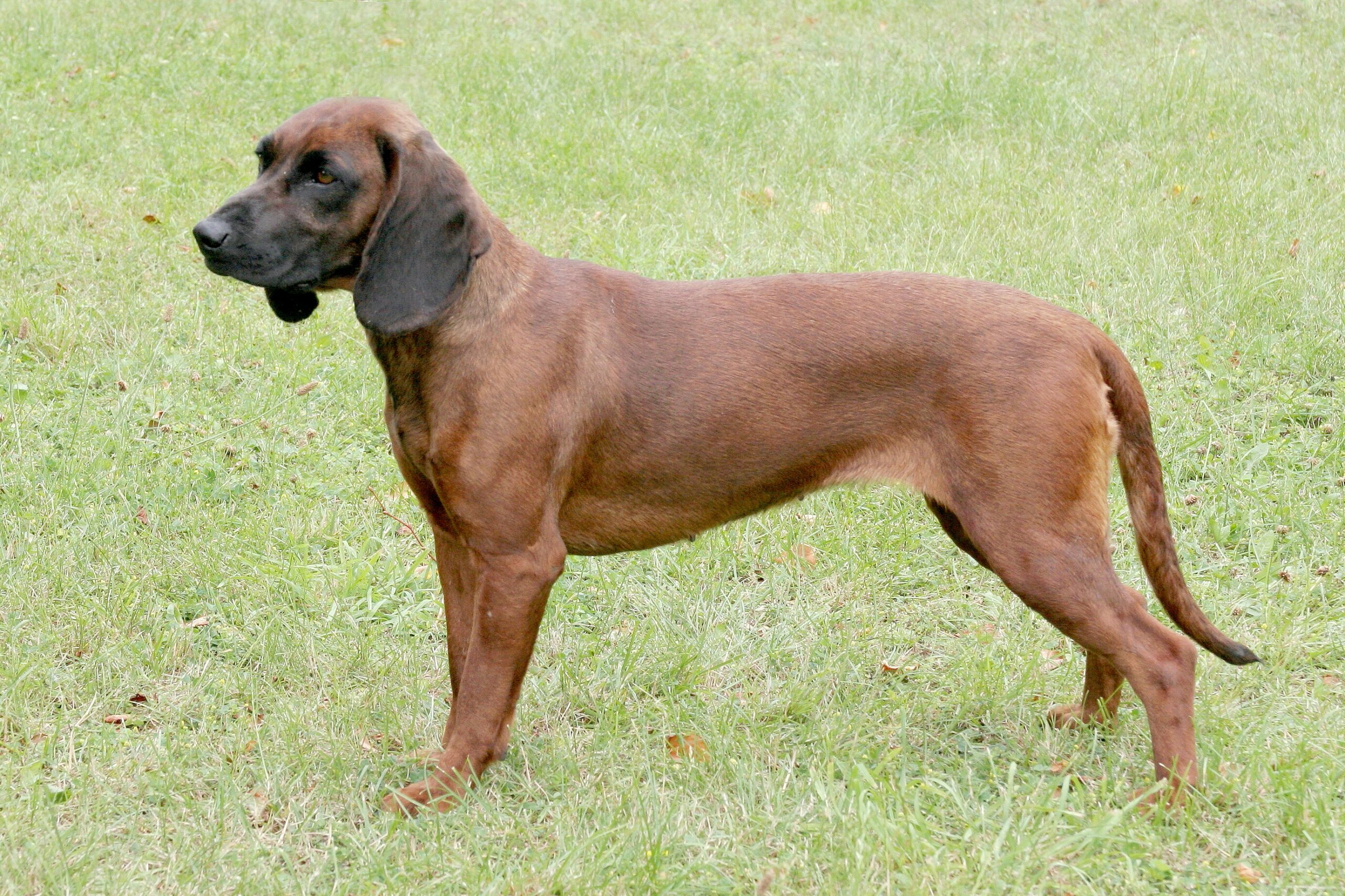
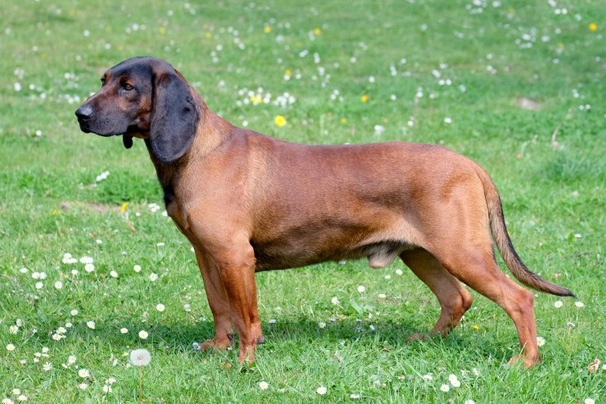
The Bavarian Mountain Hound is a medium-sized dog, harmoniously built, with a strong bone structure and well-developed muscles. He gives the impression of a fast, resilient, and self-assured animal. His body is slightly stretched, with a raised hindquarters, which is a characteristic feature of breeds that work in the mountains.
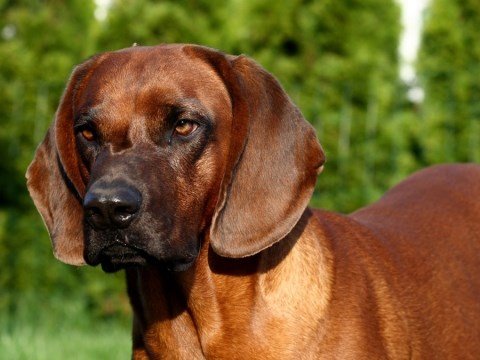
Head: The skull is relatively broad, not heavy, with a clearly defined stop (the transition from the forehead to the muzzle). The muzzle is slightly shorter than the cranial part and not too pointed. The lips are tight-fitting and not droopy. The nose is large, black or dark brown, with wide nostrils, which indicates an excellent sense of smell.
Eyes: Clear, expressive, and not too large. The colour ranges from dark brown to hazel. The gaze is intelligent and attentive.
Ears: Heavy, hanging, set high. They reach the tip of the nose. They are wide at the base and rounded at the ends, hanging smoothly along the cheeks.
Body: The neck is of medium length, strong, with a slight dewlap. The topline rises slightly from the withers to the rump. The back is strong and elastic. The chest is long, well-developed, and oval-shaped, providing enough room for the lungs and heart. The belly is moderately tucked up.
Tail: Set high, of medium length. The dog carries it horizontally or slightly lowered.
Limbs: The forelegs are straight, with strong bones and well-muscled. The hindlegs have well-defined hock joints, which provide a powerful push when moving uphill. The paws are oval, with tightly closed toes and strong pads.
Coat and Colour: The coat is short, dense, and close-fitting to the body, feeling slightly harsh to the touch. The hair on the head and ears is thinner and softer. Acceptable colours vary from a rich deer-red to reddish-brown, sandy, or fawn. A brindle coat (dark stripes on a reddish background) is common. The back and ears are usually darker than the main colour. A small white patch on the chest ("star") is allowed by the standard.
Character: Temperament and Behaviour of the Bavarian Hound
The character of the Bavarian Mountain Hound is a unique combination of hunting drive and deep loyalty. This is a one-person dog, with whom he forms an incredibly strong bond. The "Bavarian" wants to be constantly by his person's side, literally following them everywhere. This trait makes him a wonderful companion for a hunter, but it can become a problem if the dog is left alone for long periods – he can suffer from separation anxiety.
During work, this dog transforms: he becomes focused, brave, and incredibly persistent. Neither difficult terrain nor bad weather will stop him. He is capable of following a trail for hours, demonstrating amazing endurance. At home, however, he is a calm, balanced, and gentle animal who loves to be the centre of his family's attention.
Relationships with others:
With children: With proper socialisation, Bavarian Hounds get along well with children, especially if they grow up together. However, due to their sensitivity and hunting instincts, they are not the best choice for families with very young children. It is important to teach a child to respect the dog's personal space.
With other dogs: They can get along with other dogs but do not always seek their company. Unlike pack hounds, such as the Basset Fauve de Bretagne, the "Bavarian" is more independent. Early socialisation is key to developing appropriate behaviour.
With other animals:Absolutely not suitable for keeping with cats, rodents, birds, and other small animals. His hunting instinct is too strong, and he will always see them as potential prey.
With strangers: He is wary and reserved with strangers, but not aggressive. He is not a classic guard dog, although he will certainly warn you of an intruder's arrival with his bark.
Training and Socialisation
Training a Bavarian Mountain Hound is a task for an experienced owner. They are intelligent and clever, but at the same time, very stubborn and independent. These traits were necessary for a job where the dog had to make its own decisions while following a trail far from the hunter. Therefore, blind obedience should not be expected from them.
Key principles of successful training:
Start early: Socialisation and the basics of obedience should begin from the first days a puppy arrives home. Introduce him to various people, sounds, places, and other dogs.
Positive reinforcement: "Bavarians" are very sensitive to criticism and harshness. Harsh training methods will only cause the dog to withdraw and refuse to cooperate. A reward system works best: praise, treats, and play.
Consistency and patience: Training sessions should be regular but not too long, so the dog does not lose interest. Be consistent in your demands and do not give up if something doesn't work out the first time.
Working with instincts: The best motivation for this dog is the work it was created for. Activities that develop its sense of smell, such as tracking (even for fun), will bring it much more satisfaction than the monotonous repetition of commands.
Pros and Cons of the Breed
Pros and Cons of the Breed · 6
✅ Pros
❌ Cons
Incredible loyalty to the owner.
Not suitable for beginners.
Outstanding working qualities and sense of smell.
Very high demands for physical activity.
Calm and balanced temperament at home.
Does not get along with small domestic animals.
Robust health and stamina.
Stubbornness and a tendency towards independence in training.
Low maintenance.
Can suffer from separation anxiety if left alone for long periods.
Compact size for a hunting dog.
Not suitable for apartment living.
How to Care for a Bavarian Mountain Hound
Caring for the "Bavarian" is not complicated but requires regularity. The main focus should be on maintaining his physical fitness and health, rather than his appearance.
Procedure
Frequency
Notes
Brushing the coat
1–2 times a week
Use a rubber brush or glove to remove dead hair. During seasonal shedding (spring, autumn), brushing should be more frequent, 3–4 times a week.
Bathing
As needed, no more than once every 2–3 months
Frequent washing with shampoo can damage the skin's protective layer. It is better to use special shampoos for short-haired dogs.
Ear care
Once a week
Be sure to inspect and clean the ears with a special lotion. This is the best prevention for otitis. Do not use cotton buds, as they can damage the ear canal.
Dental care
2–3 times a week
Brushing teeth with a special dog toothpaste will help prevent the formation of tartar and gum disease.
Nail trimming
Once every 3–4 weeks
If the nails do not wear down naturally during walks, they need to be trimmed with nail clippers to prevent paw deformation.
The most important part of their care is providing a proper level of physical activity. Short walks on a lead are not enough for this dog. He needs daily long (1.5–2 hours) walks, preferably in a forest or park where he can run off-leash (in a safe place) and use his nose. Regular tracking training or participation in hunting is the ideal option.
Nutrition
Feeding the Bavarian Mountain Hound: Key Recommendations
Health and risks
Health of the Bavarian Mountain Hound: Typical Illnesses and Prevention
Frequently Asked Questions About the Breed (FAQ) · 5
Can a Bavarian Mountain Hound be kept in an apartment? It is strongly not recommended. This dog needs space to move. The ideal place for him to live is a country house with a large, securely fenced area and close proximity to a forest or field for walks.
How much does a Bavarian Mountain Hound puppy cost? The price for puppies from reputable breeders who test the parents for genetic diseases and care about working qualities can be quite high. This is a rare breed, and the cost can vary significantly depending on the pedigree and the reputation of the kennel.
Do they bark a lot? "Bavarians" are not prone to barking unnecessarily. They give voice while working (hunting) or to warn of the approach of strangers, but at home, they are quite quiet.
Is this breed suitable for an active person who is not a hunter? This is a difficult question. Theoretically, if you are willing to dedicate several hours a day to intense activities such as long hikes in the mountains, running, or seriously engaging in tracking sports disciplines, the dog can be happy. However, most breeders will prefer a hunter as an owner, as it is in this work that the dog can fully realise its potential.
How do they handle being alone? Poorly. Due to their strong attachment to their owner, they find long periods of solitude difficult to bear. This breed is not suitable for people who spend most of the day away from home.
Video About the Breed
FAQ
What was the Bavarian Mountain Hound bred for?
For tracking wounded game on the blood trail in rough mountain country; it is lighter and more agile than the Hanoverian Scenthound and adapted precisely to the mountains.
Is the breed suitable for a novice?
No — it is a headstrong narrow specialist with strong instincts; it should not be taken on by novices or people far from hunting; special training and exercise are needed.
What is the Bavarian Mountain Hound like at home?
Off work it is devoted and attached to the family, good with children; but without real tracking work and space it is unhappy, so it is unsuited to a flat.