Group 5 (Spitz and primitive types), Section 3 (Nordic Watchdogs and Herders) · Norway
Norwegian Buhund
An ancient Viking "farmstead dog": energetic, friendly, clever and tireless. The Norwegian Buhund is a versatile herding and guarding spitz from Scandinavia; it is devoted, quick off the mark and excellent in the family, provided it gets enough exercise and activity.
Apartment · with caveatsKidsCats · with caveatsOther dogsBeginners · with caveats
The Norwegian Buhund is not simply a dog; it is Scandinavian history brought to life in an energetic, fluffy form. These animals are extraordinarily affectionate towards all family members, and their devotion knows no bounds. Dogs of this breed are so gentle within their circle of close ones that it is difficult to imagine they could show aggression towards strangers. However, this is indeed the case when it comes to protecting territory. Protective and guarding instincts in Norwegian Buhunds are developed from birth, as for centuries their ancestors guarded farms in the harsh fjords. These dogs are also excellent hunters, although today this instinct more often transforms into playful behaviour. Learn more on Tvaryny.
Norwegian Buhund: detailed overview and characteristics
Norwegian Buhund: detailed overview and characteristics · 8
Parameter
Characteristic
Country of origin
Norway
FCI Group
Group 5 (Spitz and primitive types), Section 3 (Nordic Watchdogs and Herders)
Usage
Watchdog, herder, companion dog
Life span
13–15 years
Height (males)
43–47 cm
Height (females)
41–45 cm
Weight (males)
14–18 kg
Weight (females)
12–16 kg
Interesting facts about the breed
The Bell-Dog: Buhunds have a very wide range of sounds. Besides barking, they can yodel, grumble, and make sounds similar to singing.
Born Herders: Even if a Buhund has never seen a sheep, upon arriving at a farm, it often instinctively begins to herd animals into a group.
Smiling: Owners claim that Buhunds know how to "smile", lifting their lips and showing teeth in moments of joy, which is not a sign of aggression.
Rarity: Despite their wonderful qualities, the breed remains rare outside of Scandinavia and the UK.
History of the breed: from Vikings to the present day
The history of the Norwegian Buhund stretches back into deep antiquity, intertwined with the history of the Vikings themselves. The ancestors of this breed were the faithful companions of Scandinavian seafarers and warriors. Numerous archaeological finds bear witness to this. The most significant evidence is the excavation of the Gokstad ship, discovered by archaeologists in 1880 in Norway. This burial dates back to approximately 900 AD. Alongside a Viking king and various goods, the skeletons of six dogs of varying sizes were found. Cynologists and archaeozoologists, having analysed the bones, determined that some of these skeletons belong to the direct ancestors of the modern Buhund.
Dog experts maintain that modern Norwegian Buhunds have preserved the phenotype of those ancient dogs almost unchanged. These dogs have long helped locals with farm work: they guarded dwellings from intruders, protected livestock from wild animal attacks, transported small loads during winter, and sometimes even helped hunt bears and wolves by working in a pack. It was this versatility that made them indispensable in the harsh Norwegian climate.
These farm dogs were officially named "Norwegian Buhunds" much later. The first documented mentions under this name date back to the late 17th century, specifically 1698. The word "Buhund" translates to something akin to "homestead or farm dog", which perfectly describes their purpose. They weren't highly specialised, like sight hounds for example, but did everything the farmer needed "here and now".
The systemisation of the breed began only in the 20th century. These dogs became popular thanks to the efforts of John Sæland, who is considered the father of the modern Buhund. He began the targeted selection of the best representatives for shows and breeding. In the 1920s, the first show dedicated to this breed was organised in Jæren - a region where the breed was preserved in its purest form. In 1939, breed enthusiasts created their own national club. And in 1943, despite the war, the breed received official international recognition.
It is worth noting that a close genetic link can be traced in the formation of Scandinavian breeds. For instance, the Buhund shares common features with other northern breeds. It is a close relative of the Swedish Lapphund, which performed similar functions in neighbouring Sweden, although Lapphunds are historically more associated with Sami reindeer herding.
In the 1980s, Buhunds were introduced to the USA, where they also found their admirers. Today, there aren't too many of these dogs globally, but they are increasingly winning hearts in other countries with their sincerity and energy, whereas for Norwegians, these dogs have already become a true national treasure and a symbol of national identity.
What the Norwegian Buhund looks like: detailed exterior description
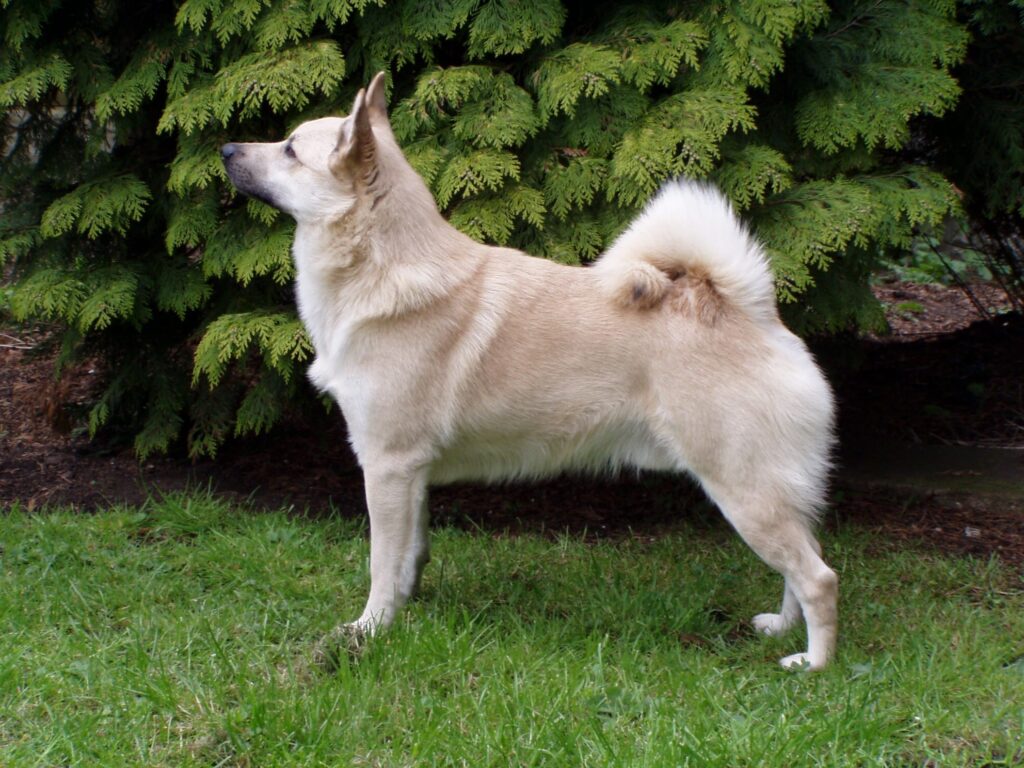
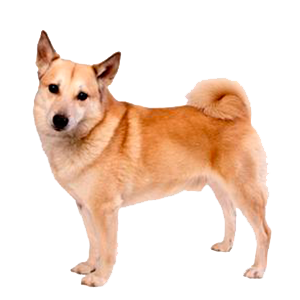
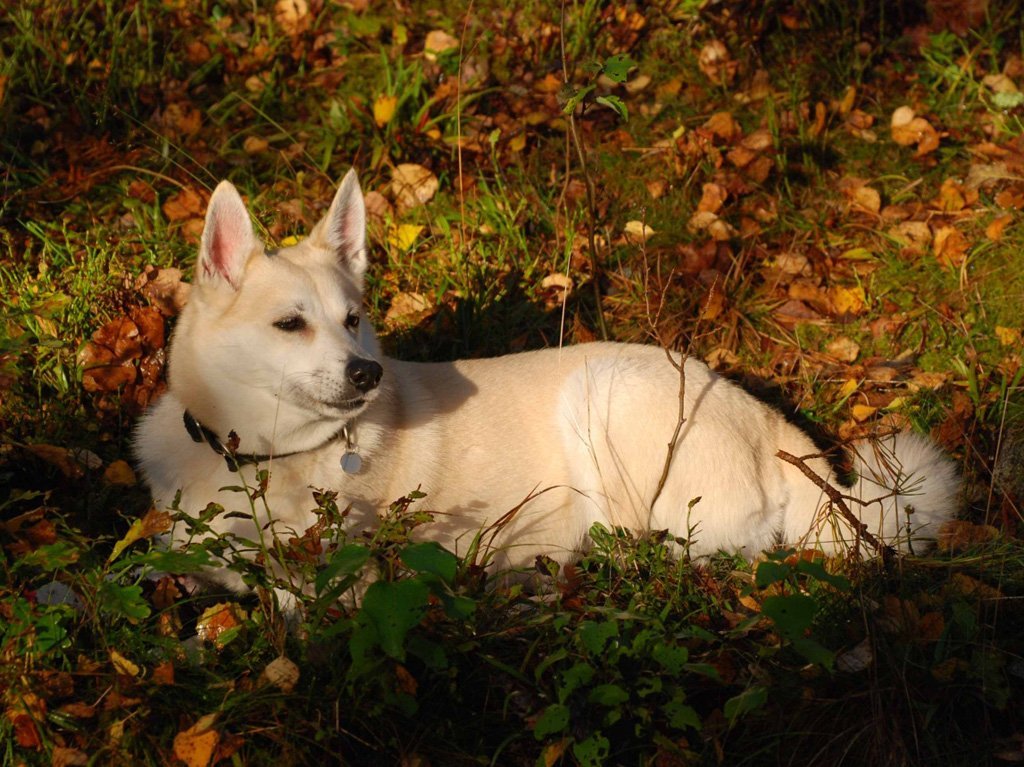
The Norwegian Buhund is a typical Spitz: slightly smaller than medium size, compact, square in format, with a proudly held head and a curled tail. Its appearance radiates alertness and energy. There is no coarseness or excessive heaviness; this is an athlete built for endurance, not for power struggles.
Head and Muzzle
The head is wedge-shaped, clean, without excess skin folds, with a fairly broad and flat forehead. The transition from forehead to muzzle (stop) is well-defined but not sharp. The muzzle is quite short, tapering gradually towards the nose, but should not be pointed or "foxy" in a negative sense. The nasal bridge is straight. The nose is always black.
The eyes are the mirror of the Buhund's soul. They are quite large, oval-shaped, and as dark a colour as possible. The gaze is intelligent, lively, and brave. The eyelids are black and close-fitting. The ears are high-set, medium-sized, erect, triangular in shape, with pointed tips. They are very mobile and react instantly to any sound, swivelling like radar dishes.
Body and Limbs
The neck is strong, of medium length, without a dewlap, carrying the head proudly. The body is compact and sturdy. The back is short and strong, straight. The chest is deep, with well-sprung ribs, ensuring sufficient lung capacity for prolonged running. The limbs are straight, parallel to each other, with well-developed muscles and strong bone. Joint angulation is moderate, allowing the dog to move easily and economically.
The paws are compact, oval-shaped, with toes tightly bunched ("cat feet"). The tail is high-set, tightly curled into a ring, carried over the back, but not to the side. It is covered with thick fur, making it look like a pom-pom.
Coat and Colour
The coat is double, which is typical for northern breeds. The outer coat is harsh, thick, and lies close to the body. The undercoat is soft, very dense, and fluffy, like cotton wool. Such a coat structure perfectly protects the dog from rain, snow, and piercing wind. The hair is shorter on the head and the front of the legs, and longer on the neck, chest, and the back of the thighs ("trousers"), forming a ruff. Moulting in this breed is heavy, especially in spring and autumn.
According to the standard, the following colours are permitted:
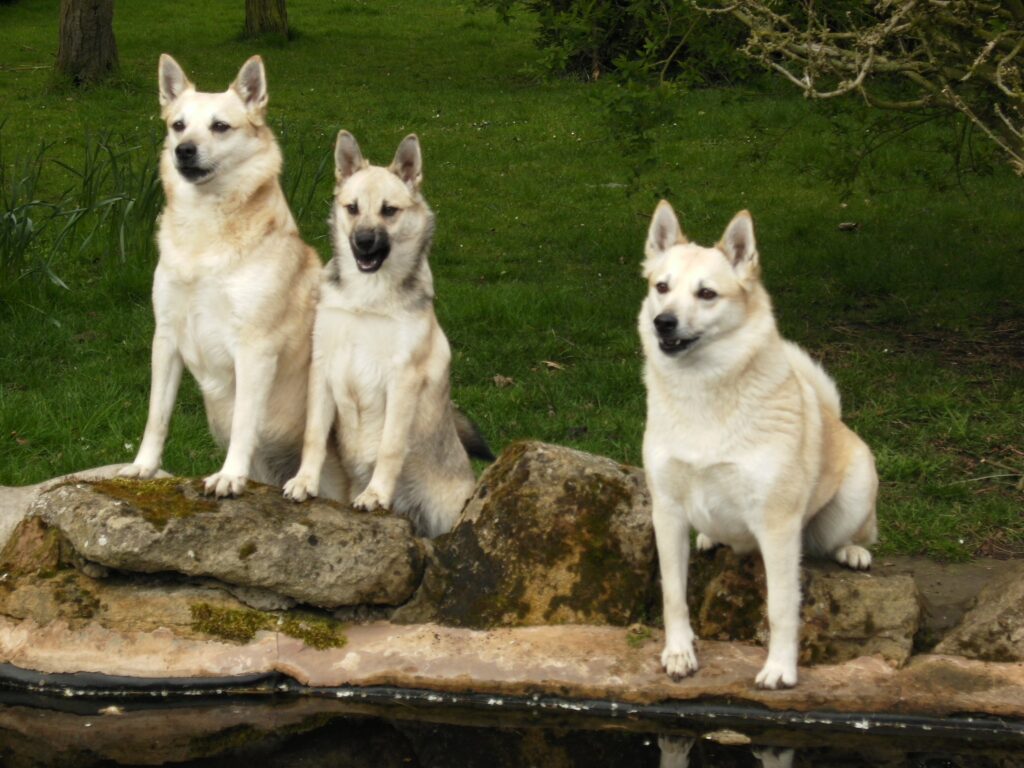
Wheaten: From light red (almost beige) to yellowish-red. The presence of dark hair tips (so-called "sable" colouring) is permitted and even welcomed, but the base tone must be clean. A dark mask on the muzzle is possible.
Black: Predominantly solid, deep black colour, without a brownish tint (although the undercoat may have a bronze sheen in the sun).
Small white spots on the chest, neck (a narrow blaze), and paws are allowed, but a large amount of white is considered a fault. Visually, inexperienced people might confuse a wheaten Buhund with an Icelandic Sheepdog, as they share common roots and a similar coat type, though Icelandics are usually slightly smaller and come in more varied colours.
Character: temperament, behaviour and psychology
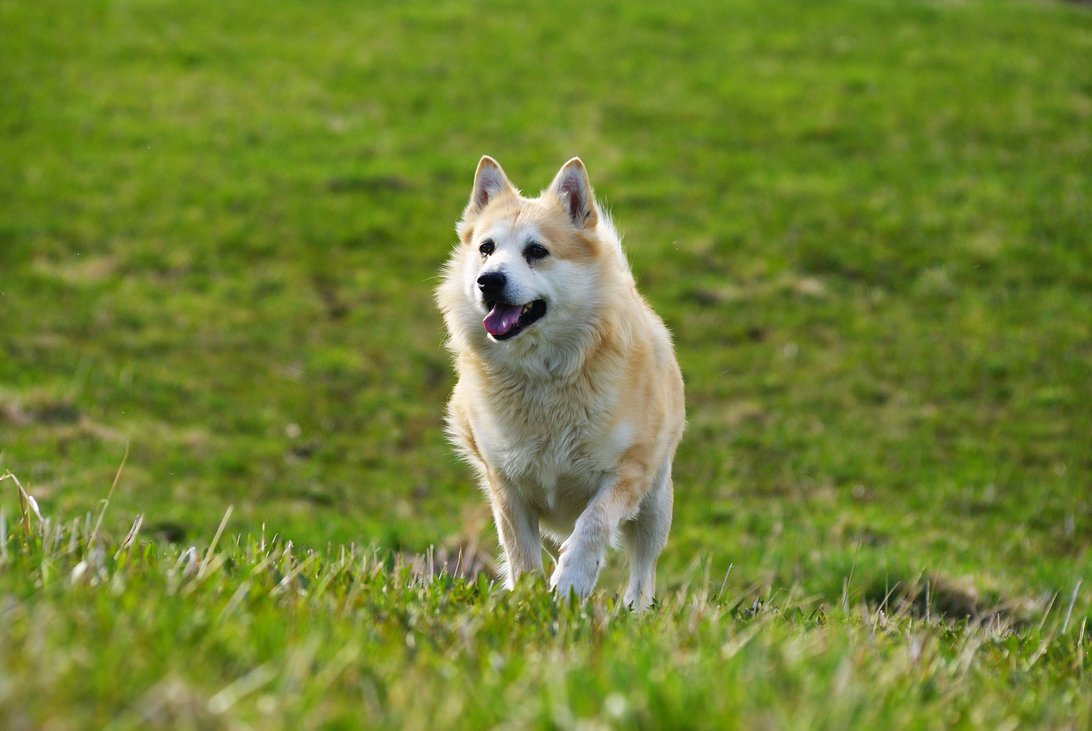
Norwegian Buhunds are a concentration of positivity, but with a serious working core. They are incredibly cheerful and good-natured dogs; they adore their owner and all members of the family they live with. The concept of a "one-person dog" is not about them. The Buhund loves everyone included in its "pack", including cats (if raised with them).
Energy and Need for Action
These dogs are very playful and jolly, loving it when the owner dedicates a lot of time to them. However, this has a flip side. From a lack of attention, boredom, and physical exercise, these dogs may start destroying everything around them: chewing furniture, tearing wallpaper, or digging holes in the yard. This isn't a display of malice; it is a cry for help and an attempt to entertain themselves. Therefore, your main task is to provide the pet with actvities.
The Buhund will appreciate any games and entertainment. Try to direct its energy into the right channel:
Create an obstacle course for your pet in the yard.
Play flyball or dog frisbee with it.
Organise a tug-of-war session (Buhunds have a strong grip).
Engage in nosework (searching for items by scent) - this tires the dog's brain excellently.
If you are not a hunter, you can simply chase birds together with your Buhund, who will undoubtedly be delighted with such a pastime.
Voice and Guarding Qualities
It is important to understand: the Buhund loves to bark. This is part of its job as a farm watchman and herder. It uses its voice to manage the herd and warn of approaching strangers. In terms of alertness, it can be compared to some other breeds. For example, although outwardly different, in its reaction level to suspicious sounds, the Buhund is not inferior to such a vigilant guardian as the Miniature Pinscher. Both breeds instantly signal the presence of guests.
The Buhund is not aggressive towards people; it will not attack without extreme necessity. Its tactic is to warn, create noise, and keep a distance. This makes it an ideal "doorbell", but not a bodyguard.
Pros and Cons of the breed
Before getting a Buhund, it is worth weighing all the "pros" and "cons", as this is an active dog that won't suit everyone.
Pros and Cons of the breed · 6
Pros (+)
Cons (-)
Very people-oriented, affectionate
Loves to bark (high noise level)
Gets along wonderfully with kids and other animals
Sheds very heavily twice a year
High intelligence, learns tricks easily
Requires significant physical exercise
Compact size, convenient for transport
May chew things out of boredom
Robust health, stamina
Strong hunting instinct (may chase cats outside)
No specific "doggy" smell
Does not like being left alone
Training and socialisation
Raising a Norwegian Buhund is an important factor that needs regular attention, ideally everyday for several hours (including walks). Nature has endowed dogs of this breed with high intelligence, the ability to reason, and to understand humans almost before they speak. They want to please the owner, which distinguishes them favourably from more independent breeds, such as, for example, the Norwegian Elkhound Grey, which is often prone to making decisions independently during a hunt. The Buhund is more tuned for cooperation.
However, as is known, mental abilities need to be developed. What exactly your pet will be like depends only on you. Norwegian Spitzes are very capable and versatile working dogs. They show excellent results in agility, obedience, and herding service. However, they need to be accustomed to specific activities from an early age.
Never use physical force on these dogs; they are good-natured and sensitive by nature and demand respect. Rudeness will lead to the dog withdrawing into itself or becoming fearful. Stock up on patience and start training your four-legged friend using positive reinforcement. Remember that treats and praise from the owner can work miracles.
Coat care and maintenance
Caring for this breed isn't complicated, but it requires regularity. The main focus is on the coat and walking.
Walks and Activity
Norwegian Buhunds need long daily walks, or preferably runs. It will be quite difficult for them to adapt to urban living conditions in a cramped flat without active exercise. They need plenty of space to pour out their inexhaustible reserves of energy. Furthermore, they don't acknowledge vehicles moving past them (bicycles, scooters); sometimes one gets the impression that these northern dogs want to "herd" them or catch up with them. Therefore, if you live in the city, do not let you dog off the lead if there is a road or cycle path nearby.
Of course, it is difficult for people rushing to work to go far from home in the morning to walk the dog for an hour or hour and a half. However, the Buhund needs this. If this dog doesn't get rid of its energy reserves in the morning, furniture and other belongings in your flat will definitely suffer. Therefore, dog experts recommend keeping these dogs out of town, in a private house with a large plot of land.
Norwegian Buhunds can adapt to any conditions; thanks to their coat, they tolerate cold easily. However, you categorically cannot chain a Buhund - these dogs are freedom-loving and social. Isolation on a chain will break the animal's psyche, making it hysterical or aggressive.
Grooming
Buhunds are tidy representatives of the canine world; moreover, they have almost no characteristic doggy smell even when the coat is wet. Therefore, they need washing extremely rarely, only in cases of heavy soiling. Frequent washing washes away the protective oily layer from the coat.
The coat of this Norwegian needs brushing several times a week with a metal comb or a slicker brush. During the moulting period (spring and autumn), you will have to brush daily, otherwise fluff will fly all over the house. Also, do not forget about timely vaccinations and visits to the vet for routine check-ups. Claws should be trimmed every 2–3 weeks if they don't wear down naturally on asphalt.
Nutrition
Nutrition: key recommendations
Health and risks
Health: typical diseases and prevention
Frequently Asked Questions (FAQ) · 4
Is the Norwegian Buhund suitable for a flat?
Theoretically yes, if you are prepared to walk actively with it for 2–3 hours a day. But the ideal place is a private house with a yard. Also consider that the dog is vocal, which neighbours through the wall might not like.
Is this dog hard to train?
No, Buhunds are very smart and want to please (food motivation is very high). They learn faster than many other Spitzes but can get distracted.
How do they handle heat?
Due to the thick undercoat, heat is harder for them than cold. In summer, training should be done early in the morning or late in the evening, and during the day provide a cool place and access to water.
Are they aggressive towards children?
No, this is one of the best family breeds. But due to its energy, a young dog might accidentally knock over a small child during play, so supervision is mandatory.
Video about the breed
FAQ
Is the Norwegian Buhund good for a family?
Very — it is a friendly, devoted and energetic dog, excellent with children; the key is to give it enough exercise and activity.
Does the Buhund shed a lot?
Yes — the dense double coat sheds heavily, especially by season; regular brushing is needed.
Is the Buhund suitable for a flat?
Possible provided plenty of exercise and activity — it is a working herder and watchdog that copes poorly with boredom.