

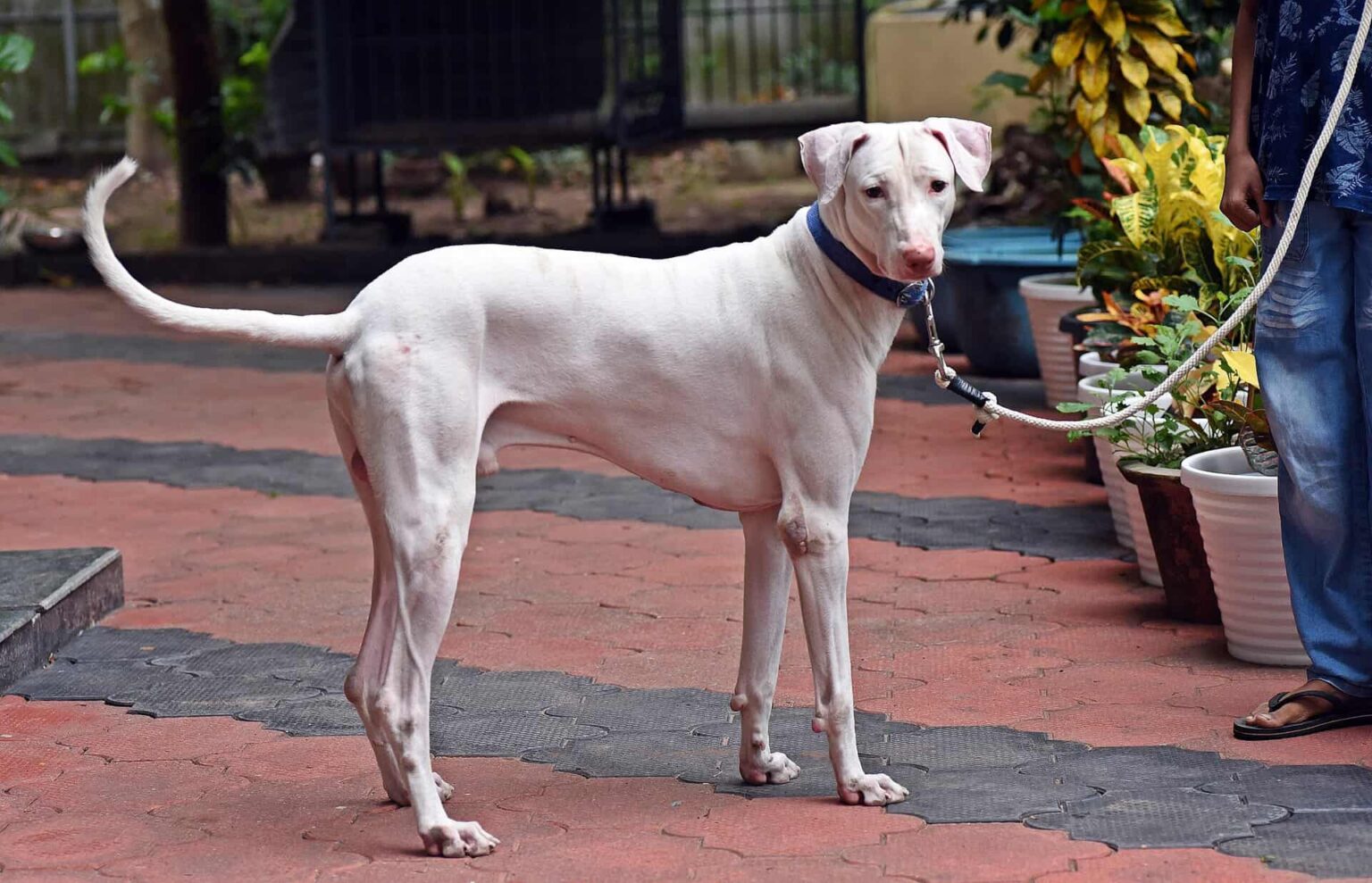
| Height | 65–75 cm |
| Weight | 30–45 kg |
| Lifespan | 10–12 years |
| FCI group | not FCI-recognised (Indian aboriginal) |
| Origin | India (Tamil Nadu) |
Exact ratings
- Congenital deafness (linked to the white colour)
- Hip dysplasia
- Demodicosis and sensitive skin
- Sunburn (pink nose, pale skin)
- A robust aboriginal breed overall
Quality protein for a large active dog and weight control. Protect the pale skin and nose from the sun; white puppies should be tested for hearing (deafness).
The Poligar Hound, also known as the Rajapalayam Dog and the Indian Ghost Hound, is not merely a dog; it is a living piece of Indian history, a symbol of the warrior caste and the constant companion of the aristocracy of centuries past. Its snow-white coat, pink nose, and cheetah-like grace make it recognisable at first glance, but behind this elegant exterior lies a powerful boar hunter and a fearless guardian. Find out more on Tvaryny.
History of the Breed’s Origin
The breed’s name comes from the small town of Rajapalayam in the Virudhunagar district of Tamil Nadu. It was here, during the reign of the Nayak dynasty, that this unique line of sighthounds was formed. The dogs belonged primarily to the class of Poligars – fuedal chieftains and landowners who used them not only for hunting but also as war dogs during the Carnatic Wars and in battles against British colonisers.
There is a legend that four Rajapalayams once saved their master’s life by fighting off a tiger attack. While this sounds like a myth, the breed’s physical strength and fearlessness are beyond doubt. Unlike many other sighthounds that rely exclusively on vision, the Rajapalayam also actively uses its sense of smell, which links it to some scent hounds. In terms of working qualities and persistence in pursuing prey, it can be placed alongside breeds such as the Plott Hound, although their hunting styles differ.
Appearance and Standards of the Rajapalayam
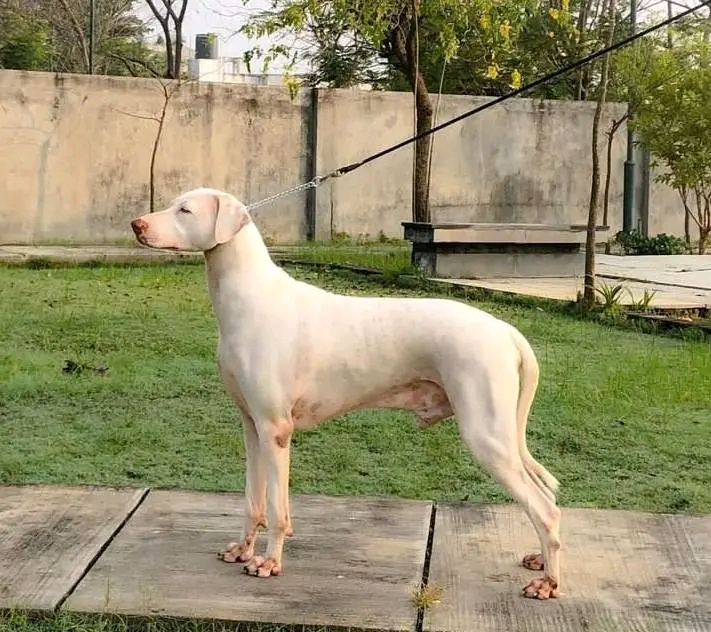
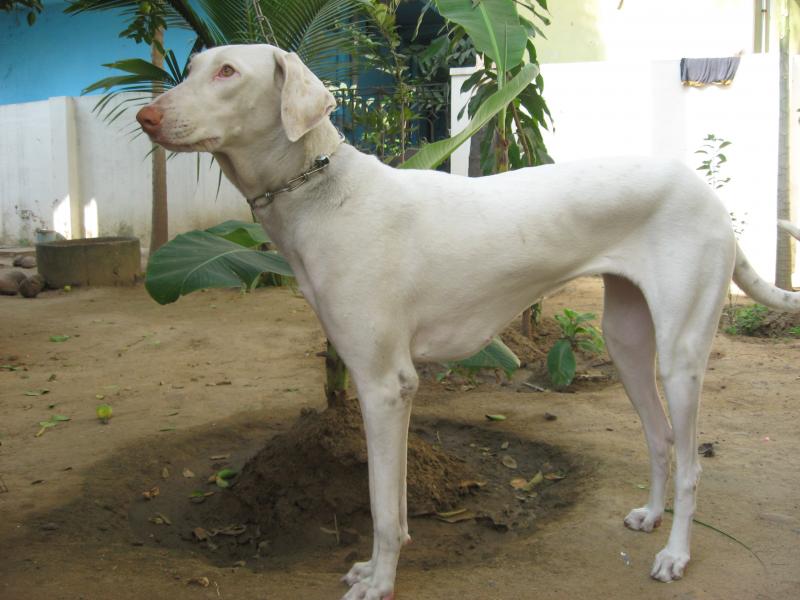
The Rajapalayam is the embodiment of power and elegance. It is a large dog, with a height at the withers reaching 65-75 cm. The build is muscular but dry, which is characteristic of all representatives of the sighthound group. The most recognisable feature is the milky-white coat, although historically other colours were found, which are now considered less desirable or are culled.
Key Characteristics of the Exterior
- Head: Dome-shaped, with a moderate stop from forehead to muzzle. The jaws are extremely powerful, a reminder of their past hunting big game.
- Eyes: Usually golden or amber in colour. The gaze is attentive, piercing, and slightly wary of strangers. Whitish eyes are considered a fault.
- Nose: Exclusively pink (flesh-coloured). This is one of the breed’s calling cards. A black nose is a disqualifying feature.
- Ears: Hanging, soft to the touch, set quite high. In a state of excitement, they may lift slightly at the base.
- Body: A deep chest that accommodates large lungs for prolonged running. The belly is tucked up tight, much like a classic Greyhound, ensuring aerodynamics.
- Tail: Long, thin, tapering towards the end. It is carried low when at rest, and may be raised during movement, but never curled into a ring.
The coat of the Poligar Hound is short and fine. In the hot climate of India, this is an advantage as it does not retain heat and offers protection against parasites, which are easier to spot on the white background.
| Parameter | Males | Females |
|---|---|---|
| Height at withers | 65 – 75 cm | 60 – 70 cm |
| Weight | 22 – 25 kg | 20 – 24 kg |
| Coat Colour | Milky-white | Milky-white |
| Life Expectancy | 10 – 12 years | 10 – 12 years |
Temperament and Behaviour: A Warrior of One Master
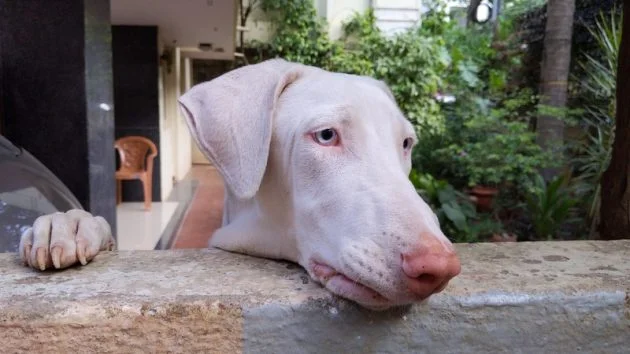
The character of the Rajapalayam is a complex mix of loyalty, independence, and aggression towards potential threats. This is not a dog that will happily greet every guest in your home. They are known as “one-man dogs”. If you win the trust of this proud animal, he will follow you through fire and water, but he may keep a distance from the rest of the family, although he will still protect them.
Interaction with the Environment
The Rajapalayam possesses an extremely strong guarding instinct. Unlike many sighthounds that are indifferent to territory, the Poligar Hound is jealous of its domain. He does not bark without reason, but if he gives voice – it means the situation demands attention. Do not expect the same sociability from him as from decorative breeds, such as the Majorcan Rater, which, despite its hunting roots, is more social in a domestic setting. The Rajapalayam is serious and reserved.
- Attitude towards children: They are patient with children of their own “pack” (family), but dislike familiarity. Leaving them alone with very small children is not recommended due to the dog’s size and reactive nature.
- Other animals: This is a hunter. Small animals (cats, rodents, small dogs) may be perceived as prey. Socialisation from an early age is critical, but even that does not guarantee complete tolerance.
Training and Education
The approach to training a Rajapalayam differs fundamentally from working with service breeds. This is an aboriginal sighthound that has been accustomed for centuries to making independent decisions during the hunt. Blind obedience is not in their nature. The “whip” method is absolutely unacceptable here: physical punishment will only embitter the dog and permanently destroy contact with the owner. Success is based exclusively on respect and positive reinforcement, and the owner will have to show considerable patience, as these dogs can be quite stubborn if they don’t see the point in a command.
A critical stage is early socialisation. Since the Rajapalayam is naturally suspicious of strangers and has a keen territorial instinct, the puppy must be introduced to various people, sounds, and situations from a young age. If this aspect is neglected, the adult dog may become overly aggressive or, conversely, fearful. Particular attention should be paid to the recall command, although even a perfectly trained sighthound is not recommended to be let off-leash in an open, unfenced area: upon seeing a moving target, he instantly “switches on” the hunter and stops hearing commands.
Care and Maintenance
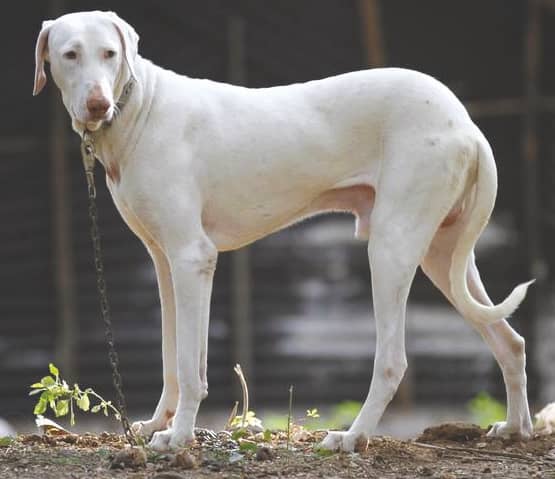
Keeping a Rajapalayam does not require complex grooming procedures, but it does require a signifcant investment of time for physical exercise. This is not a flat dog. The ideal option is a private house with a large, securely fenced garden.
Physical Exercise
This dog is built to run. A walk on a lead around the block will not satisfy him. He needs free running (in a safe place), coursing, or long runs alongside the owner’s bicycle. Without burning off energy, the Rajapalayam can become destructive: chewing furniture, digging holes, or displaying aggression.
Nutrition and Diet
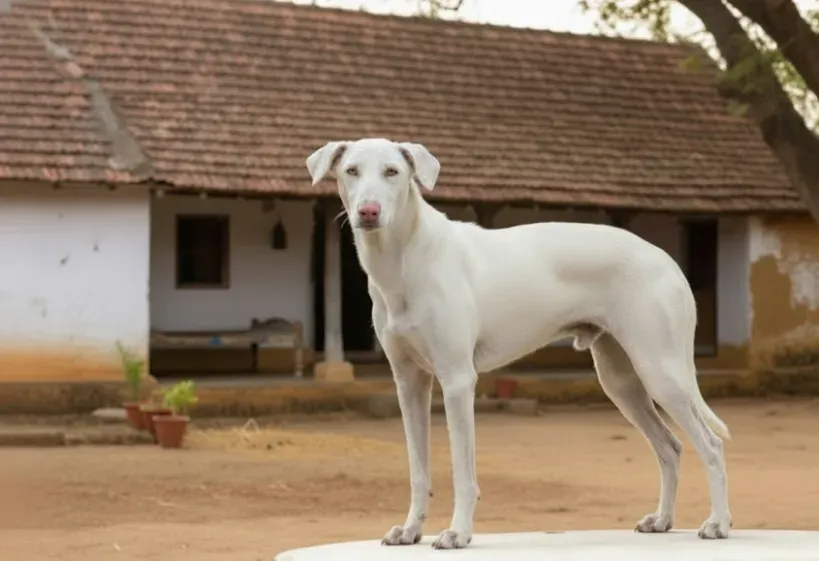
The diet needs to be high-calorie and balanced, taking into account the dog’s high activity level. It is important not to overfeed the animal, as excess weight has a detrimental effect on the sighthound’s joints. Here is an example of nutrient balance for an adult dog:
| Nutrient | Percentage Ratio | Source |
|---|---|---|
| Proteins | 30% – 40% | Beef, poultry, sea fish |
| Fats | 15% – 20% | Fish oil, animal fats |
| Carbohydrates | 30% | Rice, vegetables (carrots, courgettes) |
| Fibre | 5% – 10% | Vegetables, bran |
Important: the dog should be fed strictly after a walk, and not before, to avoid gastric torsion (bloat).
Health and Genetic Features
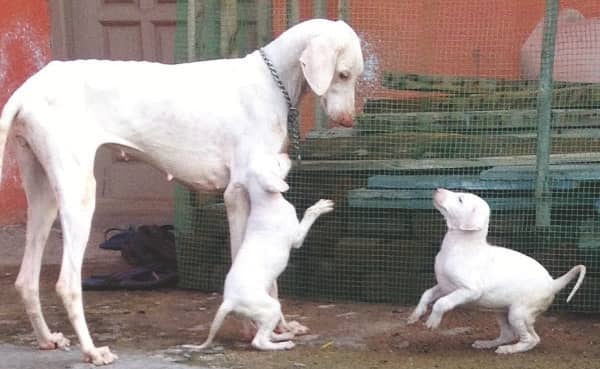
As an aboriginal breed formed in harsh conditions, the Rajapalayam has quite robust health. However, selective breeding aimed at preserving the exclusively white colour has brought its negative consequences. The main problem of the breed is congenital deafness. This is a common issue for many white animals (think of Dalmatians or white Boxers).
Common Ailments
Apart from deafness, owners should pay attention to the following aspects:
- Skin problems: Short white hair and pink skin make the dog vulnerable to sunburn and contact dermatitis. In the summer, you need to monitor the dog’s exposure to the open sun.
- Sensitivity to anaesthesia: Like most sighthounds (for example, the Caravan Hound), the Rajapalayam has a low percentage of body fat, which affects drug metabolism. The vet must be aware of this peculiarity.
- Digestive problems: The deep chest creates a risk of stomach torsion (bloat). This is a deadly condition that can be prevented with a proper feeding schedule.
Pros and Cons of the Breed
| Pros (+) | Cons (-) |
|---|---|
| Exotic and striking appearance that attracts attention. | Tendency towards dominance and independence. |
| Excellent guarding qualities, distrustful of strangers. | Requires very high physical loads. |
| Short coat that does not require clipping. | Risk of congenital deafness and skin sensitivity. |
| Extraordinary devotion to the owner. | Aggression towards other animals (strong hunting instinct). |
| High intelligence and trainability (with the right approach). | Not suitable for novices in dog handling. |
Interesting Facts About the Breed
- Postal Symbol: The Government of India values this breed so highly as a national treasure that in 2005 it released a postal stamp depicting the Rajapalayam. This was part of a series dedicated to Indian dog breeds.
- Participation in Shows: Despite its rarity, the Rajapalayam is recognised by the Kennel Club of India (KCI), but still does not have full recognition from leading world organisations such as the FCI, although work in this direction is ongoing.
- Royal Gait: The movement of this dog is often compared to the gait of a thoroughbred horse – it is a high, sweeping step (trot) that looks very aristocratic.
- State Support: To save the breed from extinction, the government of Tamil Nadu has created special breeding centres where the purity of the lines is monitored.
Frequently Asked Questions (FAQ)
Can a Rajapalayam live in a flat?
Theoretically yes, if you are prepared to dedicate 3-4 hours a day to walking with active exercise. But practically – it is torture for both the dog and the owner. This breed needs space to sprint and move constantly.
Does this dog shed much?
Their coat is very short, so shedding is not catastrophic. However, the small white hairs act like needles, sticking into furniture upholstery and clothing, and they are quite difficult to remove.
How does it cope with the cold?
Very poorly. It is a tropical breed with thin skin and no undercoat. In the conditions of a British winter, the dog needs warm clothes (jumpers/coats) even in mild frosts, and keeping them in an outdoor kennel during winter is strictly forbidden.
Is the Poligar Hound difficult to train?
Yes, this is not a German Shepherd. They are clever but stubborn. The “drill” method does not work with them; a partnership approach and positive reinforcement are needed. Rudeness can cause the dog to shut down or provoke aggression.
Video About the Breed
- A powerful, fearless guardian
- Fast and athletic, like a sighthound
- Very devoted to its family
- Sheds little, clean in daily life
- A strong guarding and hunting instinct
- Wary and territorial with strangers
- Not for a flat, a beginner or small animals
- White colour — a risk of congenital deafness
| Rampur Hound | Canaan Dog | Cane Corso | |
|---|---|---|---|
| Height | 61–75 cm | 48–61 cm | 60–70 cm |
| Energy | 4.5 | 4 | 3.5 |
| Apartment | 2.5 | 2.5 | 2 |
| Beginners | 2 | 2 | 2 |
Is the Rajapalayam a sighthound or a guardian?
Why is the breed called a “ghost hound”?
Is the breed suitable for a beginner?
Indian aboriginal type · Kennel Club of India
For apartments · For kids · For beginners · Active · Smartest · Hypoallergenic · All rankings →