

| Height | 29–36 cm |
| Weight | 3–5 kg |
| Lifespan | 12–15 years |
| FCI group | not FCI-recognised (Balearic ratter) |
| Origin | Spain (Mallorca) |
Exact ratings
Common health issues
Nutrition
The Perro Ratero Mallorquín, or Ca Rater Mallorquí (Majorca Ratter), is not a lapdog that happens to be lively. It is a working rat-catcher from a Mediterranean island, bred for a job that Britain understands better than almost anywhere else on earth — and yet the breed remains virtually unknown here. Under four kilos of muscle, nerve and opinion, it arrives on a British doorstep carrying an unfamiliar accent and a very familiar trade. Find out more on Tvaryny.
Britain’s ratting tradition — and why Mallorca’s took a different road
No country documented the rat-catching dog as thoroughly as Britain, and none did it for stranger reasons. By the middle of the nineteenth century London alone is reckoned to have had more than seventy permanent rat pits. The Cruelty to Animals Act 1835 outlawed the baiting of bulls and bears but left the rat pit standing, and into that gap poured the gambling money. Billy was engraved for posterity killing a hundred rats in five and a half minutes on 22 April 1823 — his ninth match.
That world closed only when the Protection of Animals Act 1911 made it an offence to place an animal for fighting; the last well-known pit, in Leicester, was prosecuted in 1912. It left a permanent mark on the British dog. The Black and Tan Terrier, the great rat-killer of the industrial north, was refined with whippet blood by breeders such as John Hulme, and by 1860 Manchester was the centre of the type — hence the Manchester Terrier, a dog shaped by the pit and the wager.
The Mallorcan road looks identical and is philosophically the opposite. On the island there was no pit, no stopwatch, no bookmaker and, until 1990, no club. The Ca Rater was shaped by one question asked in a farmhouse yard: did the granary lose grain this winter? Nobody wrote it down, nobody staged it, and there was no audience.
The consequences run through both breeds. Britain’s ratter became a show dog and then a rarity — the Manchester Terrier now sits on The Kennel Club’s vulnerable native breeds list, the register of British and Irish breeds falling below three hundred puppy registrations a year, and in 1945 only eleven were registered at all. Mallorca’s ratter never entered a show ring worth the name, never became fashionable, and so never crashed.
History of the breed
Honest history begins in the middle of the nineteenth century; anything earlier is inference. The dogs of the Balearics were never documented the way the dogs of English sporting gentlemen were, because the people who kept them were tenant farmers with no reason to write about a dog worth less than a goat. What can be said is that a small, short-coated, sharp-eared ratter was a fixture of the Mallorcan possessió — the fortified island farmstead — and that its work was continuous, not seasonal.
That work was the granary, the stable, the mill and the olive press: under floorboards, between stacked sacks, into the crevices of dry-stone walls. The small size is not decorative and never was, because a bigger dog cannot follow a rat into those spaces. A cornered brown rat fights and bites hard, so the selection pressure was nerve rather than obedience. These dogs worked alone, in poor light, without instruction. That is still what you get.
Rats were not the whole of it: rabbit, hare, hedgehog and thrushes all featured. On rabbit the Mallorcan technique has its own verb — buidar, “to empty out” — because the dog pushes the quarry out of thick cover rather than coursing it across open ground, the exact opposite of the island’s sighthound, the Ca Eivissenc. Hunters also strongly preferred tricolour and white-marked dogs, for the blunt reason that a plain fawn dog moving through scrub can be mistaken for a rabbit.
The closest relative is on the mainland. Look at the Valencian Rater (Gos Rater Valencià) and the family resemblance is immediate — and here it is real, not merely visual: a microsatellite study published in 2022, based on 77 hair samples collected on Mallorca, confirmed a close relationship between the two ratters.
One dog, three names
British buyers meet this breed under at least three labels and often assume they are three different animals. Ca Rater Mallorquí is the Catalan-Mallorcan form: ca is dog, rater comes from rata, rat. Perro Ratero Mallorquín is the same phrase in Castilian; Ratoner de Mallorca turns up in older writing. One population, three registers of the same language landscape. The confusion that matters is with the Valencian ratter, a separate breed with its own FCI standard, and with the Andalusian one, separate again: Spain produced several ratting dogs independently, exactly as Britain produced several terriers.
The British blood that reached Spain — but not into this breed
Here a British reader is owed a correction. You will read again and again that Spanish ratters descend from British terriers brought over by traders. For one of them that is true and beautifully documented. For the Ca Rater Mallorquí it is not.
The true case is the Andalusian Rater — the Ratonero Bodeguero Andaluz, also called the Sherry Terrier. It descends from smooth fox terrier lines taken to Jerez by British wine companies, and the bodegas are precisely why it looks as it does: a predominantly white dog with black-and-tan markings stays visible in the gloom between the casks. The FCI admitted it as standard No. 371, terrier group, section 1, on a standard dated 3 September 2024 — the fourteenth Spanish breed to get in. Males stand 37 to 43 cm, females 35 to 41.
So British blood did reach Spain and built a breed — just not this one. The 2022 genetic work looked for terrier ancestry in the Mallorcan dog and did not find it. The resemblance is convergence: two populations a thousand miles apart, given the same job and the same physical constraints, arriving independently at the same small, pricked-eared, short-coated, black-and-tan answer. A better story than borrowed blood, and the one the evidence supports.
The Valencian ratter completes the picture. It became FCI standard No. 370 in 2022, also terrier group, section 1, without working trial — males 30 to 40 cm, females 29 to 38, four to eight kilos, known locally as Rateret or Fusterrier. Note what the FCI did on admitting both: it nudged their names towards the word “terrier”. Five years ago all three Spanish ratters were unrecognised. Two are now in; the third stayed out for reasons that have nothing to do with quality.
Appearance and breed standards
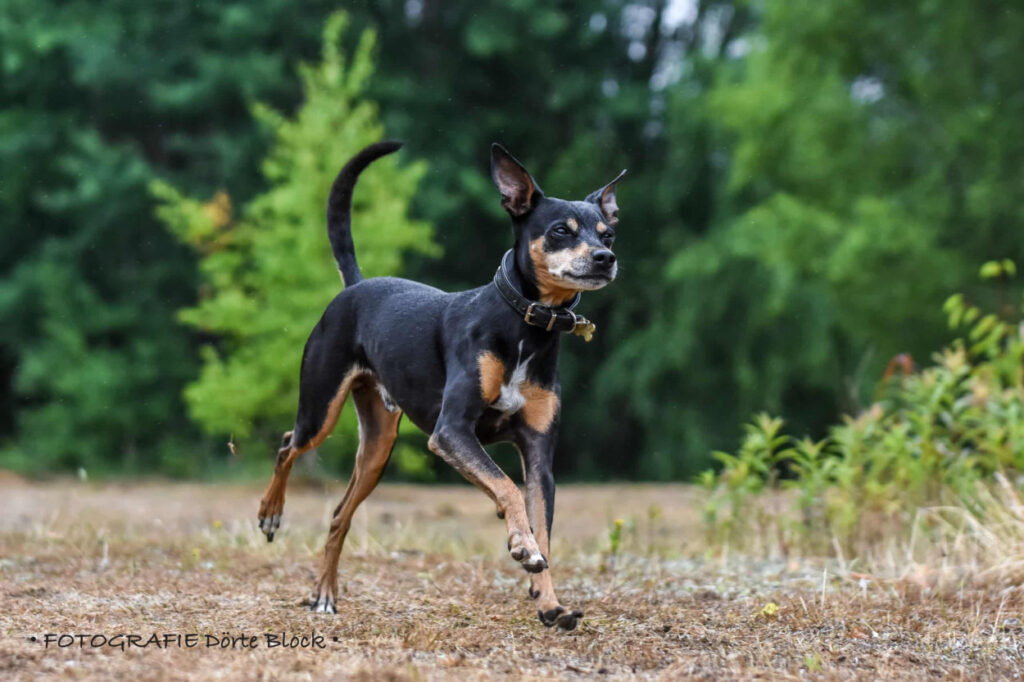
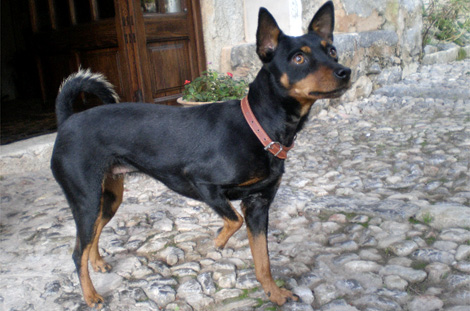
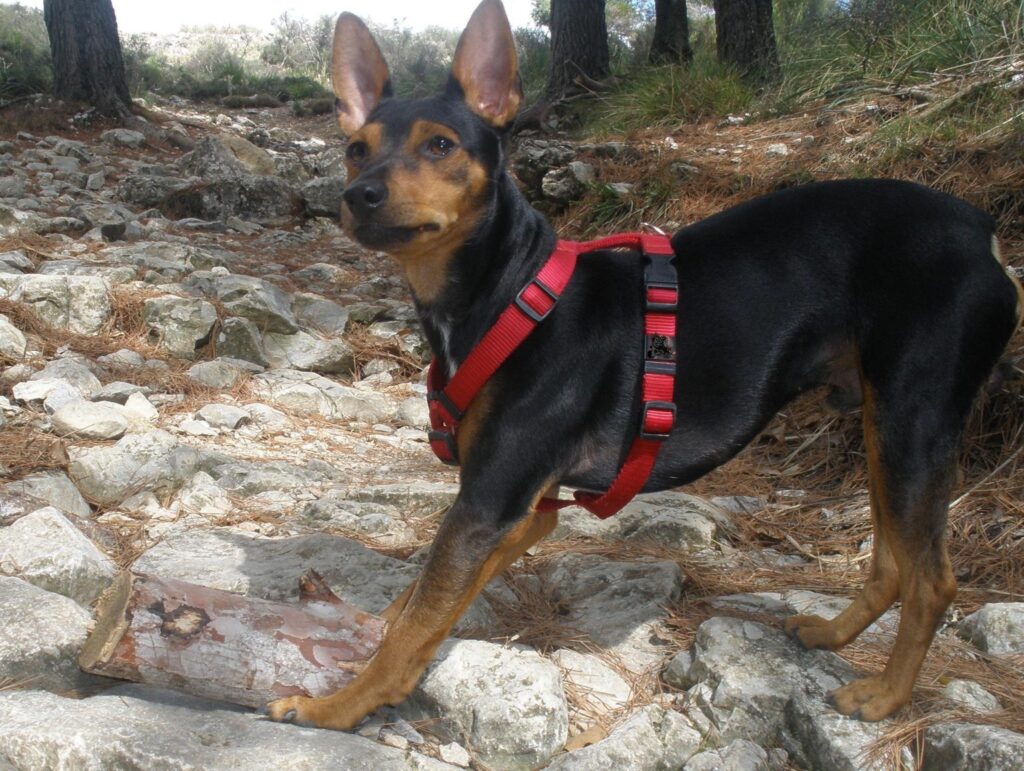
Small, but emphatically not fragile: dry muscle, light frame, no bulk anywhere, built for an instant change of direction in a confined space. The head is a shallow truncated cone, the ears firm, pointed and erect, and the eyes round and amber — that amber is a breed signature, and the detail most often lost in second-hand descriptions that simply say “dark”.
Key appearance characteristics:
- Ears: Firm, triangular, carried upright. They give the dog a permanently switched-on expression.
- Coat: Short, smooth, close-lying — and, crucially for a British owner, with no undercoat whatsoever.
- Colour: Black and tan is the commonest. Brown and tan occurs. Tricolour — black, tan and white — is also seen, with tan markings on chest, muzzle and above the eyes.
Measurements deserve honesty, because sources differ. The Balearic standard gives males 32 to 36 cm and females 29 to 33 cm at the withers, at three to five kilos — roughly seven to eleven pounds. Some references say only “not exceeding five kilos”; a few stretch the height to 40 cm.
| Characteristic | Standard Description |
|---|---|
| Height at withers | Males: 32-36 cm, Females: 29-33 cm |
| Weight | 3 – 5 kg (depending on sex and build) |
| Lifespan | 12-15 years |
| Country of origin | Spain (Majorca) |
| Purpose | Rodent hunting, companion, watchdog |
The tail: natural bobtails, docking and British law
Recognition: what papers this dog actually holds
The most misreported fact about this breed is its status. The FCI has not recognised the Ca Rater Mallorquí, and there is no FCI standard number for it; if you see one quoted, somebody has confused it with the Valencian dog. Nor is it recognised by the Spanish national kennel club, the RSCE, which lists it separately among breeds under restoration — the claim by aggregator sites and insurance blogs that the RSCE recognised the breed is simply untrue.
What it does have is a perfectly real set of documents, issued by government rather than by cynology. The Balearic authorities published an official breed standard in the regional gazette, the BOIB, on 28 December 2002; a month earlier the breed’s stud book had been formally entrusted to its club. The legal frame is Real Decreto 558/2001, on official recognition of breeders’ associations for pedigree dogs — an agricultural track, not a show-ring one.
At national level, sources give either 2003 or 2004, and both are right: the committee approved the addition on 22 April 2003, and the ministerial order, Orden APA/807/2004, was signed on 24 March 2004. Two stages of one process. The Mallorcan and Valencian ratters entered the state annexe on the same day in the same document — after which one went on to the FCI and the other did not.
Why not? Because the club declined to place itself under the RSCE, which would have meant surrendering the stud book it had spent years building. That kept control on the island and closed the road to international recognition, since the FCI route runs through the national member body. A choice, not a rejection. This dog has papers; they are simply not FCI papers.
One further point of pride. The Balearic hunting act of 2006 names the breed explicitly: article 34.5 obliges the authorities to promote conservation of the island’s own hunting breeds — the eivissenc, the mè and the rater. Few unrecognised breeds anywhere can point to a statute that names them.
The Kennel Club, the FCI and the Imported Breed Register
Bringing one home: the rules after Brexit
Realistically you acquire this breed by bringing a puppy back from Mallorca or taking on an adult already living here. The first route is doable, but the paperwork changed after Brexit and is no longer a matter of waving a pet passport at a ferry desk.
The sequence is unforgiving about order. The dog must be microchipped to the ISO standard, and the chip implanted and readable before the rabies vaccination; the other way round and the vaccination does not count. Rabies vaccination cannot be given before twelve weeks of age, and there is a minimum wait of twenty-one days after the primary dose. Coming into Great Britain the dog travels on a health certificate issued by a vet in Spain rather than an EU pet passport, and Great Britain also requires a tapeworm treatment against Echinococcus multilocularis, given and recorded by a vet between 24 and 120 hours before arrival, with entry through an approved point of entry.
Two warnings. That arithmetic means a Mallorcan puppy cannot legally arrive much before four months of age, which lands half the socialisation window in a Spanish farmyard and the rest on a British street. And the requirements are revised periodically, so check the current guidance on GOV.UK before booking anything; a breed article is a starting point, not a customs declaration.
Temperament and character of the Majorcan ratter
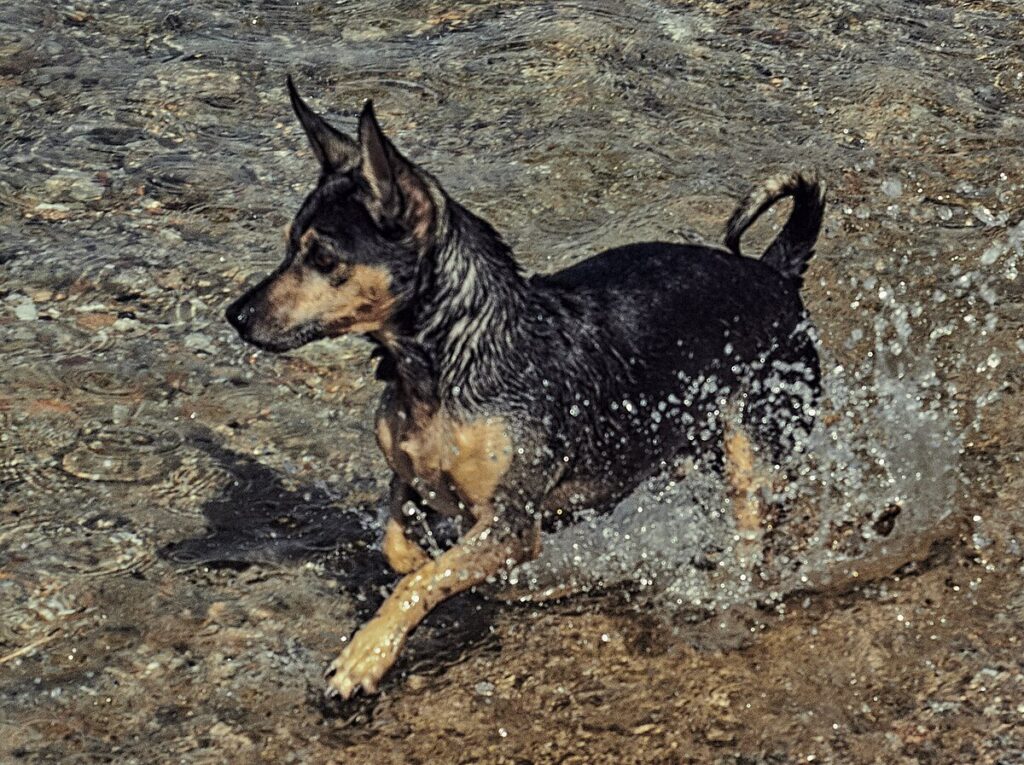
If you assume small means soft, this dog will put you right within the week. Indoors and among its own people it is genuinely affectionate, fond of laps and radiators, and inclined to pick one household member as its person. Step over the threshold and a different animal appears: alert, forward, busy assessing everything that moves.
Reserve towards strangers is normal, not a fault of upbringing. On the island the Ca Rater worked alongside the big Ca de Bestiar: the large dog did the guarding, the small one announced that somebody was coming. The ratter was, quite literally, the doorbell — and having been selected for centuries to report first and think later, it will not stop because you have moved it into a semi in Surrey.
The corollary is a dog with a firm opinion of its own competence, bred to decide alone, in the dark, against something that fights back. Handled well that reads as confidence and charm; handled badly — under-exercised or shouted at — it reads as noise, snappishness and a dog that has appointed itself head of security.
Prey drive in a British landscape
The chase response is not a behaviour to be trained away; it is the breed. Small, fast movement triggers it — a squirrel on a park path, a pigeon lifting off, a rat on a canal towpath — and the trigger is faster than a recall cue. Any honest training plan starts by accepting that.
British law is unusually accommodating on the actual job. Hunting rats and hunting rabbits with dogs are both exempt hunting under Schedule 1 of the Hunting Act 2004, on condition that the land belongs to the person hunting or the occupier has given permission. A ratter earning its keep around a stable yard or grain store with the farmer’s blessing is doing something the statute anticipates. Nothing else is.
Where the countryside turns dangerous is livestock. Under the Dogs (Protection of Livestock) Act 1953 it is an offence to allow a dog to worry livestock on agricultural land — chasing and harassing count, not only biting — and a police officer may seize a dog believed to have been at it. The Countryside Code puts it plainly: dogs on leads around sheep and cattle. A four-kilo dog that has decided a lamb is worth investigating is still, legally and morally, worrying livestock.
Fencing deserves its own paragraph, because owners underestimate it every time. This breed digs, climbs and squeezes, and was bred to find the one gap a rat used. A fence that looks secure from eye level proves nothing: check at ground level, check the gate’s bottom rail, and remember that a dog under five kilos needs a smaller hole than you are picturing.
Barking, cats and the neighbours
The barking is not a bug; it is the feature the breed was selected for, and pretending otherwise sets an owner up for disappointment. What can be trained is the volume dial and the off switch — report received, thank you, now quiet. What cannot be trained is the instinct to report at all. In a terraced house that distinction is the difference between a workable arrangement and a complaint to the managing agent. A front window onto a busy pavement is the commonest cause of a barky small dog; frosted film does more than an hour of training.
Cats are a genuine question. A puppy raised with a kitten usually ends up firm friends. An adult ratter introduced to a resident cat, or the reverse, is a lottery — and the deciding factor is rarely the dog’s character but whether the cat runs. A cat that stands its ground is furniture with opinions; a cat that bolts is quarry, and the reflex fires before any thinking happens.
Small caged pets are an engineering problem, not a training one. Hamsters, gerbils, chinchillas, house rabbits and birds are this dog’s professional quarry. Do not aim for a household where the dog is trusted around the cage; aim for one where the dog cannot get into the room. Doors, latches, and a cage out of reach of a determined climber.
Upkeep and care
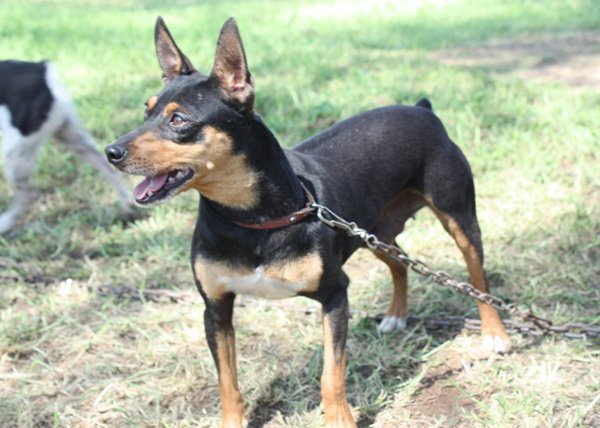
Grooming is close to nothing: no undercoat to blow, no trimming, no stripping, no groomer. A rubber mitt once a week lifts the dead hair and that is the whole regime. The breed does shed — short dark hairs that weave themselves into upholstery with impressive determination — but the volume is modest.
Ears, upright and open, stay drier than a spaniel’s; a weekly look is enough. Claws matter more than people expect, because a dog this light does not wear them down on pavements as a heavier dog does, and long claws change how the foot loads. Teeth matter most of all — see the health section.
Damp and wind: the real British problem
Plenty of Britons know Mallorca rather well — a fortnight in Palma, a hire car up to the Tramuntana, a beach at Cala d’Or. Fewer have thought about what that climate does to a dog over a few centuries. It produces an animal with a single short coat, no undercoat, almost no subcutaneous fat and a body mass of about four kilos: a very poor ratio of surface area to volume, and nothing insulating that surface.
The instinctive British assumption is that the danger is frost. It is not, or not mainly. Britain rarely delivers severe cold; it delivers damp and wind, for months at a time, at temperatures that sound harmless. A wet coat carries heat away far faster than a dry one, and moving air strips the boundary layer a dry coat would hold. Four degrees, drizzle and a stiff breeze off the Irish Sea chill this dog faster than a still, dry, sunny minus five in the Serra de Tramuntana.
The practical version is short. A properly waterproof coat, not a knitted jumper that soaks and stays soaked — the outer layer matters more than the fleece. Dry the dog on coming in, particularly chest and belly, which are least protected and first to get wet in long grass. Several shorter outings beat one long soaking. Watch for shivering, a tucked posture and reluctance to carry on, and turn for home when you see them rather than at the end of the usual loop. Grit and salt are hard on small feet, so rinse and dry the pads.
Outdoor kennelling through a British winter is simply off the table. It is not a matter of hardening the dog up; there is nothing there to harden. Conversely, the Ca Rater copes with a British heatwave far better than most of our native breeds — the one weather in which it holds the home advantage.
Training and upbringing: approach to personality
Clever and stubborn in equal measure. Drilling does not work on a dog bred to operate without instructions; the Ca Rater wants to know why a cue is worth answering, and once convinced it answers very fast indeed. Positive reinforcement, short sessions, high-value food, a game as the payoff. Nagging repetition simply teaches it that you can be ignored.
Socialisation should be front-loaded and deliberately British in content: buses, wheelie bins, the school run, umbrellas, cyclists on shared paths, pub gardens, livestock seen from a footpath. A dog that reports strangers by trade needs plenty of ordinary human traffic early, or the reporting hardens into suspicion.
Be clear about what kind of hunting dog you are handling. Where the Otterhound is a big, deliberate tracker built for water and rough ground, the Majorca Ratter is a sprinter of dry places — a short explosive dash and a decision taken in a fraction of a second. The curriculum is therefore not endurance but impulse control: a rock-solid “leave it”, an emergency stop, a recall practised on a long line for months, and a reliable settle indoors.
| Type of activity | Recommended frequency | Note |
|---|---|---|
| Walks | 2-3 times a day | Minimum 45 minutes of active movement |
| Agility / Sport | 1-2 times a week | Ideal for mental release |
| Search games | Daily at home | Helps to realise hunting instinct |
Sport, work and a job to do in Britain
A working dog without work becomes a hobbyist, and its hobbies will not be yours. The British dog scene is well stocked with outlets, and the Imported Breed Register explicitly opens most of them: agility, flyball, rally, obedience, heelwork to music, working trials and handling are all available before any question of breed classes arises.
Agility suits the build almost perfectly — small, fast, tight-turning and keen — and flyball rewards exactly the explosive burst the breed was made for. Scentwork and mantrailing may fit better still, using nose and problem-solving rather than legs; a dog that has spent forty minutes searching a car park is tired in a way an hour’s lead walking never achieves.
At home, hide food around the room, use snuffle mats and cardboard boxes and let the dog empty things out — buidar, in its original sense. Ten minutes of that in the evening buys more peace than a mile of pavement.
Health and genetic features
Occupational hazards of a ratter
This is the part a general breed profile never writes, and the part anyone who lets this dog near a barn, a towpath or a compost heap actually needs.
Leptospirosis. Brown rats and field mice are the classic reservoir, and infection needs no bite — the bacteria are shed in urine and picked up from contaminated water, mud and soil. In humans the same organism causes Weil’s disease, which is why British canoeists and farm workers are warned about it. Vaccination is routine in the British schedule and, for a dog whose hobby is rats, the least negotiable jab on the list.
Secondary rodenticide poisoning. The professional poisons used against rats in Britain are largely second-generation anticoagulants — brodifacoum, bromadiolone, difenacoum, flocoumafen — used under a stewardship regime run by the Campaign for Responsible Rodenticide Use. The fact that matters to a dog owner is timing: a poisoned rat stays alive and mobile for several days, so the most catchable rats around a treated building are often the poisoned ones. A dog that eats one takes in the anticoagulant, and the bleeding disorder shows up days later, long after anybody connects it with an incident. If your dog has eaten a rat near premises where baiting may be in progress, ring the vet the same day rather than waiting for symptoms; vitamin K1 is the standard antidote and works far better before the bleeding starts.
Parasites. Eating prey is the classic route for tapeworms and other helminths, so worming belongs on a hunting-dog schedule, not a lapdog one. Ticks come with long grass, bracken and deer country; check ears, armpits and between the toes. Lungworm, spread by slugs and snails, is now widespread across much of Britain, and a dog that noses through wet undergrowth is exactly the profile at risk — worth asking your vet about, since not all wormers cover it.
Nutrition: how not to overfeed the athlete
Pros and cons of the breed
| Pros (+) | Cons (-) |
|---|---|
| Compactness: Ideal for flat living and travel. | Loudness: Love to bark, sometimes without serious reason. |
| Health: No breed-specific disorders have been described. | Nervousness: Need early socialisation, otherwise they can become timid or aggressive. |
| Watchdog qualities: Will always warn of guests with a ringing bark. | Sensitivity to cold: Damp and wind are a real problem in the British climate. |
| Ease of care: Coat requires no effort. | Hunting drive: Can run off after prey. |
How it compares with dogs a British owner knows
The quickest way to calibrate expectations is against breeds already familiar here. The Ca Rater is lighter than almost anything a British owner would call a working terrier, and noisier than most of them.
| Breed | Height | Kennel Club status | Original job |
|---|---|---|---|
| Ca Rater Mallorquí | 29-36 cm | Not recognised | Rats in the farmstead, rabbit in cover |
| Manchester Terrier | 38-41 cm | Recognised; vulnerable native breed | Rats in the pit and the mill |
| Jack Russell Terrier | 25-30 cm | Recognised since 2016 | Fox and vermin |
| Patterdale Terrier | about 30 cm | Not recognised; treated as a type | Fox and vermin in the fells |
| Ratonero Bodeguero Andaluz | 35-43 cm | Not recognised (FCI No. 371) | Rats in the sherry bodegas |
The shorthand for a British reader: a farmyard Jack Russell, made lighter and finer, wound a notch tighter, and rather more inclined to tell you about it.
Finding one in Britain
There is no British breed club and no waiting list to join, because there is effectively no British population. Everything runs through Mallorca. The breed’s own club, founded in 1990 and recognised as a breeders’ association in 2002, holds the stud book and is the only body issuing genuine pedigrees. It runs breeding assessments twice a year, in May and October, and holds its single-breed show at Montuïri on the first Sunday in December. Small groups of enthusiasts exist in Germany and France — often a shorter road for a British buyer than the island itself.
What to ask for: registration papers from the club rather than a vague “pedigree”; written confirmation of whether the puppy is a natural bobtail; the dam’s temperament seen in person or on video, since a nervy bitch tends to produce nervy puppies; and honest information about what the litter has and has not met, given that a rural Mallorcan whelping box and a British high street have little in common.
Two warnings. Treat any advert claiming the breed is “RSCE recognised” as a red flag about the seller — it is not, and the claim is copied from careless aggregator sites. And a rare foreign breed with no British infrastructure is exactly what attracts opportunistic importers, so apply the caution you would give any overseas puppy, doubled.
Interesting facts about the breed
- On Mallorca the breed is still used for its original purpose on farms, and on rabbit in thick cover.
- Mallorca has four native breeds — Ca de Bou, Ca de Bestiar, Ca Mè Mallorquí and Ca Rater. The FCI recognised the first two. The pattern is hard to miss: the large and the spectacular got in.
- Hunters favoured tricolour and white-marked dogs so a working dog would not be mistaken for a rabbit in the scrub — safety, not fashion.
- It has very little of the classic “doggy” smell, which makes it an easy housemate in a small British home.
- The Balearic hunting act of 2006 names the breed among the island’s hunting dogs to be conserved — a distinction very few unrecognised breeds anywhere can claim.
- Its closest documented relative is the Valencian ratter, confirmed genetically — not, despite appearances, any British terrier.
Frequently Asked Questions (FAQ)
Is the Ca Rater Mallorquí recognised by The Kennel Club?
No. It appears on no Kennel Club breed list, and it is recognised by neither the FCI nor the Spanish national kennel club. Its official documents come from elsewhere: the Balearic government published a breed standard in the regional gazette in December 2002, and the breed’s own club holds the stud book. Britain can hardly be superior about it — our own Patterdale Terrier is unrecognised too.
Could I register and show one in the UK if I brought a puppy back from Mallorca?
Not by the ordinary route, which requires the breed to be Kennel Club recognised and the overseas registry to be tied to the FCI. The realistic door is the Imported Breed Register, which can admit an unrecognised breed where a breed club maintains a stud book acceptable to the Kennel Club — Mallorca’s exact position. Even then, recognition is sought on the basis of ideally twenty or more unrelated dogs with three-generation pedigrees, and registered dogs compete at first in agility, obedience and rally rather than in breed classes.
My puppy has no tail. Has it been docked illegally?
Almost certainly not. About one puppy in five in this breed is born a natural bobtail, and docking has been prohibited in Spain since 2018. The confusion is fair enough, because the breed was routinely docked historically, and because under the Animal Welfare Act 2006 a docked tail in Britain implies a certified working dog docked within five days of birth. Keep the breeder’s written confirmation and a note from your vet with the paperwork.
Will it cope with the British weather?
With sensible management, yes — but the risk is not the one people assume. A four-kilo dog with a single short coat, no undercoat and no fat suffers from damp and wind rather than frost: a drizzly four degrees with a breeze chills it faster than a dry, still, sub-zero morning. It needs a genuinely waterproof coat, a towel by the door and shorter outings on foul days. Outdoor kennelling is out of the question.
Is it legal to let it hunt rats in the UK?
Hunting rats and rabbits with dogs is listed as exempt hunting under Schedule 1 of the Hunting Act 2004, provided the land belongs to the person hunting or the occupier has given permission. So a ratter working a stable yard or grain store with the landowner’s blessing is doing what the law expressly allows for. That permission is the whole point, and it does not extend to other quarry.
How long do they live?
Twelve to fifteen years, and usually a healthy old age rather than a long decline. Higher figures circulate online; treat them as optimism rather than data, since no breed health survey stands behind them. Dental care and weight control do more to reach the top of that range than anything else available to an owner.
Is this breed suitable for a family with children?
Yes, with caveats. It plays enthusiastically and bonds hard, but it is a light, quick dog that does not tolerate rough handling, and not one whose ears can be pulled. With children under about six it needs constant supervision and a guaranteed place to retreat to. Older children who understand how to leave a dog alone generally get on with it extremely well.
Do they get on with cats and small pets?
A puppy raised with a kitten usually ends up firm friends. Introducing an adult ratter to a resident cat, or the reverse, is a genuine gamble, and the deciding factor is whether the cat runs — a fleeing cat fires the chase reflex before training can intervene. Hamsters, house rabbits and birds are a security problem rather than a training one: closed doors and unreachable cages.
Is it a good first dog, and how much does it bark?
Manageable for a committed novice, but not an easy starter breed. Barking is the honest sticking point: this dog was selected over centuries to announce arrivals, so vocalising is a working trait, not a training failure. You can shorten it, quieten it and manage the triggers — a front window onto a busy pavement is usually the culprit — but you will not remove it. In a terraced house or a flat with thin walls, be realistic about that.
Video about the breed
- Compact, good for a flat
- Devoted and affectionate to the family
- An agile, tireless ratter
- A watchful “doorbell” guardian
- A nervy, excitable temperament
- Prone to barking
- A strong prey drive (rats, small animals)
- Rare outside the Balearics
| Ratonero Bodeguero Andaluz | Prague Ratter | Jack Russell Terrier | |
|---|---|---|---|
| Height | 35–43 cm | 20–23 cm | 25–30 cm |
| Energy | 4 | 3.5 | 4.5 |
| Apartment | 3.5 | 4.5 | 3.5 |
| Beginners | 3.5 | 3.5 | 3 |
Is the Ca Rater Mallorquí recognised by The Kennel Club?
Could I register and show one in the UK if I brought a puppy back from Mallorca?
My puppy has no tail. Has it been docked illegally?
Will it cope with the British weather?
Is it legal to let it hunt rats in the UK?
How long do they live?
Is this breed suitable for a family with children?
Do they get on with cats and small pets?
Is it a good first dog, and how much does it bark?
Balearic aboriginal type (Club del Ca Rater Mallorquí)
For apartments · For kids · For beginners · Active · Smartest · Hypoallergenic · All rankings →