

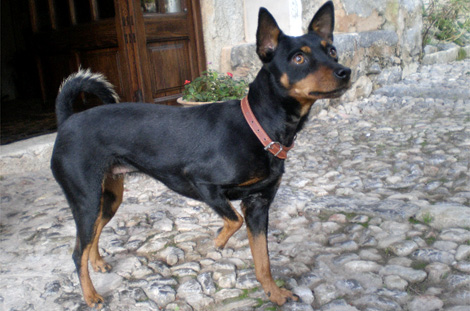
| Height | 29–36 cm |
| Weight | 3–5 kg |
| Lifespan | 12–15 years |
| FCI group | not FCI-recognized (Balearic ratter) |
| Origin | Spain (Mallorca) |
Exact ratings
Common health issues
Nutrition
The Perro Ratero Mallorquín, or Ca Rater Mallorquí (Majorca Ratter), isn’t a lapdog that happens to be small. It is a working exterminator from a Mediterranean island — nine pounds of nerve, speed, and opinion, bred to go into a hole after an animal that fights back. If that sounds oddly familiar to an American reader, it should: this country bred its own version of the same dog, on its own farms, for the same reason. Ours got a registry number. Theirs did not. Learn more on Tvaryny.
The Short Version for an American Reader
The Ca Rater Mallorquí is a small, short-coated, prick-eared farm ratter from Mallorca, the largest of Spain’s Balearic Islands. Males stand roughly 12.5 to 14 inches at the shoulder and weigh six to eleven pounds. The breed has an official written standard, a working stud book, and a club founded in 1990 — and none of that adds up to recognition by the Fédération Cynologique Internationale. There is no FCI standard number for this breed; anyone who quotes you one is inventing it.
It is also absent from the American Kennel Club’s system at every level — not fully recognized, not in the Miscellaneous Class, and not even enrolled in the Foundation Stock Service, the entry-level records program built for breeds in exactly this position. That gap is the most interesting thing about the dog, because the United States happens to own the perfect control group.
America Already Bred This Dog: Meet the Rat Terrier
Strip away the Spanish scenery and the job description of the Ca Rater Mallorquí is the job description of the American Rat Terrier. Both were assembled by farmers, not breeders with a plan, and both were selected for one thing: clearing rodents out of a barn without supervision, and without flinching when the rat turned around. The AKC standard itself opens by saying the Rat Terrier was bred for ratting and farm work, capable of hunting vermin above and below ground.
Both breeds share the same near-death experience. American farmers dropped Rat Terriers in the 1950s once chemical rodent control arrived; on Mallorca the substitution came later and slower, but poison is cheaper than a dog either way. What differs is the next chapter: in the 1990s American owners decided the Rat Terrier was worth formalizing and started the paperwork, while the Mallorcan club, founded in 1990 too, chose a different road.
The Rat Terrier’s Paper Trail — Every Step Is Dated
The comparison works because the American side is fully documented. The United Kennel Club recognized the Rat Terrier on January 1, 1999; the AKC opened companion events to it on January 1, 2006, admitted it to the Miscellaneous Class on July 1, 2010, accepted it into the AKC Stud Book on June 1, 2013, and made it eligible for the Terrier Group on June 26, 2013.
Read those dates as a clock: fourteen years from the first registry taking the breed seriously to full AKC status, with a large, motivated, geographically spread population behind it. Recognition is not a prize for being old or authentic — it is an administrative process with volume requirements, and somebody has to run it for a decade.
| Milestone | Rat Terrier (USA) | Ca Rater Mallorquí (Spain) |
|---|---|---|
| Breed club | Rat Terrier Club of America (AKC parent club) | Club del Ca Rater Mallorquí, 1990 |
| Written standard | AKC breed standard | Balearic official gazette, December 28, 2002 |
| Stud book | AKC Stud Book, June 1, 2013 | Kept by the club itself since November 21, 2002 |
| National registry | UKC 1999; AKC Miscellaneous 2010 | Not among the Spanish national kennel club’s recognized breeds |
| International status | Full AKC recognition, Terrier Group, 2013 | Not FCI recognized; no standard number exists |
| In AKC Foundation Stock Service? | Passed through it | No — never enrolled |
The Teddy and the Hairless: the Ladder Still Works
If 2013 feels like history, there is a fresher example. The Teddy Roosevelt Terrier — the short-legged branch of the same American ratting stock, named for the president credited with popularizing the Rat Terrier name — entered the AKC Foundation Stock Service in 2016, advanced to the Miscellaneous Class in July 2019, and received full recognition in the Terrier Group effective January 1, 2026, bringing the AKC roster to 205 breeds. The door is plainly not closed to short, unglamorous vermin dogs.
The third member of the family makes the contrast almost unfair. In the 1970s a hairless puppy appeared in a Rat Terrier litter in Louisiana; breeders built a line from that single mutation, and the American Hairless Terrier reached the Miscellaneous Class in 2014 and full Terrier Group recognition in 2016. A coat mutation from one litter now has a standard, a group, and a show ring; a landrace working since the mid-1800s has nothing here.
The AKC Foundation Stock Service — the Door Nobody Knocked On

The Foundation Stock Service is the AKC’s records program for breeds not yet eligible for full recognition — deliberately low-barrier, built to let a rare breed accumulate a reliable American pedigree database while its supporters organize. The current list includes several Spanish breeds, among them the Presa Canario, the Spanish Mastiff, and the Spanish Water Dog. It does not include the Ca Rater Mallorquí under any spelling.
The published requirements are specific. Advancing out of FSS calls for at least 150 dogs recorded with three-generation pedigrees, a club whose membership has voted to seek recognition, and a standard reviewed against AKC guidelines. The Miscellaneous Class calls for roughly 150 to 200 such dogs, owned by many different people around the country. Full recognition needs at least 300 registered dogs and a club of about 100 members.
Now compare reality. The entire global population sits in the low thousands, essentially all on one island of about 1,400 square miles. Putting 300 pedigreed Ca Raters across the United States would mean exporting a meaningful slice of the world’s dogs and breeding them here for generations. Not impossible — just a project nobody has started.
Why the Mallorcan Ratter Stopped and the Rat Terrier Didn’t
- Population base. American farm terriers were spread across a continent in the tens of thousands. The Ca Rater has one island. Every recognition ladder is a volume game, and volume is what this breed structurally cannot produce.
- Registry architecture. The AKC is a club of clubs: a parent club joins and keeps its identity. The European route runs up through a national kennel club to the FCI, and joining means handing your stud book upward. The Mallorcan club has kept its own genealogical book since 2002 and will not give it up.
- Motive. The Rat Terrier Club of America wanted a show ring and national events. The Mallorcan club’s stated purpose is conserving a working island dog — a goal that requires nobody’s recognition.
- Timing. By the 1990s the American ratter had lost its job and needed a new identity as a sport and family dog. On Mallorca the dog still has work, so the pressure to convert it never became urgent.
Put plainly: the Rat Terrier finished because a lot of Americans wanted a piece of paper, and the Ca Rater stopped because the people who own the breed decided the paper was not worth what it would cost them.
The Papers the Dog Does Have (They Just Aren’t FCI Papers)
Calling this breed “unrecognized” without qualification is misleading. The Balearic government published a written standard in its official gazette on December 28, 2002, and a resolution of November 21, 2002 entrusted the breed’s genealogical book to the club. Nationally the dog sits inside an agricultural framework built by a 2001 royal decree on recognition of purebred dog breeders’ associations; sources give either 2003 or 2004 for the national listing, and both mark stages of one process.
Two corrections, because English-language aggregators get these wrong constantly. The Spanish national kennel club has not recognized this breed — its site files the dog under other breeds and breeds in recovery, so any pet-insurance blog claiming otherwise is wrong. And Spain’s national livestock catalog, with its endangered-status categories and support, does not cover dogs at all, which leaves the 2022 call for a conservation program with no administrative vehicle. The formula: this dog has documents. They just aren’t FCI documents.
Two Spanish Ratters That Did Finish the Race
The clearest proof that the ceiling is not the breed’s fault comes from its own cousins. The Valencian Rater (Gos Rater Valencià) holds FCI Standard No. 370, Group 3 terriers, Section 1, without working trial, dated June 21, 2022. The Andalusian Ratonero — the Ratonero Bodeguero Andaluz — holds FCI Standard No. 371, same group and section, working trial optional, dated September 3, 2024. It was the fourteenth Spanish breed the FCI took on.
Five years ago all three Spanish ratters were unrecognized; two are now in the book. One detail ties Mallorca directly to Valencia: a Spanish ministerial order published on March 30, 2004 entered both breeds into the national annex on the same day, after a committee approval in April 2003. They started in the same document; only one kept walking. The Andalusian, incidentally, really does carry smooth fox terrier ancestry from British sherry traders — which is why people wrongly assume the same of Mallorca.
| Breed | FCI status | Males’ height | Weight |
|---|---|---|---|
| Ca Rater Mallorquí | Not recognized — no standard number | 12.5–14 in (32–36 cm) | 6.5–11 lbs (3–5 kg) |
| Gos Rater Valencià | Standard No. 370, Group 3, standard of 2022 | 11.5–15.5 in (30–40 cm) | 9–17.5 lbs (4–8 kg) |
| Ratonero Bodeguero Andaluz | Standard No. 371, Group 3, standard of 2024 | 14.5–17 in (37–43 cm) | 22–26.5 lbs (10–12 kg) |
| Rat Terrier (USA) | Not an FCI breed; AKC Terrier Group since 2013 | Two size varieties | Varies by variety |
The Four Dogs of Mallorca — and What American Registries Picked
Mallorca produced four native breeds, and the recognition pattern is almost comic. The Ca de Bou, the Majorca Mastiff, is FCI No. 249, definitively recognized in 1963; the Ca de Bestiar, the Majorca Shepherd Dog, is FCI No. 321 in Group 1. The island’s pointer, the Ca Mè Mallorquí, is not FCI recognized. Neither is the Ca Rater. The rule is blunt: the island’s two big, dramatic dogs got in; the two workmanlike ones did not.
Here is the American twist. The United Kennel Club — famously more welcoming to rare and working breeds than the AKC — recognizes the Majorca Mastiff, and recognized the Ca de Bestiar in 2006. It has no standard for the Majorca Ratter. The same filter that operated in Europe operated independently on this side of the Atlantic: two American registries, offered the same island, both took the big dogs.
One Dog, Three Names — and the Valencian Mix-Up
Ca Rater Mallorquí is the Catalan and Mallorcan name; Perro Ratero Mallorquín is Castilian Spanish; Ratoner de Mallorca appears too. One breed in three registers of the same country, not three populations. “Ca” means dog, and “rater” comes from “rata” — rat. English sources add Majorca Ratter, using the anglicized island spelling.
The confusion that genuinely matters is with the Valencian ratter — a separate, mainland, FCI-recognized breed with its own aliases, Rateret and Fusterrier. Before drawing conclusions from a listing, a pedigree, or a health study, check whether it says Mallorquí or Valencià. Close relatives, different dogs.
What the DNA Actually Says (It Is Not a Terrier)
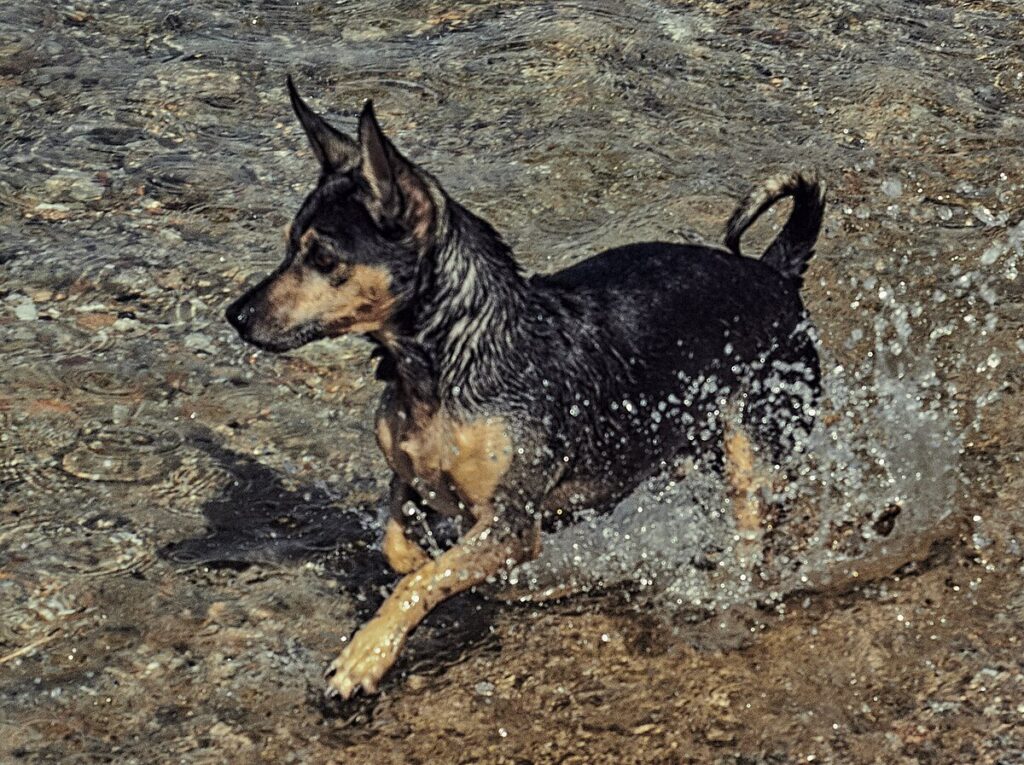
A 2022 study examined 77 hair samples from Mallorcan dogs using microsatellite markers and produced a result most breed write-ups still refuse to report. Despite a striking resemblance to British working terriers — prick ears, wedge head, black-and-tan coat — the Ca Rater Mallorquí did not come out as a terrier relative. What looks like shared ancestry is convergent evolution: two isolated populations selecting for the same job built the same-shaped animal from different raw material. The one close relative confirmed was the Valencian ratter.
The same study mapped the population’s genetic health: expected heterozygosity 0.685, observed 0.655, and an inbreeding coefficient of 0.044 — real but controlled. The registry analyzed held 363 animals, of which 146 were founders, so the base is narrow, and births have fallen steadily since 2011. Population figures elsewhere disagree — the club cites over a thousand registered dogs and about 150 puppies a year, a Spanish trade publication 2,041 — because they count different things. What is safe to say: thousands, not tens of thousands, and trending down.
Appearance and Breed Standards
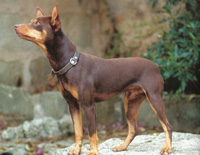
The Ca Rater is small but not delicate. Nothing reads as a toy: the body is compact and muscular, built for an instant start and a fast turn in a confined space. Males run about 12.5 to 14 inches at the withers, females 11.5 to 13, with weight generally six to eleven pounds. Some sources phrase the limits differently — “not over 11 pounds,” or heights to about 15.5 inches — honest variation in a landrace.
Key Appearance Characteristics:
- Ears: Firm, pointed, carried erect — a permanently switched-on expression.
- Eyes: Round and amber. The color is a breed marker and one of the easiest ways to spot a mislabeled photo of some other small terrier.
- Coat: Short, smooth, tight to the body — with no undercoat at all. This single fact drives most of the care advice below.
- Color: Black and tan is most common, brown and tan rarer, and tricolor — black, tan, and white — is also seen. Hunters had a practical reason to prefer the last one.
| Characteristic | Standard Description |
|---|---|
| Height at withers | Males: 12.5-14 in (32-36 cm), Females: 11.5-13 in (29-33 cm) |
| Weight | 6.5 – 11 lbs (3 – 5 kg) depending on gender/build |
| Lifespan | 12-15 years |
| Country of Origin | Spain (Majorca) |
| Purpose | Rodent hunting, companion, watchdog |
The Tail: Born Short vs. Cut Short
Roughly one puppy in five in this breed is born with no tail or only a stub — a natural bobtail, an inherited trait rather than a surgical result. Mallorcan owners historically docked the rest of the litter as routine, so the whole breed looked uniformly tailless and nobody distinguished the two causes. Docking is now prohibited in Spain, where the European convention on pet animals took effect on February 1, 2018. A tailless Ca Rater born on the island today was almost certainly born that way.
The American situation is genuinely different. There is no federal restriction on tail docking in the United States, and the large majority of states have no prohibition either. The American Veterinary Medical Association opposes ear cropping and tail docking done purely for appearance and encourages removing those practices from breed standards — a professional position, not a law.
The Rat Terrier standard is the perfect illustration. It says the tail set continues the line of the spine, that tails are customarily docked between the second and third joint, that a natural bobtail is acceptable, and that a full-length tail tapering to the hock is equally acceptable — length is unimportant. Our own farm ratter’s standard accommodates the same three-way situation, while European law has pushed the Spanish breed toward one option. Same trait, two regulatory worlds.
The Job: Inside a Mallorcan Farmstead
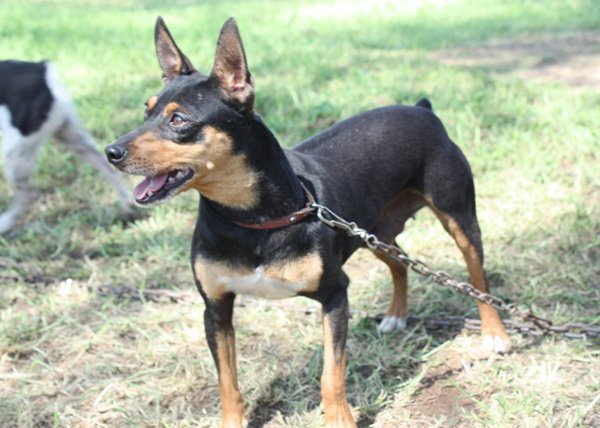
Everything about this dog’s behavior makes sense once you picture the workplace. The Mallorcan possessió — the traditional island estate — combined a grain store, a stable, a mill, and an olive press, all four rodent magnets. The dog went under floorboards, between stacked sacks, and into the gaps of dry-stone walls. That is why the breed is small: anything bigger cannot follow a rat into the space it fled to.
A cornered rat is not passive prey. It turns and bites, so selection pressure fell on nerve as much as speed — the dogs that hesitated in a dark crawlspace did not clear the barn. The work also happened alone, out of the handler’s sight, with no commands possible. A Ca Rater that acts on its own judgment before consulting you is doing exactly what island farmers selected for.
Beyond Rats: Rabbit, Thrush, and the “Buidar” Technique
Rodents were the day job, but Mallorcan hunters also used these dogs on rabbit, hare, hedgehog, and thrushes. The rabbit method has a name — buidar, literally “to empty” — and it is the opposite of what most Americans picture as a hunting dog. The Ca Rater does not course game across open ground like the island’s tall sighthound, the Ca Eivissenc. It works into thick cover and pushes the rabbit out toward the waiting hunter.
One charming consequence: hunters preferred tricolor and white-marked dogs so a flash of movement in the scrub could be told apart from the rabbit. Contrast the design with a large scenting hound and the intent gets clear. Where the Otterhound is a heavy, water-going endurance tracker built for hours of rough country, the Ca Rater is a land-based sprinter: fast approach, dive into cover, snap.
The Barking Is a Job Report
On a Mallorcan estate the Ca Rater worked in a pair with the Ca de Bestiar, the island’s big shepherd. The large dog handled deterrence; the small one announced anybody approaching. Barking was not a side effect but half the assignment. Americans have an exact analog, even if we never named it as a breed pairing — the farm dog by the gate and the sharp-eared little dog on the porch who hears the pickup first.
What it means for you: the barking is trainable down, but it is not trainable out, and any honest description has to say so. An apartment with shared walls, a townhouse with an HOA noise clause, or a condo backing onto a neighbor’s home office makes this a primary decision factor.
Temperament and Character
Inside the house this is an affectionate, physically demonstrative dog that seeks contact and usually picks one person as its own. Outdoors a different animal appears: alert, scanning, evaluating. Reserve toward strangers is normal and not a fault — unlike companion breeds bred to greet everyone, the Ca Rater assesses first. Broad early socialization matters: a well-socialized individual is watchful and polite, an under-socialized one nervous or snappy.
The prey drive deserves its own warning. Any small fast movement — a squirrel on a fence, a chipmunk, a rabbit in the yard, the neighbor’s cat — registers as a target before your voice registers as a command. In drive and willingness to commit, the Patterdale Terrier is a fair reference point, though the genetic relationship isn’t there. Off-leash freedom in an unfenced area is not a reasonable plan.
Training a Dog That Was Bred to Decide for Itself
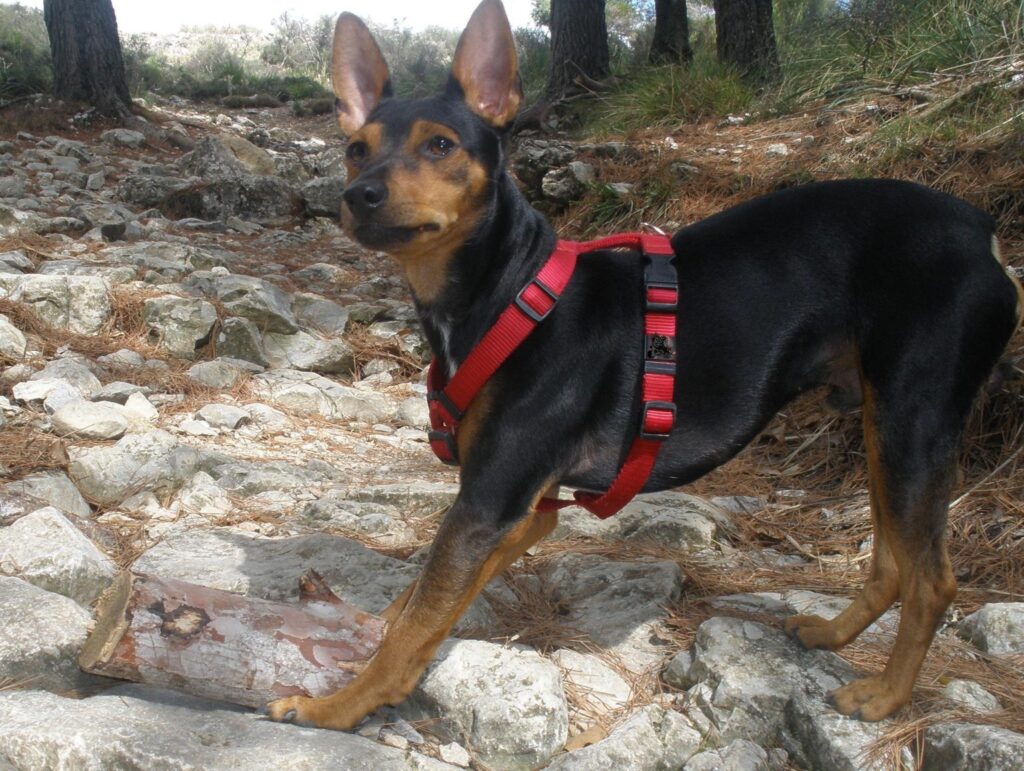
These dogs are bright and stubborn, and those are the same trait. Drilling repetitions works poorly; the Ca Rater wants a reason. Positive reinforcement, short sessions, and training framed as a game get results that pressure never will. Three priorities outrank everything else in an American pet home:
- Impulse control — not general obedience. The gap between seeing the squirrel and launching at it is where all your training has to live.
- A real recall, proofed against motion. Then assume it will fail at the worst possible moment and manage the environment anyway.
- An off switch — a settle cue, a mat, a crate the dog genuinely likes. A ratter with no way to power down becomes a barking, pacing problem by evening.
| Activity Type | Recommended Frequency | Note |
|---|---|---|
| Walks | 2-3 times a day | Minimum 45 minutes of active movement |
| Agility / Sports | 1-2 times a week | Ideal for mental release |
| Scent Games | Daily at home | Helps satisfy hunting instinct |
Sports: Where an Unregistered Ratter Can Still Compete in America
A dog with no AKC-recognized breed behind it is not shut out of American dog sports, and almost nobody tells rare-breed owners that. AKC Canine Partners exists for exactly this case: any dog not eligible for AKC registration — mixed breeds, and explicitly rare breeds the AKC does not recognize — can enroll, competes as an “All American,” and earns the same titles purebreds do in agility, obedience, rally, tracking, scent work, and Fast CAT, provided it is spayed or neutered by adulthood. A Ca Rater in Ohio can hold real AKC titles.
Barn Hunt is the other one, and for this breed it is almost too on-the-nose. Run by the Barn Hunt Association, it is open to any dog of any breed or mix that fits through a straw-bale tunnel 18 inches wide. Dogs search a bale maze for rats held in sturdy aerated tubes — the rats are protected and unharmed. The AKC, the UKC, and the Canadian Kennel Club all honor Barn Hunt titles.
Think about that: the one American sport that reproduces this breed’s literal original job is also the one with no breed requirement whatsoever. If you own one here, try it first.
The Climate Question, Answered by ZIP Code
Most breed articles treat climate as an abstraction. In the United States it is not one, because the country contains several climates at once and this dog’s suitability flips completely between them. Start from the physiology: a nine-pound body, a short single coat, no undercoat, very little fat, shaped by a Mediterranean island of warm dry summers and mild wet winters.
So the surprising conclusion is that large parts of the American South and Southwest suit this dog better than its own island does. Phoenix, Tucson, Miami, Tampa, San Diego, the Gulf Coast: a lean, heat-adapted little dog handles those summers far better than a Husky or a Bernese Mountain Dog ever will. The cautions are the ordinary American ones — walk early and late, check pavement temperature with the back of your hand, never leave the dog in a parked vehicle.
Now flip north. Minnesota, Wisconsin, Michigan’s Upper Peninsula, the Dakotas, upstate New York, northern New England: in those winters outdoor housing is not a bad idea, it is off the table entirely. No doghouse, straw bedding, or heated pad makes a coatless nine-pound dog safe at subzero wind chills. Snow Belt ownership means a real insulated coat, shortened walks on the coldest days, and paw protection against road salt and ice melt. In Florida and Arizona, indoor living is a preference; in Minnesota and Michigan it is a hard safety requirement.
American Wildlife Meets a Dog That Goes Into Holes
Here is a risk that does not exist on Mallorca and absolutely does here. This breed’s defining instinct is to investigate crevices, burrows, woodpiles, and rock gaps — and in much of the American West and Southwest, the thing in that gap is a rattlesnake, not a rat. Avoidance training is the mainstream advice in snake country; a rattlesnake toxoid vaccine exists, but veterinary opinion on it is divided, so treat it as a conversation with your vet rather than a substitute for training.
The second hazard runs the other direction: this dog is prey-sized. Coyotes are established in suburbs and city parks across most of the continental United States, and a nine-pound dog alone in a yard at dusk near Denver, Los Angeles, or suburban Chicago is a realistic target; large hawks and great horned owls add a second vector. The response is unglamorous — supervised yard time, secure fencing, no unattended after-dark outings. Add heartworm too: mosquito-borne, present nationwide, with year-round prevention the standard American recommendation.
Health and Genetics: What’s Documented and What Isn’t
Zoonoses of a Rat Hunter — the American Vaccine Picture
Leptospirosis is the headline. Brown rats and field mice are primary reservoirs, and dogs pick it up not only from the animals but from water and soil contaminated with their urine — puddles, ditches, wet leaf litter, flooded yards. Urban rat populations are a recognized source, so this is not a rural-only disease. The American Animal Hospital Association updated its guidance in 2024 to move leptospirosis from a lifestyle-dependent vaccine to a core recommendation for essentially all dogs from twelve weeks of age that go outside, backed by ACVIM and WSAVA consensus work.
Rabies is the other, and its legal handling here is patchy. Roughly forty states require rabies vaccination for dogs by statute, with the first shot typically due at three or four months. About ten — Colorado, Hawaii, Idaho, Kansas, Minnesota, Missouri, Montana, North Dakota, Ohio, and South Dakota among them — have no statewide requirement, leaving it to counties and municipalities. Do not read your state’s silence as your city’s agreement, and vaccinate regardless. Round the list out with intestinal parasites from eating prey, and with ticks.
Rodenticides: The Poison That Kills the Dog, Not the Rat
Anticoagulant rodenticides kill by preventing clotting, and they persist in the tissue of the poisoned rodent, so a dog that catches and eats a dying rat can absorb a meaningful dose without ever touching bait. The cruel part is the delay: signs can take several days to appear, long after anyone connects the dog’s condition to the rat it caught on Tuesday. Vitamin K1 is an effective antidote if treatment starts in time.
The EPA moved on this. After a risk-mitigation decision issued in 2008, with compliance expected by June 2011, the second-generation anticoagulants — brodifacoum, difethialone, bromadiolone, and difenacoum — were removed from products sold to general consumers, consumer packages were capped in size, and tamper- and weather-resistant bait stations were required outdoors. California went further, adopting a moratorium in 2020 and adding chlorophacinone and warfarin with the Poison-Free Wildlife Act signed on September 25, 2024.
There is a sting in the tail, and it is why this section belongs in an American article rather than a European one. As anticoagulants were restricted, bromethalin — a neurotoxic, non-anticoagulant rodenticide — became far more common on consumer shelves. Vitamin K1 does nothing for it; there is no specific antidote and treatment is supportive. So if your dog catches a rodent where pest control might be running, or gets into bait, call your vet or a poison control line immediately and identify the active ingredient.
Nutrition: How Not to Overfeed the Athlete
Living With One in an American Home
Grooming is genuinely easy: a short single coat needs no trimming, no stripping, and no professional appointments — a rubber mitt once a week pulls the dead hair.
Containment is where American owners get surprised. This is a digger and a squeezer. A fence that looks solid to you is evaluated by the dog for gaps at ground level, and a Ca Rater will go under a privacy fence, through the gap behind a gate post, or between deck boards. If you rely on a fenced yard, fix the ground line, not the top. Invisible fencing is a poor match for a prey drive that overrides discomfort mid-chase.
Apartment life works, with conditions. The dog is small, clean, adaptable, and has no strong doggy odor. The live issues are noise and stimulation: a Ca Rater with a window over a busy sidewalk will narrate the whole day. Managing sightlines, supplying scent games and puzzle work indoors, and building a genuine off switch are what make it viable. A recall that fails once, next to traffic, is the whole story.
Cats, Hamsters, and Kids
Be blunt about small pets: a hamster, gerbil, chinchilla, pet rat, dwarf rabbit, or small parrot is not a housemate for this breed. It is profile prey. This is an engineering problem — closed doors, secure enclosures, no shared airspace — not a training problem, and treating it as one is how accidents happen.
Cats sit on a spectrum. A Ca Rater puppy raised alongside a kitten usually ends up genuinely bonded to it; an adult dog introduced to a new cat, or the reverse, is a real gamble needing slow managed introductions. The trigger is motion — a cat that holds its ground is often ignored, while a cat that bolts flips a switch.
With children, this is a playful, tireless companion for a school-age kid who knows how to handle a small dog. It does not tolerate rough handling and is small enough to be genuinely injured by a toddler. For families with children under about five or six, supervise every interaction or choose a sturdier breed.
Bringing One Home From Spain: What Federal Law Requires
Who Should and Should Not Get This Breed
The breed’s entire institutional footprint is one club — founded in 1990, recognized as a breeders’ association in 2002, with breeding assessments each May and October and a single-breed show on the first Sunday of December in the inland town of Montuïri, plus affiliated groups in Germany and France. No American chapter, no United States breeder directory.
This dog fits an owner who wants a small dog without wanting a passive one; who has time for daily physical and mental work; who lives where the noise will not create conflict; who keeps no small caged pets; and who is genuinely untroubled by the absence of registry papers.
It does not fit a first-time owner looking for an easy small companion; a household with a hamster, a bird, or a house rabbit; a family with toddlers and no capacity for constant supervision; anyone planning to keep a dog outdoors in a cold-winter state; or anyone whose goal is the AKC conformation ring. A fair suggestion: if the description sounds exactly right, look hard at the Rat Terrier first — same dog conceptually, available nationwide, with health-tested lines, a parent club, and full AKC status.
Pros and Cons of the Breed
| Pros (+) | Cons (-) |
|---|---|
| Compact: Ideal for apartments and travel. | Loud: Barking was selected for on purpose and never fully disappears. |
| Hardy: No exaggerated conformation, controlled inbreeding coefficient. | Undocumented health: No breed screening programs or DNA panels exist. |
| Watchdog Skills: Will always warn of guests with a loud bark. | Cold Sensitivity: No undercoat — outdoor living is impossible in northern states. |
| Easy Care: Coat requires zero effort. | Hunting Drive: May run off chasing prey; unsafe with small caged pets. |
| Eligible for AKC sports via Canine Partners, and for Barn Hunt. | No AKC recognition: Not even enrolled in the Foundation Stock Service. |
Interesting Facts
- On Mallorca the breed is still used for its original purpose on working farms, as well as for hunting rabbit.
- Roughly one puppy in five is born with no tail at all — a natural bobtail, not a docking.
- Genetic testing in 2022 found no terrier ancestry despite the textbook terrier looks — the likeness is convergent evolution.
- Hunters historically preferred tricolor dogs so they would not mistake the dog for the rabbit in dense scrub.
- They lack the strong doggy odor of many breeds, which makes them pleasant housemates.
- A Balearic hunting law still in force names the breed among the native hunting dogs authorities must help conserve.
- Every dog of this breed on earth traces to an island about the size of Rhode Island and Delaware combined.
Frequently Asked Questions (FAQ)
Is the Ca Rater Mallorquí recognized by the AKC?
No. It is not fully recognized, not in the Miscellaneous Class, and not enrolled in the Foundation Stock Service, the AKC’s entry-level records program for rare breeds. It is not FCI recognized either, so no FCI standard number exists — any source quoting one is mistaken. The breed does have an official standard published by the Balearic government in December 2002 and a stud book kept by its own club.
Can I compete or earn titles with one in the United States?
Yes, in performance sports — just not conformation. Enroll in AKC Canine Partners, which accepts dogs the AKC does not recognize, including rare breeds; they run as “All American” and earn the same titles purebreds do in agility, obedience, rally, tracking, scent work, and Fast CAT, provided the dog is spayed or neutered by adulthood. Barn Hunt suits the breed even better: open to any dog that fits through an 18-inch straw-bale tunnel, with titles recognized by the AKC, UKC, and Canadian Kennel Club.
Can I import a puppy from Mallorca?
Not a puppy — a dog. Since August 1, 2024 the CDC requires every dog entering the United States to be at least six months old, appear healthy on arrival, carry an ISO-compatible microchip implanted before any required rabies vaccination, and travel with a CDC Dog Import Form receipt. Spain is on the CDC’s dog-rabies-free or low-risk list, so the heavier track for high-risk countries does not apply.
Is this basically a Spanish Rat Terrier?
Functionally very similar; genetically, no. A 2022 study using microsatellite markers on 77 Mallorcan samples found the breed is not closely related to terriers at all, despite the resemblance. Its confirmed close relative is the Valencian ratter on the Spanish mainland. The likeness to your neighbor’s Rat Terrier is convergent evolution — two farming cultures, the same rats, the same solution reached independently.
My dog has no tail — was it docked?
Probably not. About 20 percent of puppies in this breed are born tailless or with a rudimentary stub, and docking has been prohibited in Spain since the European pet-animal convention took effect there in February 2018. In the United States there is no federal ban and most states have none either; the AVMA opposes purely cosmetic docking, but that is a professional position rather than law. The AKC’s Rat Terrier standard accepts a docked tail, a natural bobtail, and a full-length tail equally.
Can it live outdoors in my yard?
No, and where you live changes how emphatic that “no” is. With a short single coat, no undercoat, and a body weight around nine pounds, this dog cannot be housed outdoors through a winter in Minnesota, Michigan, the Dakotas, or upstate New York — a safety issue, not a comfort issue. In Florida, Arizona, or along the Gulf Coast the heat side is easier for this breed than for most, but it is still an indoor dog.
How long do they live, and what should I watch for?
Twelve to fifteen years is the realistic range; longer figures circulating online are not supported. No breed-specific disease list has ever been compiled, so use general small-breed care: watch for medial patellar luxation, stay ahead of dental disease in a crowded small jaw, and control weight. Leptospirosis vaccination deserves particular attention in a rodent hunter — AAHA made it a core recommendation for outdoor-going dogs in 2024.
Is it safe with cats and small pets?
Small caged pets — hamsters, gerbils, pet rats, chinchillas, dwarf rabbits, small birds — are this breed’s literal prey category, and that is a containment problem rather than a training problem. Cats depend on history: a puppy raised with a kitten usually bonds with it, while an adult dog meeting a new cat is a genuine gamble. The trigger is movement.
Does it bark a lot, and can it live in an apartment?
It barks, and that is deliberate breeding rather than a fault: on Mallorca it worked as the alarm half of a two-dog team with the island’s large shepherd. Training reduces it; nothing eliminates it. Apartments work if you manage sightlines to windows, supply daily scent and puzzle work, and build a real settle cue — but thin walls and a neighbor who works from home should weigh heavily.
Video About the Breed
- Compact, good for an apartment
- Devoted and affectionate to the family
- An agile, tireless ratter
- A watchful “doorbell” guardian
- A nervy, excitable temperament
- Prone to barking
- A strong prey drive (rats, small animals)
- Rare outside the Balearics
| Ratonero Bodeguero Andaluz | Prague Ratter | Jack Russell Terrier | |
|---|---|---|---|
| Height | 35–43 cm | 20–23 cm | 25–30 cm |
| Energy | 4 | 3.5 | 4.5 |
| Apartment | 3.5 | 4.5 | 3.5 |
| Beginners | 3.5 | 3.5 | 3 |
Is the Ca Rater Mallorquí recognized by the AKC?
Can I compete or earn titles with one in the United States?
Can I import a puppy from Mallorca?
Is this basically a Spanish Rat Terrier?
My dog has no tail — was it docked?
Can it live outdoors in my yard?
How long do they live, and what should I watch for?
Is it safe with cats and small pets?
Does it bark a lot, and can it live in an apartment?
Balearic aboriginal type (Club del Ca Rater Mallorquí)
For apartments · For kids · For beginners · Active · Smartest · Hypoallergenic · All rankings →