

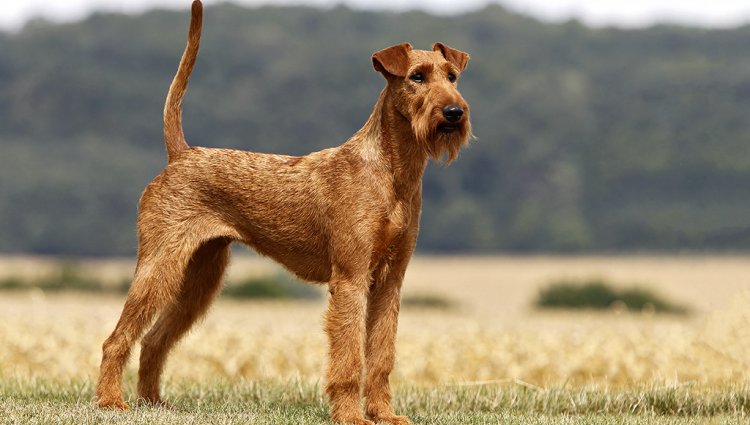
| Height | 45.5 cm (FCI) · 48/46 cm (KC ♂/♀) |
| Weight | 11.4–12.25 kg |
| Lifespan | 13–15 years |
| FCI group | 3 · terriers |
| Origin | Ireland |
Exact ratings
Common health issues
Nutrition
The Irish Terrier is a whole-coloured red terrier built on what its own standard calls the lines of speed — and the breed the English-speaking world nicknamed the daredevil. It has an unusually specific biography: its colour was narrowed to a single type by deliberate selection at the end of the 19th century, its reputation was made in the trenches of the First World War, and its principal inherited problem is written into the text of the official standard as a disqualifying fault. What follows is built on primary sources — FCI Standard No. 139, peer-reviewed papers and breed-club documents. More breed guides on Tvaryny.
One thing up front: this is not a default family dog. The Irish Terrier is devoted to people and, at the same time, ready to take up a challenge from another dog — and that duality is the part most breed descriptions quietly skip. It gets its own section here.
Irish Terrier: the breed at a glance
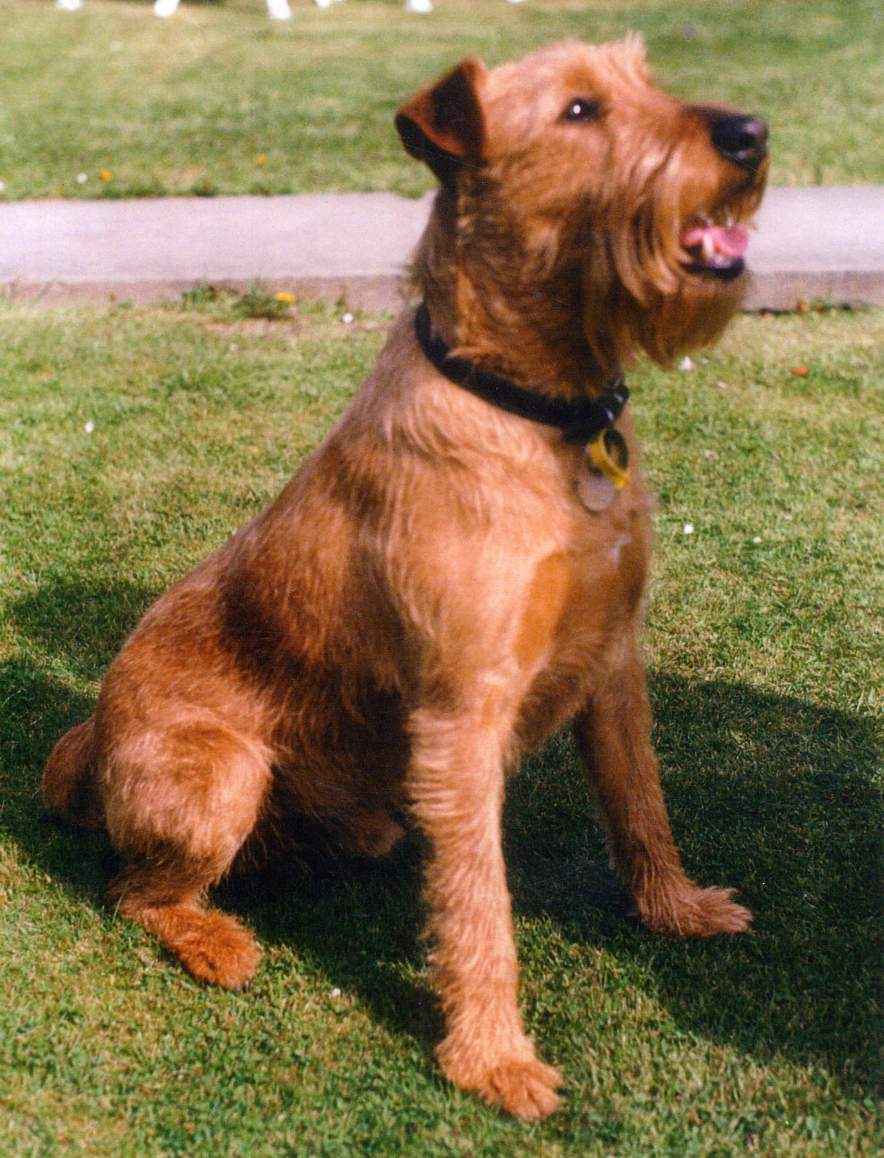
| Parameter | Value |
|---|---|
| Country of origin | Ireland |
| FCI classification | Group 3 Terriers, Section 1 — Large and medium-sized Terriers; without working trial |
| Standard | FCI No. 139; valid version dated 13.03.2001, published 02.04.2001 |
| Height at withers (FCI) | approximately 18 inches (45.5 cm) — a single figure, not split by sex |
| Height at withers (The Kennel Club, UK) | ideal: dogs 48 cm, bitches 46 cm |
| Weight (FCI) | dogs 27 lb (12.25 kg); bitches 25 lb (11.4 kg) |
| Colour | whole-coloured: red, red wheaten or yellow red |
| Lifespan | 13–15 years |
| Purpose per the standard | versatile farmyard dog, family pet, guard dog, hunter and gundog |
Note the discrepancy in height. The FCI gives one figure — approximately 45.5 cm — with no split between dogs and bitches, while the British Kennel Club sets an ideal for each sex separately. These are two documents from two organisations, and flattening them into a single “46–48 cm” range is not accurate. Weight, by contrast, the FCI does split explicitly: 12.25 kg against 11.4 kg.
History: how red pushed out every other colour
The historical summary in the FCI standard is worth reading closely, because it contradicts several popular retellings. Ireland produced four terrier breeds, and the Irish Terrier is, in the standard’s own wording, possibly the oldest of them — but the records are so scarce that proving it conclusively would be difficult. The standard names no county and no dockside rat-catchers: the country of origin in the document is simply Ireland.
The colour is the interesting part. Before the 1880s the breed’s colour had not been settled: apart from red, dogs were sometimes black and tan and sometimes brindle. At the end of the 19th century breeders made a deliberate effort to breed out the black-and-tans and the brindles, so that by the 20th century every Irish Terrier showed the red coat. In other words, the breed’s signature colour is not an ancient given — it is the result of roughly two decades of conscious selection.
Two dates worth remembering: the first breed club was set up in Dublin on 31 March 1879, and the Irish Terrier was the first member of the terrier group to be recognised by the English Kennel Club, in the late 19th century, specifically as a native Irish breed.
One more thread that often gets tangled: the modern red type took shape alongside the other wire-coated terriers of these islands — the Lakeland Terrier, the Welsh Terrier and the Kerry Blue Terrier, the last of which also belongs to the Irish four. The specific 19th-century crosses are poorly documented, which is why the standard says nothing about them — and neither will we repeat them as fact.
The First World War: a messenger dog in the trenches
This is that rare case where a breed’s war story is confirmed both by the official standard and by the man who trained the dogs. FCI Standard No. 139 states it plainly: the Irish Terrier’s reputation was enhanced during the First World War, when they were used as messenger dogs in the terrifying noise and confusion of trench warfare, thereby proving both their intelligence and their fearlessness. Note the timing: during the war, not after it.
The British War Dog School was established in 1917 by Lieutenant Colonel Edwin Hautenville Richardson, and it trained dogs principally as messengers and sentries for work close to the front line. The Irish Terrier Club of America records his verdict on the breed: “I can say with decided emphasis that the Irish Terriers of the service more than did their part. Many a soldier is alive today through the effort of one of these very terriers.”
The breed also reached literature, and here too the record is checkable. The hero of Jack London’s novel Jerry of the Islands (1917) is an Irish Terrier — in the opening chapter London describes him as a smooth-coated, golden-sorrel Irish terrier. In the foreword, signed at Waikiki Beach on 5 June 1915, London explains that the book would never have been written but for a real Irish terrier puppy called Peggy, whom he and his wife met aboard the ketch Minota in the Solomon Islands. The companion novel, Michael, Brother of Jerry, follows that same dog’s brother.
FCI Standard No. 139: what the document actually says
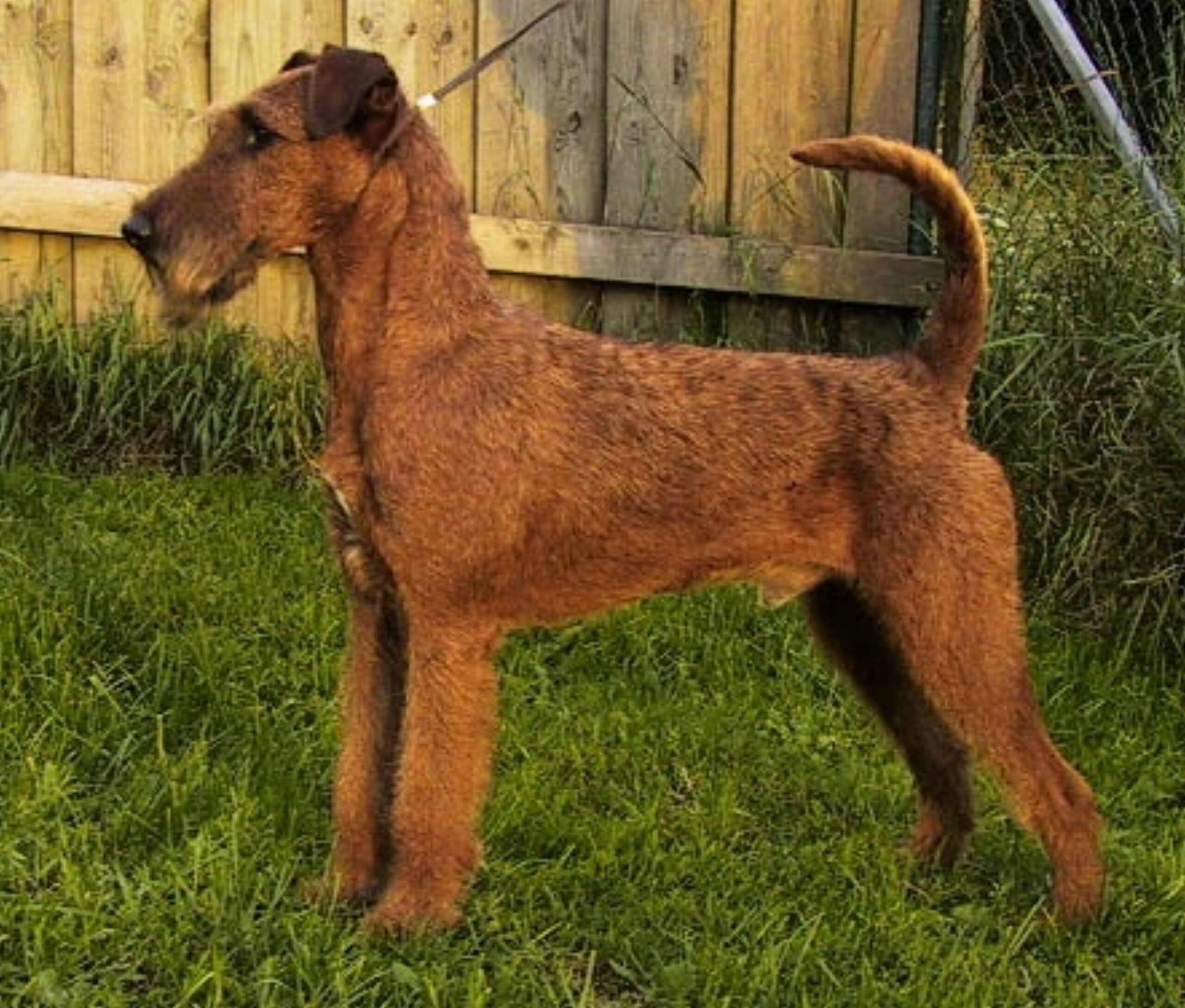
The standard describes the outline through speed. The dog must look active, lively, lithe and wiry, with plenty of substance yet free of clumsiness, because speed and endurance matter here as much as power. The wording is that the Irish Terrier must be neither cloddy nor cobby, but framed on the lines of speed, showing a graceful, racy outline.
- Head — long and free from wrinkles. The skull is flat and rather narrow between the ears, narrowing slightly towards the eyes. The stop is hardly visible, and in practice can be seen only in profile.
- Nose — must be black. Any other colour of nose is a disqualifying fault, not a minor flaw.
- Eyes — dark, small, not prominent, full of life, fire and intelligence. A yellow or light eye is described as most objectionable. The word “almond-shaped” does not appear in the document.
- Ears — small and V-shaped, of moderate thickness, set well on the head and dropping forward closely to the cheek. The top line of the folded ear should sit well above the level of the head. An ear hanging at the side like a hound’s is not characteristic of a terrier — and a semi-erect ear the standard calls even more undesirable. The hair on the ear is short and darker than the body coat.
- Teeth — strong and level, with the top incisors slightly overlapping the lower. Decidedly undershot or overshot jaws are a disqualification.
- Neck — of a fair length, free from throatiness, generally with a slight frill visible at each side running nearly to the ear.
- Body — symmetrical, the back strong and straight, the loin muscular and very slightly arched. The standard specifically allows a bitch to be slightly longer in couplings than a dog.
- Tail — set on rather high, carried gaily but not over the back or curled. The standard describes customary docking leaving two-thirds of the original length, and adds that in countries where docking is banned by law only a natural, undocked tail is allowed.
- Feet — strong, tolerably round and moderately small, toes arched, black toenails most desirable. And then the sentence we will return to in the health section: the pads must be sound and free from cracks or corny excrescence.
Colour: why red only, and what a white patch means
The standard requires a whole-coloured dog and names three permitted shades: red, red wheaten and yellow red. Then comes the nuance that is usually retold wrongly. The standard does not ban white outright: it states plainly that white is sometimes seen on the chest, and that a small amount of white is frequently to be seen in all self-coloured breeds. In the list of disqualifying faults this is recorded as: any colour other than red, yellow red or red wheaten disqualifies — while a small patch of white on the chest is permissible.
The Kennel Club’s version adds a detail the FCI wording does not carry: it calls white on the feet and black shading in the coat highly undesirable. The practical takeaway for a buyer is simple. A small white mark on a puppy’s chest is neither cause for alarm nor a sign of the wrong breed; white socks, dark shading along the back, or any tone that is not red are all worth a question to the breeder.
The history explains the strictness. Black-and-tan and brindle dogs were bred out of the breed on purpose, so black pigment in the coat reads as a return to the type that was displaced. For contrast: in breeds built on saddle and tricolour patterns — the Bernese Mountain Dog or the Austrian Black and Tan Hound — exactly that distribution of colour is what the standard asks for. In an Irish Terrier it would be a disqualification.
The coat: why stripping is not clipping
The standard describes the coat with unusual technical precision, and those lines are effectively a grooming brief. The hair should be dense and wiry, having a broken appearance but still lying flat; growing so closely and strongly together that when parted with the fingers the skin cannot be seen; free of softness and silkiness; not so long as to hide the outlines of the body; and free of lock or curl. On the face the hair is of the same description but short — about three-quarters of a centimetre — almost smooth and straight. A slight beard is the only long hair permitted and is characteristic; a “goat’s” beard, the standard warns, is suggestive of silky and bad hair running through the coat generally. The legs carry no feather and as hard a texture as the body, only shorter.
The Kennel Club version also mentions a dense undercoat beneath the stiff top hairs — the FCI text does not describe an undercoat at all. That is not a contradiction but a difference between documents: the FCI regulates the outer coat, the KC describes the double structure.
Hand stripping versus clipping: the practical difference
| Hand stripping (plucking) | Clipping with machine | |
|---|---|---|
| What happens to the hair | the mature dead hair comes away with its root | the hair shaft is cut; the root stays in the skin |
| What grows back | new guard hair — hard and strongly pigmented | mostly the soft portion; texture turns fluffy |
| Effect on colour | the red stays dense | the colour gradually dulls and fades |
| What sets the rhythm | the coat cycle — worked in sections as each area matures | length alone |
| Who it suits | show and working dogs, and any owner who wants to keep the coat type | a fallback for age, skin condition or medical reasons |
Hence the practice of “rolling the coat”: the dog is not stripped bare once a season but worked in zones, as the hair in each area ripens. The dog then carries hair of several ages at once rather than one uniform length, and the breed looks the way the standard describes it. The rest of the routine is ordinary for a wire-coated terrier — brushing, ears, nails, teeth — but the footpads in this breed are inspected separately and regularly, and the reason follows below.
Temperament: an honest look at the “daredevil”
No softening here — but no demonising either. Start with what the standard itself says, because its wording on character is unusually long and candid.
The Irish Terrier, per the FCI text, is game and capable of holding his own with other dogs, and at the same time remarkably loyal, good tempered and affectionate with mankind. But once he is attacked he has the courage of a lion and will fight to the bitter end. And then the standard does something standards rarely do: it argues with the breed’s reputation. The dog’s reputation for getting into scraps with others, sometimes even in the show ring, the document calls undeserved, stressing that the Irish Terrier is easily trained and a gentle pet, living up to his early description as the poor man’s sentinel, the farmer’s friend and the gentleman’s favourite.
Now the other half of the picture, also from breed documents. The Kennel Club’s breed page describes a fiery spirit and a daredevil nature: good-tempered notably with humans, yet potentially reactive towards other dogs. The Irish Terrier Club of America puts it even more directly — this dog is always ready to meet the challenge of another dog, while interacting well with friendly humans. The British standard sums the character up in a phrase that resists neat translation: heedless, reckless pluck.
Put those together and the sources do not actually conflict. What the standard denies is not the readiness to answer a challenge, but the idea that the Irish Terrier starts fights unprovoked. For an owner the distinction is academic: either way, on a walk it is the human, not the dog, who settles the question. The practical consequences:
- Same-sex conflict is the most likely scenario. Two males in one household is a decision to make with open eyes, not on the assumption that they will sort themselves out.
- The hunting drive of a working terrier has not gone anywhere. Small rodents and birds in the house are a poor idea; a cat is possible only with shared upbringing from puppyhood, and without illusions.
- Off-lead freedom is a question of place, not of training alone. A dog with this much courage and this much independence is quite capable of making its own decision and going after quarry.
- Socialisation with calm adult dogs from the first months is not optional; it is a basic part of keeping the breed.
- With people it is a different dog. Attachment to the family, tolerance of children, friendliness to visitors — that is what the breed is kept for, and the standard underlines it separately.
One more detail from the standard that is rarely quoted: the first item in its list of disqualifying faults is aggressive or overly shy behaviour. Belligerence beyond the norm is placed outside the acceptable by the breed’s own document — it is not something the ring rewards.
Health: two genuinely breed-specific subjects
Exercise, work and training
The standard defines the breed as a versatile farmyard dog, family pet, guard dog, hunter and gundog — a broad-spectrum working animal, not an ornament. Endurance and speed are built into the description of the outline, and without an outlet that construction works against its owner.
- Agility — a compact, fast, manoeuvrable dog in its natural format.
- Earthdog trials — an outlet for exactly the instinct that causes trouble at home.
- Nose work and mantrailing — scent games tire a terrier faster and more thoroughly than running does.
- Running and cycling together — once growth is complete, with distance built up gradually.
- Flyball — excitement in a controlled shape, which is good practice for self-control.
On training: the standard itself calls the breed easily trained, but it has little patience for monotony. Short, highly motivated sessions with rapid changes of task achieve more than long identical repetitions. Positive reinforcement here is not a fashionable method but the way to avoid breaking your relationship with a dog that answers pressure with obstinacy.
Pros and cons, unvarnished
| Strengths | Difficulties |
|---|---|
| Deeply attached to its own people; the standard stresses even temper with humans | Ready to take up a challenge from other dogs; same-sex conflict is the typical scenario |
| Hardy, fast and suited to sport and sustained work | Without a job and exercise, that energy finds its own outlet |
| The wiry coat does not drift around the house and stays dense with correct care | Needs hand stripping; clipping degrades texture and colour |
| The breed’s main inherited sign can be designed out of a litter with a DNA test on the parents | Nobody makes that test compulsory — the buyer has to ask |
| Compact size, fits urban life provided the exercise is there | An adult unneutered male needs attention paid to his urinary tract |
| Watchful without unnecessary barking | Hunting drive: small pets at home and off-lead freedom are separate problems to solve |
Who the Irish Terrier suits — and who it does not
It suits someone who wants a partner rather than an accessory and is ready to supply physical and mental work every day; who is relaxed about the fact that a walk requires attention to other dogs; who values a wiry coat that leaves no drifts of hair around the house and does not mind learning to strip it, or booking a groomer who can; who asks a breeder uncomfortable questions and reads test results.
It does not suit someone looking for a dog that raises itself, or a quiet presence on the sofa; who plans uncontrolled off-lead freedom in country with game in it; who already has an adult dog of the same sex and expects the two to divide the territory amicably; who keeps small rodents or birds at home; who intends to manage the coat with clippers and would rather not think about it. This is a breed with a character, and an honest article has to say so plainly.
Frequently asked questions
Does the Irish Terrier get on with other dogs?
With friendly ones, yes — given early socialisation and an attentive owner. But the standard describes the breed as capable of holding its own with other dogs, and both the American and the British clubs describe readiness to meet a challenge as a breed trait. The riskiest combination is two adult dogs of the same sex sharing a home.
Is a white patch on a puppy’s chest a fault?
No. The FCI standard states that white is sometimes seen on the chest and that a small amount of it occurs in all self-coloured breeds; in the list of disqualifications, a small patch on the chest is named as permissible. White on the feet, however, is called highly undesirable by the Kennel Club’s version.
Is the breed hypoallergenic?
No. The wiry coat scatters less around the home, so allergens spread more slowly — but that is housekeeping, not immunology. No dog is fully hypoallergenic, and any individual’s reaction can only be tested by contact with a particular dog.
Is it suitable for a flat?
Yes, by size. But the flat is only where the dog sleeps: the daily volume of exercise and scent work has to match a dog bred to work, or the problems will show up inside the flat.
Is the tail docked or not?
The FCI standard describes docking as customary, leaving two-thirds of the original length, and immediately adds that in countries where docking is banned by law only a natural tail is allowed. The answer is therefore set by national legislation, not by a breeder’s preference.
Sources
- FCI-Standard No. 139 “Irish Terrier”, valid version dated 13.03.2001 (published 02.04.2001).
- The Kennel Club (UK): Irish Terrier breed standard; breed page; Breed Watch Category 2.
- Binder H. et al. Palmoplantar hyperkeratosis in Irish terriers: evidence of autosomal recessive inheritance. Journal of Small Animal Practice, 2000; 41(2): 52–55.
- Drögemüller M. et al. A Mutation in the FAM83G Gene in Dogs with Hereditary Footpad Hyperkeratosis (HFH). PLoS Genetics, 2014; 10(5): e1004370.
- Brons A.K. et al. SLC3A1 and SLC7A9 Mutations in Autosomal Recessive or Dominant Canine Cystinuria: A New Classification System. Journal of Veterinary Internal Medicine, 2013.
- Irish Terrier Association (UK): club material on footpad hyperkeratosis and cystinuria.
- Irish Terrier Club of America: breed history and the Lt Col E. H. Richardson quotation.
- Jack London. Jerry of the Islands, 1917 (foreword and chapter I).
Video about the breed
- Brave and devoted
- Energetic, hardy
- Sheds little
- Main inherited sign is DNA-testable
- Keen, possible animal aggression
- Strong hunting instinct
- Needs plenty of exercise
- Terrier stubbornness
| Airedale Terrier | Kerry Blue Terrier | Lakeland Terrier | |
|---|---|---|---|
| Height | 56–61 cm | 44–50 cm | 33–38 cm |
| Energy | 4.5 | 4.5 | 4.5 |
| Apartment | 3 | 3 | 3 |
| Beginners | 2.5 | 2.5 | 3 |
What must I ask an Irish Terrier breeder?
Is the Irish Terrier good with children?
Does the Irish Terrier get on with cats?
Can I clip the coat instead of stripping it?
FCI Standard No. 139 (13.03.2001) · The Kennel Club: breed standard, Breed Watch Category 2 · Binder et al., J Small Anim Pract 2000;41(2):52–55 · Drögemüller et al., PLoS Genetics 2014;10(5):e1004370 · Brons et al., J Vet Intern Med 2013 · Irish Terrier Association
For apartments · For kids · For beginners · Active · Smartest · Hypoallergenic · All rankings →