Group 5 (Spitz and primitive types), Section 5 (Asian Spitz and related breeds) · Germany
Eurasier
A calm family spitz with the soul of a companion: level-headed, devoted, reserved with strangers and tender with its own. The Eurasier is made to live in the family as an equal member; it needs closeness and warmth of relationship, not a kennel or solitude.
Apartment · with caveatsKidsCatsOther dogsBeginners · with caveats
The Eurasier is first and foremost a family companion dog. For this breed, a cozy, favorable, and friendly atmosphere in the home is more important than working qualities or guarding territory. They become their owner's shadow, accompanying them everywhere possible. This breed was developed quite recently, yet it has already managed to win the love of many dog enthusiasts in Europe and is gaining traction in the States. These dogs are true faithful friends who need constant interaction and attention, and the most important thing for them is the warmth and tenderness of human hands. Read more on Tvaryny.
Eurasier: A Brief Overview and Breed Characteristics
Eurasier: A Brief Overview and Breed Characteristics · 8
Country of Origin
Germany
FCI Recognition Year
1973 (Standard No. 291)
Life Expectancy
11–13 years (sometimes up to 15)
Height (Males)
20.5–23.5 in (52–60 cm)
Height (Females)
19–22 in (48–56 cm)
Weight (Males)
50–70 lbs (23–32 kg)
Weight (Females)
40–57 lbs (18–26 kg)
FCI Group
Group 5 (Spitz and primitive types), Section 5 (Asian Spitz and related breeds)
What the Eurasier Looks Like: Detailed Description
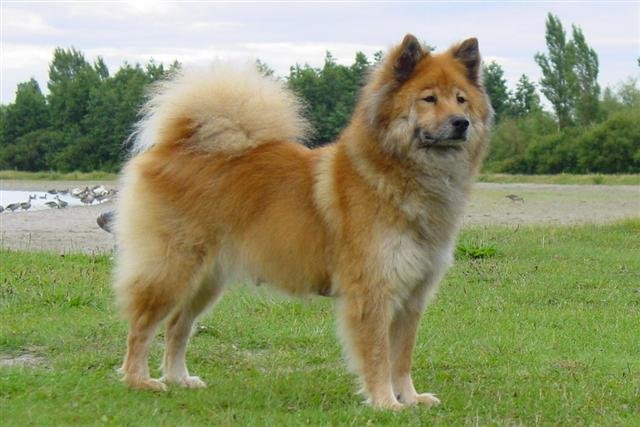
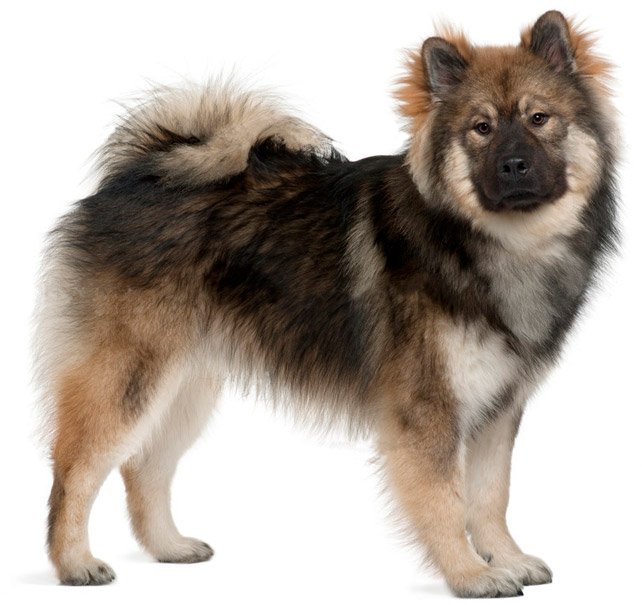
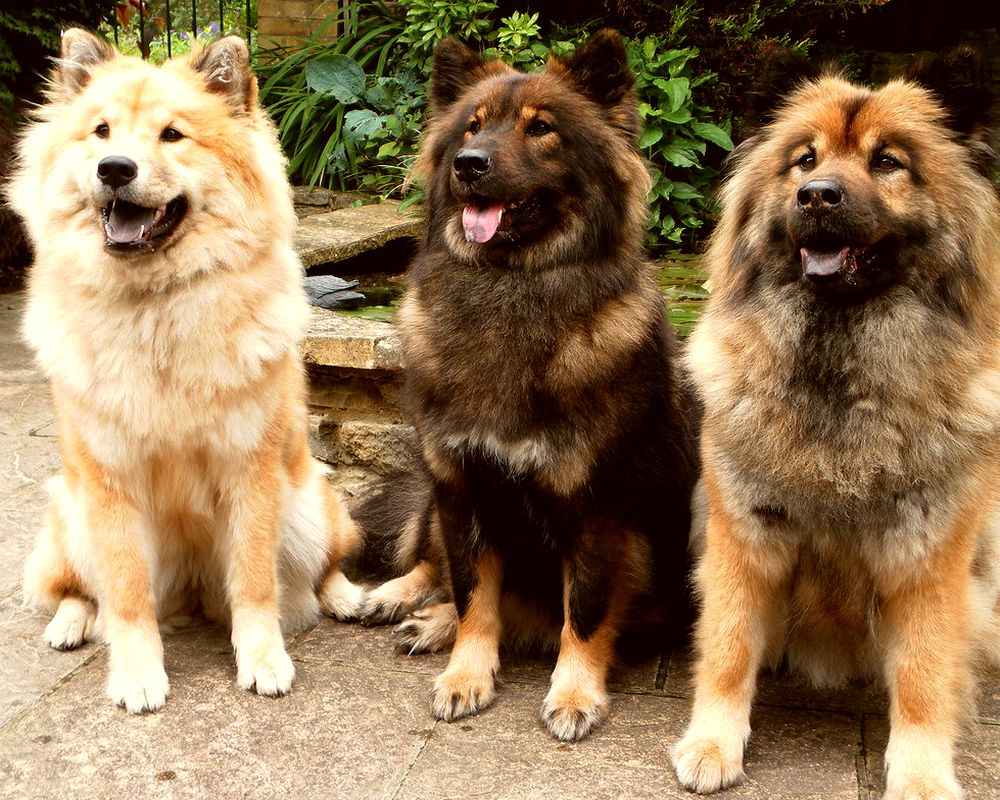
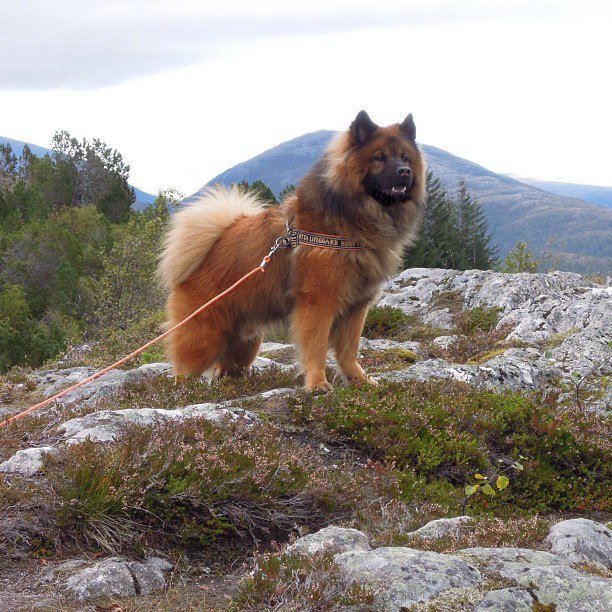
The Eurasier is a harmoniously built medium-sized dog, Spitz type, with erect ears and a characteristic "smile." It should not be too heavy, like a Chow Chow, or too light. Elegance combined with substance - this is the key to understanding the exterior of this breed.
Head and Muzzle
The head is wedge-shaped when viewed from above and from the side. The skull is broad but not excessively so; the forehead is flat with a distinct furrow. The transition from forehead to muzzle (stop) is noticeable but gentle, not sharp. The muzzle is strong, not pointed, and its length is approximately equal to the length of the skull.
Nose: The nose leather is of medium size and always black.
Lips: Dry, tight-fitting, black.
Tongue: This is a special feature. The tongue can be pink, completely blue-black (Chow Chow heritage), or spotted (pink with blue spots). All variations are permitted by the standard.
Eyes: Dark, medium-sized, the cut of the eyelids is slightly oblique (almond-shaped). The look is intelligent, lively, and friendly. Eye rims must be black.
Ears: Triangular, erect, medium-sized with rounded tips. Set wide apart (approximately the width of the base of an ear).
Body and Limbs
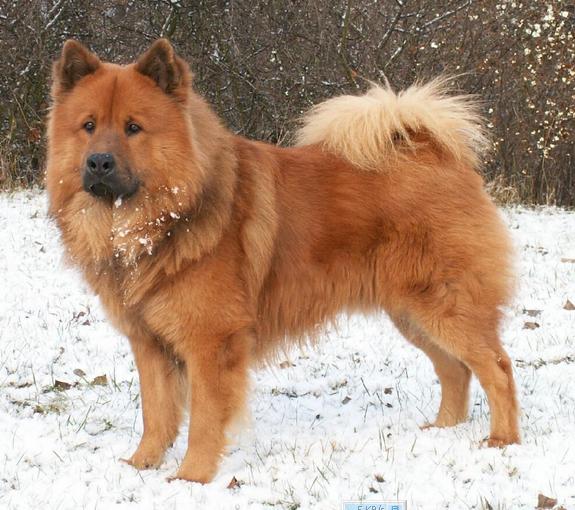
The neck is muscular, of medium length, flowing smoothly into a pronounced withers. The back is strong, straight, and expertly muscled. The chest is oval, deep, reaching down to the elbows. The Eurasier's tail is its pride. It is set high, thickly covered with long hair; when at rest it may hang down, but when moving, it is compulsorily curled in a ring or semi-ring over the back, lying tight against it.
Coat and Color
The coat is of medium length and double: it consists of a thick, soft undercoat and harder guard hair. On the muzzle, ears, and the front of the legs, the hair is short. On the back of the front legs, there are "feathers," and on the hind legs - lush "trousers" (pantaloons). On the neck, the hair forms a moderate mane, but it should not be as massive as that of a Chow Chow.
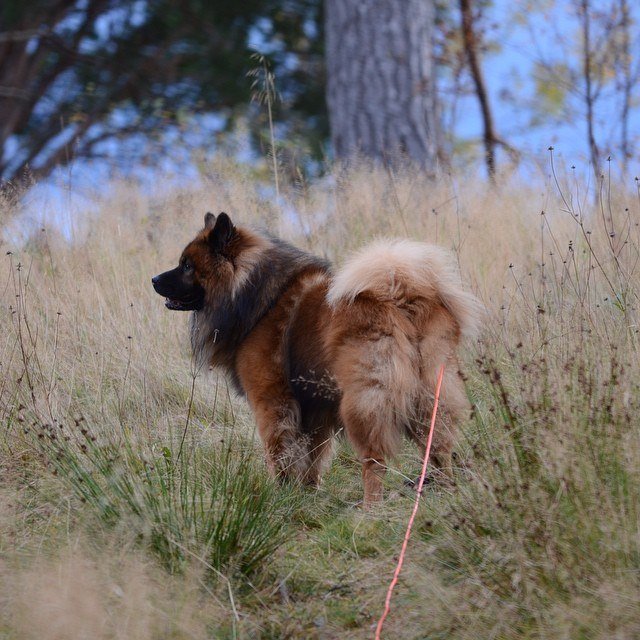
Permitted colors: The breed standard allows almost all colors and their combinations. The most common are: fawn, red, wolf-gray (agouti), black, and black and tan.
Not permitted colors: Pure white, white patches (piebald), and liver (brown). White markings (for example, on the chest) are not desirable, but small spots sometimes occur.
Interesting Facts About the Breed
The Eurasier is the youngest officially recognized German dog breed.
In Germany, breeding is strictly controlled by clubs. Puppies often cannot be bought "right now"; you need to get on a waiting list.
All Eurasiers have a natural lack of "doggy" smell, even when the coat is wet.
Unlike the Chow Chow, Eurasiers do not have breathing problems, and they are much more agile.
History of the Breed's Origin
The history of the Eurasier is an example of targeted and scientific selection aimed at creating the perfect family dog. Work on breeding this dog began in the 1950s (the active phase was in 1960), when German breeder Julius Wipfel, together with his associate Charlotte Baldamus, decided to create the ideal "northern" dog. Their goal was to combine an attractive exotic appearance with a wonderful, gentle character, maximally adapted to life in modern domestic conditions, including city apartments.
The experiment began with the crossing of two breeds. The foundation used was the Chow Chow (red and black colors), which brought calmness and independence to the genotype, and the German Spitz (Wolfspitz or Keeshond), which added a lively mind, trainability, and orientation toward humans. The first generation of dogs was named "Wolf-Chow." These dogs already possessed many desired traits, but the breeders strove for perfection.
To consolidate elegance, improve coat structure, and add even more friendliness, blood from the Samoyed was introduced into the breeding program in 1972. It was this final touch that formed the breed as we know it today. The result was a sociable family dog, very devoted, not at all aggressive (unlike some ancestors), though slightly stubborn.
An interesting fact: the famous ethologist and Nobel Prize winner Konrad Lorenz was invovled in the establishment of the breed. He purchased a puppy from the first litters, was delighted with the dog's character, and actively supported Wipfel's work. In 1973, the breed was officially recognized by the Fédération Cynologique Internationale (FCI) under the new name - Eurasier. This name symbolizes the combination of European (Wolfspitz) and Asian (Chow Chow, Samoyed) roots. By the way, if you are interested in rare Asian breeds, also pay attention to the Kai Ken (Tiger Dog), although its character differs significantly from the soft Eurasier.
Character: Temperament and Behavior
The Eurasier was created with one single purpose - to be the perfect companion. This is a dog with a very high level of empathy. They sense the owner's mood: if you want to play, the dog will joyfully join in; if you are sad or want to rest, it will simply lie down nearby and rest its head on your feet.
Attachment: This is not a dog that walks "by itself." The Eurasier suffers without human company. It cannot be kept in a kennel or on a chain - this will destroy the animal's psyche.
Attitude toward strangers: The dog is reserved, sometimes indifferent to strangers, but not aggressive. It will not go to cuddle with the first person it meets; it needs time to trust.
Guarding qualities: It is an excellent "doorbell." The Eurasier has acute hearing and will notify you of a stranger's arrival, but it rarely barks without reason. This makes it convenient for living in apartment complexes. However, do not expect active apprehension of a criminal - this is not a service breed.
Relation to children and animals: Thanks to a stable psyche, Eurasiers get along wonderfully with children and are patient with their antics. They usually live peacefully with other dogs and even cats, especially if they have known them since puppyhood.
Pros and Cons of the Breed
Advantages
Disadvantages (Peculiarities)
High intelligence and trainability
Tolerates loneliness poorly, not for busy people
Absence of useless barking
Heavy shedding 1–2 times a year
Lack of hunting instinct (won't chase cats)
Can be picky about food
Gets along wonderfully with children
Requires early socialization due to natural mistrust
Robust health compared to other breeds
Rare breed, difficult to find a puppy
Training and Upbringing
Eurasiers are very smart, but their intelligence differs from the service "automatism" of Shepherds. They learn quickly, but they do not like senseless repetition of the same command 20 times in a row. Boredom is the enemy of training this breed.
Golden Rule: Positive reinforcement only. The Eurasier is very sensitive to the owner's tone and mood. Harsh methods, yelling, or physical punishment will force the dog to withdraw into itself and refuse to cooperate. You must become a fair partner for him, not a dictator.
Socialization should start from early childhood. Introduce the puppy to various people, traffic sounds, and other dogs. This will help overcome natural mistrust and raise a confident dog. A "Canine Good Citizen" course or basic obedience class will be very usefull. Remember that there are things that the dog may simply not understand the first time, so be patient. If your pet refuses to follow the "sit" command, perhaps he is simply tired or the ground is too wet and cold.
Care and Maintenance
The Eurasier is a versatile dog in terms of accommodation. It feels great in an apartment if it has enough walks, and even better in a private house. The main condition is that it must live inside the house with the family, not in the backyard.
Coat Care
Eurasier fur has a unique property - it hardly mats (with the exception of the area behind the ears) and does not have a strong "doggy" smell.
Brushing routine: At normal times, it is enough to comb the dog 1–2 times a week with a metal comb with long teeth and a slicker brush.
Shedding period: Twice a year (spring and fall), the Eurasier "blows" its undercoat. During this period, you will have to comb the dog daily, otherwise, fluff will be all over the house. A warm bath can speed up the process of shedding old hair.
Clipping: It is strictly forbidden to clip or shave a Eurasier! This disrupts thermoregulation and coat structure. Only hygienic trimming of hair between the paw pads is permitted.
Hygienic Procedures
Bathing: Not often, usually only as it gets dirty (once every 2–3 months). Use moisturizing shampoos for dogs with a double coat type. Drying with a high-velocity dryer is mandatory to avoid skin rash under the thick undercoat.
Eyes and ears: Wipe once a week with a special lotion.
Nails: Trim 1–2 times a month if they are not worn down naturally on the pavement.
Teeth: Clean with a special brush or give dental chews to remove plaque.
Nutrition
Nutrition: What Should Be in the Bowl?
Health and risks
Health: Typical Diseases and Prevention
Frequently Asked Questions (FAQ) · 3
Do they bark a lot?
No, Eurasiers belong to the "silent" breeds. They bark only in case of real necessity, to warn the owner.
Are they suitable for allergy sufferers?
No, despite the lack of smell, Eurasiers have a thick undercoat and shed heavily, which can cause allergies.
How much does a Eurasier puppy cost?
This is considered a rare breed in the US. There is no single number — the spread within one litter can be wide. What drives it is the registration paperwork and pedigree, health clearances on both parents, the age the puppy goes home, the class (pet, breeding, or show), and the reputation of the kennel.
Video About the Breed
FAQ
Is the Eurasier good for a family?
Ideal — it is a level-headed, devoted companion that lives precisely for closeness with the family; it gets on wonderfully with children.
Does the Eurasier bark?
Little — it is a quiet breed that gives voice only for good reason; convenient for an apartment and neighbors.
Can the Eurasier be kept in a kennel?
Absolutely not — it cannot bear isolation from the family; it must live in the home as a full family member.