Group 7 (Pointing Dogs), Section 1.2 (Continental Pointing Dogs, "Spaniel" type) · France
French Spaniel
The largest and gentlest French spaniel — a tender worker of the fields: sensitive, level-headed, devoted and surprisingly kind. The French Spaniel is one of the oldest European pointing breeds; an exceptional nose and a natural retrieve combine in it with a soft, calm temper, so on the hunt it is a focused worker and at home a tender friend for the whole family.
Apartment · not suitableKidsCats · with caveatsOther dogsBeginners · with caveats
The French Spaniel (Épagneul Français) is one of the oldest European pointing dog breeds, with a history that stretches back to the Middle Ages. This elegant yet hardy dog is the epitome of an ideal hunting partner: he possesses an exceptional sense of smell, a natural instinct for retrieving, and a tireless passion for work. However, his true value lies in his dual nature: in the field, he is a focused and courageous worker, while at home, he is an incredibly gentle, devoted, and sensitive companion for the entire family.
Despite its rich history and wonderful character, the French Spaniel remains a relatively rare breed today, especially outside its homeland. It is vitally important for him to be near his owner, whom he serves with absolute obedience and adoration. His lively yet balanced demeanor is paired with a gentle attitude toward children, making him an ideal friend. Read more about the features of this amazing breed further on Tvaryny.
White with brown patches (from light cinnamon to liver)
Temperament
Gentle, balanced, intelligent, devoted, sensitive, social
Purpose
Hunting (gundog, retriever), companion dog
Activity Level
High
Grooming Needs
Medium (special attention to ears and coat)
Interesting Facts About the French Spaniel
Ancestor of Setters: It is believed the French Spaniel is a key ancestor to many modern setter breeds, particularly the English and Irish Setters.
Saved by a Priest: The breed was nearly wiped out in the 19th century, displaced by English breeds. Its revival is the merit of one man, Abbé Fournier, who dedicated his life to it.
Canadian Roots: Although the breed is French, it is incredibly popular in Canada, especially in the province of Quebec. Many believe Canadian breeders made a huge contribution to the breed's preservation and development in the 20th century.
Only One Color: Unlike many other gundog breeds, such as the Picardy Spaniel (which can be gray-roan), the French Spaniel has only one recognized color - white with brown patches.
'Soft Mouth': As befits a high-class retriever, French Spaniels have a so-called 'soft mouth' - they retrieve game (or toys) without damaging them.
History of the Breed
The history of the French Spaniel is a true drama, spanning centuries of royal acclaim, the threat of complete extinction, and a revival thanks to the efforts of dedicated enthusiasts. This breed is a direct descendant of the medieval Oysel dogs (bird-hunting dogs), which were described as early as the 14th century in the famous treatise "Livre de Chasse" ("Book of the Hunt") by Gaston Phoebus, Count of Foix.
For centuries, these dogs were favorites of French royalty. They were highly valued for their calm, methodical working style and their ability to hunt in diverse conditions. They were often found in the royal kennels at Compiègne and Fontainebleau. The French Spaniel is believed to be the ancestor or a close relative of many modern setter and spaniel breeds.
However, with the arrival of the French Revolution and the change in social structure, hunting ceased to be an exclusive privilege of the aristocracy. The 19th century saw a massive "import" of British hunting breeds - particularly English Setters and Pointers. These dogs were faster, had a wider search range, and better suited the new hunting trends. As a result, the authentic French Spaniel found itself on the brink of extinction, pushed aside by more "efficient" competitors.
The breed's revival in the late 19th and early 20th centuries is inextricably linked to one man - the priest Abbé Fournier. He was a passionate hunter and cynologist who witnessed the catastrophic decline in the numbers of these unique dogs. Abbé Fournier dedicated his life to finding and preserving the few remaining purebred examples. It was he who drafted the first official breed standard in 1906, founding the 'Club de l'Épagneul Français'.
The two World Wars again dealt a devastating blow to the breed, but thanks to the work of Abbé Fournier and other enthusiasts, it was saved. The French Spaniel is closely related to other regional French pointing dogs, such as the Picardy Spaniel and the rarer Pont-Audemer Spaniel, although it differs from them in temperament and some external features. Today, the breed is most popular in France and Canada (especially in Quebec), where it is still highly valued as a hard-working hunter and an exceptional companion.
What the French Spaniel Looks Like: Appearance
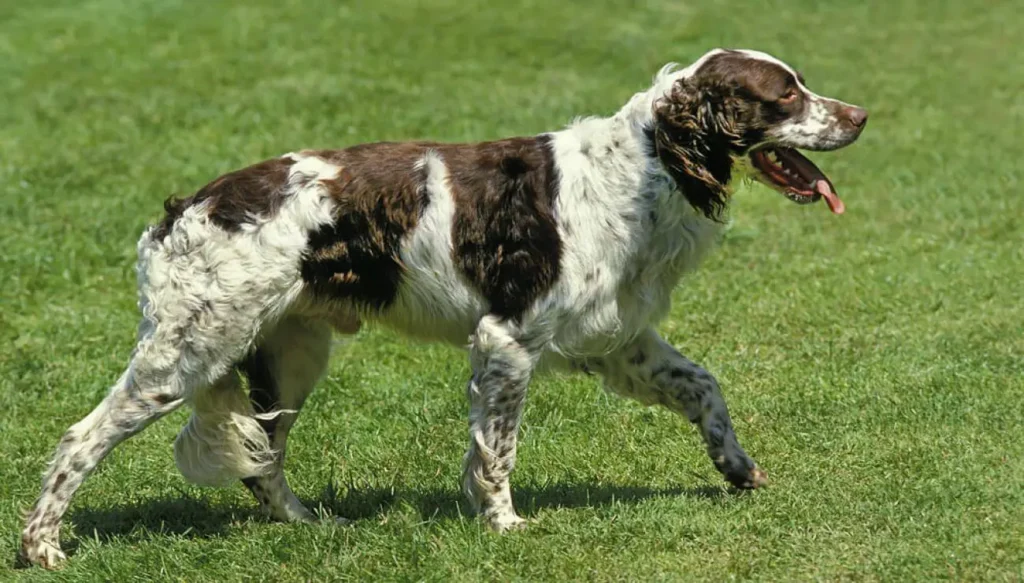
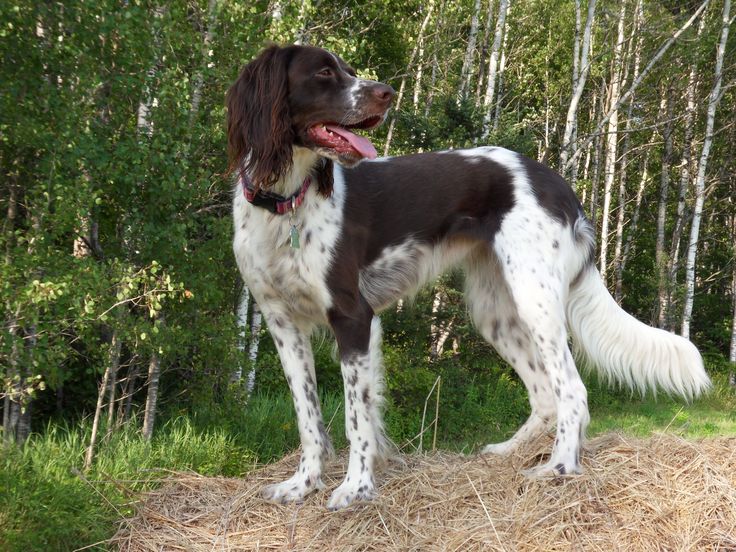
The French Spaniel is an elegant, athletic dog of medium size, blending power with refinement. It has a sturdy, but not overly heavy, build that signals stamina. Its appearance is classic 'Spaniel' type, with a long, wavy coat and a kind, intelligent expression.
The head is proportional to the body, with a slightly pronounced stop. The muzzle is long, broad, with a slightly Roman (arched) nasal bridge. The large, dark amber-colored eyes are oval and radiate a soft, intelligent expresion. The low-set drop ears are one of the breed's hallmarks: they are long (meant to reach the tip of the nose) and covered with beautiful, long, wavy hair.
The body is strong, with a deep chest providing space for powerful lungs. The back is straight, and the loin is strong. The limbs are muscular with strong bones. The tail is long, set slightly below the line of the back, and never carried above it. It has a characteristic S-shape curve and is adorned with a luxurious 'fan' of long, wavy hair.
Detailed Breed Standard (FCI No. 175)
What the French Spaniel Looks Like: Appearance · 9
Body Part
Standard Requirements
General Appearance
Elegant, medium-sized, athletic, "Spaniel" type. Appears strong and hardy.
Head
"Spaniel" type. Skull slightly convex. Stop gentle, not sharp.
Muzzle
Longer than the skull. Nasal bridge straight or slightly arched. Nose large, brown.
Eyes
Large, oval, dark amber (cinnamon color). Gaze is kind, intelligent, soft.
Ears
Set low (at or below eye level). Long, reaching the tip of the nose. Covered with long, wavy hair.
Body
Chest deep, broad. Back straight, strong. Loin short, muscular.
Tail
Long, not docked. Set low. Has an S-shaped curve. Covered with thick feathering (fan).
Coat
Long, dense, close-lying. Wavy (on ears, tail, back of legs), but never curly. Short on the head.
Color
Only one: white with brown patches (from light cinnamon to dark liver). Patches can be of various sizes, with or without roan.
Coat and Color
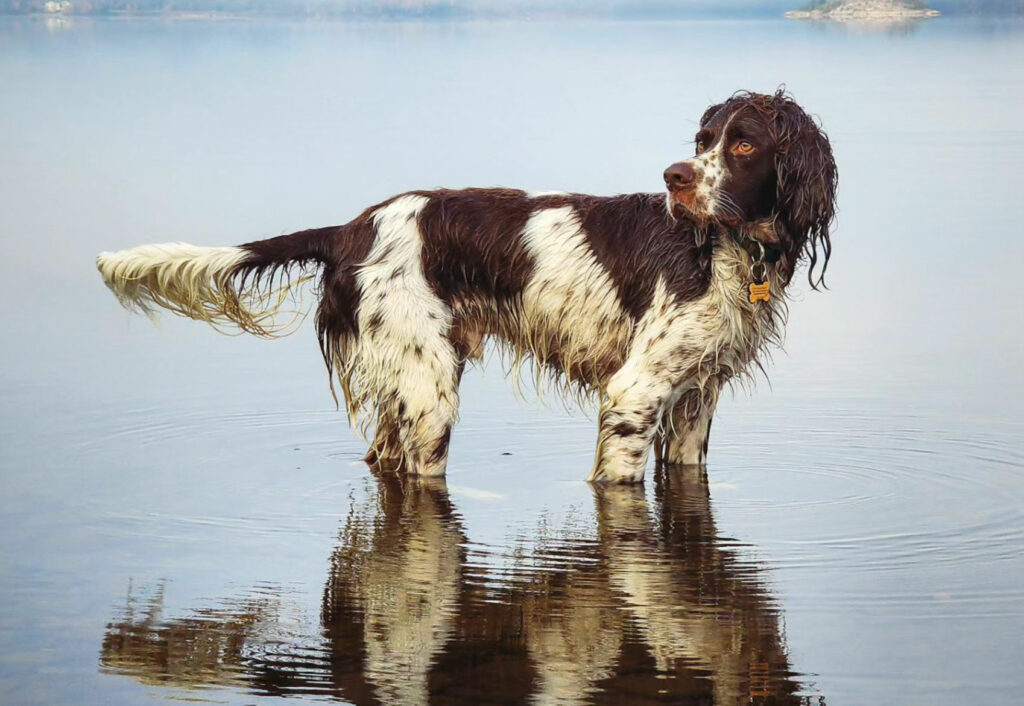
The French Spaniel's coat is its glory and protection. It is long, lies close to the body, and has a silky texture. An important feature is that the coat is wavy, not curly. The most pronounced waves and 'feathering' (long hair) are found on the ears, the back of the legs, the belly, and, of course, the tail, where it forms a beautiful 'fan'. On the head, the coat is short and smooth.
The breed has only one color, although it has variations: white with brown patches. The color of the patches can range from a light cinnamon shade to a rich dark liver. The patches can be large (forming a 'mantle') or of medium size. Roan (ticking) - small brown spots on a white background - is permissible and even desired. Other colors (black and white, tricolor) are disqualifications.
Character and Temperament
If you had to describe the French Spaniel's character in a single word, that word would be 'gentle'. These are incredibly affectionate, balanced, and socially-oriented dogs. They completely lack aggression or suspicion towards people. They bond strongly with their family and love being the center of attention, following their owner from room to room.
This breed clearly shows two sides to its nature:
At home: A calm, obedient, and very affectionate companion. He adores children and patiently endures their games, showing amazing care. He is a 'Velcro dog' in the best sense of the term.
In the field (hunting): The dog transforms. Eagerness, energy, and complete focus on the job appear. He demonstrates a confident but methodical search, courage, and a constant connection with his handler, regularly checking their location.
Sensitivity and Intelligence
The French Spaniel is a very smart and incredibly sensitive dog. He subtly picks up on his owner's mood and is eager to please. This sensitivity also has a downside: the dog reacts extremely poorly to shouting, harshness, or harsh training methods. Punishment can cause him to 'shut down', become fearful, and refuse to cooperate. He needs a patient owner who uses a 'soft hand' and positive reinforcement.
Socialization: Children, Animals, and Strangers
With children: Excellent. Thanks to their gentle and playful nature, they become wonderful nannies and playmates.
With other dogs: Usually very well. They are non-confrontational and are used to working in a pack with other gundogs.
With strangers: They are open and friendly. This is a poor guard dog - he is more likely to be happy to see an intruder than to scare him away.
With other animals (cats, rodents): This is complicated. This is a hunting dog with a strong prey drive for birds and small game. Although they can live peacefully with a cat if they were raised together, they will likely view small animals (hamsters, rabbits) or domestic fowl as prey.
An important aspect: French Spaniels do not tolerate being alone. Left alone for long periods, they suffer and can develop separation anxiety, which manifests in destructive behavior or incessant barking. This is a dog for people who spend a lot of time at home or are prepared to take their pet with them.
Training and Socialization
Training a French Spaniel is both a pleasure and a challenge. A pleasure because they are intelligent and extremely eager to please. A challenge because their sensitivity doesn't forgive mistakes in method.
Keys to successful training:
Positive reinforcement only: Treats, praise, play. Harshness, shouting, leash-jerking, or any physical punishment will have catastrophic consequences for this dog's psyche.
Patience and consistency: They are smart but can be somewhat stubborn if they get bored. Keep sessions short, interesting, and positive.
Early socialization: As with any dog, this is important. But for a hunter, it is doubly important to teach him to react correctly to small animals and birds (though instinct may still take over).
Focus on recall: The 'Come!' command must be paramount, given their strong hunting instinct.
Their hunting qualities are innate. They don't need to be 'taught' to point or retrieve - it's in their blood. The trainer's job is to channel these instincts and teach the dog to work as a team with the human. Their working style differs from, for example, the fast and explosive Brittany Spaniel. The French Spaniel works more methodically, calmly, and always stays in close contact with its handler. A Picardy Spaniel has a similar, but distinct, working style.
Pros and Cons of the Breed
Pros and Cons of the Breed · 7
Pros (Advantages)
Cons (Disadvantages)
Exceptionally gentle nature: One of the best companions, very affectionate.
High activity needs: Not suitable for inactive people or a 'couch potato' life.
Excellent with children: Very patient and playful, an ideal family dog.
Does not tolerate loneliness: Prone to separation anxiety, cannot be left for long.
High intelligence: Learns easily if the correct (gentle) methods are used.
Extreme sensitivity: Reacts poorly to shouting, harshness, or harsh training.
Balanced temperament: Calm indoors, without aggression or nervousness.
Strong hunting instinct: May chase cats, birds, and small animals.
Good hunter: Excellent retriever, loves water, great nose.
High risk of ear infections: Requires constant, thorough ear care.
Elegant appearance: A beautiful dog with a luxurious coat.
Needs regular grooming: Coat is prone to matting, needs frequent brushing.
Relatively healthy breed.
Rare breed: Can be difficult to find a good breeder and puppy.
Care and Upkeep
Grooming: Coat and Ear Care
Caring for a French Spaniel isn't overly complex, but it does require consistency, especially in two areas: the coat and the ears.
Coat Care: Their long, wavy coat needs to be brushed thoroughly 2–3 times a week to prevent mats and tangles. Special attention should be paid to the feathering on the ears, legs, belly, and tail - this is where burrs and dirt most often get stuck. The breed sheds moderately, usually twice a year (in spring and fall).
Bathing: Bathe the dog only as needed, when he is genuinely dirty. Too-frequent washing strips the natural oils that protect the skin and coat.
Ear Care: This is a critically important aspect. The combination of long, drop ears, dense hair, and a love for water creates the perfect environment for bacterial and fungal growth. The ears must be inspected daily, especially after walks or swimming. At least once a week, they should be cleaned with a special veterinary lotion to prevent otitis (ear infections).
Other: Trim their nails regularly (if they don't wear down naturally) and maintain good dental hygiene.
Activity Level and Living Conditions
This is a high-energy working breed. The French Spaniel is not a couch potato. He needs at least 1.5–2 hours of active physical exercise daily. And this isn't just a slow walk on a leash. They vitally need:
Running off-leash in a secure area.
Swimming: Most French Spaniels love water and are excellent swimmers.
Mental stimulation: Scent work, retrieving games, and training.
Can a French Spaniel live in an apartment? Theoretically, yes, but only if the owner is prepared to dedicate several hours a day to intense walks in a park, woods, or near water. The ideal home for them is a private house with a large, securely fenced yard and owners who lead an active lifestyle (hunters, hikers, runners).
Nutrition
Nutrition: Key Recommendations
Health and risks
Health: Common Conditions
Frequently Asked Questions (FAQ) About the Breed · 6
Does the French Spaniel shed a lot? They shed moderately, with two distinct seasonal periods (spring and fall). Their coat does not require trimming but needs regular brushing (2–3 times a week) to remove dead hair and prevent mats. They are definitely not 'hypoallergenic'.
Is the French Spaniel suitable for an apartment? It is highly undesirable. Theoretically, they can adapt, but only if the owner is an extremely active person, prepared to dedicate 2–3 hours a day to intense exercise (running, swimming, games) outdoors. Their high energy and need for space make them ideal for a private house with a yard.
Does the French Spaniel get along with cats and other animals? It's complicated. They have a very strong hunting instinct, especially towards birds and rodents. They can live with a cat if they were raised with it from puppyhood. However, even in this case, the instinct can take over, especially outside. It is strongly advised against keeping them in the same home with pet birds or hamsters.
Can he be left alone while you go to work? No. This is one of the breeds that tolerates loneliness the worst. They are human-oriented and suffer without their person's company. Left alone for 8 hours, they are almost guaranteed to develop separation anxiety, which can mainfest in destroying furniture, incessant barking, or howling.
Is he a good guard dog? Absolutely not. Their standard describes them as friendly and social. They will most likely greet a stranger joyfully and invite them to play. They might bark to announce a guest, but that's where their 'guarding' duties end.
What is the difference between him and an English Setter? Although they likely have common ancestors, they are different breeds. The English Setter is generally faster, with a wider and more 'explosive' search pattern. The French Spaniel works more methodically, calmly, and stays closer to its handler, maintaining constant contact. In terms of temperament, the French Spaniel is generally considered softer and more sensitive.
Video About the Breed
FAQ
What sets the French Spaniel apart among spaniels?
It is one of the largest and at the same time gentlest spaniels: the FCI describes its temper with three words rarely found together in hunting breeds — "soft, calm, obedient."
Is the French Spaniel suitable for a family?
Yes — it is a tender, devoted and patient dog, good with children; but it needs serious exercise and scent work, so it is not for an apartment and dislikes solitude.
How old is the breed?
Very — it is one of the oldest European pointing breeds, its history reaching back to the Middle Ages; it survived the threat of extinction and was revived by enthusiasts.