

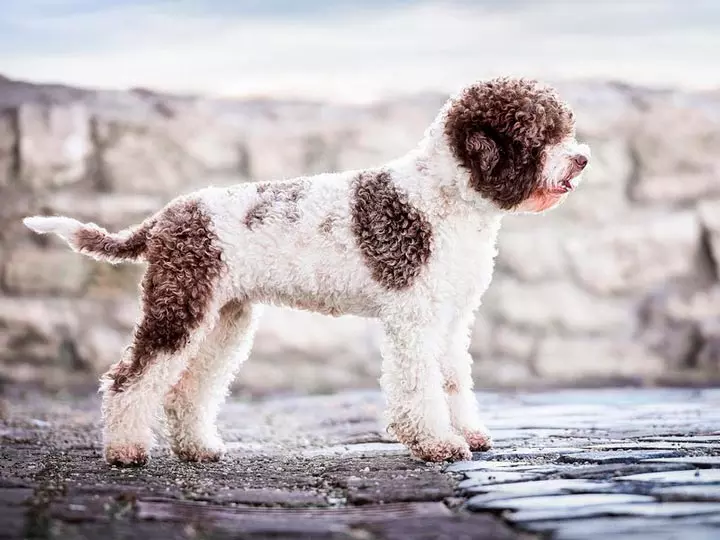
| Height | 41–48 cm |
| Weight | 11–16 kg |
| Lifespan | 14–17 years |
| FCI group | 8 · water dogs |
| Origin | Italy |
Exact ratings
Common health issues
Nutrition
The Lagotto Romagnolo, or the Italian Water Dog, is far more than just a family pet. This ancient breed boasts a truly unique work ethic and an incredibly charming personality. Famous for its sheep-like, tight curls and an unrivaled talent for sniffing out truffles, the Lagotto is captivating dog lovers across the globe. Learn more on Tvaryny.
The breed’s defining characteristic is its remarkable coat, which originally allowed its ancestors to work safely in frigid waters. A dense, waterproof undercoat combined with a harsh, tightly curled outer layer creates an impenetrable barrier against the elements. Pair this with their exceptional intelligence, work drive, and playful disposition, and you have an ideal family companion. Be warned, though-this dog’s unique needs require a dedicated approach to both groming and training.
Lagotto Romagnolo: Key Breed Information
| Characteristic | Description |
| Origin | Italy (Romagna region) |
| Original Name | Lagotto Romagnolo |
| FCI Classification | Group 8 (Retrievers, Flushing Dogs, Water Dogs), Section 3 (Water Dogs) |
| Purpose | Companion dog, specialized truffle-hunting dog |
| Lifespan | 15-17 years |
| Height at Withers | Males: 17-19 inches (43-48 cm) (Ideal 18 inches / 46 cm) Females: 16-18 inches (41-46 cm) (Ideal 17 inches / 43 cm) |
| Weight | Males: 29-35 lbs (13-16 kg) Females: 24-31 lbs (11-14 kg) |
| Temperament | Loyal, intelligent, hardworking, affectionate, energetic, easily trained |
| Coat | Thick, curly, woolly texture, waterproof, non-shedding |
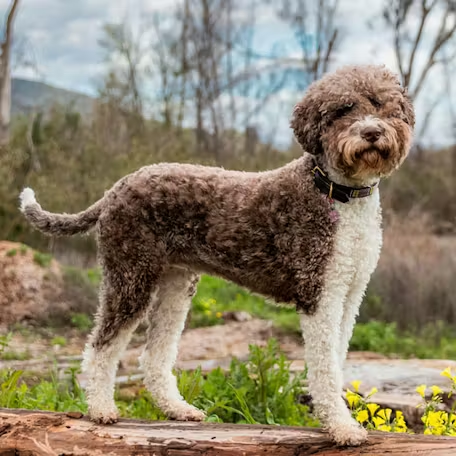
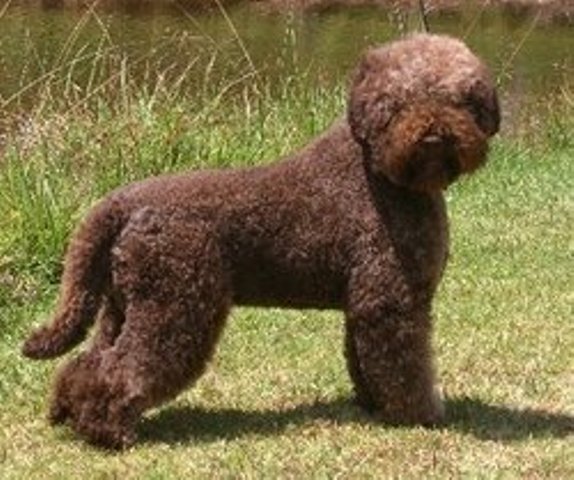
| Color | Solid off-white, white with brown or orange patches, brown roan, solid brown (various shades), solid orange. A dark mask is possible. |
History and Origin
The history of the Lagotto Romagnolo dates back centuries, making it one of the oldest known water dog breeds. The name “Lagotto Romagnolo” literally translates from Italian as the “lake dog from Romagna.” The first records of curly-coated water dogs in Italy date back to the Renaissance era. They are believed to be the ancestors of many modern water breeds, including the Portuguese and Spanish Water Dogs.
Initially, these dogs were used to retrieve fallen game, primarily waterfowl, from the marshy lowlands of Comacchio and Ravenna. Their thick, oily coat provided excellent protection from the icy water, allowing them to work for hours. However, in the 19th century, large-scale draining of the marshes in this region meant the need for water-based hunting dogs disappeared.
It was at this point that the breed found its new, and now world-famous, vocation. Thanks to their phenomenal sense of smell and a natural inclination to search, the Lagotto retrained to become the only breed in the world specialized in finding prized truffles. Their sharp intelligence and the gradual disappearance of their hunting instinct for game made them perfect for this job – the dog wouldn’t get distracted by the scents of animals in the woods.
By the 1970s, the breed was on the verge of extinction due to uncontrolled crossbreeding with other dogs. A group of Italian enthusiasts, including Quintino Tosetti, Francesco Ballotta, and Antonio Morsiani, took on the task of its revival. The Italian Lagotto Club (Club Italiano Lagotto) was founded in 1988, and the breed received preliminary recognition from the FCI in 1995, and full recognition in 2005.
What the Lagotto Romagnolo Looks Like: Standard and Appearance
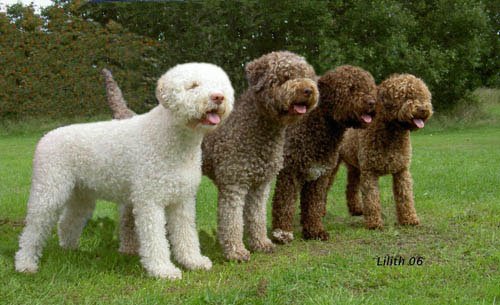
The Lagotto Romagnolo – a dog of medium size, sturdy, well-proportioned build, giving the impression of an enduring and agile animal. Their look is often described as “rustic,” emphasizing their working background.
- Body: Compact; the length of the body is approximately equal to the height at the withers, creating a square profile. The back is straight, and the ribcage is well-developed.
- Head: Trapezoidal when viewed from above, and moderately broad. The stop (transition from forehead to muzzle) is not too pronounced. The muzzle is quite broad, slightly shorter than the skull.
- Eyes: Large, rounded, with color ranging from ochre to dark brown, depending on the coat color. The expression is attentive, lively, and intelligent.
- Ears: Medium-sized, triangular shape with rounded tips, and hanging. They are set slightly above the eyebrow arches.
- Tail: Saber-shaped, not curled, covered with curly hair. It hangs down in repose but rises during movement, though never above the line of the back.
- Coat: The breed’s most distinctive feature. It has a woolly texture and forms tight, ring-like curls all over the body, except for the head where the curls are looser. There is a dense, waterproof undercoat. The coat is slightly rough to the touch. Importantly, this coat does not shed but grows continuously, similar to human hair.
Character and Temparement
The Lagotto’s temperament is one of the main reasons for its growing popularity. These are exceptionally devoted and people-oriented dogs. They strive to be full members of the famly and do not tolerate prolonged loneliness well.
Intelligence and Trainability: Lagotto Romagnolos are highly intelligent dogs. They quickly grasp new commands and enthusiastically perform tasks, making the training process enjoyable and effective. Their sharp minds require constant stimulation, so they need not only physical exercise but also intellectual challenges-puzzle toys, obedience drills, and nose work (scent detection).
Energy and Playfulness: This is an active breed that loves walks, games, and especially swimming. They have retained their love for water and will happily retrieve toys from a lake or river. While they are energetic, they are typically calm and composed at home, provided they receive sufficient exercise.
Temperament with Children and Other Animals: Lagottos generally get along wonderfully with children, acting as patient and cheerful companions. They also coexist well with other dogs and cats, especially if raised together. Early socialization is key to developing these positive traits.
Watchdog Qualities: They are good watchdogs-they will always alert you with barking when strangers arrive. However, aggression is not characteristic of the breed. They are reserved with outsiders but quickly warm up to family friends.
Care and Maintenance: Everything an Owner Needs to Know
Owning a Lagotto brings much joy, but it requires a responsible approach, especially regarding coat care and ensuring adequate activity.
Caring for the Unique Coat
The Lagotto’s coat is their pride and the owner’s primary chore. Since it does not shed but grows continuously, it is prone to matting, which can cause discomfort and skin problems.
- Brushing: Despite advice to brush daily, this is not always correct for the Lagotto. Frequent brushing “breaks up” the natural curl pattern. It’s recommended to thoroughly comb the coat with a wide-toothed metal comb once every 1-2 weeks to prevent matting near the skin.
- Clipping: This is a mandatory procedure. Lagottos need to be clipped 2-4 times a year. The clipping should be utilitarian, not decorative. The coat is shorn across the entire body to a length of about 1-1.5 inches (2.5-4 cm), maintaining a natural, slightly tousled appearance. Never shave the dog down to the skin, as the coat protects them from both cold and sun.
- Bathing: Bathe the dog as needed, not too frequently, to avoid washing away the natural protective oils from the skin. Use mild shampoos designed for curly coats.
Physical Exercise and Activity
The Lagotto Romagnolo requires about 1-1.5 hours of active exercise every day. This can include:
- Long walks or jogs.
- Games with a ball or frisbee.
- Swimming-a favorite pastime for most members of the breed.
- Participation in dog sports: agility, obedience, flyball, and, of course, nose work.
It is important to remember that due to their strong digging instinct, the area where the dog plays must be securely fenced. Don’t be surprised if your pet tries to “help” you in the garden by excavating holes.
Training and Socialization
Training a Lagotto is a pleasure. Their intelligence and eagerness to please make them excellent students. They respond wonderfully to methods of positive reinforcement-praise, treats, and games. Harshness or punishment is unacceptable, as these sensitive dogs can become withdrawn.
Early socialization is critically important. From puppyhood, introduce your Lagotto to various people, sounds, places, and other animals. This will help raise a confident and well-adjusted dog. An obedience training course is highly recommended to establish the right bond between owner and dog.
Diet: How to Feed Your Lagotto?
Health and Genetic Diseases of the Breed
Pros and Cons of the Breed
| Pros | Cons |
|---|---|
| “Hypoallergenic” Coat: Virtually non-shedding, which is an advantage for allergy sufferers. | Complex Coat Care: Requires regular combing and professional clipping. |
| High Intelligence: Easily trained, eager to please the owner. | Requires Mental Stimulation: Can become bored and exhibit destructive behavior without “work for the brain.” |
| Devoted Companion: Highly attached to the family, affectionate, and gentle. | Prone to Separation Anxiety: Does not handle loneliness well. |
| Excellent with Children: A patient and playful friend for kids. | Strong Digging Instinct: Your garden may turn into an archaeological dig site. |
| Convenient Size: Neither too large nor too small, suitable for apartment living provided there is enough activity. | Tendency to Bark: Can be “talkative,” especially when strangers appear. |
| Love for Water and Games: Always ready for active recreation. | High Cost: Puppies from responsible breeders are expensive. |
The Lagotto Romagnolo and Other Water Dogs
The Lagotto Romagnolo belongs to the large family of European water dogs that share common ancestry. Yet, each of these breeds developed its own distinct path. For instance, the Spanish Water Dog has a similar corded coat but was traditionally used as a herder and fisherman’s assistant. The Irish Water Spaniel is significantly larger than the Lagotto, has a distinctive ‘rat tail,’ and remains primarily a gundog. Other relatives, such as the Portuguese Water Dog and the Barbet, are also exceptional swimmers and retrievers. But the Lagotto is unique: it is the only breed that officially “changed professions” from a water retriever to a truffle hunter.
Interesting Facts About the Lagotto Romagnolo
- The World’s Only: This is the only breed in the world officially recognized as a specialized truffle hunter.
- Selective Scent: Through selective breeding, the hunting instinct for game was virtually eliminated in the Lagotto. This allows them to focus completely on the scent of fungi and not be distracted by the trail of a rabbit or bird in the woods.
- Color Change: Many Lagotto puppies are born with a darker coat (especially browns) that significantly lightens with age, sometimes to the color of coffee with milk.
- Absence of “Dog Smell”: Thanks to the coat structure and lack of intense shedding, the Lagotto is almost entirely free of the characteristic dog odor.
- Historical Legacy: Images of dogs very similar to the Lagotto can be found in frescoes and paintings by Italian artists, notably in the Bridal Chamber of the Palazzo Ducale in Mantua, painted by Andrea Mantegna in the 15th century.
Frequently Asked Questions About the Breed (FAQ)
Does the Lagotto Romagnolo shed much? No, they are practically non-shedding. Their coat is similar to hair and grows continuously. Dead hairs remain trapped in the curls rather than falling onto furniture, so they need to be brushed and regularly clipped to prevent matting. This makes them a good choice for people with allergies.
Is the Lagotto suitable for apartment living? Yes, they can live comfortably in an apartment provided they get enough daily physical and mental exercise. Without proper activity, they may get bored and become destructive.
Are they easy to train? Yes, they are one of the most intelligent and biddable breeds. They are quick learners and eager to please, making training an enjoyable process. They respond best to positive reinforcement.
How much does a Lagotto Romagnolo puppy cost? Puppies from a reputable breeder can be expensive. This price reflects the costs of quality care, veterinary services, and, most importantly, the expensive genetic testing of the parents for hereditary diseases. A cheap puppy sold without papers almost always costs more in the end: the screening the parents never had shows up later at the vet.
Do they get along with cats and other pets? Generally, yes. With proper and early socialization, Lagottos peacefully coexist with cats and other animals. Their weak hunting instinct is a major plus in this regard.
Video About the Breed
- Barely sheds
- Clever, learns easily
- Affectionate and people-oriented
- Long-lived, level-headed
- Needs regular grooming
- Loves to dig (truffle instinct)
- Needs moderate exercise
- May get bored without activity
| Poodle (Medium) | Spanish Water Dog | Portuguese Water Dog | |
|---|---|---|---|
| Height | 35–45 cm | 40–50 cm | 43–57 cm |
| Energy | 4 | 4.5 | 4.5 |
| Apartment | 4 | 3 | 2.5 |
| Beginners | 4 | 3 | 3 |
What is special about the Lagotto Romagnolo?
Does the Lagotto shed?
Is the Lagotto good for a family?
FCI Standard No. 298 · The Kennel Club
For apartments · For kids · For beginners · Active · Smartest · Hypoallergenic · All rankings →