

| Height | 51–61 cm |
| Weight | 18–34 kg |
| Lifespan | 12–14 years |
| FCI group | 1 · sheepdogs |
| Origin | Scotland |
Exact ratings
Common health issues
Nutrition
The Rough Collie, sometimes known as the Long-Haired Collie, is a breed that embodies elegance, intelligence, and boundless devotion. With its regal stance, well-proportioned body, graceful movements, and a luxurious, dense coat, this dog invariably draws admiring glances. It is one of the most beautiful and recognizable herding breeds in the world. Rough Collies have an incredibly flexible temperament—they can truly become whatever you want them to be, from an active athlete to a calm companion. A Collie is a reliable family friend, a dog that interacts wonderfully with children, showing patience and tenderness. They easily get along with people who lead active lifestyles and enjoy sports. Historically, during wartime, Collies successfully served as messengers, medics, and even sappers. Today, a Collie can be a fantastic search and rescue dog, a guide dog for the blind, and an excellent therapy dog. Our team at Tvaryny prepared this detailed breed overview so you can get to know these amazing aristocrats of the dog world more deeply.
Rough Collie: A Quick Breed Overview

| Characteristic | Description |
|---|---|
| Origin | United Kingdom (Scotland) |
| Official FCI Recognition | Group 1 (Herding and Cattle Dogs), Section 1 (Herding Dogs). Standard No. 156. |
| Year of First Official Mention/Recognition | Circa 1860 (first appearance at shows), standard developed in 1881. |
| Lifespan | 10-14 years (sometimes longer, up to 16 years) |
| Height at the Withers | Males: 22-24 inches; Females: 20-22 inches |
| Weight | Males: 45-65 lbs; Females: 40-55 lbs |
| Temperament | Friendly, intelligent, active, devoted, sensitive, with no signs of nervousness or aggressiveness. |
| Use | Companion, family dog, show dog, sports (agility, obedience), herding (less common today). |
| Coat Colors | Sable and white, tricolor (black with tan markings and white markings), blue merle (silvery blue with black spots/marbling and white markings, tan markings possible). |
Rough Collie Breed History
The history of the Rough Collie is rooted in the picturesque and rugged lands of Scotland and Northern England. It is believed that the ancestors of modern Collies were working herding dogs brought to the British Isles by Roman conquerors. Over centuries, these dogs were crossed with local herding breeds, adapting to the mountainous climate and the specific task of working with sheep flocks. The name “Collie” likely comes from the Anglo-Saxon word “col” or “coal,” meaning “black”—possibly due to the color of the sheep (colley sheep) they herded or the initial prevalence of dark coats in the dogs themselves.
Until the mid-19th century, Collies were not well known outside of Scotland. They were primarily working dogs whose value was determined by their herding abilities rather than their appearance. The situation changed dramatically thanks to Queen Victoria. During one of her trips to the Scottish estate of Balmoral in the 1860s, the Queen was charmed by the beauty and intelligence of these dogs. She became a fervent admirer of the breed and acquired several Collies for her royal kennels, which instantly made them incredibly popular among the aristocracy and the general public. This royal patronage led to professional dog breeders taking an interest in the breed and beginning a deliberate selective breeding effort aimed at improving their appearance.
The first Collies appeared at dog shows in Birmingham in 1860 in the “Scotch Sheepdogs” class. In 1881, the first Collie Club was established in England, which developed the breed standard. Legendary dogs like Old Cockie (born in 1867) and his descendants played a crucial role in shaping the modern Rough Collie type. Over time, the breed split into two main types: the Rough Collie, which gained worldwide fame as an elegant show dog and companion, and the Smooth Collie, which retained more working dog traits, though it also makes a wonderful companion. The breed’s popularity grew even more in the 20th century thanks to the books of Albert Payson Terhune and, of course, the globally famous character of Lassie from films and television series.
What a Rough Collie Looks Like: A Detailed Description
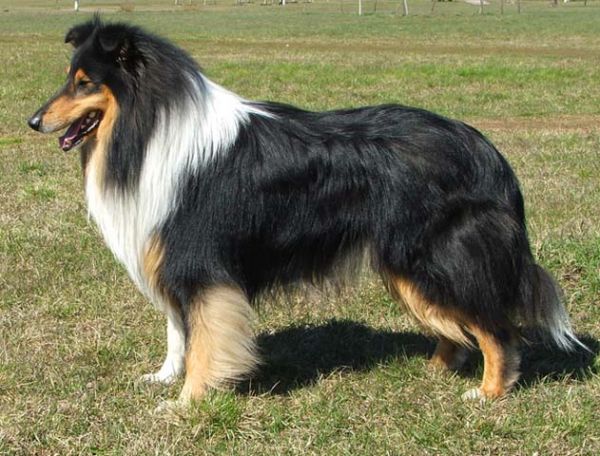
The Rough Collie is a dog of extraordinary beauty and harmony, radiating intelligence and activity. Its appearance is the result of a perfect balance and proportionality of all body parts, and its luxurious coat gives it a complete and noble look.
The head is one of the most important breed characteristics. It has the shape of a well-blunted, cleanly chiseled wedge. The skull is flat, gradually tapering from the ears to the tip of the nose. The transition from the forehead to the muzzle (stop) is smooth but noticeable. The muzzle is well-filled, not pointed. The nose tip is always black. Jaws are strong, with a perfect, regular, and complete scissor bite.
The eyes are medium-sized, almond-shaped, and set slightly obliquely. Their color is usually dark brown, with the exception of blue merle dogs, whose eyes (one or both, or parts of them) may be blue or have blue flecks. The expression of the eyes is very important—it should be gentle, intelligent, alert, and kind.
The ears are small, not set too close together on the top of the head, but also not too wide apart. At rest, they are folded back, but when alert, they stand up and approximately two-thirds of the ear is vertical, with the top third naturally tipping forward, below the horizontal. This gives the Collie its characteristic alert yet gentle expression. Ears that are fully erect or fully dropped are considered a fault.
The body is slightly elongated, with a strong, straight back and a slightly arched loin. The chest is deep and moderately broad behind the shoulder blades.
The neck is muscular, powerful, and long enough to be beautifully arched.
The tail is long, with the last vertebra reaching at least the hock joint. At rest, it is carried low, with a slight upward curve at the end. When excited, it may be raised higher but is never carried over the back.
The coat is the Rough Collie’s main adornment. It is very dense, straight, and harsh to the touch for the outer coat, which lies close to the body, and a soft, very dense undercoat that almost hides the skin. On the face, ear tips, and front of the legs, the hair is short and smooth. On the neck and chest, it forms a magnificent mane and frill. On the back of the thighs, it creates lush “trousers,” and the tail is very well-furred. The length and density of the coat are especially impressive in males.
Three main color variations of the Rough Collie are recognized:
- Sable and White: Any shade from light golden to rich mahogany or dark sable. Light straw or creamy colors are highly undesirable. White markings are typically located on the collar (full or partial), chest, legs, paws, and tail tip. A white blaze on the face and/or skull is possible.
- Tricolor: Predominantly black with rich tan markings on the head and legs. White markings are as in the sable coloration. A rusty tinge to the black coat is highly undesirable.
- Blue Merle: Predominantly a clear silvery-blue background with black spots and marbling scattered throughout. Rich tan markings (as in tricolors) are desirable, but their absence is not penalized. Large black patches, slate color, or a rusty tinge on the outer coat or undercoat are highly undesirable. White markings are as in the sable coloration.
All the listed colors should have the typical Collie white markings to a greater or lesser extent. A completely white or predominantly white coat is not recognized by the standard for the Rough Collie, although “white Collies” with colored markings on the head do exist as a result of a specific genetic combination, but they do not meet the FCI standard for shows.
Rough Collie Temperament and Behavior
The Rough Collie is a dog with an exceptionally friendly, gentle, and intelligent nature. They are known for their devotion to family and their tender attitude towards children, which makes them wonderful family pets. Aggressiveness or excessive nervousness are not typical for Collies; on the contrary, they strive for harmony and peace in the home.
Intelligence and Trainability: Collies are very smart dogs who learn quickly and are eager to please their owner. They have an excellent understanding of voice intonations and respond best to positive reinforcement methods based on praise, treats, and affection. Thanks to their intelligence, they are successful in various dog sports, such as obedience, agility, freestyle (dog dancing), and even herding (though this is rare today).
Devotion and Sensitivity: These are incredibly loyal dogs who form deep bonds with their families. They are finely attuned to their owner’s mood and can be very sensitive to criticism or a tense atmosphere in the home. Harsh handling can deeply offend a Collie and undermine its trust. A well-known case is that of a Collie named Bobbie who miraculously traveled approximately 2,000 miles across the United States to return to his family, which speaks to their incredible devotion.
Relationship with Children and Other Animals: Rough Collies are famous for their patient and gentle demeanor with children. They often become true friends and caring “nannies” for them. Of course, it’s important to teach children how to behave properly with a dog. With other pets, including cats, Collies usually get along well, especially if they grew up together. Their natural friendliness extends to other dogs, although some males may show dominance towards their own sex. Similar to Collies, the White Swiss Shepherd Dog also has a high social need and enjoys being around people.
Watchdog Qualities and Barking: Although Collies are not a classic watchdog breed, they are vigilant and will always alert you to the approach of strangers with a loud bark. Their bark can be quite piercing. It’s important to teach the dog to control its barking from an early age so it doesn’t become a problem. They are not prone to aggression towards people but can be somewhat reserved with strangers until they are convinced of their good intentions. In this way, they are somewhat similar to the smaller, but equally alert Shetland Sheepdog, also known as the Sheltie, which is also an excellent companion.
Rough Collie Health: Typical Ailments and Prevention
How to Groom a Rough Collie: Secrets to a Luxurious Coat
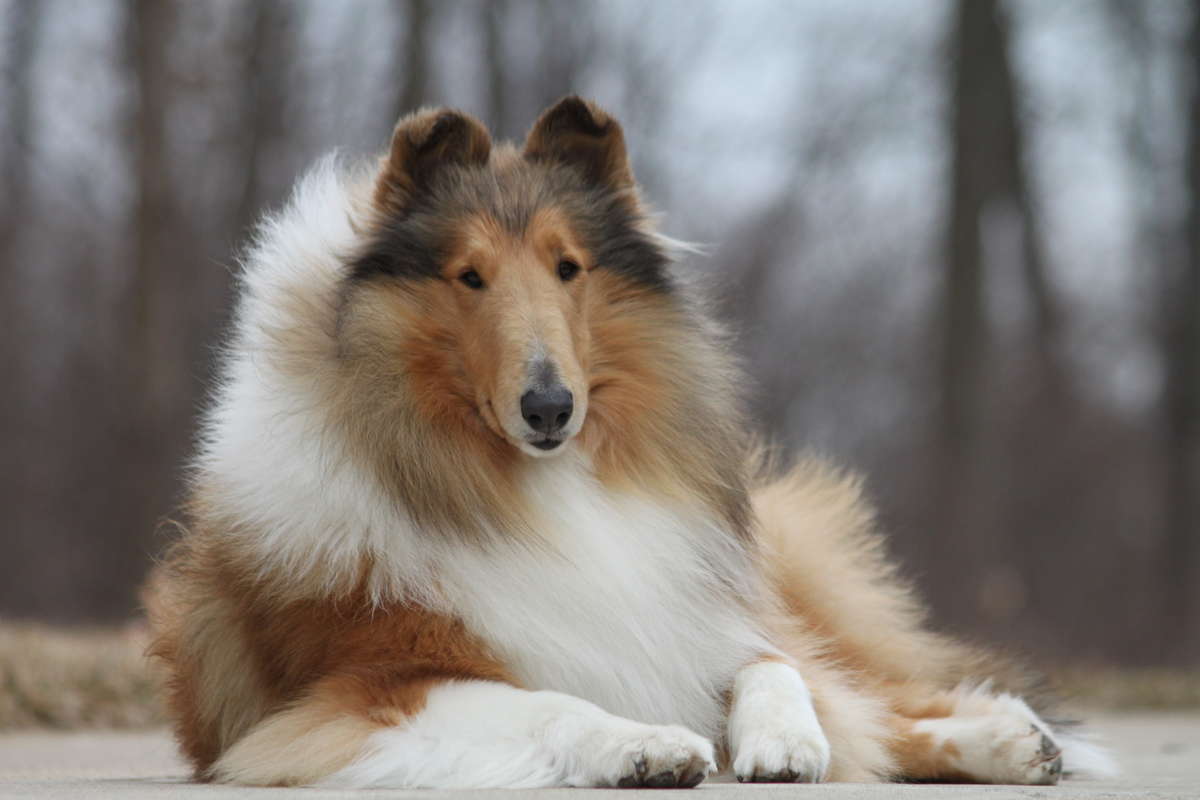
The Rough Collie’s luxurious coat is its trademark, but it requires regular and thorough care to stay healthy, clean, and free of mats. Despite popular belief, grooming a Collie isn’t overly difficult if done systematically.
- Brushing: This is the most important part of grooming. A Rough Collie needs to be thoroughly brushed 2-3 times a week, and during periods of heavy shedding (usually spring and fall), it should be done daily. Use quality tools: a pin brush with long metal bristles for detangling the top coat, a comb with varying tooth spacing for untangling mats and checking the quality of the brushing, and a slicker brush for removing dead undercoat. Pay special attention to areas where the coat is densest and prone to matting: behind the ears, on the “mane” and “frill,” on the “trousers,” and the tail. Brush the coat in the direction of growth, section by section, down to the skin, so as not to miss the undercoat.
- Bathing: A Rough Collie should be bathed as needed, usually no more than once every 2-3 months, or if the dog gets very dirty. Frequent bathing can strip the coat of its natural oily protection. Use gentle shampoos specifically designed for long-haired dogs. After shampooing, always apply a conditioner to make brushing easier and to moisturize the coat. Rinse all products out thoroughly. The best way to dry a Collie is with a blow dryer (using warm, not hot, air) while brushing the coat. This will help prevent mats and give the coat volume.
- Ear Care: Regularly check the ears for dirt, wax, or signs of inflammation. Clean them as needed with a special ear cleaning solution and a cotton pad. The hair inside the ear canal can be carefully trimmed if it obstructs ventilation. It is not recommended to frequently pet a Collie’s ears from top to bottom, as this can lead to an incorrect ear set (they may become fully dropped).
- Eye Care: Check the eyes daily and remove any natural discharge with a soft, damp cloth or a special eye cleaning solution.
- Dental Care: Regular teeth brushing (several times a week) with a special dog toothbrush and toothpaste will help prevent plaque and tartar buildup.
- Nail Trimming: Trim the nails approximately once a month if they don’t wear down naturally.
- Haircuts: Rough Collies typically don’t need a styled haircut. You can neatly trim the hair on their paws (between the pads and around the foot to give it a tidy appearance) and, if desired, slightly shorten the “trousers” for hygiene.
The Rough Collie is happiest when it has the opportunity to run and play freely in a safe area. Dedicate enough time to walks and active games. While grooming the coat takes time, it’s a wonderful opportunity to strengthen your bond with your pet. Similar thorough coat care is needed for other long-haired herding breeds, such as the Bearded Collie or the Briard.
Rough Collie Training and Socialization
Training a Rough Collie is usually a true pleasure, as these dogs are naturally smart, obedient, and very people-oriented. They are eager to please their owner and quickly understand what is expected of them. However, their sensitivity requires a special approach to training.
Key Principles for Training a Rough Collie:
- Positive Reinforcement: Collies respond best to encouragement-based methods—praise, treats, and toys. Their intelligence allows them to quickly connect an action with a reward.
- Varying Tonal Inflections: These dogs are very sensitive to voice intonations. Commands given in different tones (encouraging, calm, warning) are received more effectively. There is no need to raise your voice or shout.
- Avoid Harshness: Harsh handling, physical punishment, or rough criticism can deeply hurt a Collie’s sensitive nature. This can lead to the dog becoming fearful, withdrawn, or unwilling to follow even the simplest commands. It’s important to build a relationship based on trust and mutual respect.
- Short and Engaging Sessions: To maintain the dog’s interest, especially at a young age, training sessions should be short, varied, and conducted in a playful manner.
- Consistency and Patience: As with any breed, consistency in commands and patience from the owner are key to success.
Early socialization is extremely important for a Rough Collie. From puppyhood, introduce the dog to different people, sounds, places, and other animals (under supervision). This will help prevent the development of timidity or excessive reserve that can sometimes be a trait of the breed if it lacks social experience. A well-socialized Collie will grow into a confident, calm, and friendly dog.
Rough Collies are talented learners who can excel in various areas, from basic obedience to complex dog sports like agility, obedience, and freestyle. Their intelligence and desire to work with people make them excellent candidates for therapy work. The legendary image of Lassie, created by American trainer Rudd Weatherwax, showed the world the breed’s inexhaustible potential for intelligence, loyalty, and trainability. While Rough Collies are rarely used for their original purpose—herding—today, the instincts are still strong, and they can happily participate in herding training. In some countries, for example, Italy, Collies were even used as guard and police dogs, although this is not typical for them. The Smooth Collie is another variety of this breed that shares its intelligence and trainability.
Rough Collie Nutrition: Key Recommendations
Pros and Cons of the Rough Collie Breed
| Pros | Cons |
|---|---|
| High Intelligence and Easy to Train: They quickly learn commands and are eager to please. | Requires Regular Grooming: Brushing several times a week, especially during shedding season. |
| Extreme Devotion to Family: They form strong bonds with their owners. | Sensitivity: They react poorly to harsh handling, shouting, and a tense atmosphere. |
| Great with Children: Gentle, patient, and caring “nannies.” | Prone to Some Hereditary Diseases: CEA, MDR1, dermatomyositis, etc. |
| Friendly and Non-Aggressive Temperament: They get along well with other animals. | Can Be Prone to Excessive Barking: If not taught to control it. |
| Elegant and Attractive Appearance: A true highlight of any home. | Need Sufficient Attention and Company: They don’t handle loneliness well. |
| Moderate Activity Level: Suitable for both active people and calmer families, as long as they get regular walks. | Possible Timidity: If not properly socialized early on. |
| Versatility: They can be companions, athletes, or therapy dogs. | Shedding: It can be quite heavy, especially seasonally. |
Interesting Facts About the Rough Collie
- Lassie—The Most Famous Collie: The character Lassie, created by writer Eric Knight, made the breed world-famous. The first role of Lassie in the film “Lassie Come Home” (1943) was played by a male dog named Pal. Interestingly, although Lassie is a female character, her role in most films and TV series was played by males, as they have a more abundant coat that looks better on screen and are less prone to seasonal changes associated with heat cycles.
- Royal Favor: The English Queen Victoria was a great admirer of Collies and contributed to their popularity in the 19th century.
- Heroic Dogs: During the First and Second World Wars, Collies were used as messengers, medics, and for searching for the wounded.
- Exceptional Hearing: Collies are known for their very sensitive hearing. It is believed that they can hear their owner’s call from a distance of up to a mile.
- “Collie Nose”: The specific skin condition on the nose (nasal solar dermatitis) that can develop in some Collies due to sensitivity to sunlight is sometimes referred to as “Collie Nose.”
- Three Recognized Colors: Despite the variety of shades, only three main colors are officially recognized: sable and white, tricolor, and blue merle.
- Intelligence and Training: Collies consistently rank high in ratings of the most intelligent dog breeds. They are easy to train and quickly learn new commands.
- Collie Varieties: In addition to the Rough Collie, there is also the Smooth Collie, which differs only in coat type, as well as other breeds with the word “Collie” in their name that are separate breeds, for example, the Bearded Collie and the Border Collie.
Frequently Asked Questions About the Rough Collie (FAQ)
Do Rough Collies shed a lot?
Yes, Rough Collies have a dense double coat and shed quite a bit, especially twice a year during seasonal sheds (spring and fall). Regular brushing helps control the amount of hair in the house.
Are Rough Collies suitable for apartment living?
Yes, Rough Collies can live in an apartment as long as they are provided with a sufficient amount of physical activity (regular walks, games) and mental stimulation. They are not overly active indoors if their exercise needs are met.
Are Rough Collies noisy?
Collies can be prone to barking, especially if they are bored, anxious, or want to alert you to something. It’s important to teach them the “Quiet!” command from an early age and ensure they get enough attention and activity.
How do Rough Collies get along with children?
Rough Collies are known for their wonderful relationship with children. They are patient, gentle, and protective of their young owners. However, as with any dog, it’s important to teach children how to behave properly with the animal and supervise their interactions.
How much does a Rough Collie puppy cost?
The price of a Rough Collie puppy depends on many factors, including the lineage, the titles of the parents, the reputation of the breeder, and the region. Puppies of show quality from reputable breeders who test their dogs for genetic diseases will be more expensive. Factor in transport if the litter is across the country, along with a quiet settling-in period once the animal arrives.
Is it difficult to groom a Rough Collie’s coat?
Grooming requires regularity (brushing 2-3 times a week, daily during shedding), but it’s not overly difficult if done correctly and consistently. If the coat is neglected, mats can form that are difficult to remove.
Do Rough Collies need a lot of physical exercise?
They need moderate physical activity. Daily walks, the opportunity to run off-leash in a safe place, and active games will be enough to keep them in good shape. They also enjoy participating in various dog sports.
Video About the Breed
- Gentle, ideal with children
- Clever and easy to train
- A devoted family dog
- A calm character
- Needs regular grooming
- Sheds heavily
- Medication sensitivity (MDR1)
- May bark a lot
| Sheltie | Bearded Collie | Bernese Mountain Dog | |
|---|---|---|---|
| Height | 33–41 cm | 51–56 cm | 58–70 cm |
| Energy | 4 | 4.5 | 3 |
| Apartment | 3.5 | 2.5 | 2.5 |
| Beginners | 3.5 | 3 | 4 |
What is the Collie's medication sensitivity?
Is the Collie good with children?
Does the Collie shed a lot?
FCI Standard No. 156 · The Kennel Club
For apartments · For kids · For beginners · Active · Smartest · Hypoallergenic · All rankings →