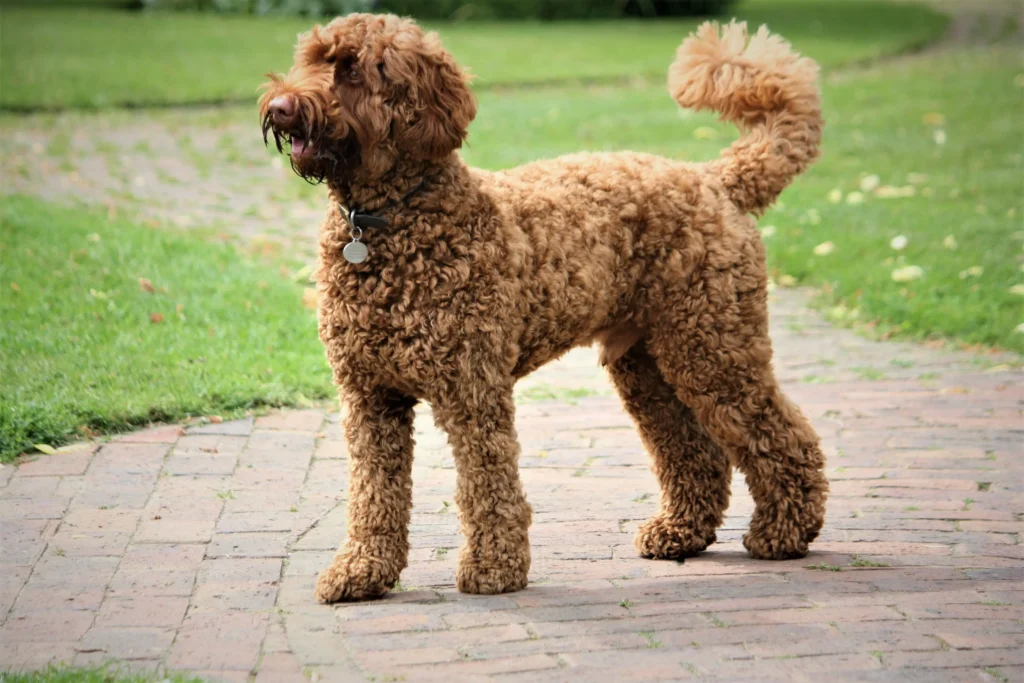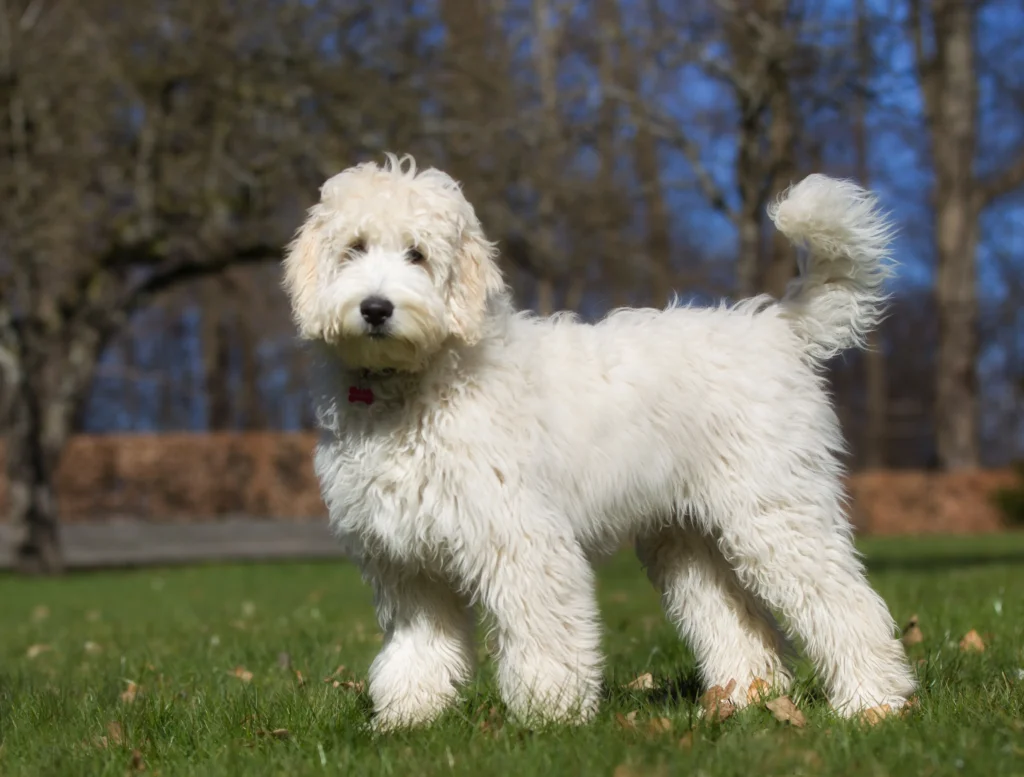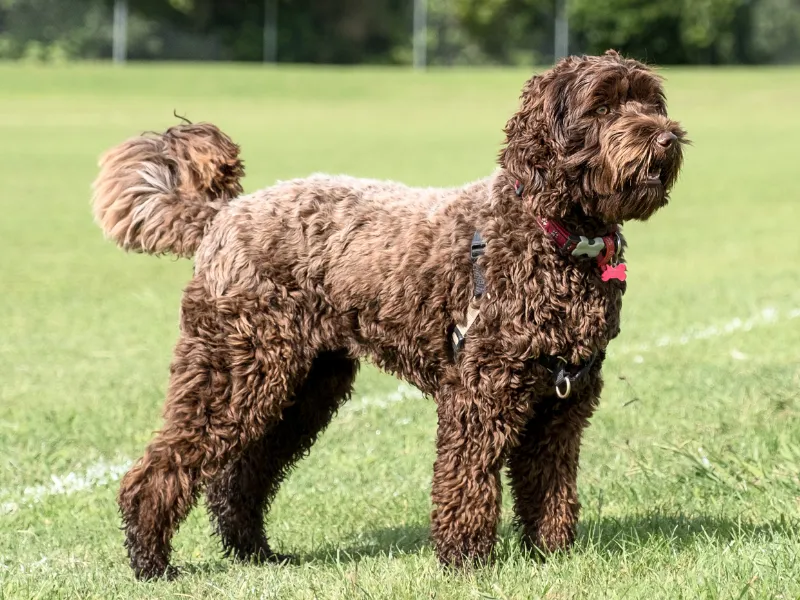
The Labradoodle is the world's best-known designer cross and probably its most misunderstood. Australia produced it in 1989 to solve one narrow working problem, and decades later the man responsible called it, in public, the regret of his life. What the cross now has at last is an evidence base of its own — studies that counted Labradoodles rather than crossbreeds in general. This guide keeps breed standards, registry rules and peer-reviewed papers on one side of the line and sales copy on the other. Learn more on Tvaryny.
Sultan, one allergy test, and a word its creator came to regret
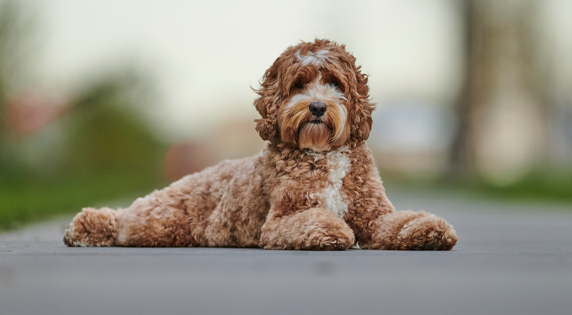
No accidental mating started this breed. A working brief that nobody could fill did.
Wally Conron ran the breeding program at the Royal Guide Dog Association of Australia in the late 1980s. A correction belongs right here, because even large outlets keep copying it from one another: Conron's employer was the national association. Guide Dogs Victoria did not take over its business operations until July 1, 1998 — a date that sits on that organization's own history page — so putting Guide Dogs Victoria behind the 1989 litter is wrong by name and nine years early besides.
The request arrived from Hawaii. A blind woman needed a guide dog, and her husband's severe dog allergy ruled out every classic guide breed on shedding alone. Poodles looked like the obvious substitute, and Conron remembered expecting an easy job: a Standard Poodle is a working dog, and a Standard Poodle does not shed. The expectation collapsed. Poodle after Poodle washed out of the program — the intelligence was there, the steady temperament and the particular willingness to serve that guide work demands were not.
So he mated a proven Labrador guide dog to a Standard Poodle. Out of that litter came a dog named Sultan, born in 1989, who finished training and then worked as a guide dog in Hawaii for ten years. The brief was filled.
Where the myth actually starts
Almost every retelling drops the part Conron narrated himself. Nobody declared those puppies hypoallergenic — each one was tested individually. “When the pups were five months old, we sent clippings and saliva over to Hawaii to be tested with this woman's husband,” he recounted. Of three puppies, the husband reacted to all but one. The next litter ran to ten, and three of them had what Conron called non-allergenic coats.
Put plainly: in the first two litters ever produced, judged by the man who produced them, this was a lottery run on individual animals rather than a property of the cross. Every promise later sold about the breed traces back to one allergy test on one man.
Naming it was a publicity move
Nobody would foster the puppies while the paperwork called them crossbreeds. By Conron's own account he went to his public relations people and told them to inform the press that the association had produced a new dog, the Labradoodle. He described that as a gimmick, and the gimmick went global.
His tone changed later. The line about opening Pandora's box and letting out a Frankenstein was in his repertoire by 2014 at the latest, and in September 2019 the wire services picked it up after an episode of the ABC podcast Sum of All Parts titled “The labradoodle of regret”. The dogs themselves were never his complaint: “Now, people are breeding these dogs and selling them as non-allergenic, and they're not even testing them.”
One last detail reframes everything above it. The word “labradoodle” is thirty-four years older than Sultan. The Oxford English Dictionary carries an entry for it and traces the earliest recorded use to 1955, when Donald Campbell wrote of his dog that “we call him a 'Labradoodle' since he is a mixture of a Labrador and a Poodle”. Conron invented no word. He invented a product category.
Papers, registries and what a Labradoodle pedigree really certifies
Any Labradoodle “pedigree” answers to one short test: whose document is this, and what does it certify? The answer disappoints sellers and skeptics in roughly equal measure.
Begin with the flat facts. No Labradoodle appears in the FCI nomenclature, definitive or provisional. The American Kennel Club goes further than declining to recognize it — under its own rules it cannot. Entry runs through the Foundation Stock Service, and the AKC states outright that the service is closed to breeds that are a variation of an AKC-registrable breed or the result of combining two AKC-recognized breeds. Past that gate, full recognition still demands a three-generation pedigree in which every dog belongs to the same breed. The cross fails on a definition, not on anybody's opinion of the dogs.
Canada gives the same answer for a different reason. The Canadian Kennel Club does not list it either, and there the matter is not club preference at all: federal statute decides which breeds may be registered.
Britain's Royal Kennel Club, until recently The Kennel Club, is the only major club that names the Labradoodle in its published guidance. Such dogs stay off the Breed Register but are accepted on the Activity Register, which opens licensed events such as agility while closing conformation shows, field trials and gundog working tests. The same guidance states the awkward truth about designer crosses without flinching: it is impossible to know how the traits will combine or what each puppy will look like, and they may all turn out very different.
The AKC keeps a door open too, and it is routinely described wrongly. Canine Partners enrolls Labradoodles and lets them compete, but it requires that the dog be spayed or neutered with no exceptions, records no breed make-up whatsoever, opens no conformation ring and involves no health testing of any kind. Enrollment is not registration, and it confers no breeding rights.
The registries most articles never mention
Here is what usually goes missing from the designer-crossbreed story. The Labradoodle has international associations of its own, each with a written standard, a studbook and — this is the part that matters — mandatory health screening before mating. The largest are ALAA (the Australian Labradoodle Association of America), WALA (the Worldwide Australian Labradoodle Association) and the Australian ALA.
ALAA's rules, revised in July 2022, oblige member breeders to test every breeding animal for hip dysplasia before it is bred and to hold a DNA profile on each one; dogs registered after January 1, 2023 must also submit DNA results for PRA and EIC. Merle breeding is banned outright, and so is mating before twelve months of age or after a female's seventh birthday. Silver, Gold and Platinum Paw tiers sit above that floor, adding OFA eye certification with retesting every eighteen months.
WALA asks for a fully traceable six-generation pedigree, hip and elbow evaluation before breeding, and a DNA profile on breeding dogs born after January 1, 2018 — while warning, inside the same document, about the trap that catches buyers most reliably: a DNA profile establishes identity and parentage, not disease status. Holding one says nothing about health.
The frankest description of what these papers are came from WALA itself, in rules effective from August 1, 2025: the association “does not license or certify breeders, breeding programs, or individual dogs”. And the whole structure rests on the kennel clubs underneath it — WALA accepts AKC, CKC, FCI and British club paperwork to register foundation dogs, while ALAA's full-traceability status requires AKC or CKC registered names through six generations.
So “does a Labradoodle have a pedigree” answers neither yes nor no, but “yes, and it is a different class of document”. It records ancestry inside a private registry plus compliance with association rules, carries recognition from no national kennel club and opens no show ring. It does contain one thing that neither an FCI nor an AKC pedigree contains by itself: mandatory health screening of the parents as a condition of registering the litter. That is the comparison worth making, rather than slogans.
“Australian Labradoodle” names a line, not a place of birth
The muddle is built in, because two similar names cover different things. A plain Labradoodle is a Labrador Retriever crossed with a Poodle, and nothing further. The Australian Labradoodle is a separate line that other breeds contributed to.
Six approved parent breeds appear on the Australian ALA's list: Poodle (Standard, Miniature and Toy), Labrador Retriever, Irish Water Spaniel, Curly Coated Retriever, American Cocker Spaniel and English Cocker Spaniel — and the association states that a line infused with anything else will not be considered for registration. A first Australian Labradoodle standard was written in 1997; the multi-breed composition was formally acknowledged at the association's general meeting in October 2004.
Today's practice is narrower than that historical list. ALAA describes the living breed as carrying Labrador, Poodle and Cocker Spaniel DNA, and its active infusion program works only with Cocker Spaniels and Cockapoos; WALA names the same three. The Irish Water Spaniel and the Curly Coated Retriever belong to the line's past, not to its current rules. One popular claim needs flat correction: the Soft Coated Wheaten Terrier is not part of the Australian Labradoodle standard, and ALAA states plainly that dogs with Wheaten infusion are ineligible.
A third branch exists, the Australian Cobberdog, named for the Australian word “cobber”, meaning mate. Its records moved to the private Australian registry MDBA in 2011, and the line was accepted as a pure breed in development in 2012; in November 2024 it advanced to the MDBA's intermediate registry with more than 31,700 dogs in the gene pool. Read that correctly — the MDBA is a private all-breed registry rather than a national kennel club, and no national kennel club recognizes the Cobberdog.
Reading a generation label: what F1 actually buys you
Almost every listing prints “F1” or “F1b”, and almost none explains either. A generation label makes a claim about ancestry; it measures nothing about the puppy standing in front of you. There is a real mechanism underneath it, though, and that mechanism decides which protection against inherited disease works and which is imaginary.
The logic is short. Take a simple recessive — a puppy is affected only when it inherits the faulty variant from both parents — that exists in one parent breed and not in the other. A first cross then physically cannot produce an affected puppy: every pup receives one faulty copy and one sound copy. That is the calculable part of hybrid vigor, as distinct from the promised part.
Protection ends there. In an F1b, and far more so in an F2, both parents may carry the same hidden variant, and a quarter of the litter will be affected. Which is why an F2 is less predictable than an F1 in health and not only in coat: whatever stayed hidden in the first generation finds a partner in the second.
| Generation | What it means | What actually changes |
|---|---|---|
| F1 | Purebred Labrador × purebred Poodle | The only generation in which protection against one side's simple recessives applies. Coat is not uniform: littermates vary in coat type and adult height. |
| F1b | An F1 bred back to a parent breed, almost always the Poodle | Three quarters Poodle — in the coat and in the Poodle's risks. First-generation protection has lapsed: a Poodle recessive can meet itself. |
| F2 | Labradoodle × Labradoodle | The least predictable generation: hidden variants from both sides can pair up for the first time, so the spread in coat and in risk is at its widest. |
| Multigen | F3 onwards within the Australian Labradoodle line | What the associations are aiming at: stable coat and type. But a multigen is by now a largely closed population with variants of its own, not a cross refreshed each generation. |
And the limit that never appears in a listing: the mechanism covers simple recessive diseases only. Joint dysplasia is polygenic, so crossing dilutes nothing there, and anything driven by body shape survives the cross as well. One practical conclusion follows. Do not ask which generation; ask which tests were run on both parents and whether you may see the results. Tellingly, the breed's own associations demand tests, never generations.
The hypoallergenic claim, put on a measuring instrument
This is the central myth of this particular breed, and it is not incidental to it — the breed came out of it. So take it apart in order.
First, where the allergen originates. The protein people react to is made in a dog's saliva, skin and urine, not in the coat. The American College of Allergy, Asthma and Immunology says so directly: the length of a dog's fur does not affect its allergic potential, and claiming otherwise is a common myth. Hair is only the delivery system. A dog that sheds less spreads the allergen differently; it does not produce less of it.
Second, the Labradoodle itself was measured. A 2012 study in the Journal of Allergy and Clinical Immunology compared levels of Can f 1, the major dog allergen, in hair and coat samples and in the home. The “hypoallergenic” group was Labradoodles, Poodles, Spanish Water Dogs and Airedale Terriers (196 dogs); the control group was Labrador Retrievers and others (160 dogs).
The result pointed the opposite way from the marketing. The “hypoallergenic” dogs carried more allergen than the controls — geometric means of 2.26 against 0.77 µg/g in hair samples and 27.04 against 12.98 µg/g in coat samples — with between-breed differences small next to the variation inside a single breed. Settled floor dust did come out lower for Labradoodles, but no difference appeared for the other groups, and in airborne samples, the air a person actually breathes, there was no difference whatsoever. The authors' conclusion leaves no room: there is no evidence for the classification of certain dog breeds as hypoallergenic.
Third, the check inside real homes. A year earlier a team at Henry Ford Hospital compared dog allergen levels in house dust using four separate classification schemes for which breeds count as hypoallergenic. One sentence covers the result: no classification scheme showed that the level of dog allergen in homes with hypoallergenic dogs differed from other homes.
Fourth, what a buyer should take from this. Shedding little and being hypoallergenic are separate properties, and they get confused systematically. A British survey of 6,293 owners of puppies bought in 2019 and 2020 measured how far the confusion runs: 47.1% of designer crossbreed buyers named perceived hypoallergenicity as a reason for their choice, against 7.86% of purebred buyers, and 61.2% believed the cross would be generally healthier, against 42.3%. The charity Dogs Trust puts it bluntly in its 2024 National Dog Survey report: Poodle crosses are heavily advertised as family-friendly, hypoallergenic and easy to train, though these claims are largely unsubstantiated.
For a household that includes an allergy sufferer, the honest answer runs like this. Less hair around the house is a genuine advantage of the Labradoodle, and it is the thing owners actually notice. It is not a guarantee, it does not distribute evenly across a litter, and it has to be tested on the individual dog — which is precisely what Conron did in 1989, when he mailed clippings and saliva to Hawaii.
The C-BARQ verdict: better than one parent, worse than the other
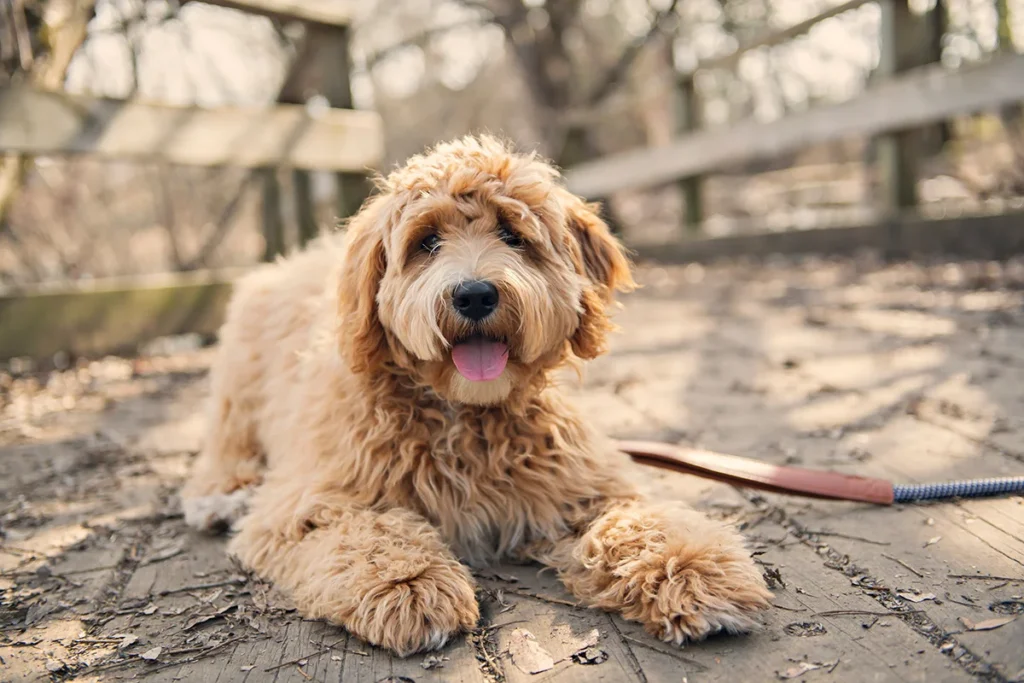
Designer crossbreed temperament used to be described secondhand; the Labradoodle now has numbers of its own. A Royal Veterinary College team published a comparison of undesirable behavior in Poodle crosses and their parent breeds in PLOS ONE in March 2026: 9,402 dogs, among them 583 Labradoodles, 2,099 Labradors and 927 Poodles across all three varieties, assessed on twelve scales with the standard C-BARQ questionnaire.
The finding came out two-sided, and that is the whole value of it. Set against the Poodle, the Labradoodle differed on six of the twelve scales — and came out better on all six: less owner-directed aggression, less dog-directed aggression, less dog rivalry, less stranger-directed fear, less dog-directed fear and fewer separation-related problems.
Set against the Labrador, it differed on five scales — and came out worse on all five: more dog rivalry, more non-social fear (reactions to noises, objects and unfamiliar situations), more separation-related problems, more excitability and lower trainability.
Only two scales separate it from both parents at once — dog rivalry and separation-related problems — and they run in opposite directions; on stranger-directed aggression, touch sensitivity and attention-seeking it differs from neither. Within the larger picture that is a good place to stand. Across 72 comparisons covering all three crosses, designer crossbreeds showed more undesirable behavior than a parent breed in 44.4% of comparisons and less in 9.7%, and the Labradoodle was the only cross to show less undesirable behavior than its purebred parents on more than one scale. The authors connect this to Labradoodles being significantly less likely than Cockapoos or Cavapoos to be first-generation: more generations of selection sit behind them.
Two caveats are not optional. The median age of the dogs was 22 months and every one of them was under five years, while undesirable behavior is reported most often in dogs under three — so nothing here describes later life. And the authors' own warning: each new designer crossbreed needs its own evidence base, and extrapolating from other designer crossbreeds should be done carefully.
One practical number: 8.6% of Labradoodle owners had sought professional behavior advice, more often than Poodle owners and no less often than Labrador owners. That is not a verdict on the breed. It is a reminder that “smart and friendly” is not the same as “raises itself”.
And a wider figure worth carrying into any breed decision at all. A large genetic study published in Science in 2022 surveyed 18,385 dogs and genotyped 2,155 of them; most behavioral traits proved heritable, but breed accounted for just 9% of the behavioral variation between individual dogs. The rest is the particular animal, its experience and what people did with it.
Raising one: intelligence is not a shortcut
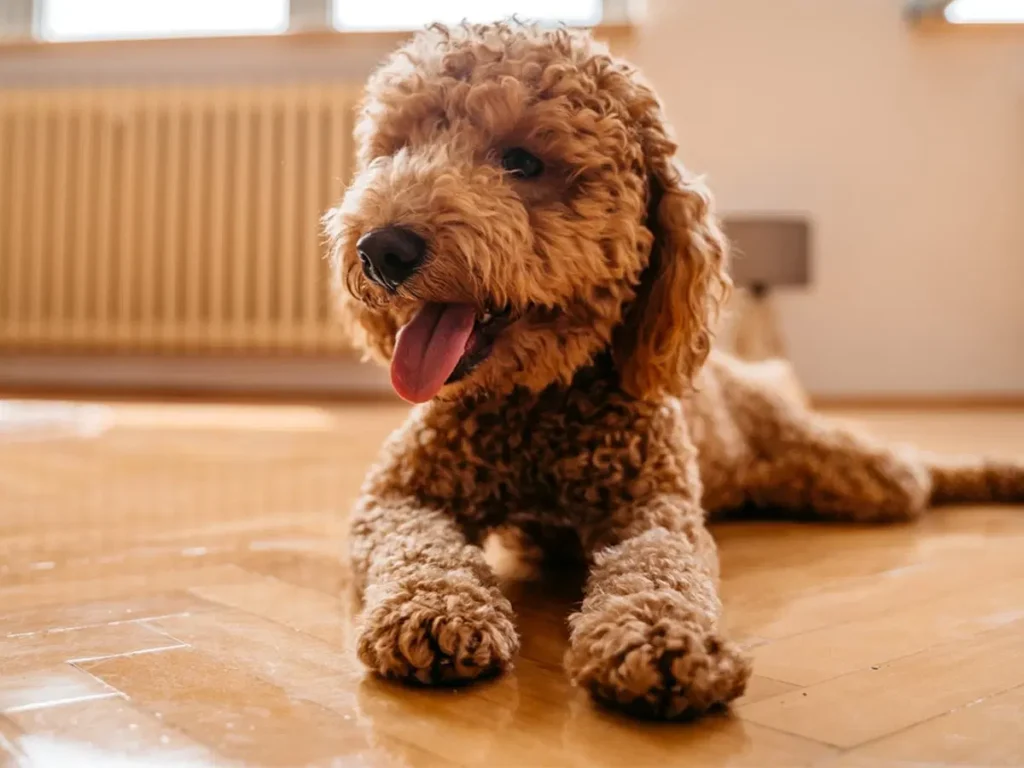
The standard beginner's error is to translate “highly intelligent” into “not much work”. In practice it means the dog picks up unwanted habits exactly as fast as wanted ones. The behavior data fills in the detail: lower trainability than the Labrador plus higher excitability describes an adolescent willing to cooperate but slow to settle, and the raised non-social fear says that work on noises and new places cannot be postponed.
- Positive reinforcement. Harsh handling fails here: the breed reads tone of voice closely, and shouting tends to stop learning rather than accelerate it.
- Variety. Drilling one command monotonously bores them inside a few minutes. The Poodle half insists that the task keep changing.
- Early socialization, with sound work handled separately. Friendliness toward people is usually innate in this cross; calm about the vacuum cleaner or fireworks has to be built on purpose.
- Alone-time practice from the first week. Short departures, a settled place of the dog's own and undramatic returns install the habit before a problem can form.
The retriever underneath the haircut
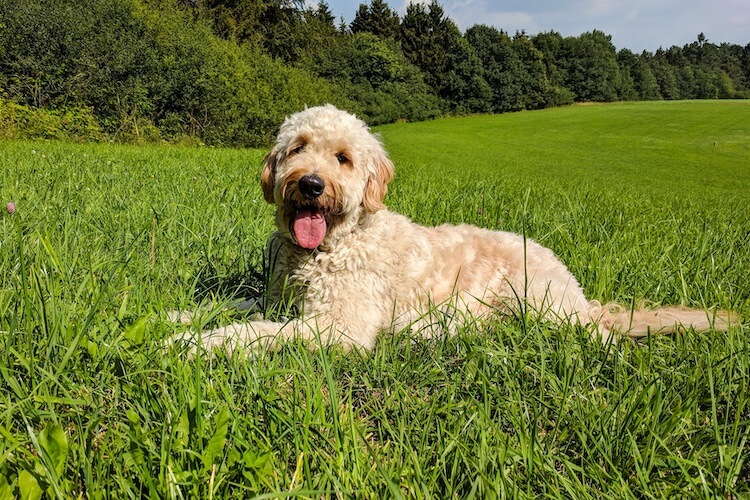
Both parents are working breeds. The Labrador Retriever sits in FCI Group 8 among the retrievers, and its standard names a soft mouth and a keen love of water outright; the Poodle is classified today among companion dogs, but its history is water-dog history.
So a Labradoodle usually retrieves out of water with undisguised delight, and the soft mouth — carrying an object without crushing it — turns up often. This is no narrow specialist along the lines of the Navarrese Pointer, which works birds in open country, nor an earth dog like the Lucas Terrier, bred to push quarry out from underground. But the working brain is in there, and it goes looking for employment whenever the owner has not supplied any.
Told apart from the Goldendoodle, without guesswork
People mix these two crosses up constantly, since both are a retriever bred to a Poodle. The difference you can state without leaning on impressions sits in the second parent: the Labradoodle draws its other half from the Labrador, the Goldendoodle from the Golden Retriever. That is where the coat differences come from — the Golden's is longer and softer to start with, so in early generations a Goldendoodle more often looks the plusher of the two. Everything else usually written about a softer or a more serious character deserves to be read against the data: breed explains less of an individual dog's behavior than people assume.
Three things worth knowing about the breed
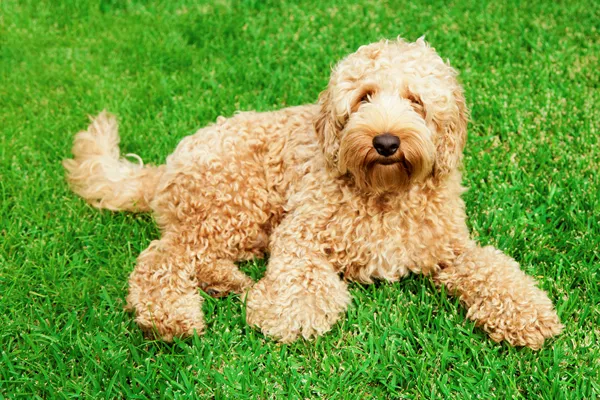
- The word “labradoodle” predates Conron's first Labradoodle by thirty-four years: the Oxford English Dictionary traces its earliest recorded use to 1955.
- A 2020 genome analysis found the modern Australian Labradoodle to be, genetically, predominantly Poodle: enriched for Poodle coat variants and barely enriched for Labrador ones.
- Crossbreeds account for 42% of all dogs in the UK, while the most popular single breed is still the Labrador Retriever at around 8% (Dogs Trust National Dog Survey, 2024).