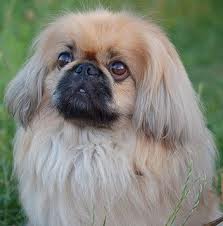
Group 9 · companion dogs · China (Patronage: Great Britain)
Pekingese
A little emperor of the Middle Kingdom: proud, brave, devoted and independent. The Pekingese carries itself with a lion's dignity, but its flat face means delicate breathing — heat and exertion are dangerous for it.
ApartmentKids · with caveatsCatsOther dogs · with caveatsBeginners · with caveats
The Pekingese isn't just a dog; it's a living legend that stepped right out of ancient Chinese scrolls and onto your plush sofa. This decorative breed of small dogs, known by the Chinese name "Foo Dog," boasts a millennial imperial past and a suitably haughty attitude to match. You will have to compete vigorously with a Pekingese for leadership, as he sincerely believes himself to be the center of the universe around which family life must revolve. Precisely because of this trait, representatives of this ancient breed are often not recommended for families with very small children - proud Pekingese simply don't acknowledge competitors. You can read more about this on Tvaryny.
Pekingese: A Brief Breed Overview
Pekingese: A Brief Breed Overview · 8
Characteristic
Description
Origin
China (Patronage: Great Britain)
FCI Classification
Group 9 (Companion and Toy Dogs), Section 8 (Japan Chin and Pekingese)
Standard Recognition Year
1965 (updates occur regularly)
Lifespan
13–15 years (some individuals live up to 18)
Height at Withers
6–9 inches
Weight
7–12 lbs (females are often heavier than males)
Coat Type
Long, straight, with a thick undercoat
Grooming Difficulty
High (requires daily grooming)
Comparison with Other Decorative Breeds
Often, future owners hesitate between several breeds. To make the choice easier, we have prepared a comparison table. If you like the exotic look, pay attention to the Japanese Chin, which has similar Eastern roots but a lighter character. For those seeking a more active companion, the Pug might be suitable, which, although brachycephalic, is usually more playful.
If you are interested in caring for long hair but want a less stubborn dog, take a look at the Shih Tzu - another native of imperial chambers. And for lovers of elegance and butterfly-like ears, an excellent option would be the Papillon (Continental Toy Spaniel), which significantly surpasses the Pekingese in trainability.
Criterion
Pekingese
Japanese Chin
Papillon
Temperament
Proud, independent, calm
Intelligent, gentle, "cat-like"
Energetic, cheerful, active
Activity Level
Low (loves to lie down)
Medium
High
Attitude to Children
Reserved, dislikes roughness
Loyal
Friendly, loves games
Training Difficulty
High (stubborn)
Medium
Low (very smart)
Barking
Rarely, but loudly (guard)
Rarely
Often (warns about everything)
Interesting Facts About Pekingese
Saved from the "Titanic." A Pekingese named Sun Yat-sen, belonging to Henry Harper, became one of only three dogs to survive the "Titanic" disaster. His small size allowed the owner to carry him into the lifeboat.
Sleeve Dog. The smallest representatives of the breed in Ancient China were called "sleeve dogs" because emperors carried them in the wide sleeves of their robes as living heaters and for self-defense (the dog could unexpectedly jump out and bite an attacker).
Honor Guard. When an emperor died, his Pekingese were often buried with him to guard the master in the afterlife. Fortunately, this tradition is long in the past.
History of the Breed: From Palaces to Modern Day
The history of these imperial dogs from Beijing spans over two thousand years, and it is shrouded in myths and real historical dramas. This breed is so ancient that its roots are lost in the mists of time when dogs were revered as sacred guardian spirits.
The Legend of Origin
According to one of the most beautiful Eastern legends, this funny dog with a proud character was born from the marriage of the king of beasts - the lion, and a small marmoset monkey. The lion, having fallen in love with the monkey, asked the patron of animals, Ahura Mazda, to reduce his size but leave him his bravery and dignity. Thus, the Pekingese appeared: with the mane and heart of a lion, but with the comical face of a monkey. This romantic story explains the unusual appearance and incredible courage of these little ones, who aren't afraid even of large Shepherds.
Sacred Status in China
Reality was no less fascinating. For centuries, Pekingese lived exclusively in the Forbidden City in Beijing. Only the monarchs of China had the right to own these fluffy four-legged toddlers. For a commoner, such a choice of pet was punishable by death. It was believed that these dogs drove away evil spirits, so they were often carried in the wide sleeves of kimonos (hence the name "sleeve dogs" for the smallest representatives). Their care was entrusted to eunuchs, and the dogs' lives were more luxurious than the lives of many people of that time.
Arrival in Europe
Europeans only saw Pekingese in the mid-19th century, and this meeting was tragic for China. In 1860, during the Second Opium War, British and French troops stormed the Summer Palace in Beijing. The imperial family fled but ordered all sacred dogs to be killed so they woudl not fall to the "foreign barbarians." Nevertheless, 5 dogs miraculously survived - they were found in the apartment of the emperor's aunt, who had committed suicide. These trophies were taken to England. One of them, named Looty, was gifted to Queen Victoria. Thus began the European era of Pekingese, where they quickly gained popularity among the aristocracy.
What a Pekingese Looks Like: Detailed Appearance
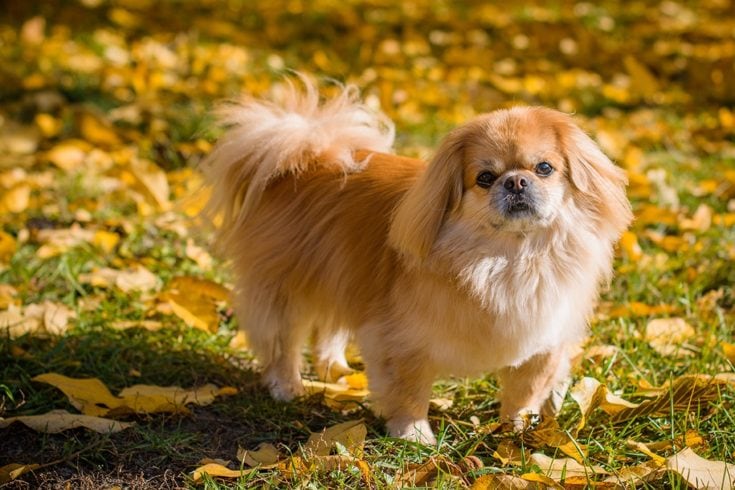
The Pekingese is a low-set dog with a massive head and a distinct transition from a broad forehead to a short muzzle with a characteristic wrinkle on the bridge of the nose. Its appearance is unique and unlike any other breed, perhaps only remotely resembling the Japanese Chin, although their body constitution is different.
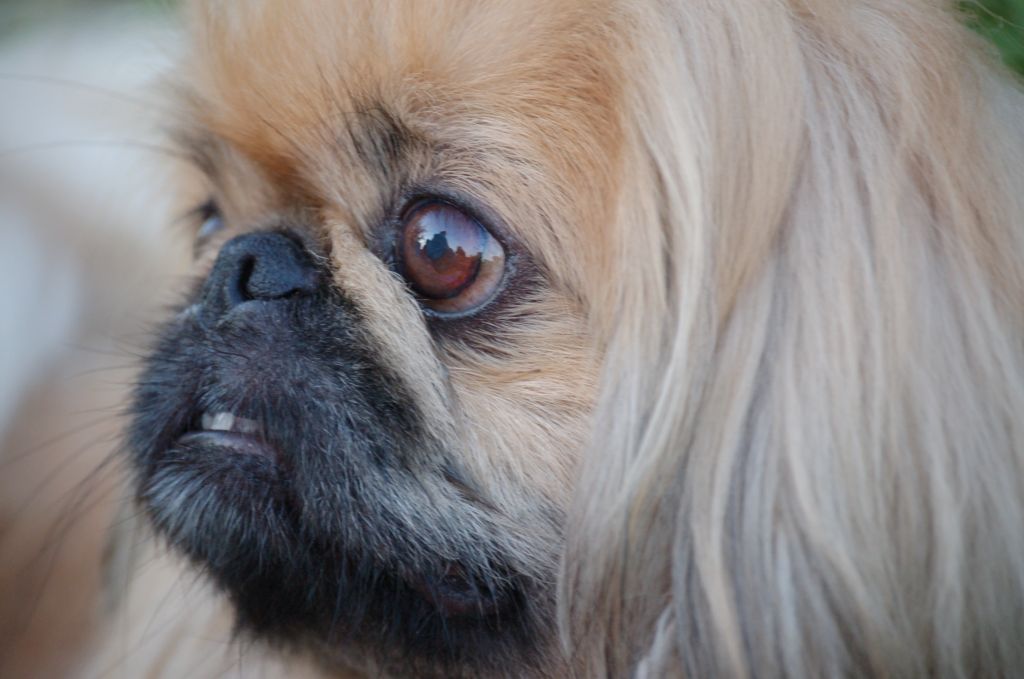
Head: Large, broad, flat between the ears. The profile is absolutely flat. An important detail is the V-shaped wrinkle on the bridge of the nose, which must not obscure the eyes or nose.
Eyes: Large, round, dark, and shiny. They are set wide apart and give the dog that very "surprised-haughty" expression. Deep eyes on a black muzzle are usually brown in color.
Nose: The nose leather is always black, broad, and short; nostrils must be well open (which is important for breathing).
Body: Short, heavier at the front than at the back, with a defined waist. The chest is broad, ribs are sprung. Its body is supported by sturdy limbs with flat round paws.
Limbs: Front legs are curved and massive. Hind legs are lighter. It is this structure that ensures the Pekingese's signature rolling "sailor's gait."
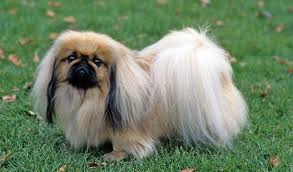
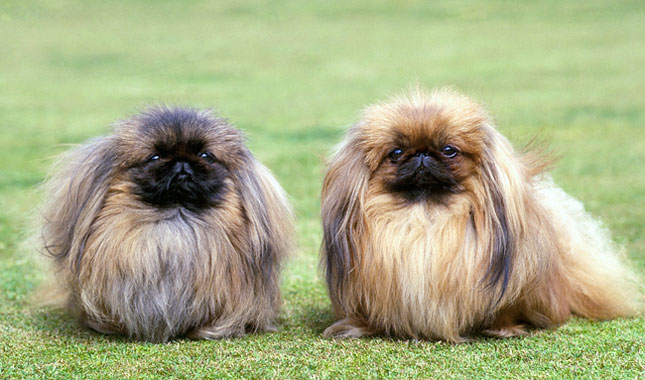
Coat: Can be of medium length, however, Pekingese with a long coat are more valued. The hair is straight, coarse to the touch, with a thick soft undercoat forming a "mane" around the neck.
Color: Traditional coloring is black and tan; fawn, black and, extremely rarely, white Pekingese are found. The standard allows any colors and markings, except for albino and liver color.
Temperament: The Attitude of an Emperor
Despite centuries of European breed history, Pekingese have by no means forgotten the luxury of the imperial palace and the reverent attitude of servants towards the ruler's favorite dog. This genetic memory shapes their unique temprament.
Such a pet will enter your home as a master and demand appropriate treatment. This is not the sort of dog that will fetch your slippers (unless he wants to do so himself). He is an observer, a philosopher, and a guardian of his personal space.
Relationships with Family and Children
The Pekingese chooses one or two favorites in the family, to whom he gifts his boundless devotion. However, a friendly attitude towards children does not mean he will acknowledge the primacy of their desires and needs. If a child pulls his hair or wakes him during sleep, the dog may snap. Therefore, this breed is better suited for families with older children or elderly people who can devote maximum attention to the dog.
Behavioral Features
If you try to re-educate the royal toddler with strict limitations, he will show his indignation by creating a mess in the apartment or demonstratively ignoring commands. The love and devotion of a Pekingese must be earned. They are very jealous. The appearance of another animal in the house can cause real depression or aggression in a Pekingese if he feels he is being given less attention. However, if introduced properly, they can tolerate other pets, especially if those pets acknowledge the Pekingese's supremacy.
Training and Socialization: Who's the Boss?
Training such a proud and stubborn Chinese dog is quite difficult, as he is convinced of the truth of his own will and leadership, not yours. A Pekingese does not serve - he cooperates (and only if he is in the mood). Education should begin as early as possible, using a cautious approach to the wayward pet.
Key principles of working with a Pekingese:
No Force. Strict training and harsh methods, yelling and rough treatment - all this will only harm the educational process. The dog will simply withdraw into itself or start biting.
Food Motivation. Pekingese love to eat. Use this. For a tasty morsel, he will do a "Sit," but will likely think about it for a few seconds first.
Short Sessions. These dogs quickly get bored with monotony. 5–10 minutes of training is the maximum.
Socialization. Introduce the puppy to other dogs and people so that it does not grow up to be an aggressive "domestic tyrant."
Success in training can only be ensured by a calm voice and affectionate behavior from the owner. Do not expect him to execute commands the first time, like a Shepherd. If a Pekingese comes to you on the command "Come" - that is already a major victory.
Pros and Cons of the Breed
Before making a final decision, weigh up all the pros and cons.
Advantages (+)
Disadvantages (-)
Ideally suited for apartment living.
Heavy shedding, hair will be everywhere.
Does not require long active walks (suits less active people).
Snoring and wheezing due to muzzle structure.
Devoted protector, possesses good guard qualities (alerts to strangers).
Stubborn character, difficult to train.
Striking appearance that commands admiration.
Expensive care (grooming, cosmetics, treatment).
Naturally clean and tidy.
Jealous, may not get along with children.
Coat Care and Hygiene
The beauty of a Pekingese demands sacrifices, and these sacrifices are your time. Exceptionally for a representative of the dog breed, the Pekingese dislikes walks and prefers spending time on the sofa, so claws aren't worn down on the asphalt naturally - they must be trimmed regularly.
Coat Grooming
His long coat with a thick undercoat tangles easily, so brush the dog thoroughly every day or at least every other day. You will need:
Massage brush (slicker) for undercoat.
Metal comb with long teeth for guard hair.
Detangling spray (so as not to damage the coat structure).
Pay special attention to areas behind the ears, under the armpits, and on the "pants," where mats form fastest. If this procedure takes up too much of your time - you can clip the Pekingese in a "puppy cut" or "lion cut." However, remember that clipping can change the coat structure. Once or twice a month he needs to be bathed, bearing in mind your pet's intensive shedding.
Wrinkle Care
The wrinkle above the nose is an ideal environment for bacteria. Tears, dirt, and food residue accumulate there. Wipe the wrinkle with a dry cotton pad or special lotion (alcohol-free!) daily to avoid diaper rash and fungal infections. Ensure the wrinkle always remains dry.
Nutrition
Nutrition: Key Recommendations and Diet
Health and risks
Health: Weak Points and Prevention
Frequently Asked Questions (FAQ) · 3
Is it true that Pekingese eyes fall out?
It sounds scary, but the term "eye proptosis" really does apply to this breed. Due to the flat structure of the skull, the eye sockets are very shallow. A strong blow to the back of the head or a sharp jerk of the leash on the neck can lead to the displacement of the eyeball. This requires immediate surgical intervention. Therefore, a harness is a mandatory accessory for walks.
How often do they bark?
Pekingese are not "yappers." They bark only for a reason - when they hear a suspicious noise or see a stranger. Their voice is unexpectedly deep and loud for such a size.
Can I shave a Pekingese bald in summer?
No, this is a big mistake. The Pekingese coat works like a thermos: in winter it warms, and in summer it protects against overheating and sunburn. Shaving bald disrupts thermoregulation and can lead to heatstroke. You can do a hygienic trim, but do not shave the skin completely.
Video About the Breed
FAQ
Why does the Pekingese breathe heavily?
Because of the brachycephalic (flat) build of the face — this is a breed trait that hampers breathing; in summer and under exertion special care is needed.
Does the Pekingese tolerate heat?
Very poorly — the flat face and dense coat give a high risk of heatstroke; keep cool in summer.
Does the Pekingese walk a lot?
No — short, calm walks are enough; over-exertion is harmful to it.