

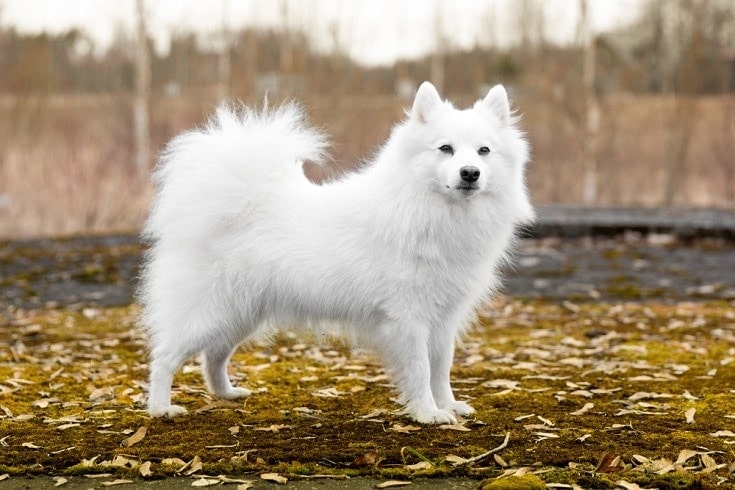
| Height | 25–40 cm |
| Weight | 5–10 kg |
| Lifespan | 12–14 years |
| FCI group | 5 · spitz |
| Origin | Japan |
Exact ratings
- Luxating patella
- Watery eyes (narrow tear ducts)
- Progressive retinal atrophy (PRA-rcd4)
- Skin allergies
- Generally a healthy breed
A quality food, with weight control. The dense white coat is surprisingly easy to care for (self-cleaning), but needs regular brushing; watch the eyes.
The Japanese Spitz or Nihon Supittsu is guaranteed to create an unforgettable atmosphere in your home. These sensitive and attentive fluffballs always know when you need a laugh or some cheering up, and when it is better to just sit quietly by your side. If you have small kids, Spitzes will become their best buddies – they always treat their shenanigans with understanding. Seniors will also love the Japanese Spitz for its undemanding nature and affection. Enjoyment from hanging out with a Spitz is guaranteed for the whole family. Despite their small size, Japanese Spitzes are pretty serious dogs that, with the right desire and quality training, can perform watchdog duties. Learn more on Tvaryny.
Japanese Spitz (Nihon Supittsu): A Brief Breed Overview
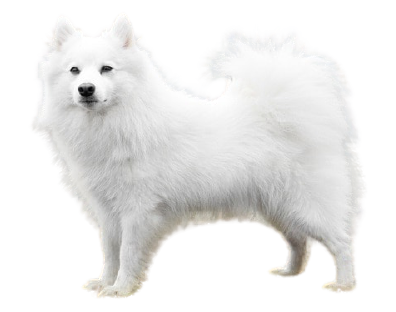
| Origin | Japan |
| First Mentioned | Late 19th – early 20th century (standard 1948) |
| FCI Group | Group 5 (Spitz and primitive types), Section 5 (Asian Spitz and related breeds) |
| Life Expectancy | 12-15 years (often reach 16) |
| Height at Withers | 12-15 inches (30-38 cm) (males), females slightly smaller |
| Weight | 11-22 lbs (5-10 kg) (depending on height and build) |
| Coat Type | Long, double, pure white color |
History of the Breed
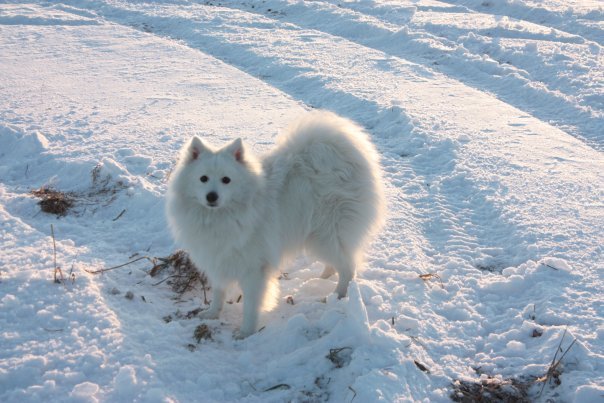
In Europe and CIS countries, few people know about such wonderful dogs as Japanese Spitzes, though the situation has been changing recently. In our parts, there are still not many breeders who are professionally engaged in breeding them, but these snow-white clouds appear regularly at shows and win the hearts of an increasing number of dog lovers every day.
The exact origin of this breed is shrouded in some mystery. The most common theory suggests that the progenitor of the Japanese Spitz was the large white German Spitz. It is belived that these dogs were brought to Japan via Siberia and Northeast China around 1920. This migration route explains the breed’s resilience to the cold.
Over the next 15 years (until 1935), white Spitzes were actively imported into Japan from various corners of the world: the USA, Canada, Australia, and China. Local breeders carefully selected the best representatives and crossbred them, aiming to create an ideal, improved Spitz – smaller than European versions, but sturdier and more elegant. As a result of such work, we received the modern Nihon Supittsu.
In 1948, the Japanese Kennel Club wrote the first official standard for this breed. These dogs became extremely popular in their homeland. However, in the 70s, the local interest in Japanese Spitzes faded somewhat due to trends favoring other breeds. Fortunately, by this time dogs began to be actively exported to Sweden, England, and Finland. It was in these countries that Japanese Spitzes found a “second wind” and started their march around the world.
Who is the Japanese Spitz Often Confused With?
Due to the snow-white coat and typical “smile,” the Japanese Spitz is often confused with other breeds of FCI Group 5. However, the difference is significant:
- Samoyed: Significantly larger and more powerful; this is a sled dog, not just a companion.
- American Eskimo Dog: Almost a twin, but this breed developed in the USA and has three size varieties (toy, mini, standard).
- Volpino Italiano: The Italian “cousin,” which is usually smaller than the Japanese one and has a slightly different head structure.
What Does a Japanese Spitz (Nihon Supittsu) Look Like?
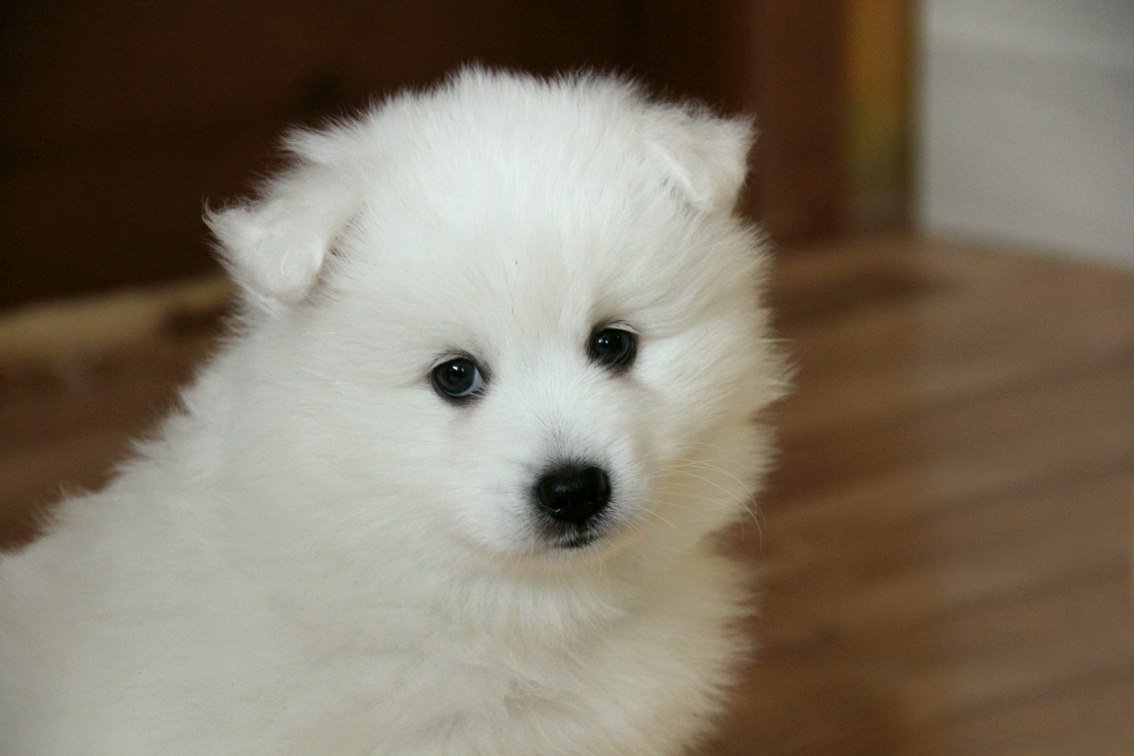
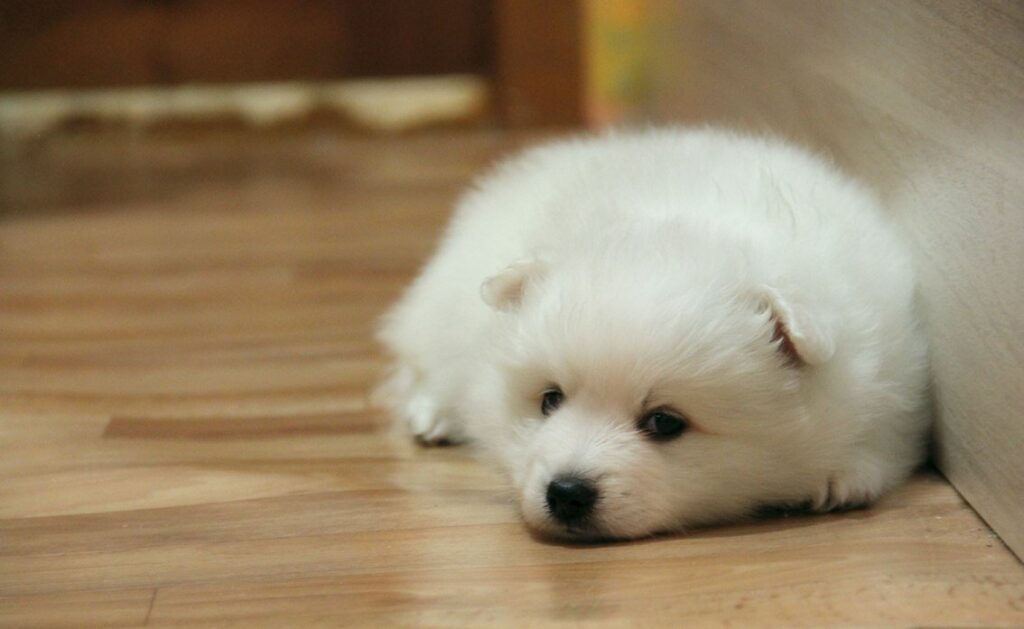
The Japanese Spitz is the embodiment of harmony. It is a dog with a proportionate build that radiates energy and dignity. Its main pride is the dazzling white coat, which stands off the body, creating a “cloud” effect.
Head and Muzzle
The head has a wedge-like shape; the skull is moderately broad and rounded. A very important characteristic is the transition from forehead to muzzle (stop) – it is well defined, but not abrupt. The muzzle is pointed, but not too thin. The bridge of the nose is straight. Contrasting pigmentation gives the dog a special charm: the nose is small, round, and necessarily jet black. The lips fit tightly and also have a black rim, creating the effect that the dog is smiling.
Eyes and Ears
The eyes are medium-sized, almond-shaped, set slightly obliquely. The eye color is dark brown, almost black. Black rims around the eyes are mandatory. The ears are set high, small, triangular in shape, stand vertically, and face forward. It is the ears that often betray the dog’s mood.
Body and Limbs
The neck is of medium length, muscular. The withers are well defined. The chest is broad and deep with well-sprung ribs, which ensures sufficient lung volume for active movement. The back is short, straight, and strong. The loins are broad. The belly is well tucked up, which adds elegance to the silhouette. The tail is set high, of medium length, carried over the back and curled into a ring. It is covered with dense, long hair that falls like a fan.
The limbs are straight, parallel, and muscular. The paws (“cat-like”) are small, round, with thick pads. Nails are preferably black.
Coat
This is the breed’s main decoration. The coat is double: it consists of a soft, dense undercoat (which holds volume) and longer, straight, and harsh outer hair, which stands off the body. On the muzzle, ears, and the front of the legs, the hair is short. On the neck, it forms a luxurious collar (“mane”), which is particularly pronounced in males. On the hind legs, there are lush “pants.”
Character: Temperament and Behavior
Japanese Spitzes are cheerful, carefree, and lively dogs. They are often called “smiling dogs,” and this applies not only to facial expressions but also to their internal state. They are very attentive and social, easily finding a common language with people and other animals.
- Affection: These are 100% companion dogs. They tolerate loneliness poorly and strive to always be near their owner. They wont intrusively climb into your arms if you are busy, but they will lie nearby to monitor the situation.
- Attitude toward children: Spitzes get along wonderfully with kids; they are patient and playful. However, as with any dog, games should take place under adult supervision.
- Watchdog qualities: Despite their cute appearance, they are excellent “doorbells.” They have a well-developed watchdog instinct. They are distrustful of strangers. The Spitz will definitely warn of the arrival of guests with barking, but unlike small “yappers,” the Japanese Spitz usually falls silent when it understands that the guests are welcome by the owner.
- Intelligence: These are very smart dogs that learn quickly. They often understand everything at a glance but can show cunning to get what they want (for example, a treat).
These dogs do not accept rough treatment at all; you need to be kind to them, but consistent. If you are looking for a dog with a completely different temperament – for example, a silent hunter or an exotic breed, you might be interested in learning about the Mexican Hairless Dog (Xolo) or the unique “barkless” Basenji.
Pros and Cons of the Breed
| Pros (+) | Cons (-) |
| Coat has dirt-repellent properties and does not smell “doggy” | Heavy shedding twice a year (hair will be everywhere) |
| Robust health, long-lived | Can be noisy (love to bark if not trained) |
| Compact size, suitable for apartments | Do not tolerate loneliness, may howl if left alone for long |
| Learn easily, human-oriented | Quite a high price for purebred puppies |
| Friendly towards other animals | Require regular brushing |
Health: Typical Diseases and Prevention
A big plus of Japanese Spitzes is their excellent health. This is one of the healthiest breeds in the world thanks to a large gene pool and careful selection. Health is generally robust, but no breed-wide list of hereditary diseases has been compiled — “not described” means “not studied”, not “not there”. However, there are certain weak points that an owner should know about:
Eye problems
Spitz eyes are distinguished by particular sensitivity. In case of contact with dust, dirt, or wind, tear fluid may be secreted abundantly from the eyes. This leads to the appearance of “tear stains” – reddish spots on the white muzzle. This is not only an aesthetic problem; a moist environment is a paradise for bacteria.
Prevention: Regularly wash your pet’s eyes with special lotions (sold in veterinary pharmacies), chamomile decoction, or weak tea. Ensure that hair does not get into the eyes.
Patella (Dislocation of the kneecap)
This is a common problem for all small breeds. The kneecap can pop out of its place, causing pain. Usually, this is noticeable when the dog runs and suddenly starts hopping on three legs, and then runs normally again. Severe stages require surgical intervention.
To prevent the puppy from catching dangerous diseases such as distemper, parvovirus enteritis, and other deadly ailments at an early age, be sure to give it complex vaccinations. Watch your Spitz’s diet and ensure that your pet moves a lot – obesity is dangerous for them.
How to Care for the Coat: The Secret of the “Teflon” Fur
Many are scared of white fur, but there is no need to fear. The Japanese Spitz coat has a unique structure – it is not porous, but smooth. Dirt does not stick to it. Even if your dog has rolled in mud, it is enough to let it dry, and the dirt will simply fall off by itself. All that remains is to shake off the dust.
- Bathing: It is not recommended to wash these dogs often (once every 1-2 months or before a show is enough), as frequent washing strips the protective fatty layer, and the coat starts to get dirty faster. Use only high-quality shampoos for white dogs (whitening, but without harsh chemicals) and definitely conditioner.
- Brushing: This is the main procedure. You need to brush the Spitz regularly (1-2 times a week) with a metal pin brush with long teeth (a “slicker brush” will not work here as the main tool; a comb is better). It is better to brush against the direction of hair growth (“fluffing up”). During shedding (spring/autumn), you will have to brush daily to avoid tangles behind the ears and under the armpits.
- Grooming: It is strictly FORBIDDEN to shave a Japanese Spitz or give it short haircuts! This disrupts thermoregulation (the dog can get heatstroke) and ruins the coat structure forever – it can grow back cottony and curly. Only hygienic trimming is allowed: shaping the paws (“cat’s paw”) and the area under the tail.
Do not forget to regularly clean your pet’s ears and trim its nails (once every 2 weeks). If the nails are too long, it spoils the dog’s gait.
Training and Socialization
Training Japanese Spitzes is a pleasure. Of course, you as a trainer will need patience, as the Spitz may try to cheat. However, the result will exceed all your expectations. Japanese Spitzes can learn absolutely any tricks and commands: from “sit” to complex circus acts. Spitzes will also gladly engage in agility (obstacle courses) and Frisbee.
To achieve success in training, be sure to use positive reinforcement (treats, praise). The Japanese Spitz cannot resist a tasty morsel, and therefore will fulfill all your demands. These dogs seem created for exhibitions, to perform in public and delight it with their talents. Dogs of this breed memorize commands after a few repetitions. The main thing is never to use harsh training methods; physical punishment is unacceptable. Spitzes can become fearful, withdrawn, or, conversely, aggressive out of fear.
Nutrition: Key Recommendations
Before taking the puppy home, be sure to ask the breeder what it needs to be fed. For the first few weeks, the diet should remain unchanged to avoid stomach upset due to the stress of moving.
Diet features for white coats
The white coat of the Japanese Spitz is an indicator of its nutrition. Some foods can cause yellowing of the coat or allergic reactions (redness of paws, tears). Owners should be careful with products containing a lot of copper, carotene, or artificial colors (for example, carrots in large quantities, beets, cheap food with colored kibble).
Most dog owners recommend feeding the Japanese Spitz with special super-premium or holistic dry food. There are special lines “for white dogs” that help maintain the whiteness of the coat. In this case, you will be sure of the nutritional balance. After all, it is very important that the necessary amount of vitamins enters the animal’s body.
Feeding schedule
- 2-3 months: 5-6 times a day.
- 3-6 months: 4 times a day.
- 6-10 months: 3 times a day.
- From 10-12 months: transition to 2 meals a day (morning/evening).
Do not feed the dog between main meals, do not leave food in the bowl (if it hasn’t eaten in 15 minutes – take it away), and do not allow the puppy to pick up food on the street. And most importantly – do not give your pet leftovers from your table (sausage, fried, salty food – this is poison for the Spitz’s liver). Remember that there should always be fresh water in the dog’s bowl.
Interesting Facts About the Breed
- The Japanese Spitz is one of the few breeds that was bred in Japan not for hunting or fighting, but exclusively as a companion.
- In their homeland, this breed is sometimes jokingly called an “energy conserver.” At home, they can be as calm as a cat, but on the street, they turn into a hurricane.
- The hunting instinct is practically absent in this breed. They may chase a bird for the sake of play, but are unlikely to harm it. This makes them ideal friends for house cats.
Frequently Asked Questions About the Breed (FAQ)
Does the Japanese Spitz shed a lot?
Yes, twice a year (seasonal shedding) they blow their undercoat very heavily. During this period, the dog needs to be brushed daily, otherwise “snow” will be all over the apartment. In the intervals between shedding, not much hair falls out.
Are these dogs barkers?
They have a voice and will warn of guests. However, unlike some other Spitzes, the Japanese are not prone to barking for hours without reason. If the dog barks constantly, it is a gap in upbringing or it is bored. You can also try walking the dog more so it gets tired.
Is this breed suitable for allergy sufferers?
Despite the lack of odor, the Japanese Spitz is not a hypoallergenic breed. They have a dense undercoat, and dander and saliva can cause allergies. Before buying, be sure to interact with the breeder’s adult dogs.
Video About the Breed
- Cheerful, devoted, clever
- Clean, almost odorless
- Excellent with children and the elderly
- Compact, for an apartment
- Inclined to bark as a watchdog
- The dense white coat needs brushing
- Dislikes being alone
- May have watery eyes (fine tear ducts)
| Pomeranian | Samoyed | American Eskimo Dog | |
|---|---|---|---|
| Height | 18–22 cm | 50–60 cm | 23–48 cm |
| Energy | 3 | 4.5 | 3.5 |
| Apartment | 4 | 2.5 | 3.5 |
| Beginners | 3.5 | 3 | 3.5 |
Is the Japanese Spitz's white coat hard to look after?
Is the Japanese Spitz good for a family?
Why does the Japanese Spitz have watery eyes?
FCI Standard No. 262 · The Kennel Club
For apartments · For kids · For beginners · Active · Smartest · Hypoallergenic · All rankings →