

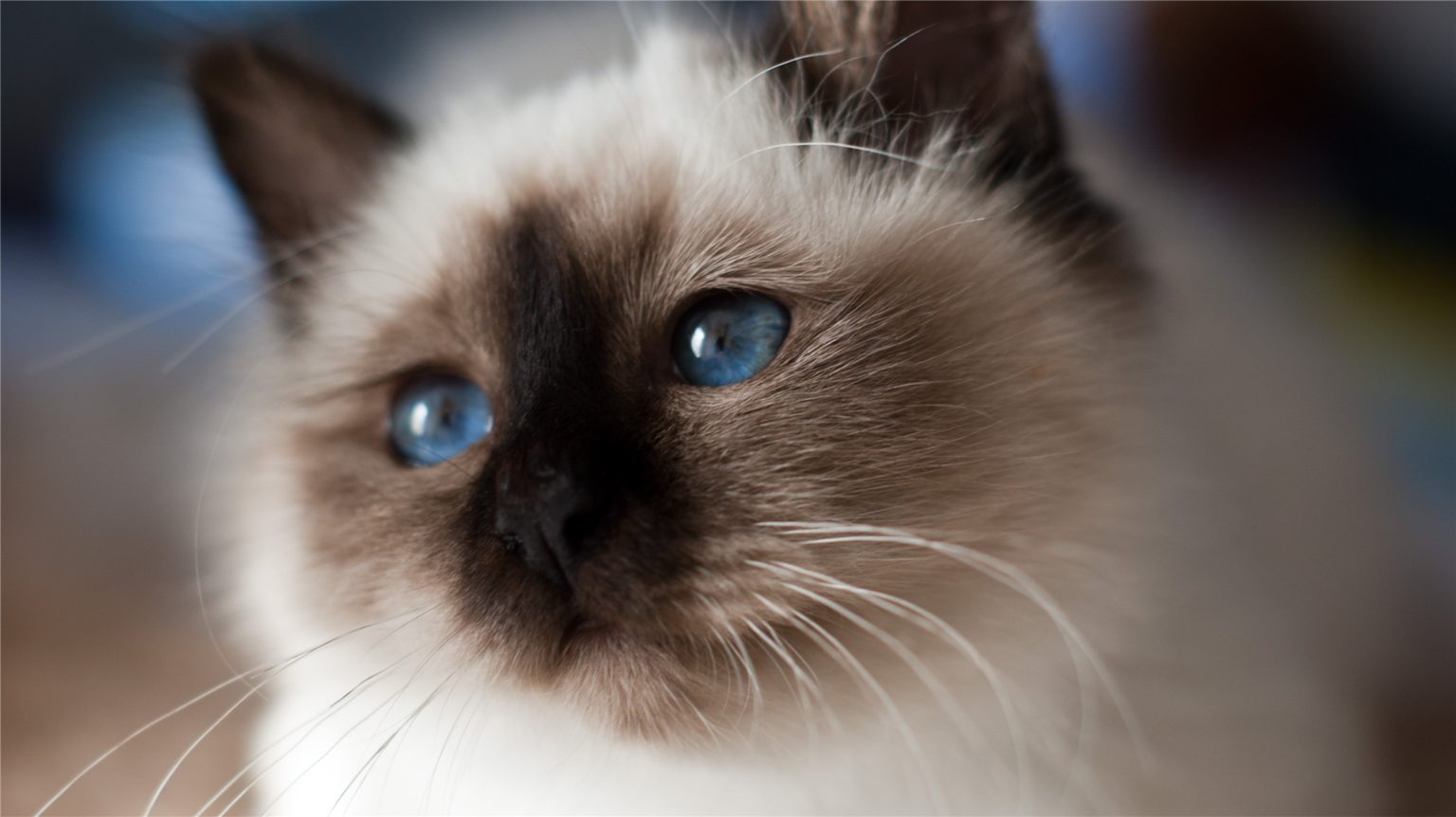
| Weight | 4–6 kg |
| Lifespan | 12–16 years |
| Coat | semi-long, silky, no undercoat |
| Recognition | CFA · TICA · WCF · FIFe |
| Origin | Myanmar / France |
Exact ratings
Common health issues
Nutrition
The Sacred Birman, or simply the Birman, is an exceptionally beautiful, semi-longhaired domestic cat breed, known for its distinctive colorpoint markings, deep blue eyes, and unique white “gloves” and “socks” on its paws. These cats are shrouded in legends that trace back to ancient temples in Burma (modern-day Myanmar) and combine elegance, a calm temperament, and a deep affection for people. To read more about cat breeds and pet care, you can check out the Tvaryny website.
This is not just a pretty pet; it’s a true companion that craves human attention and participation in family life. The Sacred Birman is the perfect choice for those who want a gentle, affectionate, and loyal cat ready to become a full-fledged family member. While Birmans can get along with other animals, they might show signs of jealousy if they feel they are not getting enough attention from their favorite human. This exquisite cat requires standard but regular grooming, especially for its luxurious coat, and a careful approach to nutrition. The breed is generally known for its robust health and an incredibly friendly, non-confrontational nature, making it a wonderful addition to many homes.
Sacred Birman: Key Breed Characteristics
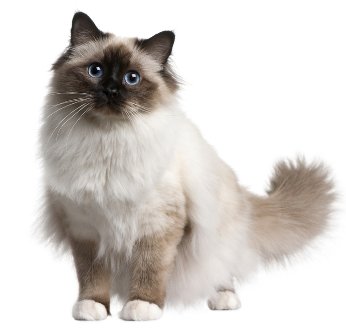
- Original Breed Name: Birman (Sacred Birman)
- Origin: Myanmar (legendary), France (official establishment)
- Breed Recognition: France (1925), Great Britain (GCCF, 1966), USA (CFA, 1967), TICA, FIFe
- Lifespan: 12-16 years, often longer with proper care
- Size: Medium to large, with a sturdy build
- Weight: Males: 10-18 lbs; Females: 6.5-12 lbs
- Coat: Semi-long, silky, with a minimal undercoat
- Color: Colorpoint (various options) with mandatory white “gloves” on the front paws and “socks” with “laces” on the back paws
- Eyes: Large, almost round, expressive, rich, deep blue color
- Temperament: Gentle, affectionate, loyal, calm, playful, intelligent, curious, social, patient
- Grooming: Moderate (regular brushing 1-2 times per week)
- Activity Level: Moderate, loves to play but is not hyperactive
- Compatibility: Gets along well with children, other cats, and dogs
- Voice: Quiet, soft, melodic
The Mysterious History of the Sacred Birman: From Temple Legends to Global Recognition
The origin of the Sacred Birman is shrouded in a veil of mysticism, where truth is closely intertwined with beautiful legends. There are two main versions of how these amazing cats came to be: one is a romantic tale that leads to the sacred temples of ancient Burma, and the other is a pragmatic account tied to deliberate breeding in France.
The temple legend, which gave the breed its name “The Sacred Cat of Burma,” is one of the most famous in the feline world. It tells of a mountain temple called Lao-Tsun, dedicated to a golden goddess with sapphire-colored eyes named Tsun-Kyan-Kse. In this temple lived white, long-haired cats with yellow eyes, who were believed to be the reincarnated souls of deceased Kittah monks. The head priest, Mun-Ha, was particularly fond of his white cat named Sinh. During a fierce attack by bandits on the temple, Mun-Ha was mortally wounded at the foot of the goddess’s statue. In that tragic moment, the loyal Sinh placed his paws on his master’s body, his head on his chest, and looked into the sapphire eyes of Tsun-Kyan-Kse. A miracle occurred: the cat’s fur took on a golden hue, like the glow of the goddess, his eyes became a deep blue, and his paws, which touched the monk’s gray hair, remained a brilliant white—a symbol of the purity of his soul. Only the tips of his paws stayed white. The next day, all the other temple cats underwent the same magical transformation. The legend claims that when a sacred cat dies, its soul accompanies the monk’s soul to paradise. The Birmans’ white “gloves” are still considered a sign of their holiness.
Historical facts point to France as the place where the breed was established in the early 20th century. The exact circumstances of the first Birmans’ arrival in Europe remain a subject of debate. According to one of the most common versions, in 1919, a pair of cats (a male named Maldapour and a female named Sita) was secretly taken from the Lao-Tsun temple and sent to France. The male died on the journey, but the pregnant Sita survived and gave birth in Nice to a kitten named Poupée de Maldapour, who became the progenitor of the European line. Other sources suggest the cats were purchased or received as gifts by members of the Vanderbilt family or by Major Gordon Russell and Auguste Pavie during their travels in the East. There is also a theory that the Sacred Birman is the result of crossbreeding between Siamese cats (from which they inherited their colorpoint markings and blue eyes) and Persian cats (from which they got their longer fur and sturdier build) in France. It’s possible that white domestic cats were also involved to solidify the white markings on the paws. For instance, the Russian Blue and Ocicat breeds have very different origins, and their histories highlight the diverse paths of feline evolution.
Regardless of the precise path of their origin, the breed was officially registered in France in 1925 under the name Sacré de Birmanie. The population suffered significant losses during World War II, and according to some accounts, only two purebred Birmans remained in Europe by the end of the war—Orloff and Xenia de Kaabaa. Thanks to the dedicated work of enthusiastic breeders, who used careful crossbreeding (possibly with Persians and Siamese again) to restore the gene pool, the breed was saved. In the 1950s, Birmans began appearing in other countries. They were recognized in Great Britain in 1966 and by the Cat Fanciers’ Association (CFA) in the USA in 1967. Today, the Sacred Birman is a beloved breed in many countries around the world, winning hearts with its beauty, gentle nature, and mysterious origins.
What the Sacred Birman Looks Like: Breed Standard and Unique Features
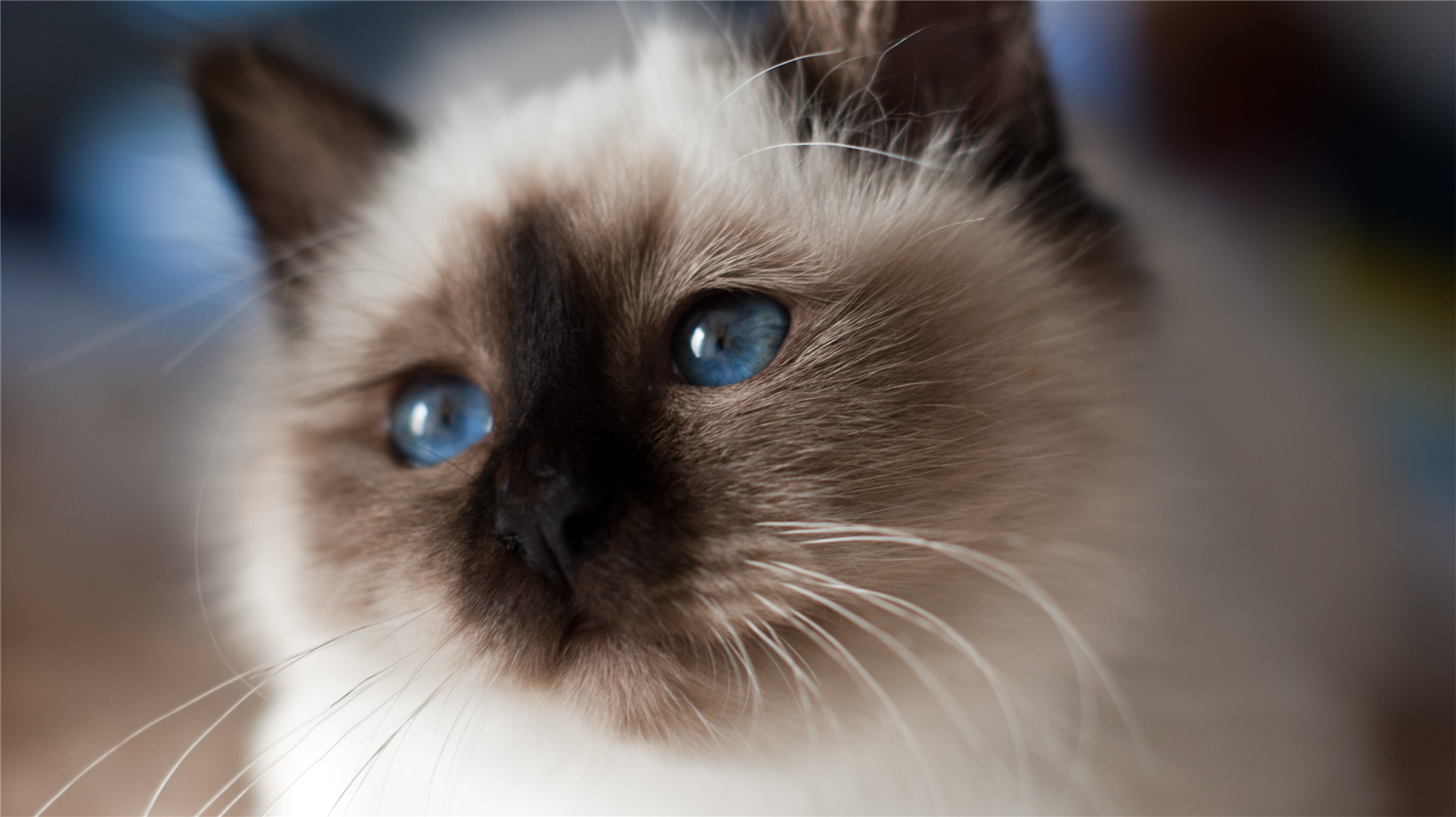
The Sacred Birman is a harmoniously built cat of medium to large size, combining strength and elegance. Its appearance is striking, with the contrast of dark points, a light-colored body, bright blue eyes, and characteristic white “stockings.”
- Overall Impression: A sturdy, slightly elongated cat with well-developed muscles and bone structure, but not massive.
- Head: Strong, broad, and slightly rounded. The forehead is slightly convex, and the cheeks are full. The nose is medium-length with a characteristic “Roman profile” (a slight bump), without a sharp break (stop) but with a noticeable indentation at the base. The muzzle is broad and rounded. The chin is strong and vertical.
- Ears: Medium-sized, not too large, set fairly wide apart, and tilted slightly forward. The base of the ear is wide, and the tips are rounded. The inner part of the ear is well-furred.
- Eyes: One of the most defining features of the breed. They are large, wide-set, and almost round, though the outer corner can be slightly uplifted. The color is a rich, deep blue (sapphire). The more intense the color, the better. The expression is soft and calm.
- Body: Long, sturdy, with a powerful chest and a straight backline. The musculature is well-developed.
- Legs and Paws: Legs are medium length, strong, with good bone structure. The paws are large, round, and compact. The most characteristic trait is the white markings on all four paws:
- Front Paws: Have symmetrical white “gloves” that end in a straight line across the paw at the joint level between the toes and the metacarpus (ideally, at the level of the third joint).
- Back Paws: Have white “socks” or “laces” that completely cover the toes and rise up the back of the leg in a sharp wedge—the “gauntlets.” Ideally, the gauntlets should be symmetrical, not extend past the hock joint, and be of equal height on both legs.
- White Markings Requirements: A pure white color, clear boundaries, and symmetry are very important criteria for evaluation, especially for show animals. Any colored spots on the white or white spots on the points are considered faults.
- Tail: Medium length, proportional to the body. It is fluffy, especially at the tip, and has the shape of an elegant plume or feather. The cat usually holds it high.
- Coat: Unique texture—semi-long, silky, and very pleasant to the touch. It has a minimal undercoat, which means the fur is not prone to severe matting or knotting, unlike Persians. A lush collar or “ruff” forms around the neck and chest, and the fur on the belly can be slightly wavy. The fur is short on the face, gradually lengthening on the cheeks, back, and sides.
- Color: All Birman cats have acromelanic (colorpoint) coloring. This means a light main body color (ranging from white to beige or golden, depending on the specific color) and contrasting dark markings (points) on the face (mask), ears, legs (except for the white gloves/socks), and tail. The contrast between the points and the body should be distinct. Kittens are born white, and the points develop gradually.
Recognized Sacred Birman Colors
The standards of various cat associations recognize a wide range of point colors in the Sacred Birman. Here are the main ones:
| Point Color Name | Point Description | Body Color | Paw Pads / Nose Leather |
|---|---|---|---|
| Seal | Deep dark brown, “seal color” | Pale fawn to warm creamy beige, darkens with age | Dark brown / Dark brown |
| Blue | Deep grayish-blue | Cool off-white or silvery gray shade | Dark gray / Slate gray |
| Chocolate | Warm milky-chocolate brown | Ivory, warm shade | Pinkish-brown / Cinnamon-pink |
| Lilac | Warm pinkish-gray, “frosty color” | Cool white (magnolia), without shading | Lavender-pink / Lavender-pink |
| Red | Bright orangey-red | White or warm cream | Pink / Pink |
| Cream | Warm pastel-cream, “apricot” | White | Pink / Pink |
| Tortie (Tortoiseshell) | A combination of the main color with red or cream patches | Corresponding to the main color, may have slight shading | Corresponding to the main color, may be mottled |
| Lynx / Tabby | Striped tabby pattern on the main color, “M” mark on the forehead, eye and nose outlines | Corresponding to the main color | Corresponding to the main color / May have a pink nose with a dark rim |
Note: Combinations also exist, such as Seal Tortie Lynx Point. The body color may darken slightly with age or exposure to cold temperatures, but the contrast with the points should be maintained.
“Golden” Personality: Temperament and Behavior of the Sacred Birman
The Sacred Birman is famous for its exceptionally gentle, balanced, and loving personality. This breed is often described as the “ideal companion” because it combines the traits of calm and active cats, creating a harmonious “golden mean.”
- Extreme Gentleness and Affection: Birmans adore physical contact. They will happily sit on your lap, sleep next to you in bed, rub against your legs, and offer a quiet, melodic purr. These cats are literally made for hugs and affection.
- Deep Affection for Humans: These are highly social animals, oriented toward their human family. A Birman often becomes a “tail” to its owner, following them around the house, watching their activities, and trying to get involved. They need daily interaction and do not tolerate long periods of loneliness well. If you spend a lot of time away from home, you should consider getting a second cat to be a companion for your Birman.
- Calm and Composed: Unlike some more active breeds, Birmans are generally very calm and level-headed. They are not prone to frantic behavior, destruction, or excessive meowing without reason. Their behavior is filled with dignity. They appreciate a quiet, harmonious atmosphere at home.
- Playfulness Throughout Life: Despite their calm nature, Birmans are not couch potatoes. They maintain an interest in games at any age. They particularly enjoy interactive games with their owner—”hunting” a feather on a stick, chasing a laser dot (with caution!), or playing with balls or toy mice. A few short play sessions a day will help keep them in good physical and emotional shape.
- Intelligence and Cleverness: Sacred Birmans are quite intelligent and curious cats. They quickly learn household rules and are easily litter- and scratch-post-trained. They can be taught simple tricks, like responding to their name, and some can even be taught to fetch toys or walk calmly on a leash. Their natural curiosity prompts them to explore new objects and places.
- Exceptional Patience and Tolerance: This is one of the key traits of a Birman’s character. They are very patient and non-aggressive, which makes them wonderful companions for children (provided the children treat the cat gently and with respect). Birmans also generally get along well with other pets, including other cats and dogs, especially if they are introduced at a young age. They would rather avoid conflict than get into a fight.
- Quiet Voice: Birmans are not a “talkative” breed. Their voice is quiet, soft, and melodic. They might “talk” to you with a soft purr or a gentle meow to get attention or ask for something, but they won’t annoy you with loud yowling.
- Adaptability: While they appreciate stability, Birmans are quite adaptable to changes in their environment as long as they feel loved and cared for by their owners.
It’s worth remembering that while Birmans are tolerant, they can show jealousy if they feel a lack of attention, especially if a new pet or family member has joined the household. It’s important to give them enough individual attention so they feel loved and needed.
Sacred Birman Health: Common Ailments and Prevention
Caring for a Sacred Birman: Coat, Hygiene, and Comfort

Caring for a Sacred Birman is not overly complicated but requires regularity, especially regarding its luxurious coat. Thanks to its minimal undercoat, it’s less prone to matting than a Persian’s, but it still needs attention.
- Coat Care:
- Brushing: It’s recommended to brush a Birman 1-2 times a week using a high-quality metal comb with varying tooth spacing or a special brush for long-haired cats (a Furminator is usually not necessary). This helps remove dead hair, prevent matting (which can still occur in the armpit, belly, and “pants” areas), and distribute natural oils through the coat, giving it a shine. During shedding periods (usually spring and fall), you may need to brush more often, possibly daily.
- Bathing: You should only bathe a Birman when necessary, for example, if the cat is very dirty or before a show. Use a special shampoo for long-haired cats. After bathing, thoroughly dry the coat with a towel and a hairdryer (on low heat and speed), brushing at the same time to prevent tangles.
- Eye Care: Birmans rarely have problems with excessive tearing, but you should regularly check the corners of their eyes. If there are small discharges or crusts, you can gently remove them with a soft, damp cloth or a special eye lotion.
- Ear Care: Once a week, check the ears for dirt, excess wax, or signs of infection (redness, unpleasant odor). You should only clean the ears if necessary, using a cotton pad or gauze soaked in a special ear-cleaning lotion. Never use cotton swabs, as they can damage the eardrum.
- Nail Trimming: Trim the tips of the claws every 2-3 weeks using special cat nail clippers. This will help prevent ingrown claws and save your furniture. Be sure to get a scratching post (or several different types) to satisfy the cat’s natural need to sharpen its claws.
- Dental Care: Regular oral hygiene is very important to prevent periodontitis and other problems. Ideally, you should brush your cat’s teeth with a special brush and toothpaste for animals several times a week. If this is difficult, you can use special dental care foods, treats, or gels.
- Comfortable Environment: Provide your Birman with a warm, cozy place to sleep, away from drafts. They appreciate soft beds or cat houses. It’s also important to provide access to clean drinking water (some Birmans love drinking fountains) and a clean litter box.
Recommended Sacred Birman Care Schedule
| Procedure | Frequency | Notes |
|---|---|---|
| Brushing the coat | 1-2 times a week (more often during shedding) | Use a metal comb or brush for long-haired cats. |
| Eye checks and cleaning | Daily / as needed | Remove discharge with a soft, damp cloth. |
| Ear checks | Weekly | Clean only if dirty with a special lotion. |
| Nail trimming | Every 2-3 weeks | Use special cat nail clippers. |
| Teeth brushing | Several times a week (ideally) | Use a cat toothbrush and toothpaste or alternative products. |
| Bathing | As needed | Use a special shampoo. |
| Veterinary check-up | 1-2 times a year | Vaccinations, parasite prevention, general exam. |
Training and Socialization for a Smart Birman
The Sacred Birman is not only a beautiful but also a quite intelligent and clever cat that responds well to training and socialization. Its natural curiosity, human-oriented nature, and calm temperament make the learning process relatively easy and enjoyable.
- Learning Basic Rules: Birmans quickly understand where the litter box and scratching post are, especially if they are taught from a young age. Positive reinforcement (praise, affection, treats) works much better than punishment.
- Intelligence and Training: Thanks to their intelligence, Birmans can be taught various commands and tricks, such as “sit,” “give paw,” or “fetch a toy.” They respond well to clicker training. Their curiosity and desire to follow their owner make it easy to engage them in training sessions. It’s important to conduct training as short, interesting play sessions so the cat doesn’t lose interest. Coercion and pressure are completely ineffective and may only frighten the animal.
- Harness Training: Many Birmans are calm about wearing a harness and leash, which allows them to be taken on safe, supervised walks outside. You should start the training gradually from a young age, letting the cat get used to the harness at home.
- Socialization: Early socialization is very important for a Birman to grow into a confident and friendly cat. Introduce the kitten to different people, sounds, situations, and (if planned) other animals in a controlled, positive environment. Thanks to the Birman’s natural tolerance, the socialization process usually goes smoothly.
- Using Interactive Toys: To stimulate a Birman’s mind and prevent boredom, use interactive puzzle toys that require the cat to make an effort to get treats.
Remember that patience, consistency, and positive reinforcement are the key elements of successful training and raising a Sacred Birman. Their desire to please their owner and their natural cleverness make them wonderful students.
Sacred Birman Nutrition: How to Please a Picky Eater
Pros and Cons of the Sacred Birman Breed
Like any breed, the Sacred Birman has its advantages and potential disadvantages that future owners should consider.
| Pros (+) | Cons (-) |
|---|---|
| Extremely gentle and affectionate nature: The ideal companion for those who want a loving cat. | Requires a lot of attention: Does not tolerate loneliness well, can become clingy or jealous if it doesn’t get enough interaction. Not suitable for people who are constantly away from home. |
| Calm and balanced temperament: Not prone to aggression or destructive behavior. | Picky eating habits: Some members of the breed can be very fussy about food. |
| Highly social: Gets along well with children and other pets. | Needs regular grooming: Although the coat doesn’t mat as easily as a Persian’s, it needs to be brushed 1-2 times a week. |
| Beautiful and striking appearance: Blue eyes, colorpoint markings, and white “gloves” make them unique. | Predisposition to certain hereditary diseases: The need for careful breeder selection and potential costs for veterinary care (screenings for HCM, PKD). |
| Intelligent and clever: Responds well to training and socialization. | Sensitive to cold and drafts: Requires a warm place to rest. |
| Quiet voice: Does not annoy with loud meowing. | Relatively high cost of kittens: The range is wide and depends on the paperwork, the parents’ health clearances and the class of the animal. |
| Moderate activity level: Playful but not hyperactive. | Prone to weight gain: Requires control over diet and activity. |
Fun Facts About the Sacred Birman
- The white “gloves” are a genetic mystery: The gene responsible for the Birman’s characteristic white paw markings (the gloving gene, symbol gl) is recessive and not yet fully mapped. Achieving perfectly symmetrical and correctly shaped gloves and socks is one of the most difficult tasks for breeders.
- Born white: Like all cats with colorpoint markings, Birman kittens are born completely white. The darker points and blue eye color develop during the first weeks of life under the influence of temperature (colder body parts darken).
- “Velcro cat”: Because of their immense need for human attention and their habit of following their owner, Birmans are sometimes jokingly called “Velcro cats.”
- Not to be confused with the Burmese: The name “Birman” is often confused with the “Burmese” breed. They are completely different breeds with distinct appearances, histories, and temperaments. The Burmese is a short-haired cat with a round head and golden eyes.
- Inspired Karl Lagerfeld: The famous fashion designer Karl Lagerfeld adored his white Birman cat named Choupette. She became a true social media star, had her own maids, a private jet, and even “inspired” the creation of cosmetic and accessory lines.
- Temperature-dependent coloring: A Birman’s coat color can change slightly depending on the ambient temperature. In a colder climate or during winter, the points may become darker, and the body color may become a little more saturated.
- Similarities to other breeds: With its colorpoint markings and blue eyes, the Sacred Birman resembles Siamese and Himalayan cats, while its size, fluffy coat, and gentle nature share some similarities with Ragdolls. However, the unique white “gloves” and the specific coat texture without an undercoat set the Birman apart from other breeds.
Frequently Asked Questions About the Sacred Birman (FAQ)
Do Sacred Birmans shed a lot?
Yes, Birmans shed like most cats, especially seasonally (spring, fall). However, thanks to the lack of a dense undercoat, their shedding can be less intense than in some other long-haired breeds. Regular brushing helps to control the amount of hair in the house.
Are Sacred Birmans good for people with allergies?
Unfortunately, there are no completely hypoallergenic cat breeds. Birmans produce the Fel d 1 allergen (a protein in their saliva and sebaceous glands), just like other cats. While some people with mild allergies may tolerate Birmans better due to their less dense undercoat (meaning less loose hair is spread around), this is highly individual. Before getting a Birman, people with allergies are recommended to spend time with members of the breed.
How much does a Sacred Birman kitten cost?
The cost of a Sacred Birman kitten from a responsible breeder can vary significantly depending on the lineage, quality (pet, breeder, show-class), color, and region. Expect a wait: established breeders have their litters spoken for well in advance.
Can a Sacred Birman be kept exclusively indoors?
Yes, Birmans thrive in an indoor-only environment. They do not need to go outside to live a happy life, provided they are given enough attention, playtime, a safe environment, and places to climb and observe (such as cat trees by a window).
Do Sacred Birmans require a lot of coat maintenance?
Compared to Persian cats, a Birman’s coat is easier to care for due to its minimal undercoat. However, regular brushing (1-2 times a week) is still necessary to prevent matting and keep the coat in good condition. This is not a breed you can neglect brushing entirely.
Why are Sacred Birmans’ eyes always blue?
The blue eye color in Birmans (as in Siamese and Ragdolls) is linked to the same gene responsible for their colorpoint markings (temperature-sensitive albinism). This gene limits the production of the melanin pigment not only in the fur but also in the iris of the eye. The absence of pigment in the front layer of the iris causes light to reflect off the deeper layers, creating the appearance of a blue color (similar to why the sky appears blue).
How long do Sacred Birmans grow?
Birmans are a slow-developing breed. They reach their full physical size and final coloring at approximately 2-3 years of age.
- Calm, tender, “dog-like”
- A striking colorpoint with white “gloves”
- Devoted, good with children and animals
- Quiet, ideal for an apartment and a novice
- The semi-long coat needs regular brushing
- Dislikes being left alone for long
- A tendency to heart disease (HCM) and PKD
- Attached — needs the family's attention
| Ragdoll | Siamese Cat | Turkish Angora | |
|---|---|---|---|
| Weight | 4.5–9 kg | 3–5 kg | 2.5–5 kg |
| Energy | 3 | 4.5 | 4 |
| Apartment | 5 | 5 | 4.5 |
| Beginners | 4.5 | 3 | 3.5 |
Where do the Birman's white “gloves” come from?
How does the Birman differ from the Ragdoll?
Is the Birman good for a family and a novice?
CFA / TICA / WCF / FIFe standards (Birman)
For apartments · For kids · For beginners · Most affectionate · Quietest · Hypoallergenic · All rankings →