

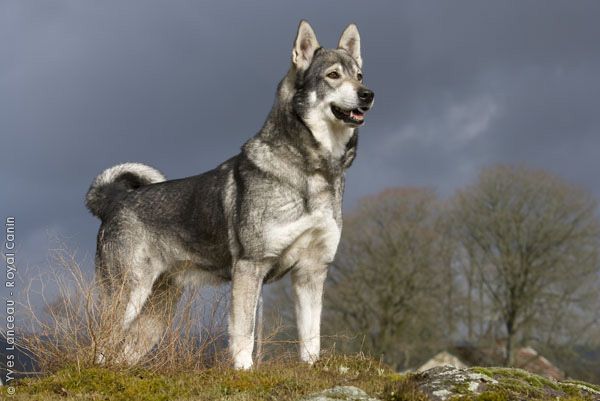
| Height | 52–65 cm |
| Weight | 25–35 kg |
| Lifespan | 12–14 years |
| FCI group | 5 · spitz and primitive |
| Origin | Sweden |
Exact ratings
- Sturdy overall — but with the cautions listed below
- Hip dysplasia
- Progressive retinal atrophy (PRA)
- A tendency to boredom without work
- The dense undercoat sheds heavily by season
A quality protein diet for a very active breed, with weight control. Intense exercise and an outlet for the hunting instinct are a must; secure fencing; regular brushing of the dense coat.
The Jämthund, or Swedish Elkhound, is a majestic and powerful hunting dog that embodies the wild nature of Scandinavia. These dogs need fresh forest air, the freedom to roam, and vast spaces to fulfill their instincts. They are versatile hunters, capable of working with small fur-bearing animals and birds, as well as large predators such as moose, bear, or lynx. Their hunting style is similar to other Laikas: they independently track down their prey and then hold it in place with a loud, ringing bark, alerting the hunter to their location. You can learn more about this unique breed and its characteristics on Tvaryny.
These are exceptionally resilient dogs, capable of working for hours in the most severe weather conditions, from deep snow to marshy terrain. Their courage and fearlessness are legendary. At the same time, the Jämthund is strongly bonded to its owner, is good with children in its family, and does not display unwarranted aggression towards people. Although he will always alert you to the approach of strangers with a loud bark, he should not be used as a chained guard dog. Such a life is a true prison for him. These dogs need a lot of running, preferably in the wild, and hunting. This is their main purpose and the meaning of their life.
Jämthund (Swedish Elkhound): A Brief Breed Overview
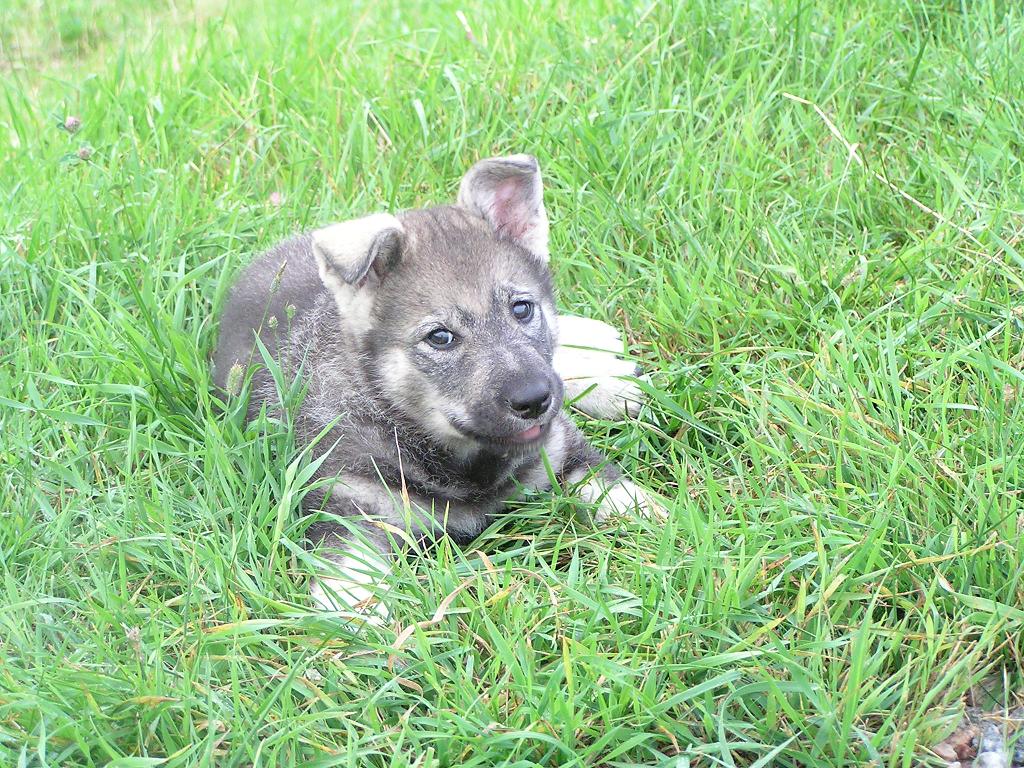
| Characteristic | Value |
|---|---|
| Breed Name | Jämthund, Swedish Elkhound |
| Country of Origin | Sweden (Jämtland province) |
| FCI Classification | Group 5 (Spitz and Primitive Types), Section 2 (Nordic Hunting Dogs) |
| Year of Breed Recognition | 1946 |
| Life Expectancy | 12-14 years |
| Height at Withers | Males: 57-65 cm, Females: 52-60 cm |
| Weight | Males: 25-35 kg, Females: 20-30 kg |
| Temperament | Brave, energetic, balanced, loyal, independent |
| Primary Purpose | Hunting large game (moose, bear), a companion dog for active people |
History of the Jämthund Breed
The history of the Jämthund stretches back to ancient times and is closely intertwined with the lives of people in the harsh northern regions of Scandinavia. These dogs are descendants of ancient Spitz-type dogs that have accompanied hunters and gatherers for millennia. Archaeological finds indicate that dogs of a similar type existed in what is now Sweden, particularly in the province of Jämtland, as far back as prehistoric times. They were not just hunting aids but full members of communities, performing roles as guards and companions.
For centuries, Jämthunds were bred exclusively for their working qualities. The main selection criteria were endurance, courage, the ability to work in extreme conditions, and hunting passion. For a long time, they were not recognized as a separate breed and were often confused with their smaller relative, the Norwegian Elkhound Grey. Both breeds were used for hunting moose (Swedish “älg,” hence the name “Elkhound” – moose dog), but the Jämthund was always larger, more powerful, and specialized in bigger game. While the Norrbottenspets is another small Swedish hunting spitz, the Norwegian Elkhound Black is a close relative that differs in its coloring and more compact build.
It was only at the beginning of the 20th century that enthusiasts began working on the standardization and official recognition of the breed. They aimed to preserve the unique characteristics of the large hunting dogs from Jämtland. Thanks to their efforts, in 1946, the Swedish Kennel Club officially recognized the Jämthund as a separate breed. The first standard was written in 1953, solidifying its status and distinctions from other Scandinavian Laikas. Today, the Jämthund is the national dog of Sweden, highly valued in its homeland, but it remains quite rare outside of Scandinavia.
What the Jämthund Looks Like: A Detailed Description of Appearance
The Jämthund is a large Spitz-type dog that conveys an impression of strength, endurance, and confidence. It has a robust, somewhat elongated build, yet remains agile and elegant.
- Head: Wedge-shaped, elongated, with a broad, slightly rounded skull. The stop (transition from forehead to muzzle) is clearly defined but not too abrupt. The muzzle is long, gradually tapering towards the nose. The bridge of the nose is straight, and the nose itself is large and black. Lips are dry and tightly fitting.
- Eyes: Oval in shape, medium-sized, usually dark brown. The gaze is calm, attentive, and intelligent.
- Ears: Set high, erect, triangular in shape with pointed tips. Very mobile, indicating the dog’s keen hearing.
- Body: Strong, with a powerful neck devoid of dewlaps. The chest is deep and broad, providing ample room for lungs and heart. The back is straight and strong. The loins are broad and muscular.
- Limbs: Straight, parallel, with strong bone structure and well-developed musculature, which is key to endurance during prolonged running. Paws are oval, tightly knit.
- Tail: Set high, of medium length. The dog carries it curled into a tight ring, resting on its back or to its side.
- Coat: Typical for northern breeds – double. The outer coat is harsh, straight, and lies close to the body. The undercoat is very thick, soft, and light (almost white), providing excellent protection against cold and moisture. On the head and front of the limbs, the hair is short, while on the neck, chest, tail, and back of the legs, it is longer, forming a “collar” and “trousers.”
- Color: Various shades of wolf-gray (zonary gray). A characteristic feature is the light (cream or light gray) markings on the muzzle, cheeks, throat, chest, belly, legs, and under the tail. These lighter areas create a typical “wolfish” appearance.
Character: Temperament and Behavior of the Jämthund
The character of the Jämthund is a unique blend of calmness and hunting fervor. At home, he is a balanced, sensible, and very loyal dog. He is affectionate with his family, patient with children he grows up with, and needs human attention and love. However, this is not a breed that will constantly demand affection. The Jämthund is self-sufficient and can calmly observe what is happening, lying in his corner.
But everything changes when the dog enters the forest. Here, his primal instincts awaken. He becomes energetic, tireless, and incredibly purposeful. Hunting is his passion and the meaning of his life. Jämthunds are renowned for their bravery, bordering on fearlessness. They are not afraid to confront large predators such as bears, lynx, or moose, holding them until the hunter arrives. This breed possesses high intelligence and is capable of making independent decisions in complex situations, which is extremely valuable in hunting. At the same time, they remain obedient and are always focused on the owner, with whom they work in a close tandem.
Towards strangers, the Jämthund is wary but not aggressive. He will certainly warn of guests’ arrival with a loud bark. With other dogs, especially large ones, competition for dominance can arise, so early socialization is extremely important.
Pros and Cons of the Jämthund Breed
| ✅ Pros | ❌ Cons |
|---|---|
| Exceptional Hunter: One of the best breeds for hunting large game. | Requires immense physical exertion: Not suitable for apartment living or inactive people. |
| Robust Health: no breed-wide list of hereditary diseases has been compiled — “not described” means “not studied”, not “not there”. | Strong Hunting Instinct: May run off chasing prey, requires secure fencing. |
| Family Devotion: Very attached to its owner and gets along well with children. | Independent Nature: Can be stubborn, requires an experienced owner. |
| Balanced Temperament: Calm and sensible in a home environment. | Needs Space: Best suited to a country house with a large territory. |
| Low Maintenance: Coat doesn’t require complex grooming, just brushing during shedding season. | Tendency to Dominate: May conflict with other dogs of the same sex. |
Jämthund Health: Typical Diseases and Prevention
The Jämthund, like most aboriginal breeds that have undergone rigorous natural selection, boasts excellent health and a strong immune system. Health is generally robust, but no breed-wide list of hereditary diseases has been compiled — “not described” means “not studied”, not “not there”. However, as with any large dog, there are certain risks that an owner should be aware of.
- Hip Dysplasia: While not a widespread disease for the breed, it occasionally occurs in large and active dogs. It’s important to choose a puppy from verified parents who have undergone appropriate testing.
- Progressive Retinal Atrophy (PRA): Some lines may be prone to this eye disease. Responsible breeders test their dogs for the presence of this gene.
- Urinary Stones: The original text mentioned the formation of stones in the urinary tract. This can indeed be a problem, often associated with improper nutrition (excess protein, minerals) and insufficient water intake. It’s crucial to provide the dog with access to clean water and a balanced diet.
- Injuries: As an active hunting dog, the Jämthund is prone to working injuries: cuts, sprains, and bites from wild animals. It’s important to always carry a first-aid kit and regularly inspect the dog after walks in the forest.
Prevention is key to a long and healthy life for your beloved pet. Regular vaccinations and treatment for parasites (fleas, ticks, worms) are mandatory, especially for a hunting dog that comes into contact with wild fauna. Annual preventive check-ups with a vet will help detect any problems at an early stage.
How to Care for and Keep a Jämthund
The Swedish Jämthund is a free-spirited dog that would be cramped and unhappy in a city apartment. Ideal conditions for him are a country house with a large, securely fenced area where he can run freely. It’s best to keep him in a spacious kennel with an insulated dog house. Despite his dense coat, which protects against bad weather, the dog should have a place to shelter from rain, scorching sun, and severe frost.
Caring for the Jämthund’s coat is straightforward but requires regularity. His dense coat needs to be brushed 1-2 times a week to remove dead hair and prevent matting. Twice a year, in spring and autumn, Jämthunds undergo intense shedding, during which they shed their entire thick undercoat. During this period, the dog will need daily brushing. Frequent washing of these dogs is not recommended. Their coat has a natural protective layer that repels dirt and water. Frequent washing removes this layer, so bathing should only be done in cases of heavy soiling. Also, don’t forget standard hygiene procedures: regular ear cleaning, eye checks, and nail clipping if they don’t wear down naturally.
Training and Socialization
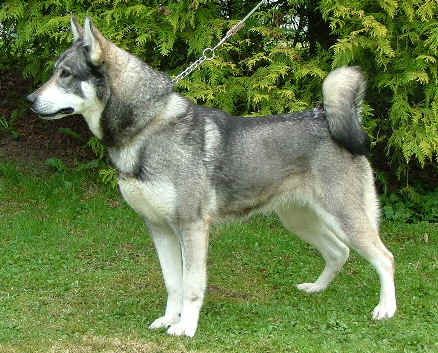
Training a Jämthund is a task for an experienced and patient owner. These are very intelligent dogs that quickly grasp commands, but their independence and innate tendency to make their own decisions can complicate the process. They were bred to work at a distance from the hunter, so blind obedience is not inherent to them. You should never shout at a Jämthund or use harsh force – this will only undermine your trust and lead to stubbornness. The best approach is positive reinforcement, consistency, and building a partnership. Understanding other Nordic hunting breeds, such as the Karelian Bear Dog or the West Siberian Laika, can provide valuable insights into working with these independent dogs.
From an early age, a puppy should be introduced to the forest, various sounds, smells, people, and other animals. Early socialization is crucial for raising a well-balanced adult dog. There’s no need to try to turn a Jämthund into a circus performer by teaching him a multitude of unnecessary tricks. The main focus should be on obedience commands, recall, and impulse control. If the dog is intended for hunting, its training (field preparation) should begin at a young age, ideally under the guidance of an experienced hunter or with more experienced dogs.
Jämthund Nutrition: Key Recommendations
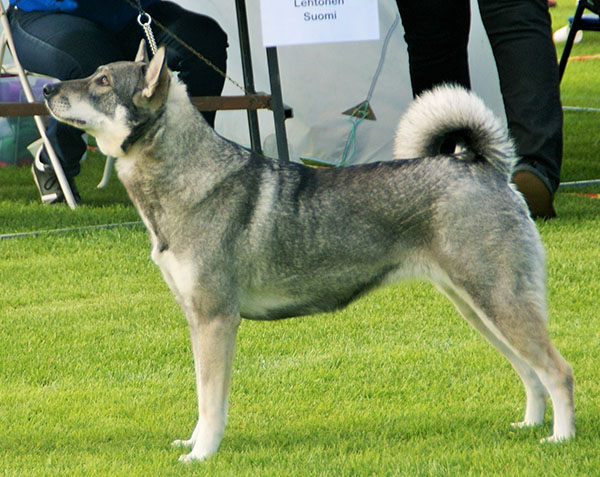
The diet of a working dog like the Jämthund must be balanced and high in energy. Under no circumstances should the dog be overfed, as excess weight creates additional strain on joints and the heart. The diet should be based on high-quality animal protein (meat, fish, offal).
During periods of high exertion (hunting season, intense training), the caloric content of the diet should be increased. Many owners use high-quality dry foods specifically formulated for active large-breed dogs, supplementing them with natural products. If the dog is temporarily not hunting and leads a less active lifestyle, the portion should be reduced to avoid weight gain. In addition to meat, it’s beneficial to add small amounts of vegetables (carrots, pumpkin), fermented dairy products, and fish oil to the diet. Always ensure the dog has free access to fresh, clean water, especially in hot weather and after physical exertion.
Jämthund and Other Nordic Breeds
The Jämthund is often compared to other Scandinavian and Siberian hunting Laikas. Although they share common roots and a similar purpose, there are significant differences between them. Some, such as the Norrbottenspets, are considerably smaller, while the Norwegian Elkhound Black differs in color and is more compact.
| Breed | Primary Purpose | Size (Height at Withers) | Temperament |
|---|---|---|---|
| Jämthund (Swedish Elkhound) | Hunting moose, bear | 57-65 cm (males) | Calm, brave, independent |
| Norwegian Elkhound Grey | Hunting moose | 49-52 cm (males) | More energetic, “vocal”, playful |
| Karelian Bear Dog | Hunting bear, wild boar, moose | 54-60 cm (males) | Very keen, can be aggressive towards other dogs |
| West Siberian Laika | Universal hunter (fur-bearing game, large game, birds) | 55-62 cm (males) | Balanced, very people-oriented, versatile |
Interesting Facts About the Swedish Elkhound
- National Symbol: The Jämthund is officially recognized as the national dog of Sweden.
- Name Speaks for Itself: “Jämthund” literally translates to “dog from Jämtland” (a province in Sweden).
- Ancient Origin: The remains of a dog found in Överhogdal, Sweden, dated to 7000 BCE, strongly resemble the modern Jämthund.
- “King of the Forest”: In its homeland, Jämthunds are often called “King of the Forest” for their bravery and skill in moose hunting.
- Not Just a Hunter: Thanks to their strength and endurance, Jämthunds are also used as sled dogs and in rescue operations.
Frequently Asked Questions About the Breed (FAQ)
Is the Jämthund suitable for apartment living?
No, absolutely not. This breed needs space, a large area for exercise, and intense physical activity. Life within four walls will lead to destructive behavior and psychological problems for the dog.
Does the Jämthund shed a lot?
Yes, very heavily. Twice a year, a seasonal shed occurs, during which the dog completely changes its undercoat. During this period, hair will be everywhere, and daily brushing is essential.
Can a Jämthund be kept with other animals?
It’s challenging. A strong hunting instinct makes him dangerous to cats and other small domestic animals. He may get along with other dogs if he grew up with them, but he is prone to dominance, especially with dogs of the same sex.
Is the Jämthund a good guard dog?
He is an excellent “alert system” – he will always warn you with a loud bark about the approach of strangers. However, he is not a classic guard dog, as he typically does not display aggression towards people.
Video about the Breed
- A fearless, hardy all-round hunter
- Devoted to its master, good with the family's children
- Very robust "natural" health
- Resistant to the harshest cold
- A very strong hunting instinct (dangerous to cats)
- Loud — barks a lot (a working trait)
- Independent — not for an apartment or a novice
- Needs forest, space and work
| Norwegian Elkhound (Grey) | Norwegian Elkhound (Black) | Karelian Bear Dog | |
|---|---|---|---|
| Height | 49–52 cm | 46–53 cm | 49–57 cm |
| Energy | 4.5 | 4.5 | 5 |
| Apartment | 2 | 2 | 1.5 |
| Beginners | 2.5 | 2.5 | 1.5 |
What does the Jämthund hunt?
Is the Jämthund suitable for an apartment?
Is the Jämthund good with the family?
FCI Standard No. 42 · Svenska Kennelklubben
For apartments · For kids · For beginners · Active · Smartest · Hypoallergenic · All rankings →