

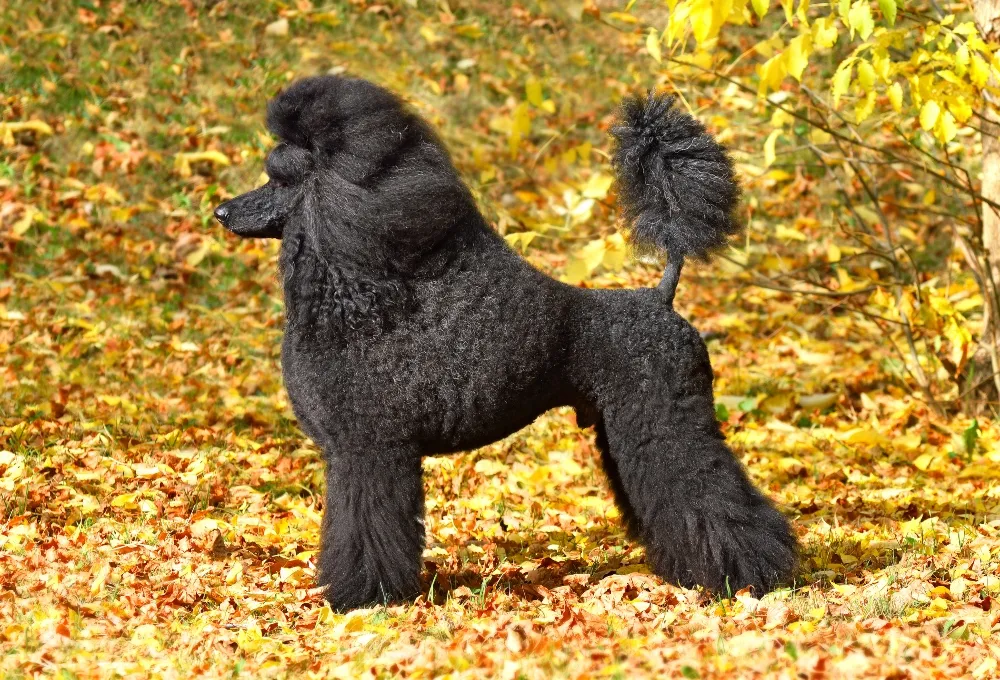
| Height | 35–45 cm |
| Weight | 9–15 kg |
| Lifespan | 12–15 years |
| FCI group | 9 · companion and toy dogs |
| Origin | France / Germany |
Exact ratings
- Generally a healthy breed
- Progressive retinal atrophy (PRA)
- Hip dysplasia
- Addison's disease (endocrine)
- Sebaceous adenitis (skin); gastric torsion (less often)
A balanced food for an active medium breed, with weight control. Regular professional grooming of the curly coat; provide exercise and mental activity (the poodle grows bored without work).
The Medium Poodle is an ancient and unique breed, blending outer elegance with exceptionally high intelligence and an unmatched ability to learn. The Medium Poodle isn’t just a decorative lapdog; it’s the descendant of skilled hunters and a talented performer. Your family will never have a dull moment with this cheerful, lively, and curly-coated companion, who is unlikely to cause trouble with disobedience or uncontrolled shedding. Often called the “golden mean” of the Poodle world, this variety fills a unique niche, offering the benefits of large and small dogs in one perfect package. Read more on Tvaryny.
At a Glance: Key Characteristics of the Medium Poodle
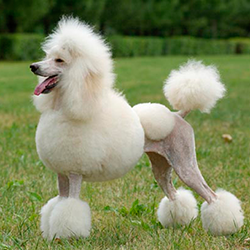
The Medium Poodle is officially recognized as the fourth Poodle size by the Fédération Cynologique Internationale (FCI). It perfectly bridges the gap between the Miniature and Standard sizes.
| Official Name | Poodle (Medium) / Kleinpudel / Caniche Moyen |
| Country of Origin | France (though Germany disputes this) |
| Year of First Mention (Size Standardization) | 1954 (official FCI recognition) |
| Lifespan | 12-15 years (often longer) |
| Height at Withers (FCI) | 35-45 cm (approx. 13.8 – 17.7 inches) |
| Weight (Approximate) | 8-15 kg (approx. 18 – 33 lbs) |
| FCI Group | Group 9 (Companion and Toy Dogs), Section 2 (Poodles) |
| Intelligence | Extremely high (ranks in the top 3 smartest breeds) |
| Shedding Level | Very low (considered hypoallergenic) |
| Grooming Need | Very high |
| Activity Level | High, requires mental and physical stimulation |
Breed History
The Poodle’s history is a fascinating story, shrouded in controversy over its true homeland. Although France is officially considered the breed’s country of origin (and it is the national dog of France), Germany also lays a strong claim. The name “Poodle” comes from the German word “Pudeln”, which means “to splash in water.” This is a direct reference to their original purpose.
Originally, Poodles were not salon pets, but hardworking water retrievers. They accompanied hunters of ducks and other waterfowl, fearlessly leaping into icy water to retrieve game. Their unique curly coat, while high-maintenance, provided excellent protection from the cold and damp.
Official recognition of the medium variety came in the first half of the 20th century, although these curly water hunters have been known since the Middle Ages. The classic “lion clip” seen in show rings today had a practical purpose. Hunters would shave the dog’s hindquarters to make swimming easier but left “pom-poms” of hair on the joints (paws, hips) and chest to protect vital organs and joints from the colld.
Over time, thanks to their exceptional intelligence, charisma, and elegant appearance, Poodles migrated from the hunting grounds to the fashionable salons of European aristocracy. They became favorites in royal courts, particularly in France. They were also used extensively in circus performances, where they performed amazing tricks that further highlighted their cleverness.
Breeding Poodles for size led to the emergence of four official varieties. The Medium Poodle (Moyen/Klein) was standardized to offer a dog that was more compact than the Standard Poodle, but more robust and sturdier than the Miniature Poodle. This size was perfectly suited for city life while retaining all the breed’s working potential and vitality.
What Does a Medium Poodle Look Like: Appearance and Standard
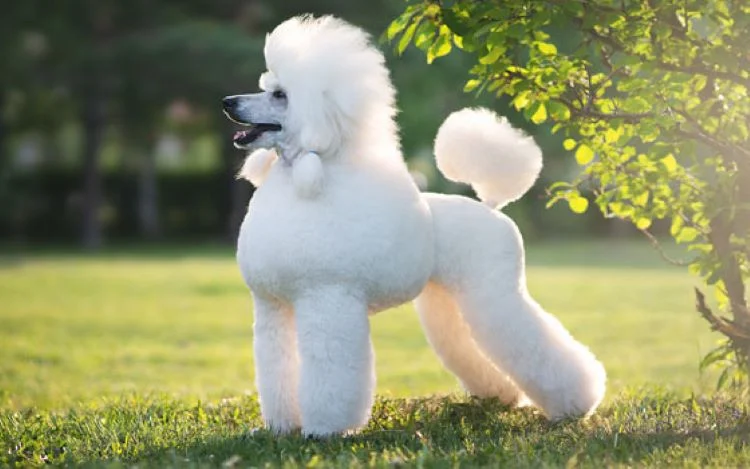
It’s hard to find someone unfamiliar with the Poodle’s distinctive appearance. This elegant, curly-coated breed is easily recognized even by children. The Medium Poodle is the embodiment of elegance, proportion, and harmony. It looks like a scaled-down version of the Standard Poodle, retaining all its noble features.
- General Appearance: A dog of harmonious proportions, with a characteristic curly or corded coat. Gives the impression of being intelligent, attentive, and active.
- Head: Elongated and proportional to the body. The muzzle and skull are roughly equal in length. The stop (transition from forehead to muzzle) is slight, not abrupt.
- Eyes: Almond-shaped, dark (black or dark brown). Dark amber is permissible in brown Poodles. The expression is lively, intelligent, and alert.
- Ears: Long, hanging, and set close to the head. Covered in very long, wavy hair. The tips of the ears should reach the corners of the lips.
- Body: Proportional. The body length is slightly greater than the height at the withers. The back is level, and the loin is strong and muscular.
- Tail: Set quite high, carried raised (but not curled over the back). Tails were traditionally docked, but this is now banned in most European countries, and the standard requires a full, natural tail.
The breed’s crowning glory is, of course, its coat. It comes in two types:
- Curly Coat: The most common type. The coat is dense, springy, abundant, and sheep-like. It forms tight, small curls. It should not feel harsh to the touch.
- Corded Coat: Less common. Forms characteristic thin cords that should be at least 20 cm (approx. 7.9 inches) long. This type of coat requires completely different, highly specific care.
Regarding color, the FCI standard recognizes several solid (self-colored) coats. Any markings or patches of another color are considered a fault.
| Color | Description |
|---|---|
| Black | Deep, rich black with no hint of red. |
| White | Pure white. The skin should be pink, but the pigmentation on the lips, nose, and eyelids must be black. |
| Brown | Rich, warm, dark brown. Should not be light or “faded.” |
| Grey (Silver) | Uniform grey color. Puppies are born black and “clear” to silver over time. |
| Apricot | An even shade ranging from light apricot to a rich, saturated hue. |
| Red (Red Fawn) | A rich red or red-fawn color. This is a relatively new recognized color. |
Character: Temperament and Behavior
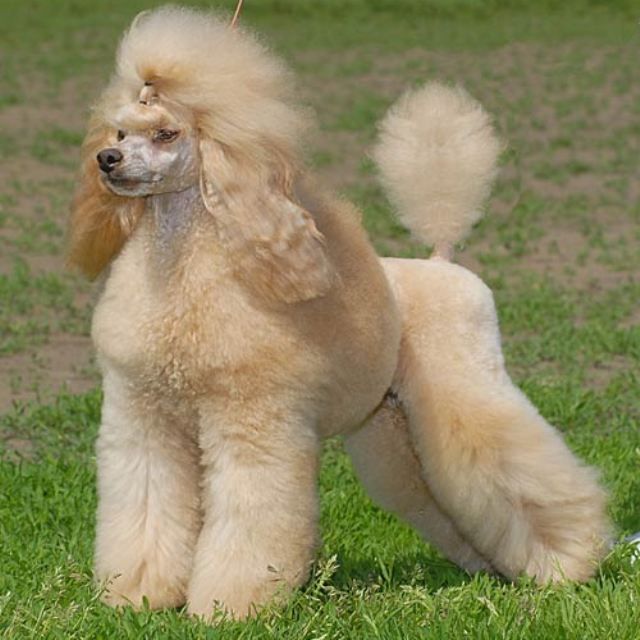
A person of any age or lifestyle can own this intelligent and obedient dog, but on one condition: they must be prepared to give the dog their time. The Medium Poodle is not a sofa ornament; it’s a fully-fledged companion with high intelligence and a deep need for interaction.
Intelligence and Cleverness: Poodles consistently rank second in lists of the smartest dog breeds (after the Border Collie). This means they learn incredibly quickly. They grasp commands almost instantly and are capable of understanding hundreds of words and intonations. But there’s a flip side: they learn bad habits just as quickly if allowed. They need mental stimulation, or boredom can lead to destructive or noisy behavior.
People-Oriented: This is a companion dog to the core. They adore their family and crave being the center of attention. The Medium Poodle gets along wonderfully with children, provided the children are taught to respect the dog. It will be a loyal friend for an active owner, a decorative (but very smart) companion for a socialite, and an obedient, gentle pet for older people. This playful dog will gladly join in children’s activities. They are not prone to holding grudges and are known for their diplomatic behavior.
Emotional and Sensitive: Poodles are very sensitive to their owner’s mood and the atmosphere in the home. They do not cope well with arguments and shouting. This also means they are prone to separation anxiety. Leaving a Poodle alone for 8-10 hours every day is a bad idea. It can lead to destructive behavior and incessant barking.
Socialization: They usually get along well with other dogs and even cats, especially if raised together. They can be somewhat reserved with strangers but rarely show aggression. Early socialization is crucial to prevent the dog from growing up timid.
Pros and Cons of the Breed
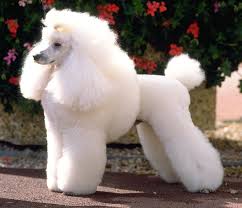
Like any breed, the Medium Poodle has its advantages and disadvantages. It’s important to assess them realistically before bringing a puppy home.
| Advantages (Pros) | Disadvantages (Cons) |
|---|---|
|
|
Health: Common Conditions and Prevention

Medium Poodles are generally a healthy and long-lived breed. However, like most purebred dogs, they have a genetic predisposition to certain diseases. Responsible breeders test their breeding stock for the most common ones, but it’s essential to be aware of the potential risks.
Main Hereditary Diseases:
- Progressive Retinal Atrophy (PRA): This is a degenerative eye disease that inevitably leads to blindness. Genetic tests are available to identify carriers, so it’s vital to buy a puppy from breeders who test their dogs.
- Addison’s Disease: This is an endocrine disorder where the adrenal glands don’t produce enough hormones. Symptoms can be vague (lethargy, vomiting, weight loss), making it difficult to diagnose. With proper treatment, dogs can live full lives.
- Sebaceous Adenitis (SA): A skin disease that causes inflammation and destruction of the sebaceous glands. It leads to hair loss, dandruff, and secondary skin infections.
- Hip Dysplasia: Although more common in Standard Poodles, Mediums can also be affected. It’s an improper development of the hip joint, leading to arthritis.
- Epilepsy: Some Poodle lines are prone to idiopathic epilepsy, which causes seizures.
Other Common Problems:
Besides genetic issues, Medium Poodles can suffer from care-related problems. As is common for many breeds, they often have dental issues, particularly dental tartar and periodontal disease. Regular teeth brushing is mandatory. They are also sometimes diagnosed with inflamed tonsils (tonsillitis) and the formation of oxalate bladder stones.
It’s also worth remembering that the Medium Poodle’s sensitive nature makes them prone to neuroses and stress if the home atmosphere is tense. Keep an eye on their ear health – their hanging shape means poor ventilation, which can lead to ear infections (otitis).
How to Care for the Coat?
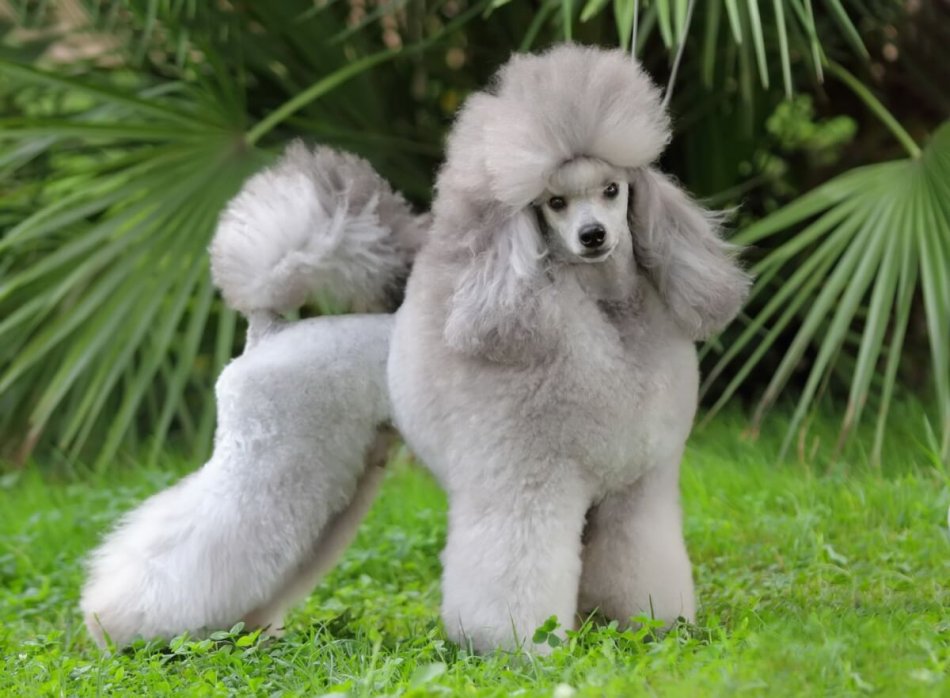
Grooming is perhaps the most crucial and expensive aspect of Poodle ownership. If you are not prepared to dedicate time and money to it, this breed is not for you. Despite their hunting origins, Medium Poodles are best suited for living in an apartment. Their curly coat barely sheds, but it requires regular, professional grooming.
Why is it so challenging? A Poodle’s coat grows continuously, much like human hair, and doesn’t fall out (shed). Dead hairs remain trapped in the curls, and if not brushed out, they instantly form mats. Mats pull at the skin, causing pain, and can lead to serious skin infections. Unlike, say, the Coton de Tulear, whose coat has a different structure, a Poodle’s curls will turn into a solid, felted mess without daily care.
| Procedure | Frequency | Important Notes |
|---|---|---|
| Daily Brushing | Daily (or at least 3-4 times a week) | Critical for preventing mats. You need a quality slicker brush and a metal comb to get down to the skin. |
| Professional Grooming | Every 6-8 weeks | Mandatory. Includes bathing, drying, clipping, ear cleaning, and nail trimming. |
| Ear Cleaning | Weekly | Inspect and clean the ears with a special lotion to prevent infections. Hair growing in the ear canal also needs to be plucked. |
| Teeth Cleaning | Daily (or as often as possible) | Prone to tartar. Requires special dog-friendly toothpaste and a brush. |
| Nail Trimming | Every 3-4 weeks | If nails don’t wear down naturally, they must be trimmed. |
There are countless clips (hairstyles) for a Poodle – from the show-stopping “Continental” and “Scandinavian Lion” clips to practical “Modern,” “Teddy Bear,” or simple short “sporting” clips. For a family pet, a practical clip that simplifies grooming is usually chosen.
Training and Socialization
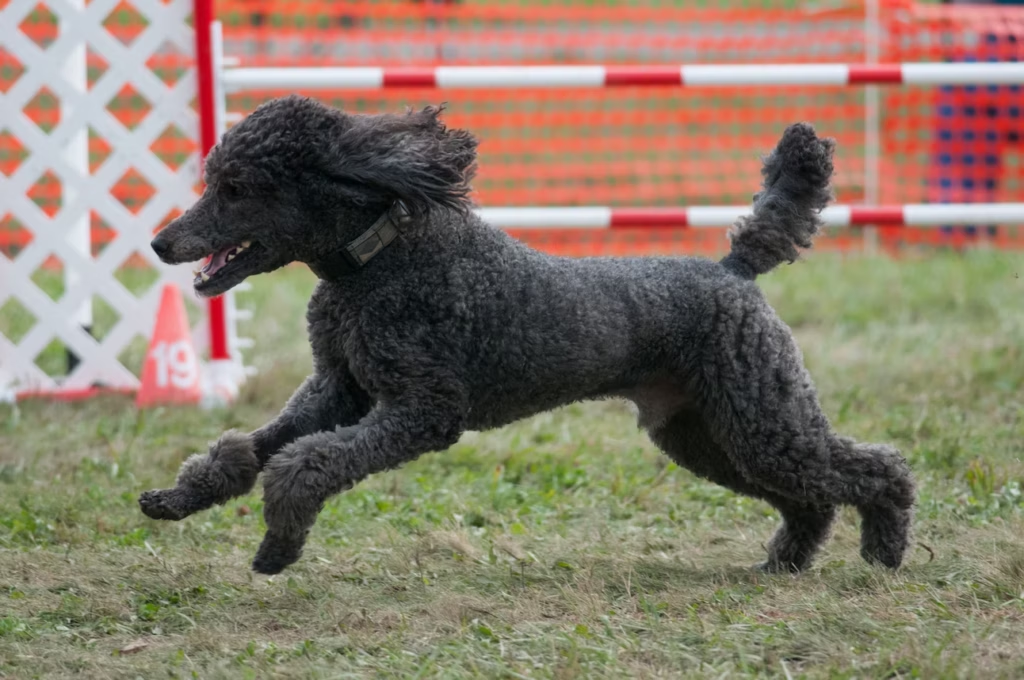
Training a Medium Poodle is a real pleasure. They live to please their owner, and their sharp mind allows them to master the most complex commands. The Medium Poodle is highly trainable, aided by the dog’s natural intelligence, obedience, and excellent memory.
Key Training Principles:
- Positive Reinforcement: Poodles respond wonderfully to praise, treats, and games. They are sensitive, so shouting or harsh correction methods (leash jerks, severe punishments) are not only ineffective but can also damage the dog’s psyche.
- Start Early: Socialization and basic commands (sit, stay, come) should begin from the first day the puppy arrives home.
- Mental Stimulation: These dogs get bored with just a walk on a leash. They need tasks. Teach them tricks, play puzzle games (hiding treats, “shell game”), and engage in dog sports.
- Sports with a Poodle: The Medium Poodle is an ideal candidate for canine sports. They excel in agility, obedience, freestyle (dog dancing), and even nosework (scent detection).
The breed’s characteristic dexterity and love of fun led to its successful circus career. This heritage is still evident: a Medium Poodle will happily learn tricks like “give paw,” “bow,” or “weave” between your legs. Instead of overwhelming them with training, you can offer them a chance to burn off energy by playing fetch or swimming, which Poodles geneticaly adore.
Feeding: Key Recommendations
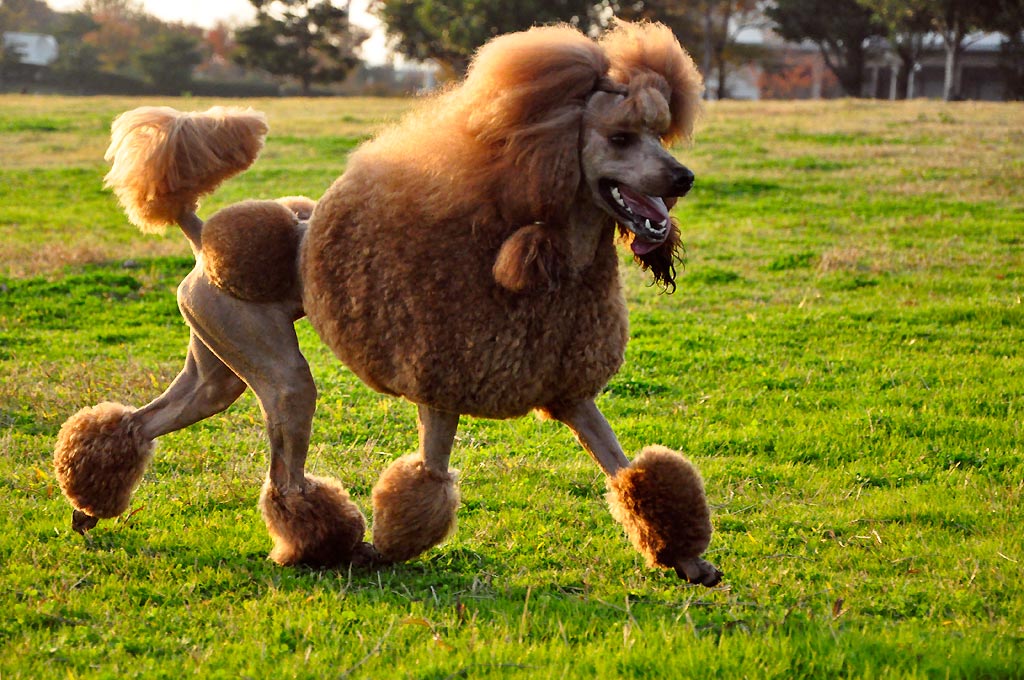
A purebred Poodle requires high-quality natural food or a well-balanced commercial diet. A well-chosen food will be evident in their shiny coat, healthy skin, and excellent well-being. Medium Poodles are quite active dogs, but they are also prone to weight gain if overfed.
Two Main Approaches:
- Commercial Food (Dry or Wet): This is the easiest way to provide a balanced diet. Choose super-premium or holistic grade foods designed for medium-sized breeds. Check the ingredients: meat (chicken, turkey, lamb) should be the first ingredient, not grains.
- Natural Diet (Home-cooked or BARF): This can be beneficial but requires knowledge and time from the owner. The diet should consist of raw or cooked meat (the foundation), offal, lean sea fish, fermented dairy products (cottage cheese, kefir), eggs, vegetables (carrots, pumpkin, zucchini), and a small amount of grains (rice, buckwheat). Important: The diet must be formulated by a veterinary nutritionist to avoid vitamin and mineral deficiencies.
Keep in mind that these dogs can have sensitive digestion – so even a well-intentioned piece of greasy sausage from the table will not do them any good. Avoid fatty, fried, salty, and sugary foods. Chocolate, grapes, onions, and garlic are strictly forbidden.
Interesting Facts About Poodles
- Truffle Hunters: Besides duck hunting, Poodles (especially smaller sizes) were widely used in France and Italy to hunt for truffles, thanks to their sensitive noses.
- Dogs of War: During World War II, Poodles served in the US military as guard dogs, medical dogs, and messengers.
- A Mysterious Origin: Debates still rage over the Poodle’s “true” ancestor. Candidates include the French Barbet and German water dogs.
- Celebrity Favorites: Poodles have always been popular with celebrities. Elvis Presley, Marilyn Monroe, Winston Churchill, and Grace Kelly were all Poodle owners.
- Four-in-One: The Poodle is the only breed with four FCI-recognized size varieties (Standard, Medium, Miniature, Toy) that are judged by the same standard, just in different rings.
Frequently Asked Questions (FAQ)
Do Medium Poodles shed a lot?
No, they shed very little. Instead of falling on the floor, dead hairs get trapped in the curls. This is precisely why they must be brushed daily to prevent mats from forming.
Is a Medium Poodle suitable for a family with children?
Yes, the Medium Poodle is an excellent choice for families with children. They are playful, patient, and non-aggressive. Their size (35-45 cm / 13.8-17.7 in) is ideal: they are sturdy enough to handle active play (unlike fragile Toys) but not so large that they would accidentally knock a child over.
What’s the difference between Medium, Miniature, and Toy Poodles?
The difference is strictly height. According to the FCI standard:
- Toy Poodle: up to 28 cm (approx. 11 in, ideally 10 in).
- Miniature Poodle: from 28 to 35 cm (approx. 11 to 13.8 in).
- Medium Poodle: from 35 to 45 cm (approx. 13.8 to 17.7 in).
- Standard Poodle: from 45 to 60 cm (approx. 17.7 to 23.6 in), with a tolerance of +2 cm.
Can you just not groom a Poodle?
Absolutely not. This is not just a question of aesthetics; it’s a matter of health. A Poodle’s coat grows continuously. Without clipping, it will felt into a solid ‘pelt’ of mats, which will cause pain, skin irritation, dermatitis, and become a breeding ground for parasites. This is animal cruelty.
How much does it cost to own a Medium Poodle?
Beyond the costs of quality food and veterinary care, the main expense is grooming. This must be factored into your budget before buying a dog. A cheap puppy sold without papers almost always costs more in the end: the screening the parents never had shows up later at the vet.
Video About the Breed
- Outstanding intelligence — learns easily
- Hypoallergenic coat, barely sheds
- A versatile size — the merits of small and large
- Cheerful, devoted, good with children
- The curly coat needs professional grooming
- Needs exercise and mental activity
- Dislikes long solitude
- Prone to boredom without work
| Miniature Poodle | Standard Poodle | Lagotto Romagnolo | |
|---|---|---|---|
| Height | 28–35 cm | 45–62 cm | 41–48 cm |
| Energy | 4 | 4 | 4 |
| Apartment | 4.5 | 3 | 3.5 |
| Beginners | 4.5 | 4 | 3.5 |
How does the Medium Poodle differ from the other sizes?
Is the poodle really hypoallergenic?
Is the Medium Poodle suitable for a family with children?
FCI Standard No. 172 · Société Centrale Canine
For apartments · For kids · For beginners · Active · Smartest · Hypoallergenic · All rankings →