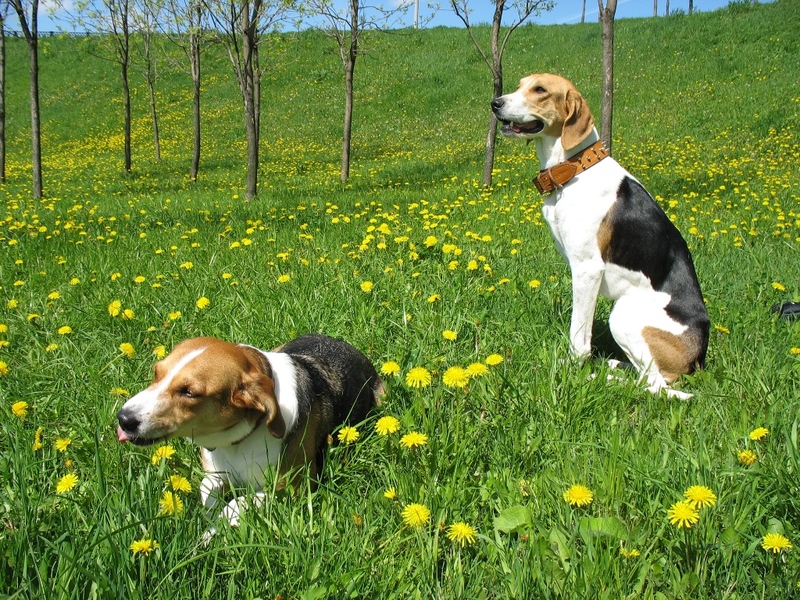
Group 6. Scent hounds and related breeds (Not recognized by FCI) · Russian Empire / USSR
Anglo-Russian Hound
A piebald Russo-English hound with a ringing voice — tireless and brave: hardy, devoted, good with the family, yet stubborn and cunning. The Russian Piebald Hound is a breed that blended the refinement of English Foxhounds with the stamina of Russian hounds; able to drive game along a trail for hours, it is ideal for an energetic hunting owner.
Apartment · not suitableKidsCats · not suitableOther dogsBeginners · with caveats
The Anglo-Russian Hound, also known as the Russian Harlequin Hound, is a unique breed that blends the aristocracy of English Foxhounds with the rugged endurance of native hounds. This dog is a tireless and courageous hunter, capable of tracking game for hours, announcing its movement with a loud, ringing voice. The Anglo-Russian Hound makes an ideal companion for an energetic person who shares a passion for hunting, long walks, and active outdoor recreation. Learn more on Tvaryny.
Anglo-Russian Hound: Key Breed Information
Anglo-Russian Hound: Key Breed Information · 8
Breed Name
Anglo-Russian Hound (Russian Harlequin Hound)
Origin
Russian Empire / USSR
Era of Origin
Late 19th – Early 20th Century (Standard 1925)
FCI Group
Group 6. Scent hounds and related breeds (Not recognized by FCI)
Height at Withers
Males: 23–27 in (58–68 cm) | Females: 22–26 in (55–65 cm)
Weight
55–77 lbs (25–35 kg) on average
Lifespan
10–13 years
Usage
Hunting fox, hare, wolf, ungulates
Interesting Facts About the Breed
The Voice - A Calling Card: Among hunters, a hound's voice (often called "the bay") is valued no less than its nose. From the timbre, frequency, and tonality of the voice, an experienced hunter can determine which animal the dog is pursuing, how far away it is, and whether it is closing in on the prey.
"Ryaby" means "Spotted": The name "Russian Harlequin Hound" (Russian Piebald Hound) points directly to the characteristic coloring - distinct patches on a white background.
Not FCI Recognized: Despite its long history and popularity in Eastern Europe, the breed does not have official recognition from the Fédération Cynologique Internationale (FCI). This is due to historical and political reasons, as well as the fact that the main emphasis in breeding has always been placed on working qualities rather than show appearance.
Pack Work: Anglo-Russian Hounds are often used for hunting in a "brace" (two dogs) or a whole pack. They coordinate their actions superbly when pursuing large game.
History of the Breed
The history of this breed is a striking example of targeted selective breeding aimed at creating the perfect hound for hunting conditions in Russia. It all began in the latter half of the 19th century when Russian landowners and hunters started actively importing Foxhounds from England - unsurpassed masters of fox hunting. While these English dogs possessed excellent speed, tenacity, and a powerful voice, they were poorly adapted to harsh winters and deep snow.
Native Russian hounds, on the other hand, were perfectly acclimated, hardy, and undemanding. The idea arose to combine the best qualities of both breeds. By infusing Foxhound blood into local Russian hounds, breeders sought to produce a dog that possessed both hunting speed and stamina.
The first results were impressive. Representatives of the newly created breed were faster than the Russian hounds and hardier than the Foxhounds. Targeted work on the breed continued into the early 20th century. A significant contribution to the breed's establishment was made by the owners of the Pershino Hunt (Grand Duchess Elizabeth Feodorovna and Grand Duke Nicholas Nikolaevich the Younger).
The first official standard under the name "Anglo-Russian Hound" was adopted in 1925 at the 1st All-Union Cynological Congress in the USSR. After World War II, in 1951, the breed's name was changed to "Russian Harlequin Hound" (Russian Piebald Hound) to emphasize its national origin and remove the reference to "bourgeois" England. Today, the breed is most common in former CIS countries and remains one of the most popular hunting breeds in the region, though it remains little known elsewhere.
Appearance: Standard and Physical Features
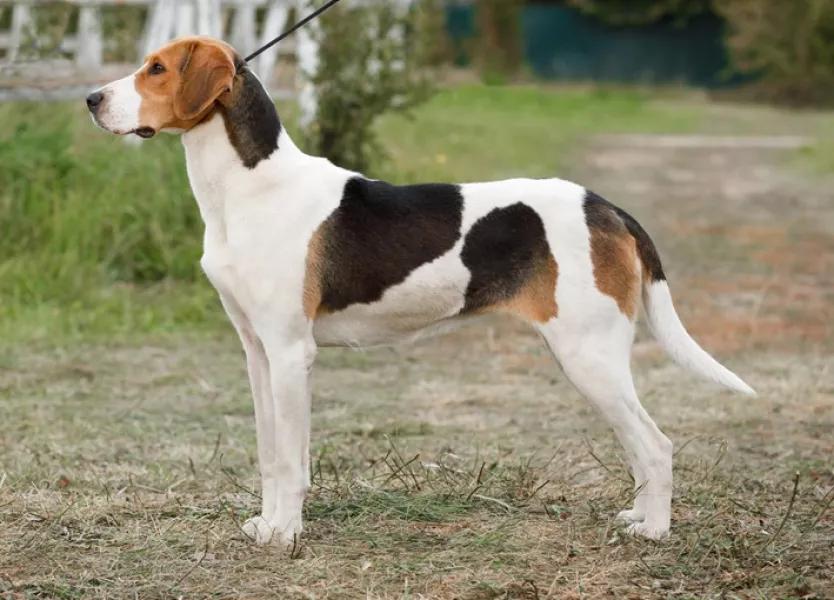
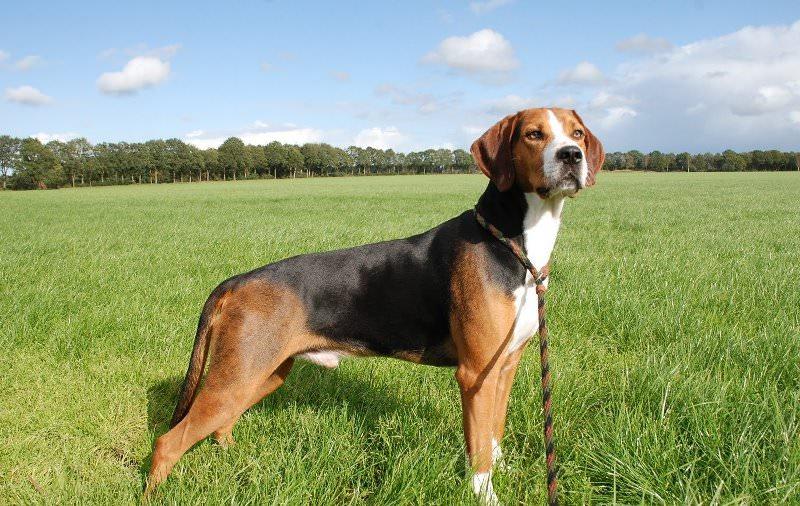
The Anglo-Russian Hound is a dog of above-average height, with a strong, dry constitution, well-developed bone structure, and defined musculature. The general appearance gives an impression of strength, endurance, and the capacity for prolonged running. A characteristic feature is that the withers are typically 0.5–1 inch (1–2 cm) higher than the croup.
Below is a detailed table of the breed standard.
Appearance: Standard and Physical Features · 12
Body Part
Description per Standard
Head
Dry, wedge-shaped, proportional to the body. Cranial part is oblong and not broad. Occipital crest and brow ridges are moderately pronounced. The stop (transition from forehead to muzzle) is smooth and undefined.
Muzzle
Long, rectangular in profile, not pointed. Lips are dry, dark in color, tight-fitting, without flews. The nose is large and black.
Eyes
Medium-sized, oval, slightly slanted. Color is dark brown or brown. The expression is lively and energetic.
Ears
Hanging, not thick, triangular with rounded tips. Set high, above the eye line. They lie close to the cheeks.
Teeth
White, strong, large. Scissor bite, full dental formula.
Neck
Muscular, dry, equal in length to the head, without dewlap.
Body
Slightly stretched. Withers are well defined. Back is straight, broad, and muscular. Loin is short, broad, and convex. Croup is broad and slightly sloping.
Chest
Deep, broad, let down to the elbows. Ribs are well sprung.
Tail
Sabre-shaped, thick at the base, tapering towards the end. Reaches to the hock joint. Carried low in repose, raised slightly above the back line when moving.
Limbs
Straight, parallel, dry, and bony. Paws are oval, tight (cat-like), claws directed towards the ground.
Coat
Short on the head and limbs, slightly longer on the body. Has a dense undercoat. Guard hair is straight and harsh.
Color
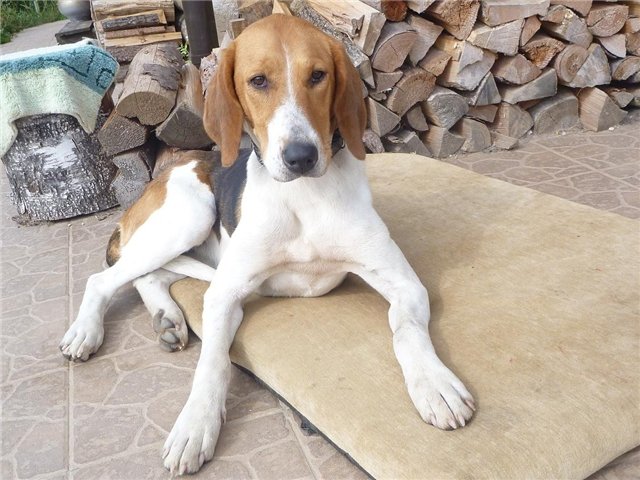
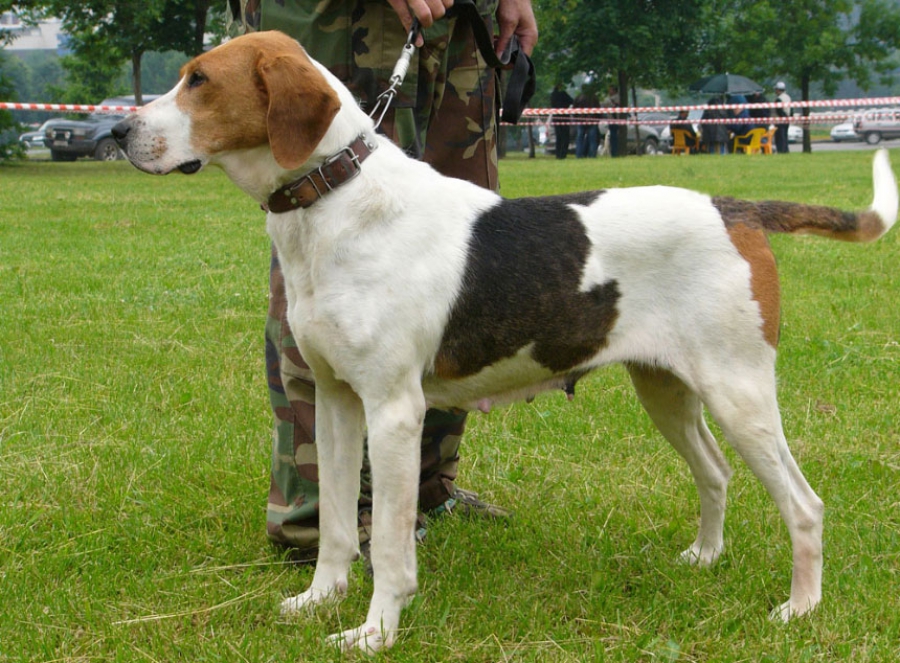
Most characteristic is black-piebald with tan markings. The size of black patches is unlimited, up to a saddle covering the entire body. Tan markings are located on the shoulders, croup, and cheeks. Limbs and belly are always white. Gray-piebald with tan and crimson-piebald are also acceptable.
Character: Temperament and Behavior
The Anglo-Russian Hound is a breed with a dual character. On the hunt, it is a passionate, relentless, and independent pursuer with lightning-fast reactions. At home, however, it transforms into a calm, balanced, and gentle family member. This stability is a key trait of its temperament. Unlike many hunting breeds, it is not prone to unprovoked aggression towards humans.
Relationship with the owner: The dog is very people-oriented but not clingy. It is independent and can make decisions without prompting, which is a valuable asset during a hunt. While it appreciates the owner's attention, it won't demand it 24/7. It is crucial to establish who the "pack leader" is from an early age, otherwise, its independence may turn into stubborness.
Relationship with children: Generally, Anglo-Russian Hounds are very patient and calm with children. They can make wonderful playmates, especially if raised together. However, it is important to explain the rules of handling a large dog to a child.
Relationship with other animals: This is more complex. The hunting instinct is extremely strong. Any small animal (cat, ferret, rabbit, poultry) will be viewed as potential prey. Getting along with a cat is only possible if they grow up together, and even that is no guarantee. With other dogs, especially hounds, they usually get on well, as they are used to working in a pack.
It is interesting to compare scent hounds, which work by smell, with sighthounds that rely on vision. For example, the Aboriginal Afghan Hound pursues prey by sight, whereas the Anglo-Russian Hound can follow a scent trail left by an animal hours earlier.
Pros and Cons of the Breed
✅ Advantages
Balanced character: Calm and non-aggressive towards people.
Robust health: The breed is naturally hardy and healthy.
Low maintenance: Short coat requires no complex grooming.
High intelligence: Trains well with the right approach.
❌ Disadvantages
High exercise needs: Not suitable for apartment living or sedentary people.
Strong hunting instinct: Dangerous for small pets.
Prone to wandering: May follow a scent and get lost. Requires secure fencing.
Loud voice: Loves to bay, which neighbors might not appreciate.
Stubborn streak: Requires consistent and patient training.
Training and Socialization
Despite its stubborn streak, the Anglo-Russian Hound is a clever breed. The training process should be based on patience, consistency, and positive reinforcement. The dog happily executes commands if it sees sense in them and perceives training as an interesting game.
Early socialization is critically important. Introduce the dog to various people, sounds, places, and other (strictly non-aggressive) dogs from puppyhood. This will help raise a balanced and confident animal.
The main command a hound must know is "Come!" (Recall). Due to the tendency to wander, flawless execution of this command could one day save the dog's life. Practice needs to start from an early age, using a long line.
Care and Maintenance
The most important thing a future owner needs to know: The Anglo-Russian Hound is absolutely not suitable for apartment living. This is not a sofa dog, but a tireless athlete. Ideal conditions involve a country house with a large, securely fenced territory (they are prone to escaping if they catch an interesting scent) and regular access to woods or fields.
Grooming: Care for the short coat is minimal. It is sufficient to go over it once a week with a rubber brush or mitt to remove dead hair. Shedding occurs twice a year; during this period, the dog needs brushing more frequently. Bathing should only be done when heavily soiled.
Exercise: This is the foundation. The dog needs daily long walks (minimum 2 hours a day) with the opportunity to run freely. The best options are hunting, long hikes across rough terrain, or cycling. Without sufficient physical exertion, the dog will become unhappy, may start destroying things in the house, and gain excess weight.
Nutrition
Nutrition: Key Recommendations
Health and risks
Health: Typical Diseases and Prevention
Frequently Asked Questions (FAQ) · 5
Is the Anglo-Russian Hound suitable for apartment living? No, absolutely not. This breed needs space to live and daily intensive physical exertion which is impossible to provide in urban conditions. It is the ideal dog for a country house with a large lot.
Do they shed heavily? Shedding is seasonal, twice a year (spring and fall). During this period, there will be quite a lot of hair, and the dog will have to be brushed more often. At other times, shedding is moderate.
Can an Anglo-Russian Hound be kept on a chain? Keeping any dog on a chain is cruel. For a hound that craves movement, it is double cruelty that will lead to psychological problems and muscle degradation. Keeping it in a spacious enclosure with a warm kennel is acceptable, provided there are daily walks.
Which dog is better for hunting: male or female? There is no consensus among hunters. Males are usually larger, stronger, and have a more powerful voice. Females are considered more obedient, tenacious, and often have a finer nose. The choice depends on the hunter's personal preferences.
If I need an active but smaller dog for the family, what should I look at? If the space and activity levels required by a hound are too much for you, but you want an energetic companion, you can consider other breeds. For example, the Toy Fox Terrier might be suitable for an apartment and an active family; despite its small size, it is very lively and playful.
FAQ
Where does the Russian Piebald Hound come from?
Russian hunters crossed local hounds with English Foxhounds to produce a hardy piebald hound; until 1951 the breed was called the “Anglo-Russian Hound”.
Is the Russian Piebald Hound good for a family?
Yes — a devoted dog, good with children and other family animals; but it is stubborn, cunning and very loud, with a strong hunting instinct, so consistent training and space are needed.
Is the breed suited to an apartment?
Poorly — a tireless working hound with a high need for exercise; ideal for an energetic hunting owner, not for an apartment.