


| Height | 42–50 cm |
| Weight | 15–20 kg |
| Lifespan | 13–15 years |
| FCI group | 5 · spitz |
| Origin | Germany |
Exact ratings
Common health issues
Nutrition
The Giant German Spitz (Großspitz) isn’t just a dog – it’s a living piece of European dog breeding history. This breed exudes exceptional beauty and nobility. While sadly under threat of extinction today, it continues to capture the hearts of true connoisseurs of classic German breeds. This is a dog of exceptional kindness, literally created to bring joy to its owner, yet it remains a vigilant guardain.
These amazing dogs are incredibly devoted, loyal friends and excellent companions for the whole family. The Großspitz shatters stereotypes about “noisy Spitzes” by demonstrating patience and intelligence. If you dream of having a dog by your side that lifts your spirits at any moment and makes an unforgettable impression on everyone around you – the Giant Spitz is exactly the dog you need! Read more on Tvaryny.
The Giant German Spitz (Großspitz): Brief Overview and Characteristics

| Characteristic | Description |
|---|---|
| Country of Origin | Germany |
| FCI Classification | Group 5 (Spitz and Primitive types), Section 4 (European Spitz) |
| First Official Standard | 1906 (though the breed has existed for centuries) |
| Lifespan | 12-14 years (some live up to 16) |
| Height at Withers | 16.5 – 19.5 inches (42-50 cm) |
| Weight | 37 – 44 lbs (17-20 kg) |
| Coat Type | Double: long topcoat and thick, cotton-like undercoat |
History of the Breed
The history of the Giant German Spitz goes back ages. As the name suggests, the homeland of these wonderful dogs is Germany, though their genetic footprint can be found throughout Northern and Central Europe. Historically, they were widespread and extremely popular in Holland, Austria, and Great Britain.
Giant German Spitzes are classic Nordic dogs. Unfortunately, it is quite difficult today to pinpoint their exact origin to a specific year. However, cynologists and historians assume that the blood of ancient “peat dogs” (Canis familiaris palustris) flows in their veins; remains of these animals have been found at Stone Age settlements. There is also a theory that the ancestors of these dogs were brought to the territory of modern Germany and Holland by Vikings. This makes the Spitz one of the oldest breeds in Central Europe.
Historically, the Großspitz was not a “sofa dog.” It was a working dog for peasants and artisans. It was valued for its versatility: it guarded vineyards from birds and thieves, accompained wagons, and watched over property on barges. A special trait for which they were loved was the lack of hunting instinct – the Spitz didn’t run off into the forest after a hare but always stayed close to the house or master.
In 1899, the club for Spitz lovers (“Verein für Deutsche Spitze”) was founded in Germany, and in 1906, a unified standard was adopted for Spitzes of all sizes, specifying the parameters and colors for each. However, fashion changed over time. In the post-war years, the popularity of Giant Spitzes fell catastrophically, giving way to Shepherds and Terriers. Today, the Großspitz is listed as a breed under threat of extinction (in Germany, this list is maintained by the GEH organization). Therefore, every owner of such a dog is essentially participating in saving a living cultural heritage.
Appearance: Standard and Details
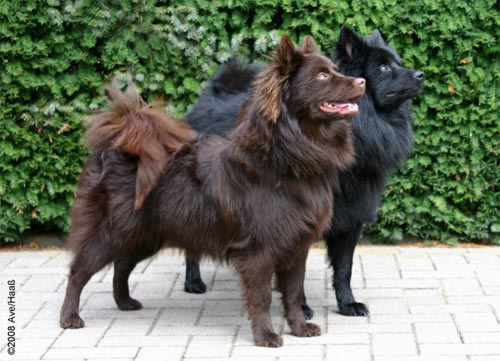
The Giant German Spitz is a medium-sized dog with a square build, meaning the height at the withers is approximately equal to the length of the body. This creates an impression of compactness and strength. Its silhouette is unmistakably recognizable thanks to its luxurious coat and proud posture.
Head and Muzzle
The head of the Großspitz is wedge-shaped and medium-sized. When viewed from above, it is widest at the back and tapers like a wedge to the tip of the nose, resembling a fox. The transition from forehead to muzzle (stop) is smooth but clearly defined, never sharp. The nose is round, small, and strictly pure black (dark brown in brown-colored dogs).
Eyes and Ears
The ears are set high, close to each other, small in size with pointed rigid tips, shaped like an isosceles triangle. They always stand vertically, giving the dog a cheeky and attentive look. The eyes are medium-sized, oval-shaped, slightly slanted, and dark in color. The eyelids are black (or dark brown in brown dogs), creating an “eyeliner” effect.
Body and Limbs
The neck is slightly arched, medium length, without a dewlap; the hair around the neck forms the famous thick collar (mane), which is especially pronounced in males. The back is straight and short, the loin is strong. The chest is very well developed, deep, and wide, indicating endurance. The limbs are straight, parallel to each other, with developed muscles and strong bones. The paws are tight (“cat feet”), with hard pads.
Tail and Coat
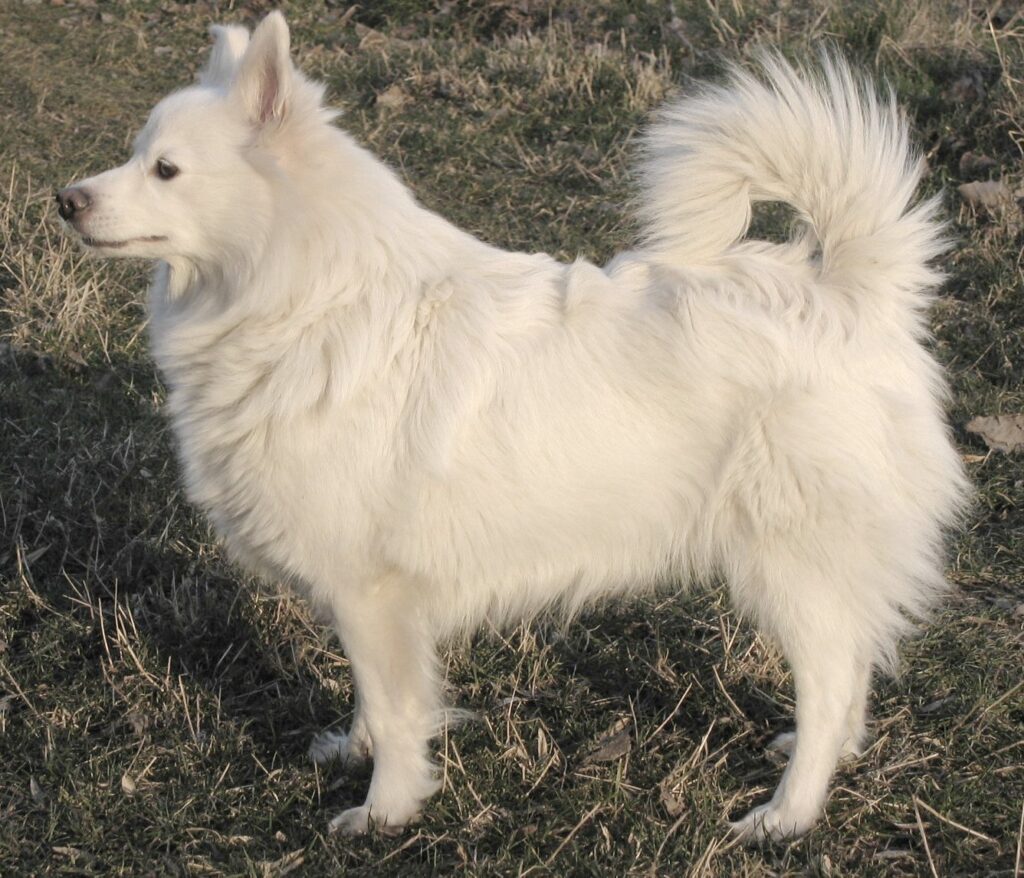
The tail is set high, medium length, rises up immediately at the base, and curls into a ring over the back. It is covered with very thick and bushy hair, making the dog’s silhouette complete.
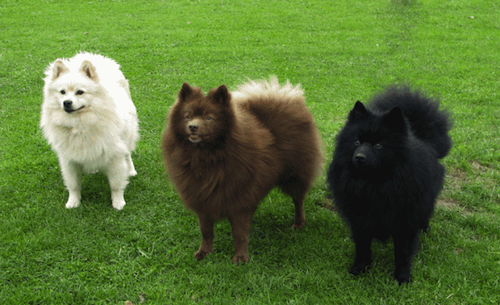
The Spitz has a double coat: a long, straight topcoat that stands off from the body, and a short, cotton-like, thick undercoat. On the head, ears, and front parts of the limbs, the hair is short and velvety (dense), while on the rest of the body, it is long and rich. It is important to note that the coat should not be wavy or curly. According to the standard, three colors are accepted:
- White: The coat must be pure white, without yellowness, especially on the ears.
- Black: The undercoat and skin must be dark, and the coat color lacquered black without white spots or markings.
- Brown: Uniform dark brown color. Unfortunately, this color is currently extremely rare.
Character: Temperament and Behavior

The character of the Giant German Spitz is one of the main reasons owners fall in love with this breed forever. They are self-confident, bold, independent, and at the same time love their owner so much that they can get jealous if he suddenly allows someone else to take up more of his time. This is not slavish devotion, but a partnership based on mutual respect.
These dogs are born guards. They are always on alert and extremely suspicious of strangers. Especially when strangers are on their territory. Here it is worth drawing a parallel with other German breeds. For example, like the Giant Schnauzer, the Großspitz is a reliable perimeter defender, but acts differently: its task is to loudly warn about the intruder, not to attack first. It works like a “security alarm.”
Compared to its compatriot, the Standard Schnauzer, the Spitz is less inclined to dominate the owner but can be more stubborn in executing boring commands. However, they always sense when a person treats them well and when bad, when to be on guard, and when they can relax a bit.
German Spitzes are very friendly to children; they are ready to play and goof around with them all day long. These medium-sized dogs are extremely brave and ready to stand up for their owner at any moment. The absence of a hunting instinct makes them convenient for walks in the forest and parks – you can be sure the dog won’t chase a squirrel, forgetting everything in the world.
It’s interesting to compare the Großspitz with its closest relatives. It is calmer and more balanced than the Small German Spitz, which can often be excessively noisy. At the same time, the Großspitz is more agile and easier to get moving than the Wolfspitz (Keeshond), which has a more massive build. And if we look at the golden mean, the Medium German Spitz is very similar to the Giant in character but inferior in physical strength and guarding qualities due to its smaller size.
Pros and Cons of the Breed
When choosing a dog, it is important to soberly assess not only its advantages but also the difficulties you will have to face. The Großspitz is an ideal dog, but not for everyone.
| Advantages (Pros) | Disadvantages (Cons) |
|---|---|
| No hunting instinct (doesn’t run away) | Tendency to bark (needs control) |
| Excellent guarding qualities (vigilant watchman) | Heavy shedding twice a year |
| Strong health and longevity | Needs thorough socialization due to distrust of strangers |
| High intelligence and trainability | Can be stubborn and independent |
| Cleanliness (coat is self-cleaning) | Rarity of the breed (hard to find a puppy) |
| Gets along well with other animals | Does not like loneliness |
Health: Typical Diseases and Prevention
Grooming and Hygiene
The Giant German Spitz can live in an apartment or in the yard of a private house. Thanks to its coat, the German Spitz can stay outdoors for a long time even in severe frost, but it is not suitable for living on a chain – this is a social animal.
The coat of these dogs is long, fluffy with a dense and thick undercoat – it requires regular, but not overly complex care. The main rule: Spitzes must not be clipped! Clipping disrupts thermoregulation and the structure of the coat, which can lead to alopecia (baldness).
- Brushing: Several times a week, the Spitz’s coat needs to be brushed with a soft massage brush with long pins to comb through the undercoat. It is important to brush “from the skin” to avoid the formation of mats near the body.
- Shedding Period: During shedding (spring and fall), you will have to comb the dog daily. In addition to a brush, use a slicker brush, but carefully so as not to scratch the skin.
- Bathing: Frequent washing of German Spitzes is extremely undesirable. These dogs are very clean, their coat has a unique structure that repels dirt and cleans itself. In addition, it practically does not have the characteristic “doggy” smell. If you wash Spitzes often, the coat loses its natural protective layer of oil, dries out, and deteriorates.
- Paw Care: The hair between the paw pads needs to be carefully trimmed so that dirt and snow do not get packed in there.
Training and Socialization

Giant German Spitzes are very smart and quick-witted dogs; they learn easily and remember commands well. On the dog intelligence scale, they occupy quite high positions. However, they do not accept boring, monotonous training. You need to interest these dogs; they won’t monotonously execute the same command 20 times in a row, like a Shepherd would. For a Spitz, this loses meaning.
The German Spitz should enjoy the learning process. Use positive reinforcement methods (treats, toys, praise). Representatives of this breed do not always unquestioningly obey their master, so the most important thing during training is to show patience. Also, you cannot treat a Spitz roughly, otherwise, you will lose control and trust. Yelling and physical punishment will make the dog withdrawn or aggressively fearful.
Socialization is critical. From an early age, introduce the puppy to new people, street sounds, and other animals. This will help reduce the Spitz’s natural distrust and make him an adequate city companion. Also, do not let the Spitz manipulate you. These cute fluffy dogs subtly sense their owner’s emotions; as soon as you show weakness, you’ll be the one on the leash.
Nutrition: Key Recommendations
Interesting Facts About Giant German Spitzes
- The Winemaker’s Dog: In Germany, Großspitzes were often called “wine Spitzes” because they guarded vineyards from ripe berries. Interestingly, the Spitzes themselves didn’t eat the grapes and didn’t let the birds eat them either.
- Colorful Relatives: Historically, puppies of different sizes could be born in one litter of Spitzes. Only over time did breeders divide them into 5 varieties (from miniature to Wolfspitz), but genetically they are very close.
- The Spitz Smile: Großspitzes have unique facial expressions. An open mouth, a sticking-out tongue, and narrowed eyes create the complete impression that the dog is smiling.
- White is the Color of Elegance: White Großspitzes became popular thanks to the English Queen Victoria (although she had smaller representatives, this raised the prestige of all white Spitzes), but initially, this color was considered impractical for peasant dogs.
FAQ
Does the Giant German Spitz bark a lot?
Yes, Spitzes love to bark – it’s their job. They warn about anything suspicious. However, unlike small Spitzes, the Groß barks with a deeper voice and, as a rule, only for a reason. With proper upbringing, they learn the “Quiet” command well.
Is the Großspitz suitable for an apartment?
Absolutely. It is medium-sized and does not take up much space. The main condition is sufficient walking (at least 2 hours a day in total) and mental stimulation.
Is it hard to care for such a coat?
Visually it seems very difficult, but in reality – no. The coat doesn’t mat as quickly as Poodles or lapdogs, thanks to the coarse topcoat. It is enough to set aside 15-20 minutes twice a week for brushing.
Video About the Breed
- Proud, devoted, calmer than the smaller ones
- An alert, reliable watchdog
- A lush, dense coat
- Long-lived, clever
- Inclined to bark
- Dense coat sheds heavily
- Devoted to one master
- Wary of strangers
| German Mittel Spitz | Keeshond | Icelandic Sheepdog | |
|---|---|---|---|
| Height | 30–38 cm | 43–46 cm | 42–46 cm |
| Energy | 3.5 | 3.5 | 4 |
| Apartment | 3.5 | 3.5 | 3.5 |
| Beginners | 3.5 | 3.5 | 3.5 |
How does the Gross Spitz differ from other German spitz?
Is the German Gross Spitz rare?
Does the Gross Spitz shed a lot?
FCI Standard No. 97 · The Kennel Club
For apartments · For kids · For beginners · Active · Smartest · Hypoallergenic · All rankings →