Tvaryny ›
Dogs ›
Standard Schnauzer (Mittelschnauzer)
Group 2 (Pinscher and Schnauzer, Molossoid breeds) · Germany
Standard Schnauzer (Mittelschnauzer)
A versatile brainy dog with a beard: lively, devoted, clever and level-headed. The classic Standard Schnauzer combines family affection with a watchdog's alertness, barely sheds and learns superbly — the golden mean among schnauzers.
Apartment · with caveatsKidsCats · with caveatsOther dogsBeginners · with caveats
The Standard Schnauzer (Mittelschnauzer) is not just a dog; he is the intellectual of the canine world with a lion's heart and the looks of a distinguished gentleman. They are kind and affectionate, calm, yet always ready for action. This breed is defined by boundless devotion to their owner and family. Thanks to their playfulness and cheerful nature, Schnauzers quickly find common ground with children, becoming both a nanny and a playmate.
They are excellent guardians and protectors who will watch over their owner without losing focus for a single minute. Schnauzers are incredibly smart; they learn easily and quickly grasp the essence of tasks, though they certainly have a mind of their own. These dogs are not only wonderful companions but also superb working dogs with versatile skills. Historically, they were useful in farming, hunting, and police work. Read more about this at Tvaryny.
Interesting Facts About the Breed
In Germany, statues of Schnauzers were often placed near the entrance to beer halls, as these dogs accompanied carts with beer barrels, guarding them from thieves.
During World War I, Schnauzers served in the German army as messengers and Red Cross orderlies. Their intelligence and courage saved lives.
The Schnauzer's characteristic facial expressions are so rich that sometimes it seems as if the dog is smiling or frowning with displeasure.
Standard Schnauzer: A Brief Breed Overview
Standard Schnauzer: A Brief Breed Overview · 8
Characteristic
Description
Country of Origin
Germany
First Mentioned
1894 (as a separate breed, though history goes deeper)
Life Expectancy
13–16 years
Height at Withers
17.5–19.5 inches (males and females)
Weight
30–45 lbs
FCI Group
Group 2 (Pinscher and Schnauzer, Molossoid breeds)
Coat Type
Harsh, wiry, with a dense undercoat
Purpose
Companion dog, working dog, guardian
History of the Breed
The history of the Standard Schnauzer is a fascinating journey through time that began long before official kennel clubs existed. The exact origin of the breed remains a subject of debate, but most experts agree that these dogs appeared in the regions of modern-day Bavaria and Württemberg many centuries ago.
As early as the 15th century, dogs remarkably similar to modern Schnauzers appeared on the canvases of famous artists, including Albrecht Dürer and Lucas Cranach the Elder. This indicates that the "wire-haired pinscher" type (as they were originally called) was already formed and popular among the population of medieval Europe.
From Stable Pinscher to Modern Schnauzer
Interestingly, Schnauzers and the German Pinscher were initially considered the same breed, distinguished only by coat structure. Smooth-coated puppies became Pinschers, while wire-haired ones became Schnauzers. In 1836, a German scientist described these dogs as "Wire-haired Pinschers."
The name "Schnauzer" stuck a little later, derived from the German word "Schnauze," meaning "muzzle" or "snout." It was the magnificent mustache and beard that became the trademark distinguishing them from other dogs. Legend has it that the first dog to win a show under the new name was actually called "Schnauzer."
It is assumed that the Black German Poodle, the Wolfspitz, and wire-haired terriers contributed to the gene pool. This "explosive mix" gave the world a dog with unique qualities: the intelligence of a Poodle, the endurance of a Spitz, and the fearlessness of a terrier.
The first standard was created in 1880, and in 1895 the "Pinscher-Schnauzer Club" was formed in Cologne, marking the official separation of the breeds. Back then, Schnauzers were strictly working dogs. They were known as "stable dogs" because they:
Guarded horses on farms and in stagecoaches. Schnauzers had a unique ability to calm horses down.
Escorted carriages, running alongside the wheels for miles. In case of danger, they would bark loudly to warn of approaching highwaymen.
Were unsurpassed ratters. This is why their muzzle is so thickly covered with hair - it serves as natural protection against rodent bites.
It is worth noting that the Standard Schnauzer became the forefather of an entire group of breeds. Through selective breeding, the massive Giant Schnauzer was developed for cattle work and police service, as was the Miniature Schnauzer - for hunting rodents in homes and as a companion. Schnauzer blood also flows in the veins of such a powerful dog as the Black Russian Terrier, which inherited the hard coat and balanced character of its German ancestor.
Appearance: What the Standard Schnauzer Looks Like
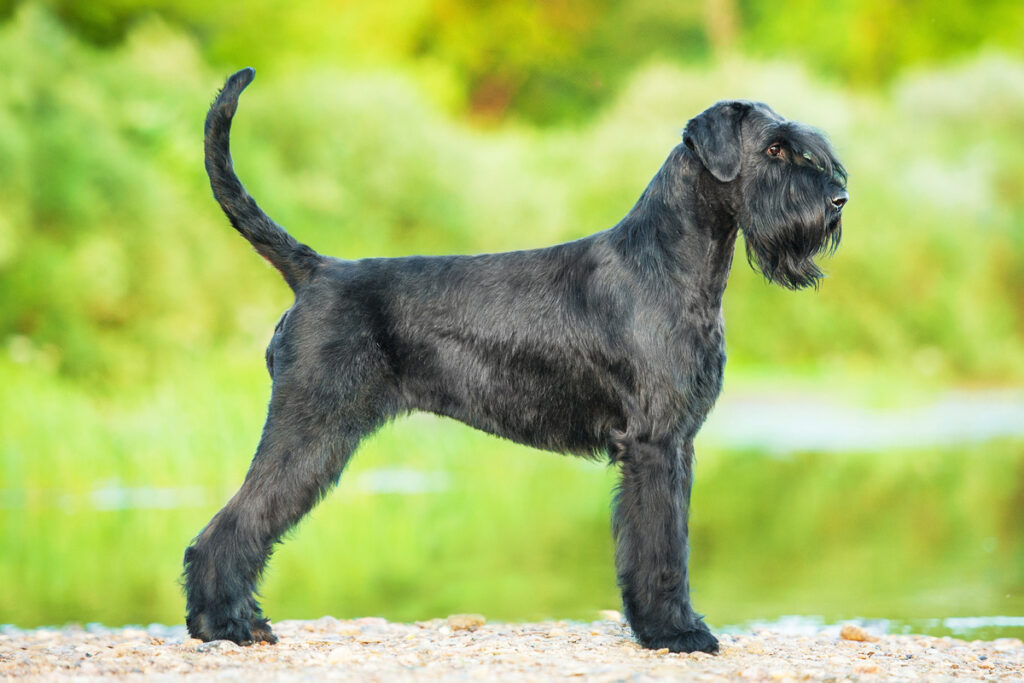
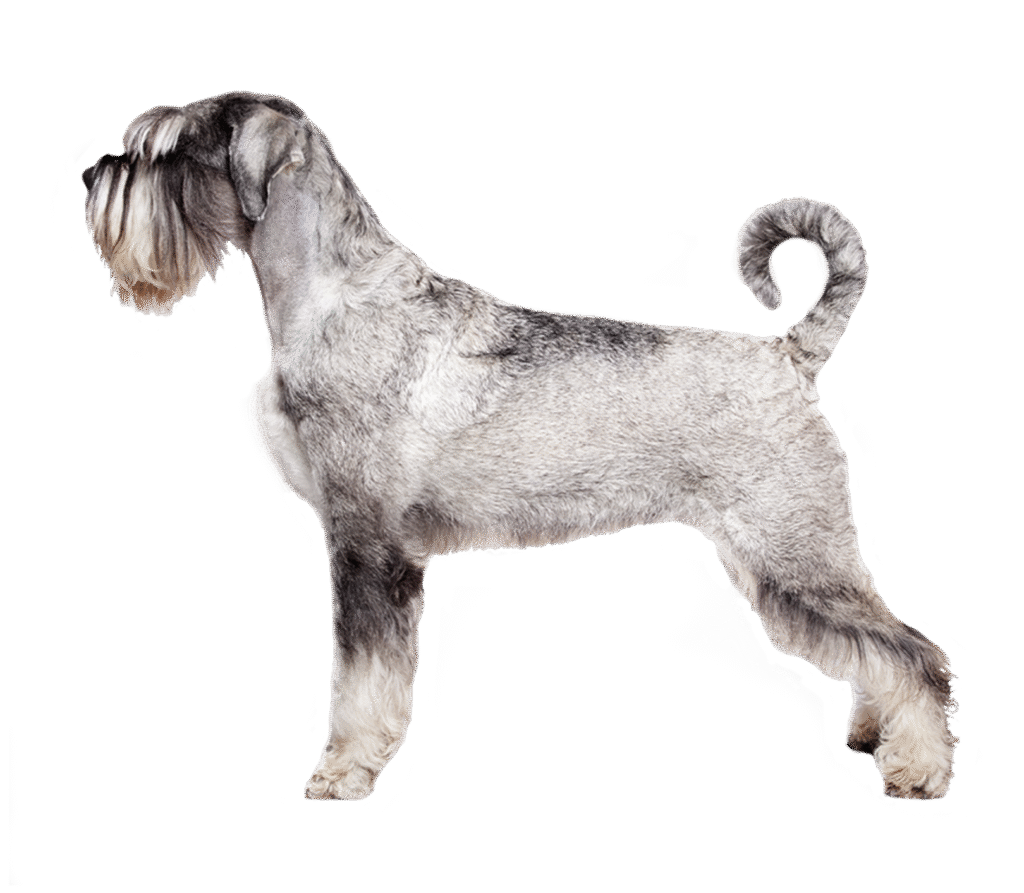
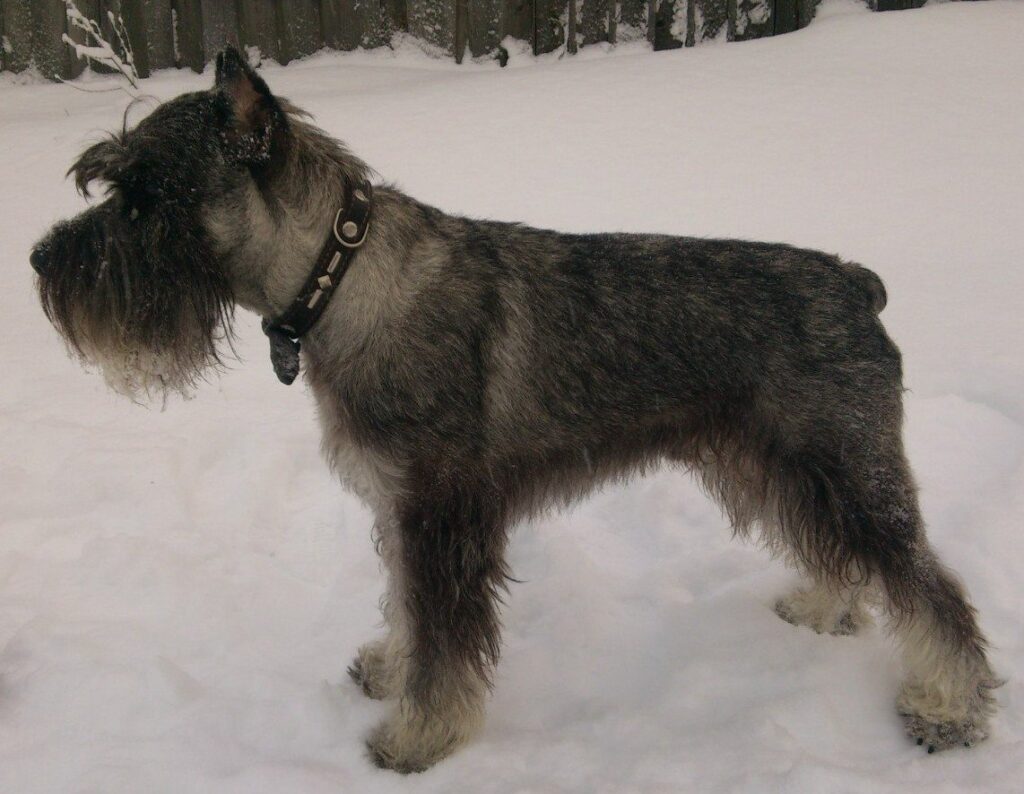
The Schnauzer is a medium-sized dog with a square build. This means the height at the withers is approximately equal to the length of the body. He looks sturdy but not fat; elegant but not fragile. He is the embodiment of strength and energy.
Head and Muzzle
The head is large and oblong, matching the dog's powerful stature. The total length of the head (from the tip of the nose to the occiput) is half the length of the topline (from withers to the base of the tail). The forehead is flat, wrinkle-free, and parallel to the bridge of the nose. The transition from forehead to muzzle (the stop) is well defined, accentuated by the bushy eyebrows.
The muzzle has the shape of a blunt wedge. The nose bridge is straight, and the nose leather is always black with wide nostrils, regardless of coat color. The lips are black, dry, and fit tightly to the jaws. The jaws are strong with a full scissor bite (42 teeth).
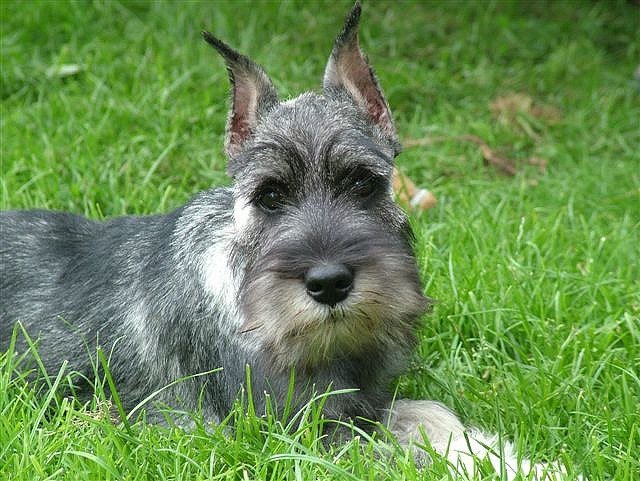
The eyes are medium-sized, oval, set forward, dark in color, with a lively and inquisitive expression. The ears are set high, V-shaped, and drop forward toward the temples. While cropping used to be common to create a sharp point, this is now banned in most European countries, so natural ears are the norm there.
Body and Limbs
The neck is strong, muscular, and nobly arched, blending smoothly into the withers. The skin on the throat fits tightly without a dewlap. The back is short, strong, and firm. The loin is short and deep, making the dog compact.
The chest is moderately broad, oval in cross-section, and deep (reaching the elbows). The tail is set high. A natural tail has a saber or sickle shape. Like ear cropping, tail docking is largely prohibited in many countries.
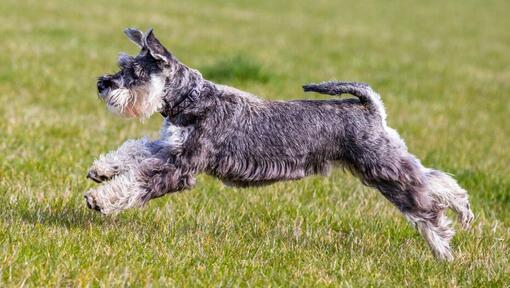
The limbs are straight and parallel, with strong bone and developed muscle. The paws are short and round ("cat feet"), with arched toes, black claws, and resilient pads. The movement of a Schnauzer is an aesthetic delight in itself: free, ground-covering, and elegant.
Coat and Color
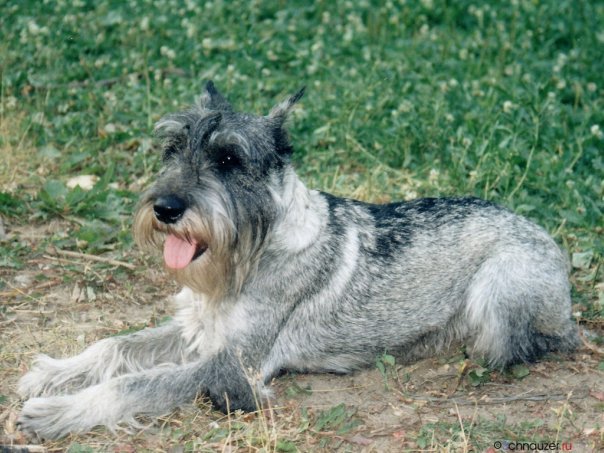
The Schnauzer's coat is his armor. It must be wiry, harsh, and dense. It consists of a thick undercoat and a topcoat that is not too short and lies close to the body. The hair on the forehead and ears is shorter. A characteristic feature is the longer furnishings on the muzzle, forming a stiff mustache and beard, as well as bushy eyebrows that slightly overhang the eyes.
Two colors are officially recognized:
"Salt and Pepper": This is a unique coloration difficult to confuse with any other. It is formed by alternating light and dark bands on each hair. The general tone can vary from dark steel to silver. A dark mask on the muzzle is essential.
Pure Black: Deep black "raven's wing" color without any markings. The undercoat must also be black.
Character: Temperament and Behavior
They say the Schnauzer has a "human brain." This is no exaggeration. This is a highly intelligent dog capable of analyzing situations and making independent decisions. The Mittelschnauzer is the sanguine type of the dog world: balanced but active; cheerful but not hysterical.
Family Relations: They become deeply attached to all family members but usually choose one "primary" owner to adore. However, they are not intrusive. If you are working at the computer, the Schnauzer will simply lie at your feet or nearby, keeping you in sight. They are patient with children and happy to join in any games, but they do demand respect.
Guarding Qualities: He is a natural-born watchman. Suspicious of strangers but not aggressive without cause. A Schnauzer never lies - if he barks, there is a good reason. Unlike some decorative breeds, such as the Russian Toy Long Haired, which might yap from sheer excitement, the Schnauzer uses his voice sparingly and to the point.
Dominance and Cunning: The Standard Schnauzer is a cunning manipulator. If you allow him to break a rule just once (like sleeping on the bed or begging at the table), he will remember it for life and try to repeat the success. They constantly test the boundaries, doing so with such a charming expression that it is simply impossible to scold them.
Pros and Cons of the Breed
When choosing a dog, it is important to weigh all the pros and cons, because there are no perfect breeds, only those that are perfect for you.
Pros (+)
Cons (-)
Low Shedding: With proper care, hair does not drop out, keeping the house clean.
Complex Coat Care: Requries professional hand stripping and regular brushing.
High Intelligence: Learns commands easily, understands human speech and gestures.
Cunning and Stubbornness: May ignore commands if they don't see the point.
Versatility: Companion, athlete, guardian.
Need for Activity: Not suitable for lazy people; requires long walks.
Compactness: Ideal size for apartments and car travel.
Dominance: May try to take the leadership position in the family or conflict with other dogs.
Robust Health: Long-lived among medium-sized dogs.
Loud Voice: They love to "talk" if training is neglected.
Training and Socialization
Training a Schnauzer should begin the moment he crosses your threshold. These dogs are incredibly smart, but this intelligence is often used to find ways to dodge commands. Schnauzers do not accept blind drills. They are partners.
Key Training Principles:
Consistency: If "no" means no, it means no forever. Even if he looks at you with "those" eyes. One concession - and you have lost the war for leadership.
Motivation: A Schnauzer won't work for free. Find what he loves most - a ball, treats, or emotional praise.
Variety: Monotonous repetition of the "sit" command 20 times in a row will bore a Schnauzer, and he will simply "switch off." Make lessons interesting, in the form of a game.
Schnauzers show excellent results in dog sports: agility, obedience, and nosework. Sport is the best way to channel the dog's boundless energy into a peaceful course.
How to Care for the Coat?
Grooming a Schnauzer is a true art. The main feature of the breed is that they do not shed naturally. Dead hair does not fall out but remains in the coat. If not helped, it mats, hinders the growth of new hair, and the dog begins to look messy.
Hand Stripping
The basis of care is hand stripping. This is the mechanical removal (plucking) of dead hair. The procedure is usually carried out 2–3 times a year, typically in spring and fall. A professional groomer uses a stripping knife or fingers to remove the old topcoat, allowing new, harsh, and shiny hair to grow.
Warning! Never clip a Schnauzer's body with electric clippers if you plan to show the dog or want to preserve the correct coat structure. After clipping, the coat becomes soft, loses its protective properties, fades (especially Salt and Pepper), and begins to tangle.
Daily Hygiene
The Schnauzer's pride - the beard, mustache, and eyebrows - requires special attention.
Beard: It needs to be washed after every meal (or wiped with a damp cloth) to avoid unpleasant odors and bacterial growth.
Paws: Hair between the pads should be trimmed to prevent the accumulation of dirt, snow (in winter), and burrs.
Ears: Hair can grow inside the ear canal of drop ears. This needs to be carefully plucked (it doesn't hurt the dog) to ensure ventilation.
Nutrition
Nutrition: Key Recommendations
Health and risks
Health: Typical Diseases and Prevention
Frequently Asked Questions (FAQ) · 3
Is the Standard Schnauzer suitable for beginners? Yes, but on the condition that the novice is ready to work with a trainer. A Schnauzer can quickly take advantage of an inexperienced owner.
Are these dogs barkers? They bark only on business. They are not yappers, but they will certainly notify you of the arrival of guests or a delivery.
How do they get along with cats? If the animal grew up with a cat, they will be best friends. However, if an adult Schnauzer sees a cat on the street for the first time, the hunting instinct may kick in (remembering their ratter past).
Video About the Breed
FAQ
How does the Schnauzer differ from the Miniature Schnauzer?
It is the "medium" size between the Miniature and the Giant; the same character and near-absence of shedding, but a more convenient all-round format.
Does the Standard Schnauzer shed?
Barely — it needs stripping rather than brushing; suited to those who dislike hair in the home.
Is the Schnauzer good for a family?
Yes — it is a devoted, clever and alert companion, good with children given proper socialization.