

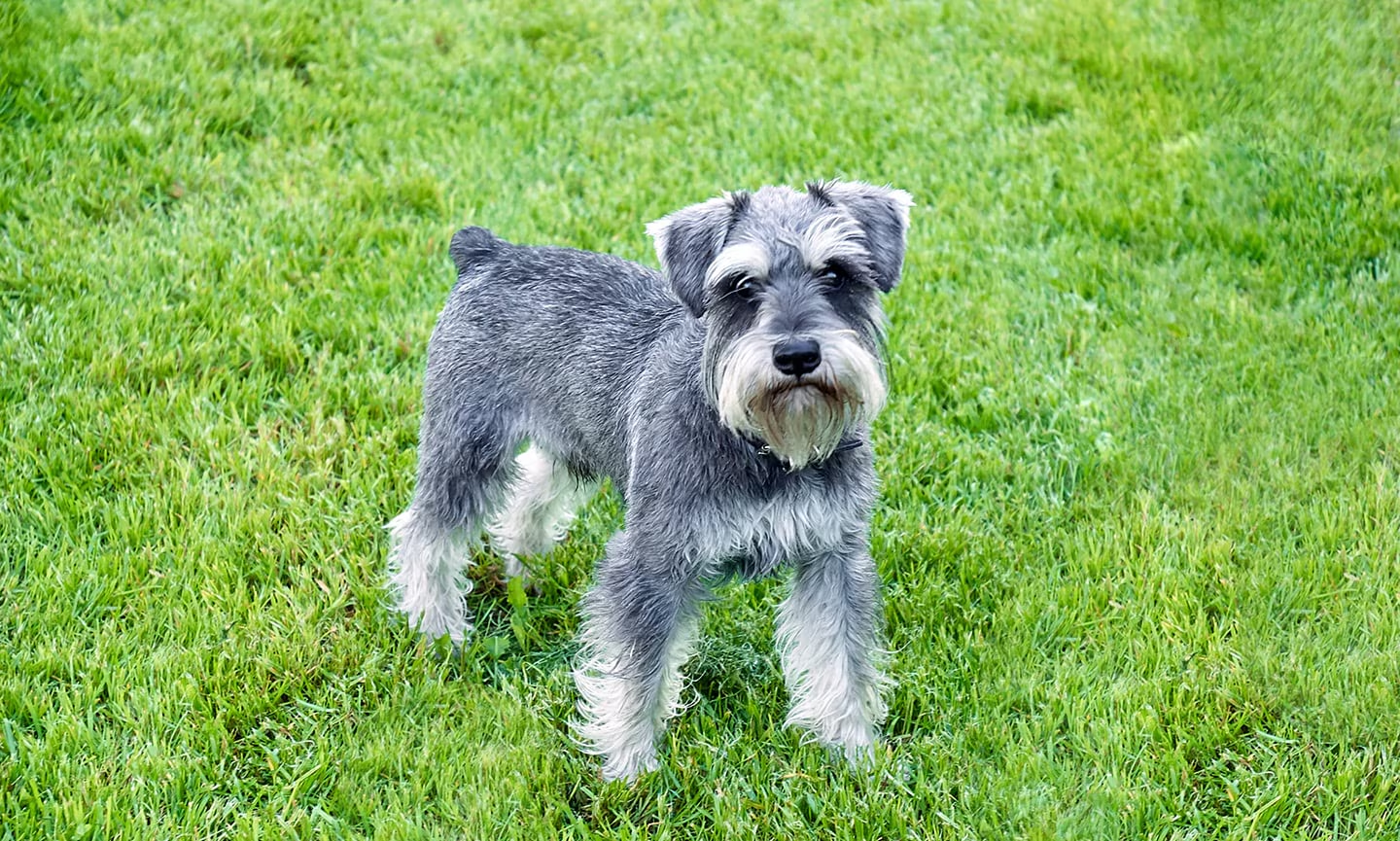
| Height | 30–35 cm (FCI) |
| Weight | 4–8 kg (FCI) |
| Lifespan | 13.3 years (Dogs Trust) · 11.6 (primary care) |
| FCI group | 2 · pinschers and schnauzers |
| Origin | Germany |
Exact ratings
Common health issues
Nutrition
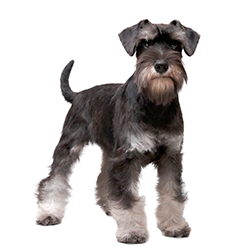
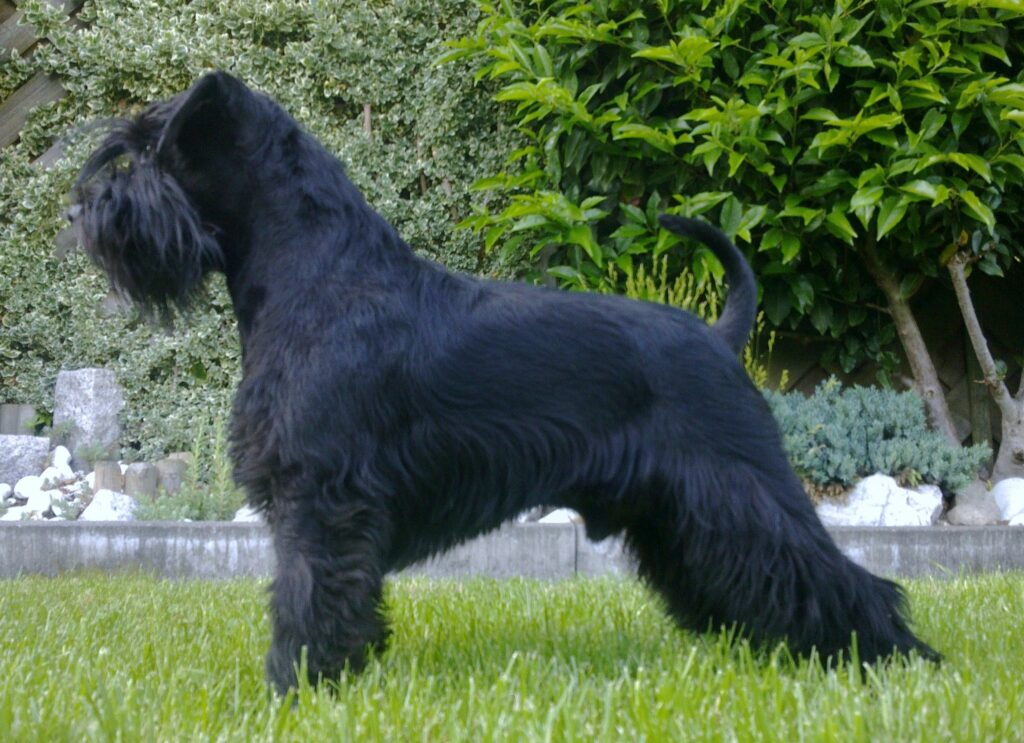
The Miniature Schnauzer (Zwergschnauzer) is the smallest of the three Schnauzers and a breed in its own right, with its own standard — not a shrunk-down Standard or Giant. FCI Standard No. 183 calls it a scaled-down image of the Schnauzer without the faults of dwarfism: same proportions, undeformed head and skeleton, the whole dog fitting inside a square about thirty-odd centimeters on a side. It is the most frequently registered Schnauzer in most registries and one of the few breeds whose veterinary medicine turns on fat metabolism rather than joints or breathing. Below: the standard from the source document, the points where three registries disagree, the genetics with gene names, and the grooming practice that brings most people here. More about dogs at Tvaryny.
Miniature Schnauzer: the short version
| Characteristic | Description |
|---|---|
| Country of origin | Germany |
| FCI group | Group 2, Section 1 “Pinscher and Schnauzer type”, without working trial |
| Purpose per the standard | House dog and companion |
| Height at the withers, FCI | 30–35 cm — the same for dogs and bitches |
| Weight, FCI | approximately 4–8 kg |
| Coat type | Harsh, wiry, with a dense undercoat; beard and eyebrows |
| Colors, FCI | Black, salt and pepper, black and silver, pure white |
| Tail, FCI | Natural, carried saber- or sickle-fashion |
Every row is taken apart below. These figures are the FCI’s; the American Kennel Club and the Kennel Club in Britain use different yardsticks, and no document supports merging all three into one range.
History: where the smallest Schnauzer came from
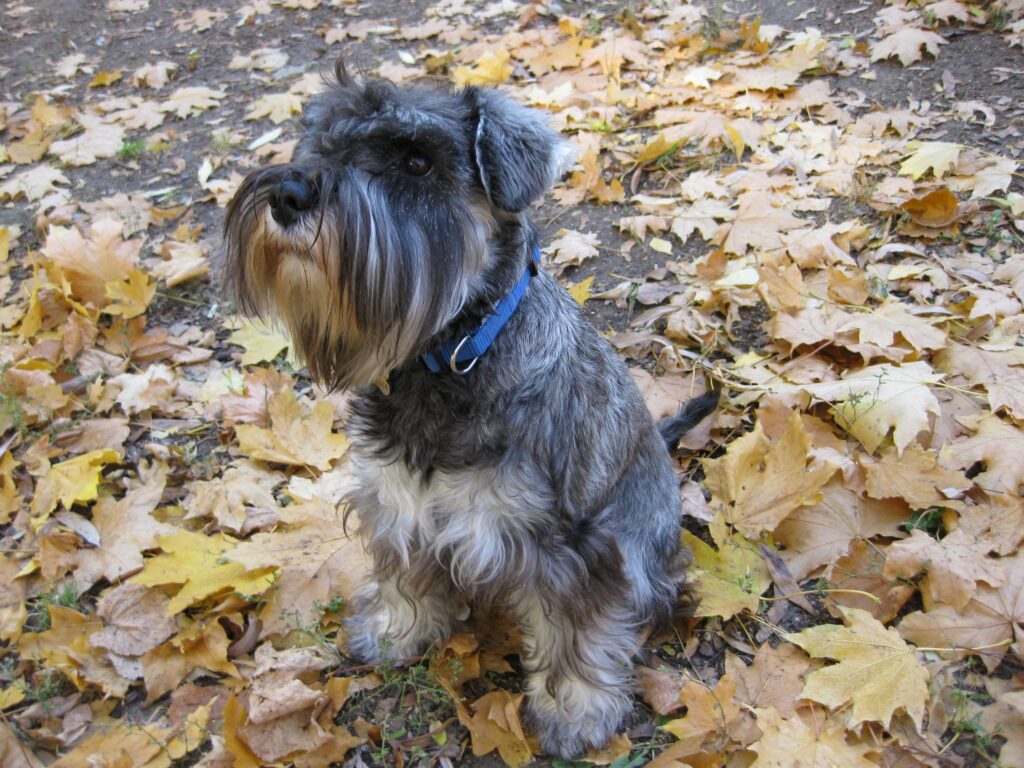
The name is transparent: German Schnauze is “muzzle,” Zwerg is “dwarf” — together, roughly “the little whiskered one.”
The most interesting thing about the history is that the standard tells it itself. The FCI “Brief Historical Summary” says that around the turn of the century the miniature Schnauzer from around Frankfurt am Main set out on its own path, and was then still described as a wire-haired Zwergpinscher. It admits how hard the work was: with different shapes, sizes and types in play and a jumble of harsh, soft and silky coat textures, breeding a small dog with the look and working qualities of its older brother was “no easy task.”
That detail matters, because a misunderstanding grew out of it. The dog was then called a wire-haired Zwergpinscher — a fact about a name, not about ancestors. In retelling it became a claim that Miniature Pinscher blood brought the size down, which no major registry writes in its historical note.
What the registries do say is worth comparing. The British club names one donor, the Affenpinscher: the size reduction is believed to have come from an infusion of its blood. The AKC adds the Poodle but hedges — “said to be descended from.” The American parent club names only the Affenpinscher. Three official versions, three ancestor lists, no source cited. The defensible phrasing is “the clubs believe,” not “it has been shown.”
Early dates deserve the same caution. Years of the “first registration in 1888” and “first shown as a separate breed in 1899” type come from the registries’ historical sketches with no document attached. What can be checked precisely is the date in the FCI database: July 13, 1955, the breed’s final international recognition.
The three paths then diverged sharply. The Giant Schnauzer went into service and protection work, the Standard Schnauzer stayed the all-purpose farm dog, and the Miniature took a niche the family lacked: a compact watchdog and companion for a home with no room for a large dog. The FCI says it plainly under utilization — “house dog and companion,” no working trial.
FCI Standard No. 183: what the document actually says
The current edition is dated 2007. A few provisions are worth knowing even outside the show ring, because they explain why the dog looks as it does.
- Square outline. Height at the withers approximately equals body length, and the head’s length from nose tip to occiput equals half the topline from withers to tail set.
- Full dentition. The standard names 42 teeth and a strong scissor bite. A level bite is a fault; overshot, undershot and wry mouth are disqualifications.
- Front angulation given as numbers. The shoulder blade lies at about 50° to the horizontal, the upper arm forming an angle of 95–105° with it. Unusual: most standards stop at “well angulated.”
- Size is policed hard. A deviation up to 1 cm is a minor fault; over 1 cm but under 2 cm a serious fault; over 2 cm a disqualification. An undersized “teacup” Schnauzer is not a variety but a dog outside the standard.
- Natural tail. Saber- or sickle-fashion carriage is wanted. Docking is not provided for anywhere in the text.
The notes also require that only functionally and clinically healthy dogs of breed-typical conformation be bred from — putting a sire’s health on the same footing as its show grade.
AKC, the Kennel Club and FCI: three registries, three yardsticks
The commonest error in breed descriptions is to take the lower bound from one document and the upper bound from another and publish it as “the height of the Miniature Schnauzer.” No standard contains that range.
| Registry | Height | Color | Group |
|---|---|---|---|
| AKC (United States) | 12 to 14 inches | salt and pepper, black and silver, solid black | Terrier |
| FCI (Standard No. 183) | 30–35 cm, the same for both sexes | black, salt and pepper, black and silver, pure white | Group 2, pinschers and schnauzers |
| The Kennel Club (Britain) | ideal: 36 cm dog, 33 cm bitch | salt and pepper, black, black and silver, white | Utility |
The disagreements are substantive, not editorial:
- Sex. The FCI gives one range for both sexes. The British standard separates them and names an ideal for each — and the male ideal sits above the entire FCI upper limit. It also warns that overly small, toylike dogs are untypical and undesirable.
- White. The FCI recognizes a pure white dog with white undercoat as a full variety with its own show status, and the British standard permits white. The AKC allows only three colors and disqualifies any other. Not Europe versus America, though: the second American registry, the UKC, does recognize white. The position belongs to the AKC, not the continent.
- Tail. The FCI describes a natural tail. The American standard calls for a docked one — just long enough to be clearly visible over the topline — and says all others are to be severely penalized. This is the sharpest divergence, and it runs past aesthetics into law: most European countries ban cosmetic docking, while the AKC text is written where no ban applies.
- Group. Pinschers and schnauzers at the FCI, Utility in Britain, Terriers at the AKC — which calls it a sturdy, active dog of terrier type. By origin it is not a terrier; that is a classification decision, not an ancestry claim. They split the family differently too: the AKC puts the Miniature in Terriers and the Standard and Giant in Working; Britain puts the Miniature and Standard in Utility, the Giant in Working; the FCI keeps all three in Group 2.
Practical takeaway: ask which standard the breeder works to. A dog ideal for the British ring may be oversized under the FCI, and a European import may not match what an American judge holds.
Three Schnauzers, three separate breeds
The FCI treats the Miniature, Standard and Giant as three separate breeds with three separate standards. They are not three sizes of one breed, and the confusion is not harmless: size, working purpose and even life expectancy differ.
British longevity data allow a rare comparison of all three in one study. Work published by Dogs Trust in 2024, built on 584 734 dogs in the United Kingdom (284 734 of them deceased) across 155 breeds, puts the median life expectancy of the Miniature Schnauzer at 13.3 years (confidence interval 13.2–13.5), resting on 1977 recorded deaths in the breed. The Standard Schnauzer gets 13.0 years, the Giant 12.1 — within the family the smallest lives longest, fitting the general pattern.
One number alone would mislead, so here are three — different countries, different methods, which is why they must not be merged:
- 13.3 years — median survival in the British Dogs Trust sample (Kaplan–Meier method).
- 11.6 years — median age at death in a British primary-care veterinary study covering 3857 Miniature Schnauzers; that median rests on only 86 recorded deaths.
- 13.4 years — life expectancy in a Japanese study drawn from Tokyo pet cemeteries (286 Miniature Schnauzers). And here is the interesting part: in that same sample the all-breed figure was 13.7, so in Japan the breed came out below average rather than above it.
Not a contradiction — different populations, counted differently. Median survival, median age at death and life expectancy are three distinct quantities, and none is a promise to an individual dog. The primary-care authors open their paper by asking whether the breed really is “relatively healthy and long-lived,” as it is commonly held to be: specialists treat that reputation as an assumption to test, not a fact.
On numbers of dogs, Britain registered 2956 Miniature Schnauzers in 2025 against 155 Giants and 113 Standards. In Germany the gap is far smaller and unstable: 579 Miniatures were born in 2025 against 427 Giants, while in 2016 the ratio was reversed — 843 Miniatures against 1128 Giants. “The most popular Schnauzer” is a claim about one country in one year, not a general truth.
Build and appearance: head, ears, body
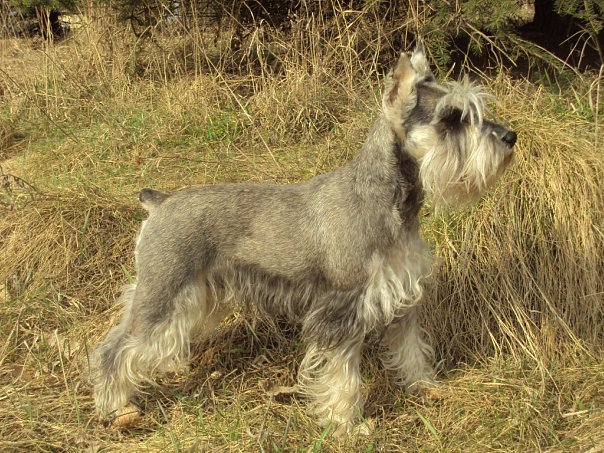
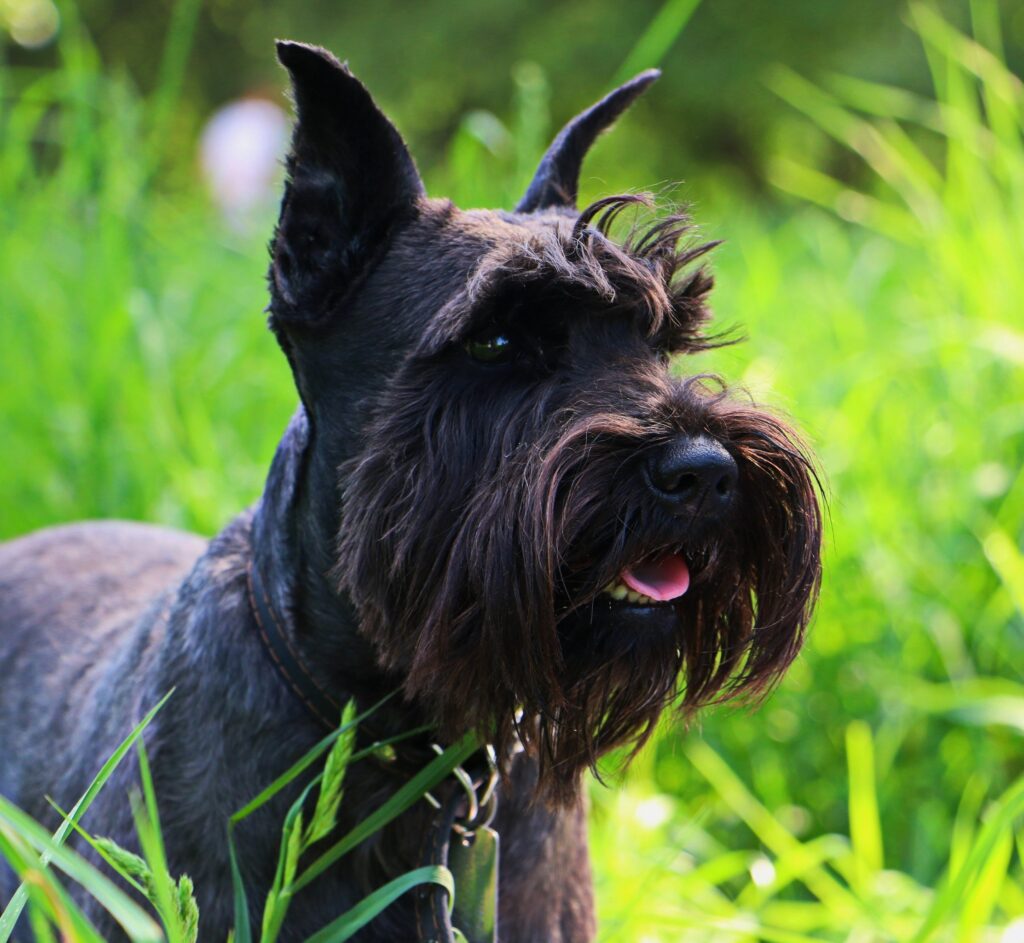
The head is the recognizable part: a strong, elongated skull without a sharply protruding occiput, a flat forehead free of wrinkles and parallel to the bridge of the nose, a muzzle ending in a blunt wedge. The stop looks pronounced because of the eyebrows — the effect is coat, not bone, and that is where the professorial expression comes from.
- Eyes: medium-sized, oval, directed forward, dark, lively in expression; eyelids close-fitting.
- Ears: drop, set high, V-shaped, inner edges against the cheeks, turned forward toward the temples; folds parallel and not rising above the skull’s top line. Cropping is not described in the FCI standard; the American standard still describes both forms, cropped and natural.
- Nose: a well-developed nose leather, always black. The American standard adds that any other color is a disqualification.
- Body: topline falling away slightly from the withers, which are the highest point; back short and firm, loin short and deep, chest moderately broad, oval in section, reaching the elbows.
- Feet: short and round, catlike, toes close-knit and arched, nails short and dark.
Movement is supple, elegant, free and ground-covering: the forelegs reach as far forward as possible, the hindquarters supply a springy drive, back and joints staying firm. Pacing is a fault.
The coat and its four colors
The coat is double: a dense undercoat and a not-too-short topcoat lying close to the body. The standard requires it long enough that its texture can be checked — too short a clip removes the judge’s ability to assess the dog. Neither bristly nor wavy; softer on the legs, short on forehead and ears. The typical marks are a not-too-soft beard and bushy eyebrows lightly shading the eyes. The four FCI colors:
- Pure black with a black undercoat.
- Salt and pepper. The breeding aim is an even medium shading with well-pigmented pepper and a gray undercoat; every shade from dark iron-gray to silver-gray is allowed. The British standard adds the mechanism: each hair is banded dark–light–dark, and that produces the overall gray tone.
- Black and silver. The standard lists exactly where the white markings belong: above the eyes, on cheeks, beard and throat, in two separated triangles on the forechest, on pasterns and feet, inside the hind legs and around the anus. Undivided triangles are a fault.
- Pure white with a white undercoat.
Every color variety requires a dark mask in harmony with the overall color, and distinct light markings on head, chest and legs are undesirable in salt and pepper. A patchy coat in black-and-silver and white dogs is a serious fault, as is white or patchy coat in blacks and salt-and-peppers.
A dog that wins shows in Europe is disqualified under AKC — worth knowing if the puppy is meant for shows abroad.
Then there are colors in no standard at all — chocolate, liver, the various “parti” patterns. The British registry keeps a public tally and places the Miniature Schnauzer among breeds where registrations of non-standard colors exceed 2%. Those dogs exist and are registered, but no standard recognizes them: a “rare color” is a departure from the breed description, not an advantage.
Temperament and life with a family
The FCI describes the temperament with restraint: the character resembles the Schnauzer’s but comes out through the behavior of a small dog, and intelligence, fearlessness, endurance and vigilance together make an agreeable house dog, watchdog and companion that can be kept without difficulty even in a small apartment. The British standard is shorter: alert, reliable, intelligent; a companion above all.
In practice that means a dog who wants to be present for everything: he rarely lies down in another room, following his person to the kitchen, the bathroom, the front door. Unlike the German Spitz breeds — the Medium German Spitz (Mittelspitz) or the Giant German Spitz (Grossspitz), which more often keep their distance — the Schnauzer wants participation, not co-residence.
Important: the vigilance the standard names as a breed trait shows up at home as voice. Not a failure of upbringing — it is what the breed was selected for. You can manage it; you cannot cancel it.
Children. The breed tolerates rowdy play and usually joins in gladly, which does not suspend the ordinary rule: a small child’s contact with any dog belongs under adult supervision, and the dog needs a place the child does not enter.
Cats and small pets. With a cat in the same home a Schnauzer more often negotiates than fights. Hamsters, rats and guinea pigs are another matter: the breed was built from small farm dogs whose job was clearing rodents out of stables. Counting on that instinct not to fire is a poor plan; separating the animals physically is reliable.
Who the breed suits, and who it does not
It will suit you if you live in an apartment and want a dog interested in you daily; if you will walk three times a day with puzzles and games, not five minutes at the curb; if you need a doorbell, not a guard; and if you accept coat care as permanent.
It will not if silence is a hard requirement; if the dog would spend most of the day alone; if you want a maintenance-free dog, since a harsh coat left alone does not clean itself; or if you feed from the table, the riskiest household habit for this breed.
The most repeated advantage — “it doesn’t shed” — needs qualifying. The harsh coat does leave almost no hair on clothes and furniture, but not because it fails to renew itself: the dead hair does not fall out on its own and stays in the skin until removed. Shedding has not disappeared; it has moved from your floor to a grooming appointment.
There is a direct measurement behind the hypoallergenic claim, though not on Miniature Schnauzers. A study in the Journal of Allergy and Clinical Immunology (2012) compared 196 dogs of breeds commonly called hypoallergenic with 160 dogs of other breeds, measuring the major dog allergen on the hair, in the coat, in house dust and in air. The result ran opposite to expectation: on hair and in coat the “hypoallergenic” dogs carried more allergen, and in air there was no difference at all. The authors are blunt — there is no basis for a hypoallergenic category of breeds.
The Miniature Schnauzer was not in that sample, so carry the finding over carefully — but the Airedale Terrier, closest in coat type, was included. The mechanism explains the result: the main dog allergens sit in saliva, dander and skin secretions rather than hair, so “little hair on the couch” and “safe for someone with allergies” are two different statements.
Grooming: hand stripping versus clipping
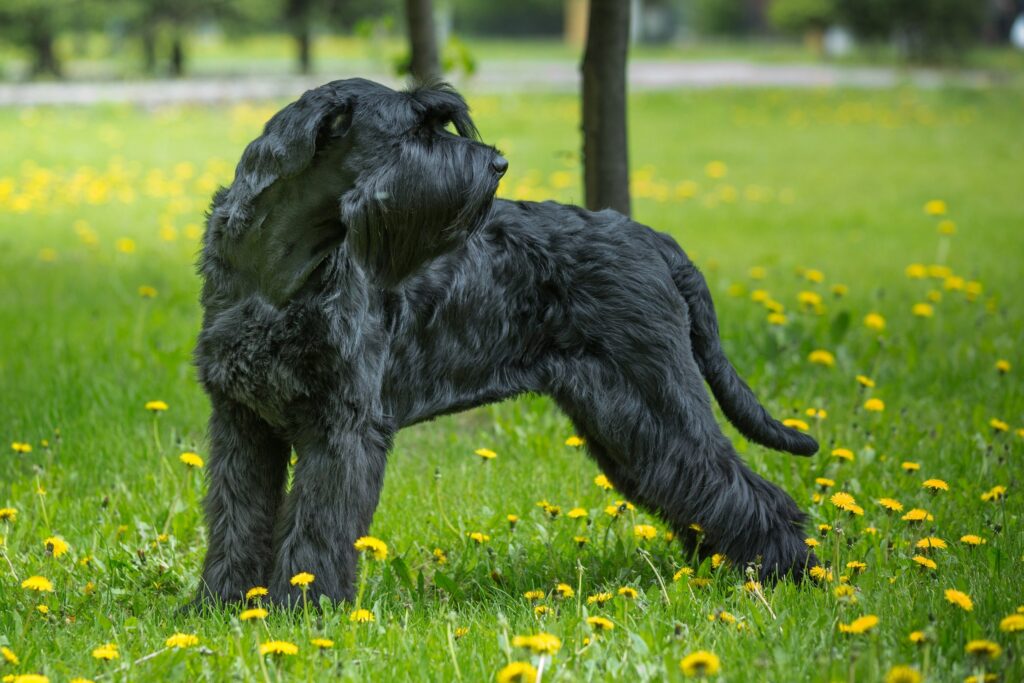
Hand stripping is the mechanical removal of a ripe, dead guard hair together with its root, after which the follicle grows a new one. Clipping cuts the hair off and leaves the root in place; the dead guard hair goes nowhere, and what grows in has different properties.
Separate what rests on a document from what rests on craft. The American standard explicitly requires the coat on head, neck, ears, chest, tail and body to be plucked, and adds that in show condition the body coat must be long enough for its texture to be judged; for the ring, stripping is the document’s requirement, not a groomer’s preference. That a clipped coat goes soft and loses color is the pooled experience of groomers and breeders — consistent with the mechanism, but we cite no study behind it.
The working routine:
- Body. Stripping on a schedule agreed with your groomer: harsh coat ripens in cycles, so the procedure follows the coat, not the calendar.
- Clipped rather than plucked are usually only certain zones: ears, throat, belly, inner thighs.
- Furnishings — beard, eyebrows, leg skirt — brushed daily. This hair is softer and mats readily.
- The beard after meals. Wipe or rinse it, or it stays permanently damp — a medium for bacteria and a source of odor. With dry food the problem is smaller than with canned.
- Ears. The canal grows hair in this breed and is cleared carefully to preserve ventilation. Have a groomer or veterinarian show you the technique — over-thorough removal harms too.
- Nails and teeth. Nails shortened as they grow; teeth brushed regularly, since in small breeds this most affects the gums.
The beard and eyebrows, finally, are not a haircut. A paper in Science (2009) covering more than a thousand dogs from 80 breeds showed that most coat types in purebred dogs are explained by variants in just three genes — RSPO2, FGF5 and KRT71 — with facial furnishings governed by RSPO2. The Schnauzer’s beard is inherited, not made with scissors.
Fat metabolism: the breed’s defining medical subject
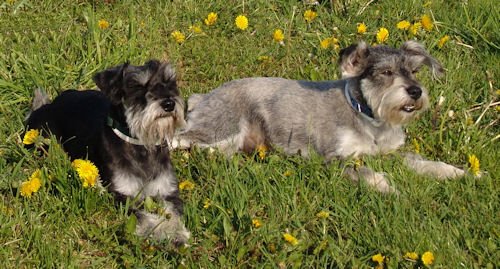
The one subject a veterinarian raises first is elevated triglycerides — not a folk observation but a quantitatively measured trait.
A study from the Texas A&M University laboratory in the Journal of Veterinary Internal Medicine (2007) examined 192 clinically healthy Miniature Schnauzers and 38 healthy dogs of other breeds. Triglycerides above the reference interval turned up in 63 Miniature Schnauzers (32.8%) against 2 dogs (5.3%) among controls. Median triglycerides were higher in the Schnauzers, cholesterol did not differ statistically — so this is about triglycerides specifically, not “high cholesterol.”
The most important result is the age curve, and it is steep — the share with triglycerides above normal, by age:
| Age | Share with elevated triglycerides |
|---|---|
| under one year | 15.4% |
| one to three years | 15.7% |
| six to nine years | 43.5% |
| over nine years | 76.7% |
The control group of other breeds showed no such age dependence at all, and no difference between males and females. So a panel run on a puppy says nothing about six or eight years of age: monitoring must be repeated, not done once.
A correction on how these figures get read. The British primary-care study, working from the records of a random sample of Miniature Schnauzers, did not find hyperlipidemia among the twenty-five most frequent diagnoses in the breed. No contradiction: 76.7% is the share of dogs in whom the value was measured and came out high, whereas a diagnosis list reflects what made it into the chart.
One further finding concerns the kidneys. A 2016 study examined 57 Miniature Schnauzers — 34 with elevated triglycerides, 23 normal. Protein in the urine above threshold appeared in 60% of the dogs with elevated fats and in none (0%) of the normal ones. That sounds alarming, so the second step matters: in a follow-up by the same group, dogs with that proteinuria were watched for about a year and a half on average, and kidney values did not deteriorate. A genuine finding, but clinically quiet on that horizon.
The same group took the next step in JAVMA (2011), comparing 28 Miniature Schnauzers with hypertriglyceridemia and 31 with normal triglycerides. In the high-fat group median insulin was higher, and the share with high insulin was 28.6% against 6.5% in controls (odds ratio 5.8; confidence interval 1.1–30.2). Elevated triglycerides here often travel with insulin resistance.
A caution about language: “associated with” is not “causes” — this work shows an association, not a causal chain. Nor are elevated triglycerides a diagnosis in themselves; secondary causes exist (endocrine disease, medications, insufficient fasting before the draw), so the result is for a veterinarian to interpret, not the owner.
Pancreatitis and what travels with it
The fat story is why owners hear “pancreatitis” so often, and the evidence differs in strength from claim to claim. The predisposition to hypertriglyceridemia is documented by the numbers above. “The breed is prone to pancreatitis” is repeated as settled in reviews and handbooks, but we do not quote a separate epidemiological risk figure for the Miniature Schnauzer: the classic studies of canine pancreatitis risk factors name other breeds, or whole groups of them.
What does exist is a direct observation inside the breed, worth more than a general ranking. A 2011 study compared 17 Miniature Schnauzers that had been through pancreatitis with 34 of the same age without that history. Even after recovery, elevated triglycerides were present in 71% of the first group against 33% of the second (odds ratio 5.02; confidence interval 1.4–17.8). The elevated fats are not a consequence of the inflammation but a state that stays with the dog afterward.
For scale: in a British owner survey covering 2910 Miniature Schnauzers, pancreatitis had been diagnosed at some point in 7.6%. That is a within-breed share from owner recall with no comparison group — it shows how familiar the subject is, not how much riskier the breed is.
The practical advice does not change; it just gets a foundation. Acute pancreatitis often develops after a single fatty treat, so a piece of cheese, sausage or bacon is not a neutral trifle. Signs that call for a veterinarian the same day: repeated vomiting, refusal of food, lethargy, a painful abdomen, and the characteristic “praying” posture with forelegs down and rear end up.
The good news is that intervention works. In a prospective study from the same laboratory (JVIM, 2020), 16 Miniature Schnauzers with hypertriglyceridemia were switched to a commercial reduced-fat diet, blood measured twice before the change and twice after. Median triglycerides before were 480 and 493 mg/dL; afterward, 177 and 168. By lipoprotein profile, 15 of the 16 (94%) counted as hyperlipidemic before and 7 of 16 (44%) after. A low-fat diet here is not just-in-case advice but an intervention with a measured effect in this breed.
One clarification: breed-disease lists often include diabetes mellitus. A British primary-care study covering 480 469 dogs aged three years and over did find increased odds of diabetes in the breed — but only in the simplest model. Once age, sex and neuter status were accounted for, the association stopped being statistically significant, and in a large Swedish insurance sample the breed did not appear among the highest-risk at all. The defensible wording: the concern is understandable and the link with insulin resistance is shown, but “breed predisposition to diabetes” is not an established claim today.
Bladder stones: why calcium oxalate
The second breed subject is urinary stones, and here they have a characteristic composition. The German laboratory Laboklin analyzed 2772 urinary stones by infrared spectroscopy, sent in from German veterinary practices during 2017–2019 (Tierärztliche Praxis, 2021). Across all breeds struvite predominated (44.7%), calcium oxalate monohydrate 24.5%. By breed the picture changes: among stones from Miniature Schnauzers, calcium oxalate accounted for 54.8% — the highest share of any breed named. Median age of dogs with oxalate stones: 10 years.
Read that carefully: 54.8% is the composition of stones in the Miniature Schnauzers whose stones were sent for analysis, not the proportion of the breed that develops stones. It says which type to expect, not how often stones occur.
How much higher the breed’s risk is happens to be easy to get wrong, and an American study of 258 898 submitted stones from 2010–2015 shows why. The authors calculated the Miniature Schnauzer’s risk three times against three comparison groups and got three different numbers for the same breed: an odds ratio of roughly 2 against dogs whose stones were of another composition; about 8 against all hospital patients free of urologic problems; about 12 against the breed population at large.
None is more “correct” — they answer different questions, and any risk figure should be read with its denominator. What the study establishes unambiguously is that all twelve high-risk breeds turned out to be small, and that the mean age at first episode in the study was a little over eight years. Hence the authors’ advice to begin routine urine monitoring in high-risk breeds at roughly five or six years of age — before symptoms appear.
Why oxalate in particular is partly explained by work from the Virginia veterinary college (JVIM, 2020) comparing 24 male Miniature Schnauzers: 9 with oxalate stones, 15 without. In the stone formers the urine calcium-to-creatinine ratio stayed higher through all eight hours of observation — they excrete more calcium in the urine. A cutoff of 0.06 gave 93% specificity and 56% sensitivity: a positive result carries weight, a negative one does not rule the disease out.
Day to day: constant access to water, the chance to empty the bladder several times a day rather than holding it for hours, and an immediate visit to the veterinarian for straining, blood in the urine or frequent unproductive attempts. In males a stone can block the urethra — an emergency.
How the two subjects connect: a study in JVIM (2022) showed that in dogs generally the odds of calcium oxalate stones rise with blood triglycerides. But in part of the analysis those authors deliberately excluded Miniature Schnauzers so the breed would not pull the result — so the correct statement is “the fat–oxalate link is shown in dogs generally,” not “proven in Miniature Schnauzers.”
Eyes: PRA and the honest story of one DNA test
Progressive retinal atrophy (PRA) is an inherited degeneration of the photoreceptors leading to loss of sight. In this breed it was described long ago: in the Journal of Heredity (1999) an early form — photoreceptor dysplasia — was documented, with autosomal recessive inheritance confirmed by pedigrees and test matings. Seven candidate genes were checked and four ruled out; the causal gene was not identified. What happened next shows the science as a process rather than a finished answer.
- The University of Pennsylvania group (G3, 2019) collected DNA from 51 affected Miniature Schnauzers and 56 clinically normal dogs of the breed; mean age at diagnosis among the affected was about 3.9 years. The analysis narrowed the search to a region on chromosome 15 and proposed a complex structural variant of PPT1.
- The University of Helsinki group (PLoS Genetics, 2020) showed the breed carries at least two genetically distinct forms of PRA — loci on chromosome 15 and on the X chromosome — and for the first proposed a different culprit: a regulatory substitution in an intron of HIVEP3, inside a predicted transcription factor binding site.
Both groups were right about the locus and disagreed about the culprit. Instead of trading arguments they checked each other’s data and published a joint formal comment (PLoS Genetics, 2020), whose conclusions bear on what a breeder buys as a “PRA test”:
- Both variants lie in the same region, HIVEP3 roughly one and a half million base pairs from PPT1.
- The “incomplete penetrance” of PPT1 reported earlier was an artifact of method: the markers used to call the zygosity of a complex structural variant are not suited to it, and a dog counted as a homozygote proved to be a heterozygote.
- The authors state plainly that the genetic data cannot distinguish which variant is causal, and that the cause may yet be a third one in the same region.
- Until that is settled the HIVEP3 variant can be used in testing — with the authors’ caveat: if HIVEP3 is not causal, recombination between it and the true cause will produce wrong test results.
What a puppy buyer should take from this: the test exists and is worth using, but it is a marker test, not a definitive one, and it does not replace regular examination by a veterinary ophthalmologist — a more honest answer than “there is a DNA test, so the question is closed.” Cataract comes up often here too, and the same rule applies: clouding of the lens shows up at a scheduled eye exam, and it is the exam, not a blood panel, that catches it early.
Three mutations with direct DNA tests
Unlike PRA, three other breed conditions have their causal variant pinned down unambiguously, and the test is direct, not a marker.
Congenital myotonia. A mutation in CLCN1, the gene for the skeletal muscle chloride channel (the ClC-1 protein); inheritance recessive. Affected dogs move stiffly, struggle to rise and show characteristic jaw changes. The test came from the University of Pennsylvania: a 2002 paper tested 372 Miniature Schnauzers from the United States, Canada, Australia and Europe. Of these, 292 (78.5%) were clear, 76 (20.4%) carriers and 4 (1.1%) affected; the mutant allele frequency was 0.113. Pedigree analysis showed every carrier and affected dog traced to a single popular carrier sire.
That last detail is the most valuable part of the work, and the numbers must be read through it: not a random sample but dogs submitted for testing, converging on a common ancestor. So 20.4% is not “the carrier rate in the breed” but a measure of how far one sire can spread a variant through a closed population.
Persistent Müllerian duct syndrome. A disorder of sexual development in which a genetically male animal retains rudiments of the female reproductive tract. The cause is exact: a single base-pair substitution in AMHR2, the anti-Müllerian hormone receptor gene, creates a premature stop codon in the third exon, and translation breaks off at the 80th amino acid — the receptor is never built. Inheritance is autosomal recessive, expressed only in males; consequences are cryptorchidism, infertility and raised risk of testicular tumors. A 2018 study genotyped 216 North American Miniature Schnauzers: mutant allele frequency 0.16, carrier share 0.27. The authors’ conclusion is direct — test breeding animals and cryptorchid males.
Susceptibility to mycobacteria. The newest finding and the rarest condition. In 2024 Scientific Reports described a primary immunodeficiency that leaves adult Miniature Schnauzers with progressive disseminated Mycobacterium avium complex infection — one mammals are normally resistant to. Comparison of 8 infected dogs, 9 uninfected relatives and 160 control Miniature Schnauzers pointed to chromosome 9, and whole-genome sequencing to a single-codon deletion in CARD9. Every infected dog tested was homozygous, and the allele has been found in the breed worldwide. This is the first spontaneous animal model of CARD9 deficiency.
Keep the proportions in mind: myotonia and Müllerian duct syndrome are uncommon, disseminated mycobacterial infection rare. The value of these findings is not that owners should fear them, but that a recessive condition with a known gene disappears from a breed in one generation if breeding animals are tested and two carriers are never mated.
Heart, rhythm and skin
Questions to ask a breeder
Feeding
Training, socialization and exercise
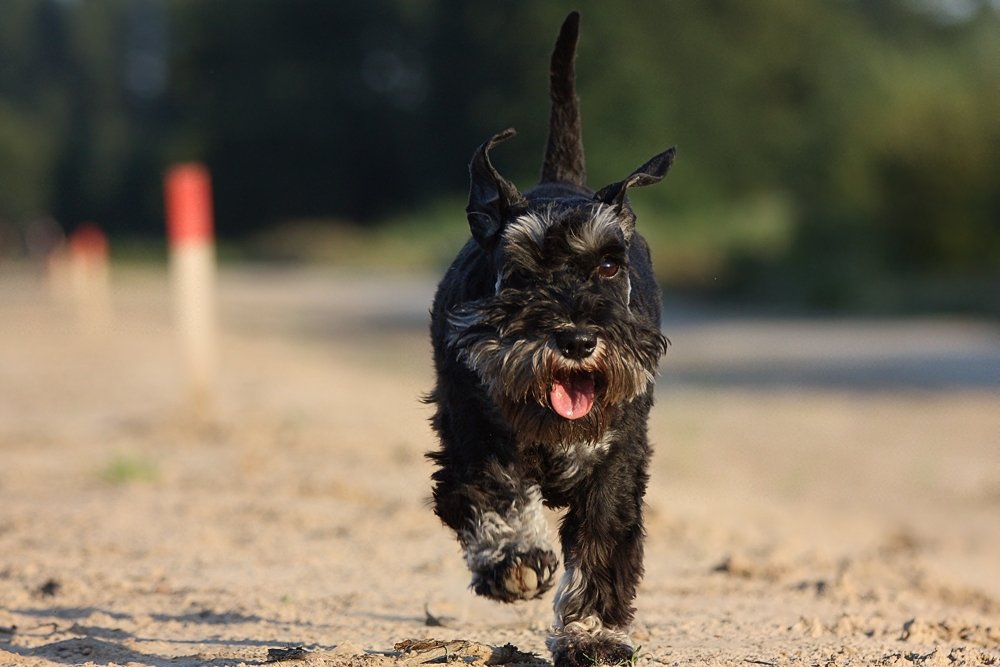
A Miniature Schnauzer learns fast — and just as fast the things you never taught him. This is a breed that checks whether a command is really binding, not from stubbornness but because it reads consistency well.
The famous “intelligence ranking” deserves an honest note. In Stanley Coren’s classification the breed holds 12th place, in the “excellent working dogs” band, whose stated learning rate is a new command in 5–15 repetitions. Two corrections keep that from misleading. First, 5–15 repetitions describes the band, not this breed: dozens of others sit in the same group. Second, the ranking rests on a survey of obedience judges, not a cognitive test, and the author uses it to measure only “working and obedience” intelligence. Position 12 is about predicted trainability on the field, not cleverness.
Socialization. The critical window is the first months. Breed vigilance without experience turns into barking at everything that moves: cyclists, joggers, strange dogs. The task is not to teach him not to be afraid but to bank calm impressions — surfaces, traffic, the elevator, a noisy street, friendly dogs of all sizes — each ending neutrally or pleasantly.
Barking. Removing it entirely will not work — it is the vigilance the breed is valued for. The working approach: teach a “Quiet” cue away from the situation, reinforce not silence in general but the pause after the signal, and remove the trigger in parallel, for instance by blocking the window view onto the entry.
Impulse control. For a choleric dog, stay exercises — “Place,” “Wait” — beat new tricks: they supply what is missing, the ability to do nothing. Start with seconds and lengthen.
Exercise. Compact does not mean low-need. Miniature Schnauzers do well in dog sports calling for speed and precision — agility, obedience, scent games. Scent work suits apartment owners especially: hunting treats in grass or boxes tires a dog more than half an hour of running and takes no space. What does not work is harshness: a dog who decides that mistakes around people are dangerous becomes not more obedient but more cautious and slower to learn.
Interesting facts about the Miniature Schnauzer
- One dog, three groups. Pinschers and schnauzers at the FCI, Utility in Britain, Terriers at the AKC. The breed has not changed; the classification systems have.
- The standard admits it was hard to create. The FCI wording about a jumble of harsh, soft and silky textures is a rare case of an official document describing the difficulty of selection, not only the result.
- In the United States it is steadily popular. Over the past decade the American Kennel Club has kept the Miniature Schnauzer between 16th and 19th place in its popularity rankings — a stability few breeds manage.
- It became a model for human medicine. The CARD9 defect found in Miniature Schnauzers in 2024 produced the first spontaneous animal model of that immunodeficiency, previously studied mainly in knockout mice.
- The beard is a gene, not a haircut. Facial furnishings are governed by a variant of RSPO2 — the same gene that gives beards and eyebrows to other wire-haired breeds.
- The smallest lives longest — depending on the country. In British data the Miniature Schnauzer’s median life expectancy beats the Standard’s and the Giant’s. In the Japanese sample it came out below the all-breed average — a reminder that “breed longevity” is measured in a particular population.
Frequently asked questions
Are the Miniature, Standard and Giant Schnauzer one breed in three sizes?
No. The FCI recognizes three separate breeds with separate standards. Size differs and so does purpose: the Miniature is a house dog and companion by its standard, while the older relatives have a working history. Even life expectancy differs — in British data 13.3 years for the Miniature, 13.0 for the Standard, 12.1 for the Giant.
Which height is correct — 30–35 cm or 36?
Both, depending on the document. The FCI sets 30–35 cm for both sexes, the British standard an ideal of 36 cm for a dog and 33 cm for a bitch, the American 12 to 14 inches with disqualification outside those limits. Merging them into one “correct” range is not defensible — say which standard you mean.
Do Miniature Schnauzers bark a lot?
Yes, and it is a breed trait, not a malfunction: vigilance is written into the standard as one of the qualities that make this dog a watchdog. Barking responds to early socialization, a “Quiet” cue and the removal of triggers, but counting on a silent dog is not realistic.
Is it true that the breed does not shed and suits people with allergies?
The harsh coat leaves almost no hair around the house, because a dead guard hair stays in the skin until stripping instead of falling out. But “little hair on the couch” and “safe for someone with allergies” differ: the main dog allergens are in saliva, dander and skin secretions. Before deciding, spend a few hours indoors with an adult of the breed.
Why does a Miniature Schnauzer need a low-fat diet?
Because elevated triglycerides here are documented by numbers: among 192 clinically healthy Miniature Schnauzers, 32.8% were above normal against 5.3% of other breeds, and a prospective study showed a reduced-fat diet lowers those values markedly. The specific fat content is for a veterinarian to prescribe from a test.
Which DNA tests should a breeder have done?
Direct tests exist for congenital myotonia (CLCN1) and persistent Müllerian duct syndrome (AMHR2); since 2024, genotyping for the CARD9 variant too. A test linked to PRA is offered as well, but it is a marker test: in a joint comment the authors of both groups warned the causal gene is not finally established. An eye examination by a veterinary ophthalmologist therefore stays mandatory.
Can a Miniature Schnauzer live outside in a kennel run?
No. The standard defines the breed as a house dog and companion, and that is no formality: it copes badly with isolation from its family. Size is a second argument — a small body loses heat quickly, and the undercoat does not compensate in hard frost.
What does keeping one involve beyond ordinary care?
We give no monetary estimates — an editorial decision. The breed-specific list, though: professional care of the harsh coat for life; the parents’ DNA tests, worth asking about before buying; a scheduled eye examination with a veterinary ophthalmologist; periodic fasting triglyceride checks in the adult dog, more important with age; and urine monitoring, which high-risk breeds should begin at five or six years of age.
Video about the breed
- Leaves almost no hair around the house
- Smart, learns quickly
- Compact, suits an apartment
- Alert doorbell of a watchdog
- Needs regular grooming
- Inclined to bark
- A special metabolism (pancreatitis, stones)
- Can be stubborn
| Miniature Pinscher | West Highland White Terrier | Standard Schnauzer | |
|---|---|---|---|
| Height | 25–30 cm | 25–28 cm | 45–50 cm |
| Energy | 4 | 3.5 | 4 |
| Apartment | 4 | 4 | 3.5 |
| Beginners | 3 | 3.5 | 3.5 |
Are the Miniature, Standard and Giant Schnauzer one breed in three sizes?
Which height is correct — 30–35 cm or 36?
Do Miniature Schnauzers bark a lot?
Does the Miniature Schnauzer really not shed, and does it suit people with allergies?
Why does a Miniature Schnauzer need a low-fat diet?
Which DNA tests should a breeder have done?
Why calcium oxalate stones in Miniature Schnauzers specifically?
Can a Miniature Schnauzer be kept in an outdoor kennel run?
FCI Standard No. 183 · Royal Kennel Club · American Kennel Club · United Kennel Club · Journal of Veterinary Internal Medicine · JAVMA · Journal of Veterinary Cardiology · Tierärztliche Praxis · Scientific Reports · PLoS Genetics · G3: Genes, Genomes, Genetics · Science · Journal of Heredity · Journal of Allergy and Clinical Immunology
For apartments · For kids · For beginners · Active · Smartest · Hypoallergenic · All rankings →