

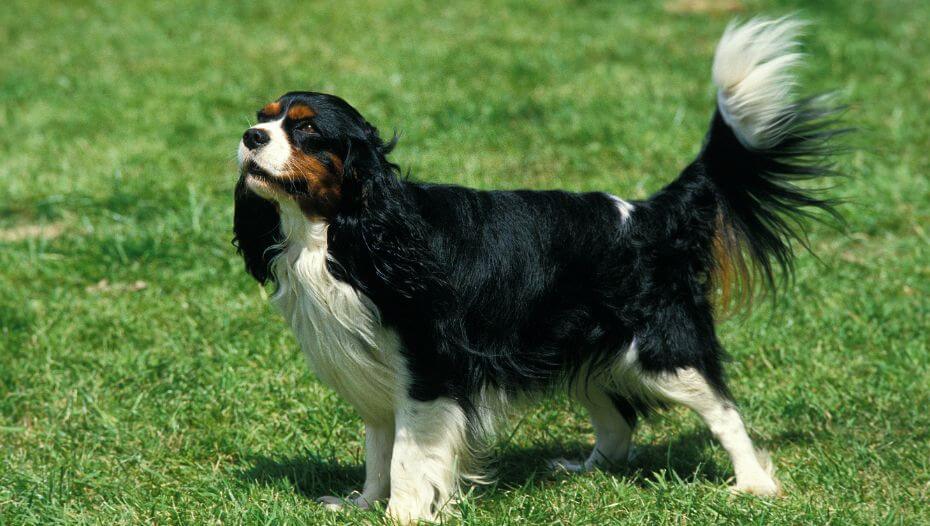
| Height | 30–33 cm |
| Weight | 5–8 kg |
| Lifespan | 9–14 years |
| FCI group | 9 · toy spaniels |
| Origin | United Kingdom |
Exact ratings
Common health issues
Nutrition
The Cavalier King Charles Spaniel is the embodiment of elegance and boundless devotion. This is not just a dog; it is an intellectual companion that has spent centuries learning to read a person’s mood at a glance. This aristocratic breed ranks among the top ten most expensive dogs. Affectionate and refined, this dog dislikes noise and hustle; it has the ability to calm you with its behavior and delights the eye with the straight locks of its cascading coat. This four-legged friend is better suited as a living room ornament than an active partner for marathon running, although one should not underestimate its spaniel nature. Read more on this at Tvaryny.
Cavalier King Charles Spaniel: Brief Overview and Breed Passport
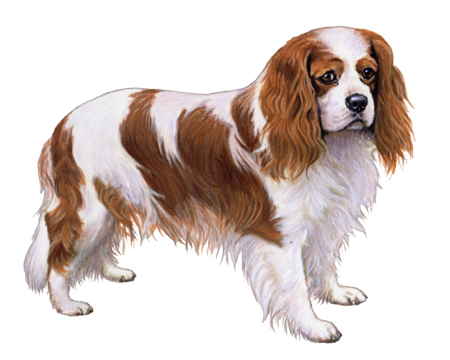
| Characteristic | Standard Data |
| Origin | Great Britain |
| FCI Classification | Group 9 (Companion and Toy Dogs), Section 7 (English Toy Spaniels) |
| Year of Official Recognition | 1954 (as a separate breed from the King Charles) |
| Life Expectancy | 10-12 years (some individuals live to 14-15) |
| Height at Withers | 12-13 inches (30-33 cm) |
| Weight | 12 – 18 lbs (5.4 – 8.2 kg) (preferably within standard limits) |
| Coat Type | Long, silky, free from curls |
Breed History: From Palaces to the Present Day
The history of “Cavaliers” reads like a gripping historical novel. This decorative breed emerged from complex breeding efforts to revive the original image of the English Toy Spaniel, famous at the 17th-century royal court. Initially, small spaniels were favorites of the Stuart dynasty. King Charles II was so obsessed with these dogs that, according to legend, he issued a decree allowing them in any public place, including Parliment. In those days, these dogs were used not only as live heating pads but also as flea magnets, protecting their noble owners from parasites.
However, with the accession of William III of Orange, fashion changed. The King preferred Pugs. To please the monarch, breeders began crossing classic spaniels with Pugs and Japanese Chins. This led to a radical change in appearance: the muzzle became flat, the skull domed, and the eyes wide-set. Thus appeared the modern King Charles Spaniel (without the “Cavalier” prefix). The old type, depicted in paintings by Van Dyck and Gainsborough, was almost forgotten.
The revival began only in the 1920s. American Roswell Eldridge visited Crufts and was disappointed not to find any “old-type” spaniels with long noses there. Enthusiasts responded to the challenge. Thus, through the selection of dogs with longer muzzles, the first standard of the new “old” breed was developed in 1928. It was named the “Cavalier King Charles Spaniel,” adding the word “Cavalier” (as supporters of King Charles I were known during the Civil War) to distinguish them from their snub-nosed relatives.
What the Cavalier King Charles Spaniel Looks Like: Detailed Appearance

A graceful dog of small stature with a long silky coat gives an impression of softness and gentleness. Unlike many other toy breeds, the “Cavalier” should not look too fragile or lightweight; it is a small spaniel with substantial bone.
Head and Eye Expression
The head is a key breed characteristic. The skull between the ears should be almost flat, distinguishing it from the domed skull of the King Charles. The transition from forehead to muzzle (stop) is moderate, not too deep. The muzzle is about 1.5 inches long, tapering to the nose, but should not be pointed. The main “weapon” of the Cavalier is its eyes. They must be large, dark, round, but not protruding. The look should be soft and “melting,” instantly triggering a desire to offer the dog a treat.
Coat and Colors
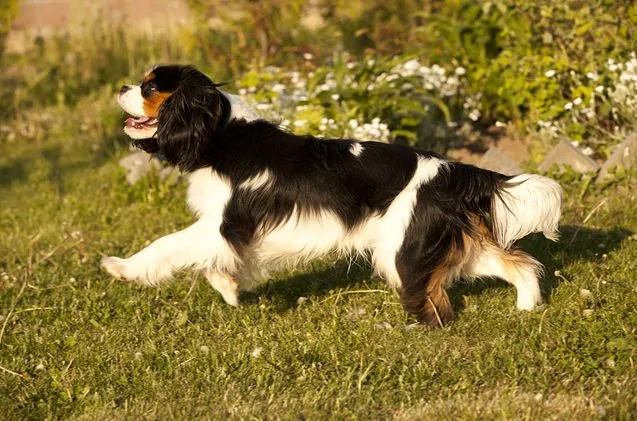
The coat is long, silky, and pleasant to the touch. A slight wave is permissible, but curls are considered a fault. Rich feathering adorns the ears, legs, and tail. There are four officially recognized colors of the Cavalier King Charles Spaniel:
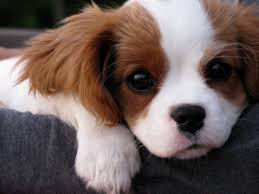
- Blenheim: This is perhaps the most famous color. It combines two tones: rich chestnut-red markings on a pearly white background. The markings on the head should be symmetrical, leaving a white lozenge between the ears. Highly prized is the presence of a unique chestnut spot in the center of this lozenge – the “Spot of Lord Marlborough.”
- Ruby: Implies a solid rich red (mahogany) color. White markings on the chest or paws are considered undesirable in this variety.
- Tricolor: Sometimes called “Prince Charles.” This is a black and white pattern with clearly defined markings. An essential element is the tan markings over the eyes, on the cheeks, inside the ears, and under the tail.
- Black and Tan: Raven black with bright tan markings. White marks are not permitted in this color. This variety is sometimes referred to as “King Charles.”
Comparison with Other Breeds: How to Avoid Mistakes
Novices frequently confuse Cavaliers with similar breeds. Confusion arises most often with its closest relative and ancestor – the King Charles Spaniel. The main difference: the King Charles is smaller, has a snub nose, and a more domed head.
There is also a certain resemblance to other decorative dogs. For instance, the Continental Toy Spaniel Papillon also has spaniel roots but is distinguished by characteristic “butterfly” ears and a more fragile build. The Eastern representative, the Japanese Chin, was also an imperial favorite but possesses completely different facial expressions and coat structure.
If you are looking for a more exotic long-haired friend, it is worth paying attention to breeds such as the Tibetan Terrier (which is not actually a terrier, but a herding companion dog) or the sacred Tibetan Spaniel, which has guarded monasteries in the Himalayas for centuries.
Character and Temperament: Ideal Companion or Cunning Manipulator?
Since the breed was bred exclusively as companion dogs, Cavalier King Charles Spaniels fit the image of a family friend perfectly. They are practically devoid of aggression. These are “Velcro dogs” that will follow you into the bathroom, kitchen, and onto the couch. They are affectionate with all family members, yet they often choose one “primary” owner with whom they establish an almost telepathic bond.
However, behind this angelic appearance hides a clever manipulator. It is vital to establish human authority and leadership immediately (gently, without harshness), then you will not have problems with the four-legged rascal. If the Cavalier realizes that its sad eyes act on you like hypnosis, it will receive treats from the table constantly, which leads to obesity.
Behavioral Features:
- Attitude towards children: Cavaliers are patient and playful, making them ideal for families with children. But teach kids correct behavior with a small dog, as usually the non-aggressive little one might nip in response to blatantly painful or careless handling.
- Fear of loneliness: It craves human presence above all else, so it suffers painfully even from short separations. This is not a breed that can be left home alone for 8-10 hours. They may howl or damage things due to stress.
- Hunting instinct: Do not forget that this is a spaniel. Upon spotting a pigeon or squirrel, the “couch potato” can instantly transform into a hunter and dash into the bushes, ignoring commands.
Health: Genetic Risks and Prevention
Care and Grooming: How to Maintain the Royal Look?

Despite the long coat, caring for a Cavalier King Charles Spaniel creates fewer difficulties than might appear at first glance, as their coat does not need trimming (and it is not even recommended, so as not to spoil the natural structure). Cavalier King Charles Spaniels are house dogs in the full sense of the word, so they must live alongside their owner, in warmth and comfor.
Basic Care Procedures:
| Procedure | Frequency | Specifics |
| Brushing | 2-3 times a week | Pay special attention to areas behind the ears, under the armpits, and on the “trousers” where mats often form. Use a comb and slicker brush. |
| Bathing | Every 2-3 weeks | Use professional cosmetics to moisturize the long coat. Do not use a hot hairdryer to dry the fluffy mite quickly – hot air will damage its skin and dry out the coat. |
| Ear cleaning | Weekly | Inspection is mandatory. Remove dirt only from the visible part of the ear canal with a special lotion. |
| Paw care | Regularly | The fur between the paw pads needs trimming so that dirt and grit don’t accumulate there, and also so the paw doesn’t splay. |
| Dental hygiene | 2-3 times a week | Small dogs are prone to tartar build-up, so brushing with a toothbrush is critically important. |
Training and Socialization: Educating a Gentleman
Cavaliers are smart and eager to please, making them excellent students. However, they can be occasionally absent-minded. The best method is positive reinforcement. No shouting or physical punishment – this will only frighten the sensitive dog and destroy trust.
A notable feature of these decorative little ones is a moderate need for physical activity, but this does not mean they are lazy. King Charles Spaniels are sedentary at home, but they come alive outdoors. One short walk a day is sufficient for them just for bathroom purposes, but for heart health, at least one hour of walking in total per day is recommended. If you want your four-legged favorite to keep you company on longer outings, you will have to accustom it to increasing loads carefully and gradually.
At the same time, a King Charles Spaniel is unlikely to be able to accompany an owner during professional marathons – its heart is not designed for extreme loads, although it will accept a light jog with joy.
Nutrition: Key Recommendations
Pros and Cons of the Breed
Before getting a puppy, weigh up all the pros and cons, because responsibility for an animal’s life is a serious step.
| Pros (+) | Cons (-) |
| Incredibly affectionate and attached character. | Prone to serious genetic diseases (heart, syringomyelia). |
| Ideal size for an apartment and travel. | Does not tolerate loneliness, requires constant attention. |
| Friendly towards other animals and children. | Requires regular grooming of long coat (sheds). |
| Absence of aggression towards people. | May pick up trash on the street (“vacuum cleaner”). |
| Smart and easy to train. | High cost of a puppy and potentially expensive veterinary care. |
Interesting Facts About the Breed
- The Cavalier King Charles Spaniel featured in the series “Sex and the City” as Charlotte’s pet named Elizabeth Taylor.
- According to legend, after the execution of King Charles I, his dog refused food and died of grief, which became a symbol of the breed’s devotion.
- The word “Duchess” was frequently used as a name for dogs of this breed in the Victorian era.
- Despite their “toy” appearance, Cavaliers successfully compete in agility and obedience competitions.
Frequently Asked Questions (FAQ)
Do Cavalier King Charles Spaniels shed a lot?
Yes, they shed, especially in spring and fall. Regular brushing helps control the amount of hair in the house, but you won’t be able to avoid it completely on furniture.
Do these dogs bark?
Cavaliers are generally not “yappers.” They may bark to warn of guests arriving, but are not prone to barking without reason. However, from boredom or loneliness, any dog may start to vocalize.
Is this breed suitable for allergy sufferers?
No, the Cavalier King Charles Spaniel is not a hypoallergenic breed. Their fur and dander can cause an allergic reaction.
Video About the Breed
- Remarkably gentle and sociable
- Excellent with children and animals
- Compact, ideal for an apartment
- Easy to teach, eager to please
- A high predisposition to heart disease
- Cannot bear being alone
- Ear and coat care
- Can gain weight
| King Charles Spaniel | Papillon | Tibetan Spaniel | |
|---|---|---|---|
| Height | 25–28 cm | 20–28 cm | 25–25 cm |
| Energy | 2.5 | 4 | 3 |
| Apartment | 4 | 4 | 4 |
| Beginners | 4 | 3.5 | 3.5 |
What do Cavaliers most often suffer from?
Is the Cavalier good for a family with children?
Can the Cavalier be left alone?
FCI Standard No. 136 · The Kennel Club
For apartments · For kids · For beginners · Active · Smartest · Hypoallergenic · All rankings →