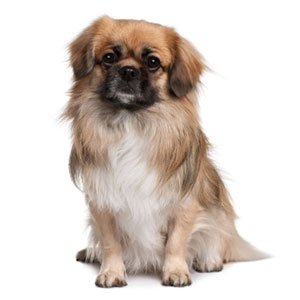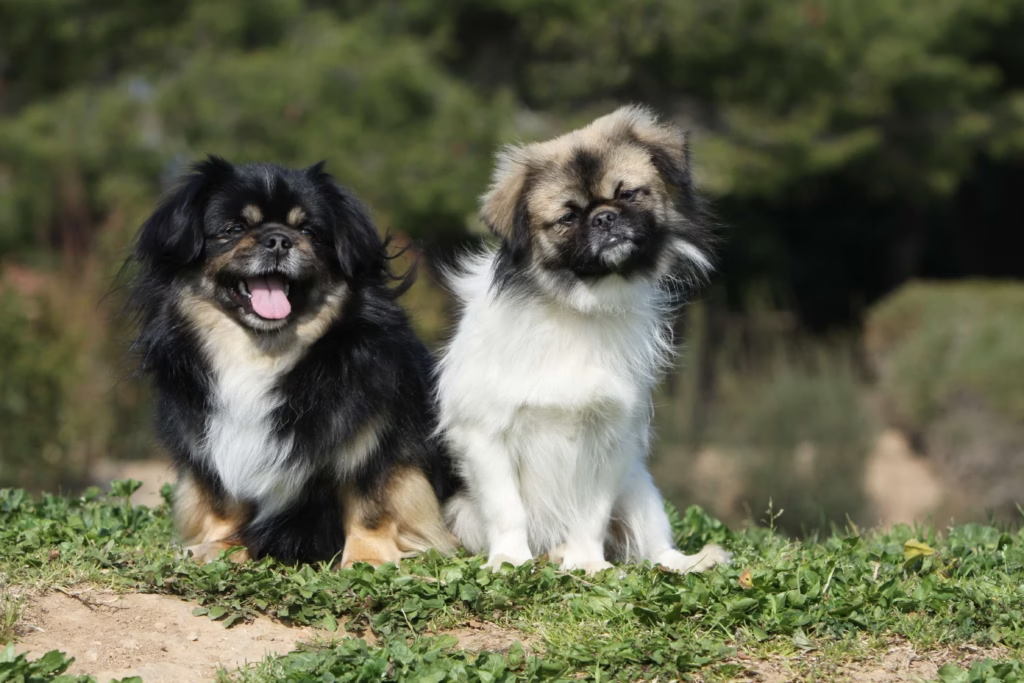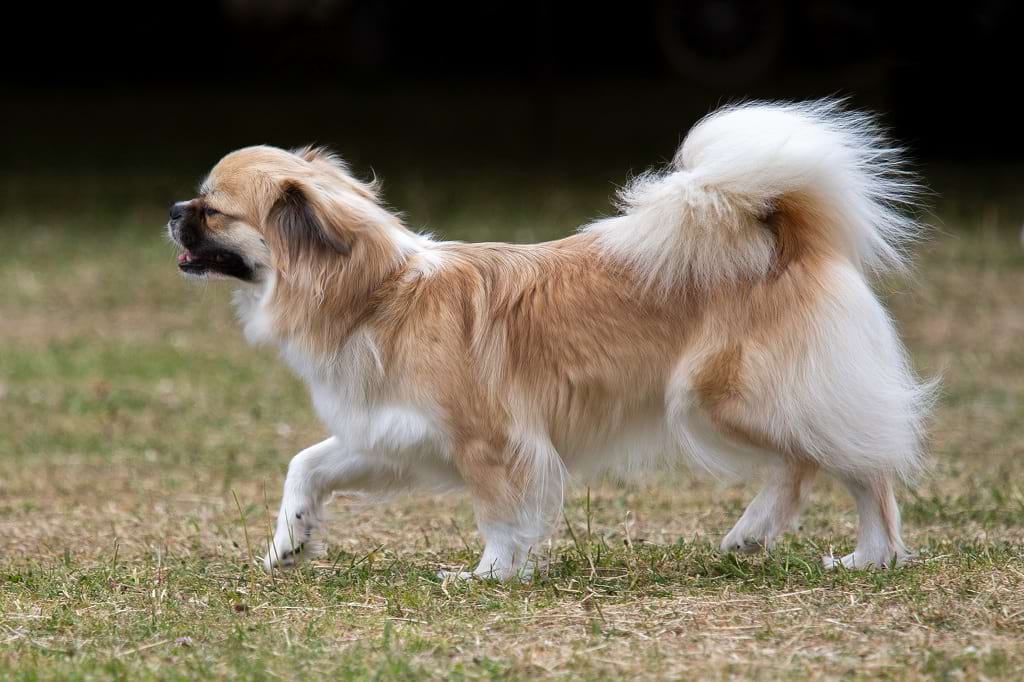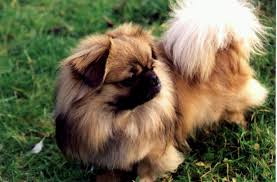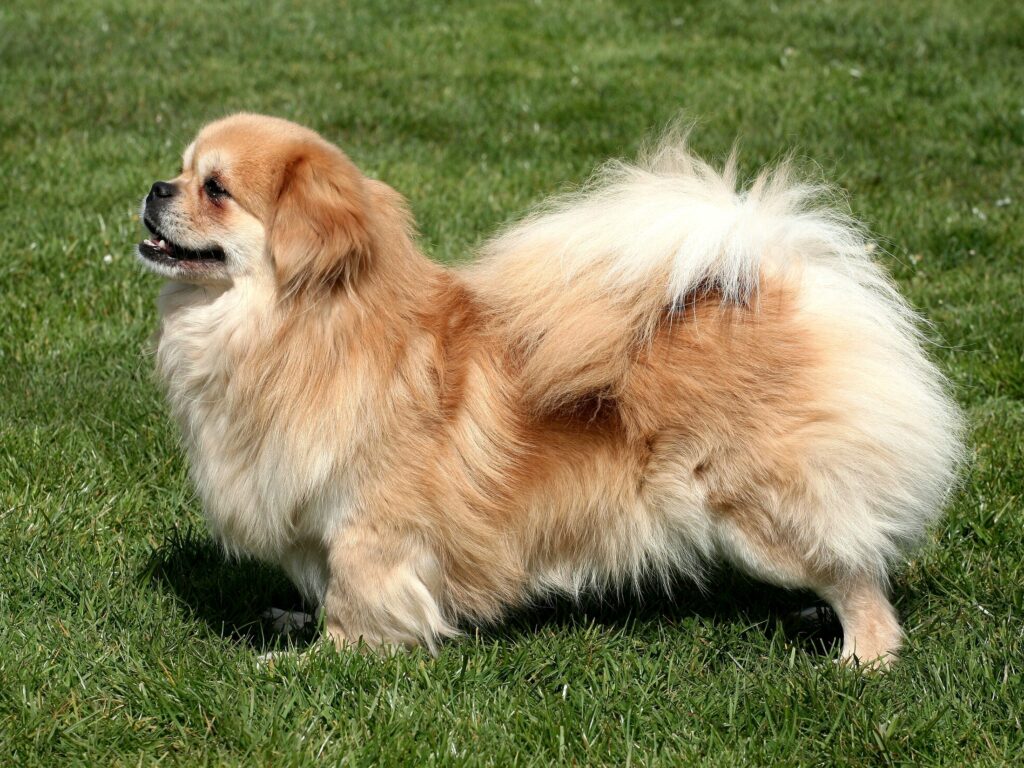
The Tibetan Spaniel is a small Tibetan companion dog with a shawl of longer hair over the shoulders, a plumed tail carried high over the back, and the wide-set gaze the American standard calls “apelike.” The main point comes first: it is not a spaniel. Europeans supplied the name, and it rests on an outward resemblance, not on ancestry or work. More about dog breeds at Tvaryny.
Everything below rests on primary material: three breed standards, the annual reports of the British eye examination schemes, registration statistics, peer-reviewed genetics, and dog books from the close of the nineteenth century and the opening of the twentieth. Where the sources disagree, this page names the disagreement instead of picking the neater version.
Despite the name, this is not a spaniel
Spaniels are western European gundogs whose job is to find game and flush it for the gun. The Tibetan Spaniel has never done that work, and no standard in force gives it a hunting function. In FCI standard No. 231 the line marked Utilization carries two words: companion dog.
The registries say so themselves. The Kennel Club states plainly on its breed page that early European travelers in Tibet handed the breed the spaniel title because they saw a likeness to the toy spaniel at home, and that the Kennel Club later took the name over. The American Kennel Club puts the question in its own description and answers it on the spot. Are they spaniels? No, not in the Western sense, not the way a Cocker or a Cavalier is. Tibbies belong to the old Asian tradition of small companion dogs that also produced the Pekingese, the Pug and the Lhasa Apso.
The paperwork backs that up. The FCI keeps the breed in Group 9, companion and toy dogs, Section 5, Tibetan breeds, without working trial; FCI spaniels sit in Group 8, among the flushing dogs. The AKC files the breed under the Non-Sporting Group, the Kennel Club under Utility rather than with the gundogs. Three independent registries have each placed the Tibetan Spaniel about as far from the real spaniels as their systems allow.
Where the name came from — and why it misleads
The word spaniel means, literally, Spanish dog. Collier, writing in 1921 and leaning on Murray of the Oxford dictionary, lists the older forms spaynel, spanyel and spayngyel, traces them to the Old French espaignol, “Spanish,” and notes that the word first surfaces in English texts in 1388. Tibet has nothing to do with any of it.
The mechanism that produced the name is well understood, and it repeats. A European meets an unfamiliar small dog with drop ears and a long coat, reaches for the nearest familiar category, and the category sticks. The same happened to the Tibetan Terrier, which is not a terrier either. But a wrong name does not stay a mere word: it steers expectations, and the buyer looking for a spaniel ends up with an independent Asian watchdog that holds opinions of its own.
Tibetan dogs at the Manchu court: what is actually documented
The firmest historical trail left by small Tibetan dogs leads not to a monastery but to Peking. Collier, in his 1921 monograph Dogs of China & Japan in Nature and Art, in the chapter on the Chinese lion dog, describes the custom: Tibetan lamas sent the Manchu emperors small shaggy, or lion, dogs as a gift and a diplomatic courtesy.
Two circumstances weigh more than the custom itself. Collier says outright that nobody knows when the gifts began; he only supposes the practice may reach back to the early period of the Manchu dynasty, founded in 1583. And he dates the end precisely — the custom ceased in 1908, when the Dalai Lama visited the Dowager Empress and presented her with several dogs.
On the origin of the breed the same author says something no later writer has improved on: how it ever arose in Tibet is, in his words, impossible even to guess at. When the specialist who devoted a whole book to the subject refuses to date a breed, every round number in the popular retellings earns suspicion.
What this tells the reader: the custom of presenting small Tibetan dogs to the Chinese court is documented, but the identification of those dogs with the modern Tibetan Spaniel is not. Collier writes about Tibetan lion dogs in general and mentions them alongside the “Lhassa terrier.”
The monastery legend and the silence of the early literature
The most popular story has these dogs turning prayer wheels inside monasteries. It can be tested the way any origin legend is tested: find the earliest printed appearance of the breed and see what is missing from it.
In Collier — a 1921 monograph on the dogs of China and Tibet, with a separate chapter on Tibetan lion dogs and the lamas who kept them — the word prayer occurs twice, both times in different scenes: a ceremony during an eclipse and a rite for driving out an evil spirit. There are no prayer wheels turned by dogs anywhere in the book. The early cynological literature does not know this episode; it enters the breed stories much later.
The silence of the preceding generation is more telling still. The Illustrated Book of the Dog by Vero Shaw (1881) is a large British survey with a chapter of its own on toy spaniels. The word Tibetan does not appear in it once; the only Tibetan entry in the index is the Tibetan Mastiff.
The name reaches print only at the start of the twentieth century, and very narrowly. The American Dog Book carries a chapter titled “The Lhassa Terrier and Tibet Spaniel” with a frank disclaimer attached: neither breed has yet reached America, so the author writes from other people’s accounts, not his own experience. The British collection of 1907 gives “The Tibetan Spaniel” a single page and reports that until recently the breed was unknown in England, while now it may often be seen at shows where foreign dogs are admitted. In the index of that volume the breed occupies exactly one line.
Both texts lean on the same person, the Hon. Mrs. McLaren Morrison. The earliest English-language record of the breed thus comes from one informant and is corroborated by nobody. That is no reason to throw it out, but a strong reason to stop repeating its details as settled fact. And by 1921 Collier does not use the name Tibetan Spaniel at all: his index carries “Lhassa terrier” instead.
What survives from the retellings? The role of a doorbell watchdog on the monastery walls is described by both the AKC and the Kennel Club — a registry position rather than an archival document, and it deserves to be read as one. The claim that these dogs were never sold and only given away is contradicted by the earliest sources. In the chapter written in 1905 and 1906 the owner herself describes them as objects of trade in Asia and mentions that one of her own dogs was picked up in a market, while the British collection of 1907 notes that such dogs are frequently brought over the border into northern India. Gift-giving as a court custom is documented; a ban on selling is not.
The Tibetan name is also better taken from a dated source. Collier, citing Ramsay’s Western Tibet (Lahore, 1890), gives the form lags k’yi, “hand dogs.” It applies to Tibetan lion dogs in general, and that caveat ought to travel with it.
How the breed reached Britain and America
The Kennel Club sets out the Western history briefly and with dates. The first Tibetan Spaniels arrived in Britain in the late Victorian period, but the breed became noticeably more numerous only after the Second World War. It settled for good when Lord and Lady Wakefield came home from western Tibet with their dogs; Colonel and Mrs. Hawkins brought theirs at much the same time. Those imports formed the core of British breeding. The breed association was founded in 1957.
In the United States the road ran longer. The AKC recognized the Tibetan Spaniel in 1983 and placed it in the Non-Sporting Group; the national breed club, the Tibetan Spaniel Club of America, was organized earlier still, in 1971. The American standard now in force was approved on May 11, 2010 and took effect on July 28, 2010.
Club and registry histories tend to drift in the breed’s favor: a more heroic role, a rounder number, an older date. So the dates of club founding and recognition are taken here from the registries themselves, while everything that happened inside Tibet is treated more warily. The same caution applies to the neighbors — the Lhasa Apso has a Western history of its own, and the two should not be run together.
How rare the breed is today
No guesswork is needed: the British registry publishes annual figures for every breed in the Utility group. This is how many Tibetan Spaniels were registered in Britain.
How rare the breed is today · 10
| Year | Registrations |
|---|---|
| 2016 | 169 |
| 2017 | 169 |
| 2018 | 154 |
| 2019 | 170 |
| 2020 | 146 |
| 2021 | 180 |
| 2022 | 151 |
| 2023 | 85 |
| 2024 | 110 |
| 2025 | 104 |
For scale, the same 2025 table gives the Tibetan Terrier 593 registrations, the Shih Tzu 1124, the Bulldog 2711 and the French Bulldog 7750. The breed is thin on the ground even beside its neighbors in the group.
Handle this table with care. The registry document is headed “for the years 2015–2024,” while the column labels inside it run 2016 through 2025. Anyone who trusts the heading shifts the whole row by a year. We went with the columns: a separate quarterly report from the same registry gives 43 + 24 + 20 + 17 for 2025, that is 104 — exactly the final column.
A small population shows up in the genetic diversity figures. In a calculation covering every breed in the British registry across 1980–2014, the Tibetan Spaniel had a rate of inbreeding of 0.00271 per year, a generation interval of 4.22 years and an effective population size of 43.67. The reference lines on that chart sit at 100 and at 50; the breed lies below both. For a buyer the conclusion is practical: in this breed the question of how closely the parents are related is not a formality.
The head: the “apelike” expression, the bite and the hare foot
The word that sounds like slang in most breed write-ups stands in the American standard itself: the eyes are to produce an apelike expression. It is a combination of traits — a medium-sized oval dark eye, set well apart and looking forward, a short blunt cushioned muzzle, and a black rim around the lids.
The bite is slightly undershot: the lower jaw sits a little in front. The American standard adds that a level bite is acceptable provided the chin is wide and deep enough to keep the blunt look of the muzzle, and that the teeth should not show when the mouth is closed. A heavily undershot bite that leaves the lower teeth exposed is a fault.
The foot is a breed marker in its own right. The standard calls for a hare foot: small, neat, with feathering between the toes that often extends past the foot. A round cat foot is undesirable — the detail breed descriptions garble most often, and the document spells it out plainly.
How brachycephalic is the breed? The classifications disagree
The question is not academic: advice about heat, exercise and anesthesia hangs on the answer. Honestly, researchers classify this breed differently from one another, and any page presenting one side as settled fact is misleading its reader.
- A large British study of the health of brachycephalic dogs sorted breeds into three columns — 34 brachycephalic, 169 mesocephalic, 66 dolichocephalic. The Tibetan Spaniel stands in the mesocephalic column, next to the Tibetan Terrier and the Tibetan Mastiff.
- A paper measuring the craniofacial ratio did the opposite and enrolled the breed as potentially at risk on the strength of its build. But its dataset holds exactly one dog of the breed: a ratio of 0.32, and that dog showed no signs of obstructive syndrome. One measurement carries no breed-level conclusion.
- A large 2025 study of anesthetic mortality put the breed on its a priori list of brachycephalics — but that list is very broad and holds the Newfoundland and the Rottweiler too, a rough phenotypic label rather than a measurement.
- The work built specifically around the airway syndrome — the functional grading scheme for breathing and the largest study of all, covering fourteen brachycephalic breeds — did not examine this breed. The authors of the latter say plainly that their list was never meant to be exhaustive, so nothing follows from the absence.
The standards do not describe a flat face either: all three registries say muzzle of medium length, and the American standard calls a “broad flat muzzle” a fault while treating an overly pronounced stop as a fault as well. Under Breed Watch the Kennel Club keeps the breed in category 1: no specific points of concern for judges.
None of this removes the practical advice; it sharpens it. The muzzle is shortened, so ordinary sense about heat applies — no walking in the heat of the day, no leaving the dog in a car, no forced running in muggy weather. What cannot be done is to pin airway syndrome figures measured on the Pekingese or the Chin onto the Tibetan Spaniel: those are other breeds’ numbers, gathered on other skulls.
Eyes: PRA3 and why a clear test is not a guarantee
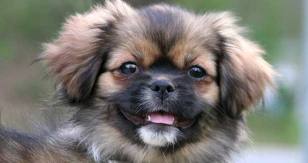
Progressive retinal atrophy is the one inherited condition for which a specific mutation has been pinned down in this breed. A 2014 paper worked on British material and followed the trail end to end.
The investigators ran a genome-wide association study on 22 affected and 10 unaffected Tibetan Spaniels using 15,674 markers, and found a locus on chromosome 10 (p = 2.01×10⁻⁵ before correction, p = 0.014 after permutation correction). The critical interval was 3.794 Mb wide and held 31 genes. Targeted resequencing found in one of them — FAM161A — an insertion of about 230 base pairs beside the splice acceptor site, with a 132-base-pair SINE element inside it. During RNA maturation exon 5 is skipped, the reading frame shifts and the protein terminates early. The form was named PRA3.
Inheritance is recessive and penetrance complete or nearly so: of 24 dogs homozygous for the mutation, 22 became affected, which is 91.7%. The mean age at diagnosis was 4.8 years; the American ophthalmology reference describes late onset, at 4–5 years, while the European one describes ophthalmoscopic signs appearing between one and a half and four or five years of age.
The part that matters most to owners and breeders. The mutation accounts for only part of the PRA in this breed. In the same paper, among 247 Tibetan Spaniels examined there were 35 clinical cases of PRA — and 22 of them (62.9%) were homozygous for FAM161A, while 11 (31.4%) carried two copies of the normal variant. The American reference states the same thing outright: the test explains about 60% of cases, and at least one further form of PRA is present in the breed. A clear DNA result does not excuse anyone from an annual examination by an ophthalmologist.
Among the 116 dogs clinically free of PRA at their last examination, 14.7% were carriers and 85.3% carried two copies of the normal variant; none was homozygous for the mutation.
The same work separates this breed from its neighbors. Tibetan Terriers carry the mutation too, but it explains less there: of 12 cases of PRA, four were homozygous, that is 33.3%. In Lhasa Apsos — 23 dogs examined, nine with PRA — not a single carrier was found, so PRA3 is absent from that cohort.
Three eye examination schemes: why their lists differ
This divergence deserves a section to itself, because an owner who has read one list will be startled by the next.
| Scheme | What it lists for the Tibetan Spaniel |
|---|---|
| BVA / RKC / ISDS (Britain), list of inherited eye conditions, January 2026 revision | Entry 63: PRA only. By way of contrast, entry 64 is the Tibetan Terrier: PRA and lens luxation |
| ACVO / OFA (United States), reference on inherited eye conditions, 2023 edition | Entropion, distichiasis, persistent pupillary membranes, cataract, opacity of the tips of the Y sutures, retinal atrophy (generalized and PRA-FAM161A). Breeding is not advised on cataract, generalized retinal atrophy and PRA-FAM161A |
| ECVO (Europe), breed manual, 2021 revision | Microphthalmia, entropion, distichiasis, trichiasis, cataract, lens luxation, PRA3, micropapilla or optic nerve hypoplasia, optic nerve coloboma |
Why are the lists so different? The British scheme certifies only those conditions for which an inherited basis is accepted in the breed. The American reference draws heavily on its own examination registry, and in its table every condition except PRA-FAM161A is marked “undetermined” in the inheritance column. The European manual sets out a broader clinical list of conditions “known or suspected to be inherited.”
One entry we deliberately do not carry over. The European manual lists neuronal ceroid lipofuscinosis under the Tibetan Spaniel, but the source that entry cites is a paper about Tibetan Terriers. In the international database of inherited animal traits the matching mutation is recorded for the Tibetan Terrier and the Australian Cattle Dog, not for our breed. The cited source does not support its own claim, so this condition has no place in the health picture of the Tibetan Spaniel.
Here is what the British examination data show. In the registry’s annual report for 2025, which covers the last 15 years and counts registered dogs only, the Tibetan Spaniel row carries 1568 examinations, 61 of them in 2025; 1567 were unaffected and 0 affected. The Tibetan Terrier in the same report has 4218 examinations and six affected dogs. These are numbers on breeding stock brought in for testing rather than prevalence in the population — but the figure is telling.
The registry also publishes a separate report on PRA3 DNA tests in this breed. We counted it by two independent routes and arrived at the same result: 246 results — 226 clear, 20 carriers, none affected; the test dates run from April 4, 2013 to November 3, 2025.
What to screen before breeding
The two big registries hand over different but compatible sets — and the structure of the British recommendations is itself worth reading.
| Who recommends | Level | What exactly |
|---|---|---|
| Kennel Club | Good Practice — the minimum strongly advised | One item and no more: prioritizing genetic diversity. No test for any specific disease appears at this level for the breed |
| Kennel Club | Best Practice — the full set | The PRA3 DNA test and an eye examination under the BVA / KC / ISDS scheme |
| AKC (on the national breed club’s submission) | — | Exactly two: a patella evaluation and an examination by a veterinary ophthalmologist |
That the British registry placed genetic diversity rather than a disease at its minimum level fits the effective population size quoted in the section on rarity. In a very small breed, how closely the parents are related is a risk at least equal to any single mutation.
The AKC recommendation to evaluate the patellae is exactly that — a screening recommendation from the breed club, not a measured prevalence of luxation. A large British study of patellar luxation in primary-care practice does not name this breed anywhere; the breeds with raised odds there are the Pomeranian, the Yorkshire Terrier, the Chihuahua, the French Bulldog and, as it happens, the Lhasa Apso. So the knees are checked because the club advises it for a small breed, not because a frequency has been measured in Tibetan Spaniels.
One further entry deserves precision. The breed was included in a peer-reviewed study of portal vein anomalies as one of eight small breeds, with a ratio of 160 cases to 155 controls. That is inclusion in a cohort, not an estimate of risk: the study found no significant association. A review article on portosystemic shunts mentions the breed among those predisposed to portal vein hypoplasia, but rests on a small retrospective series. The topic is present in the literature, the evidence is weak, and presenting it as a breed disease would overstate the case.
Heat and anesthesia: what a cohort of 55,019 showed
A great deal gets said about anesthesia and short-nosed breeds, and the direction of the claim is often reversed. The largest modern study on the subject makes it possible to answer with figures.
A total of 55,019 records of general anesthesia in dogs were analyzed; once euthanasias and deaths unrelated to anesthesia had been excluded, 54,542 remained. Overall anesthesia-related mortality came to 0.69% (378 cases; 95% confidence interval 0.62–0.76). In mixed-breed dogs it was 0.68% (109 of 16,129).
The result that matters is this. Crude mortality in brachycephalic dogs was indeed higher — 0.82% against 0.65%. But once baseline health had been accounted for on the ASA scale, the relative risk came out at 1.19 with an interval of 0.96–1.47, so the difference stopped being significant. The authors write plainly that differences between breeds mostly reflected how sick the patient already was, not the shape of the face.
The “Tibetan breeds” section, which under the FCI classification takes in our breed as well, numbered 908 dogs and five deaths in this cohort — 0.55% (interval 0.24–1.28) — and after adjustment the relative risk stood at 0.79 (0.32–1.94). No elevation was shown. After the same adjustment an excess risk survived only in the Chihuahua (1.80; 1.08–2.99) and the Spanish Water Dog (2.72; 1.23–6.01).
No breed-specific anesthetic sensitivity has been described for the Tibetan Spaniel, and there is no reason to invent one. What matters is the baseline health of the dog, the skill of the team and the monitoring. Small size alone calls for attention to dosing, thermal management and recovery — a property of body mass, not of breed.
On heat the advice needs none of the contested classifications: a short muzzle cools inhaled air less efficiently, so on hot days walk early in the morning and again in the evening, carry water, never leave the dog in a car, and do not push active games in muggy weather.
How long they live
Here the breed has a strong and recent figure behind it. A 2024 British study worked through 584,734 dogs, 284,734 of them dead, and built survival estimates for 155 breeds.
The Tibetan Spaniel row in the supplementary table reads: 351 dogs alive, 137 deaths, a median of 15.2 years with a 95% confidence interval of 14.8–15.7 and a hazard ratio of 0.45 (0.38–0.53). The main text names the breed among those least vulnerable to early death — it gives way only to the Lancashire Heeler and its median of 15.4 years.
How long they live · 6
| Breed in the same study | Median, years |
|---|---|
| Lancashire Heeler | 15.4 |
| Tibetan Spaniel | 15.2 |
| Tibetan Terrier | 13.8 |
| Tibetan Mastiff | 13.3 |
| Bulldog and French Bulldog | 9.8 |
| Mastiff | 9.0 |
The AKC breed page gives 12–15 years — a registry rule of thumb rather than a study result, which is why it sits apart from the median of 15.2. The British life tables built on veterinary practice records do not contain the breed: they cover only the common breeds.
What does not follow from this. A long median lifespan is not a certificate of health and not a reason to skip screening. The breed is small in numbers, so there is little veterinary data on it, and the absence of a described condition means a gap in the data rather than an absence in the dogs.
How it differs from the Lhasa Apso, the Shih Tzu and the Pekingese
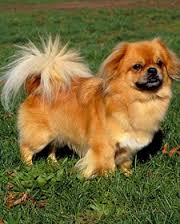
These four breeds really are related — modern genomics keeps them in a single subgroup. But they are easy to confuse only in a poor photograph: in the standards they part company visibly.
| Feature | Tibetan Spaniel | The neighboring breeds |
|---|---|---|
| Muzzle length | Medium, blunt, cushioned; a flat muzzle is a fault | In the Pekingese the muzzle is far shorter and flatter |
| Coat | Medium in length, lying rather flat; a mane on the neck | In the Lhasa Apso and the Shih Tzu the coat is much longer, often to the ground |
| Proportions | The body is slightly longer than the height at the withers | In the Lhasa Apso the elongation is more pronounced |
| Foot | Hare foot; a round cat foot is undesirable | The foot shape is described differently |
| Bite | Slightly undershot | In the Pekingese the undershot bite is more marked |
A word about the Pekingese: a shared genetic subgroup does not make one breed the forebear of another, and the outward likeness of the muzzles comes from common origin rather than borrowing. Where popular texts write about progenitors, the data hold only proximity inside a cluster.