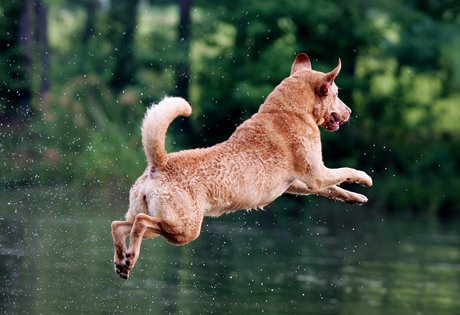
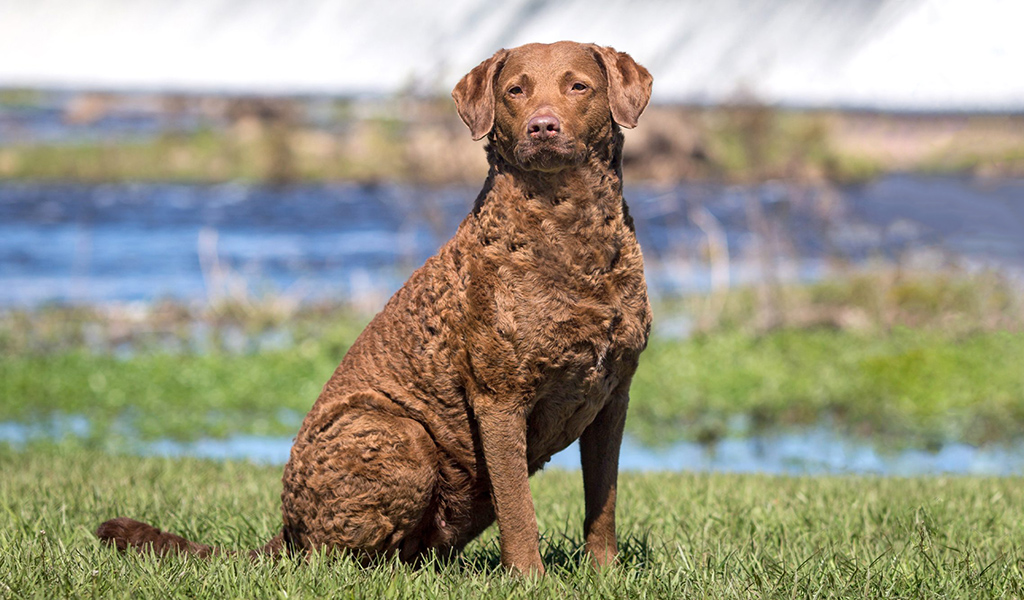
A hardy “brown clown” of icy waters: strong, independent, devoted and remarkably tough. The Chesapeake Bay Retriever was created to retrieve game from an icy bay; hard-working and protective of its family, reserved with strangers — a working retriever with character, not for the sofa.
More independent and stubborn than other retrievers
Reserved, wary of strangers
A high need for exercise and work
Bored and destructive without activity
Size
ToySmallMediumLargeGiant
Compatibility
Apartment · not suitableKidsCats · with caveatsOther dogs · with caveatsBeginners · with caveats
The Chesapeake Bay Retriever, or 'Chessie' for short, is not just a gundog but a true American legend, forged in the harsh conditions of its namesake bay. This sturdy, resilient, and incredibly intelligent medium-sized dog was bred to work in the most challenging environments. Its unique coat and powerful jaws, capable of retrieving up to ten ducks in a single trip, make it an unparalleled water hunter. Capable of working for hours in icy water, the Chessie possesses exceptional working qualities and a strong instinct. It's less commonly found purely as a family pet because, without proper socialisation and exercise, it can display stubbornness and even aggression. However, for its owner, the Chesapeake Bay Retriever becomes the most loyal friend and a dependable partner. Learn more on Tvaryny.
The Chesapeake Bay Retriever: A Look at an American Legend
The Chesapeake Bay Retriever: A Look at an American Legend · 7
Origin
United States (Maryland)
FCI Classification
Group 8 (Retrievers, Flushing Dogs, Water Dogs), Section 1 (Retrievers)
Year of Recognition
1878 (as the Chesapeake Bay Ducking Dog)
Life Expectancy
10–13 years
Height at withers
Dogs: 58–66 cm, Bitches: 53–61 cm
Weight
Dogs: 29.5–36.5 kg, Bitches: 25–32 kg
Other Names
Chessie, Chesapeake, CBR
Interesting Facts About the Chesapeake Bay Retriever
State Dog: Since 1964, the Chesapeake Bay Retriever has been the official state dog of Maryland, USA.
Unique Eyes: Their characteristic yellowish or amber eyes are one of the breed's calling cards.
"Soft Mouth": Despite their powerful jaws, Chessies are renowned for their ability to retrieve game very gently, without damaging it.
Unmatched Memory: Hunters note the ability of these dogs to remember the fall location of several birds at once and retrieve them in sequence.
Work Ethic: It is said that a Chessie can retrieve 100–200 ducks in a single day of work in icy water.
History of the Breed: From Shipwreck to National Symbol
The history of the Chesapeake Bay Retriever is one of the most fascinating and romantic in the world of dog breeding. It began in 1807, when the English brig 'Canton' was shipwrecked off the coast of Maryland. The crew and cargo were rescued, along with two puppies of the Newfoundland breed (or, more accurately, the Lesser Newfoundland, also known as the St. John's Water Dog). The red-coated dog named Sailor and the black bitch named Canton were gifted to local gentlemen who appreciated their outstanding abilities in the water.
These dogs were not related and were never bred together, but they became the progenitors of a new breed. Throughout the 19th century, their descendants were crossbred with other breeds found in the Chesapeake Bay area. These likely included various retrievers, such as the Curly-Coated Retriever, as well as water spaniels like the Irish Water Spaniel, and perhaps even local hounds to improve scenting ability and endurance. The primary goal of this selective breeding was to create a dog capable of working all day in the icy waters of the bay, retrieving hundreds of shot ducks. Thus, the Chesapeake was born—a dog with incredible strength, stamina, and a unique waterproof coat. By 1878, the breed was officially recognised, and in 1964, the Chesapeake Bay Retriever became the official symbol of the state of Maryland.
Standard and Appearance
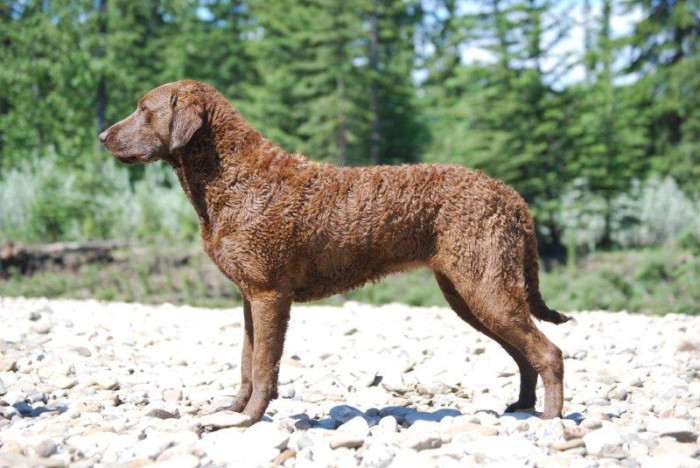
The Chesapeake Bay Retriever is a dog of strong, balanced, and powerful build. Its appearance speaks of the strength and endurance needed for work in difficult conditions. The key trait of the breed is functionality, not refined beauty. Every detail of its exterior has a practical purpose.
Standard and Appearance · 8
Body Part
Description According to the Standard
Head
A broad and round skull with a moderate stop. The muzzle is approximately the same length as the skull, tapering towards the nose but not pointed.
Eyes
Very light, ranging from yellowish to amber. This is one of the most distinctive features of the breed. The gaze is clear and intelligent.
Ears
Small, set high, hanging loosely, and of medium thickness.
Body
Strong and of medium length. The hindquarters are as high as the withers, or even slightly higher. This gives the dog a powerful push for swimming.
Tail
Medium length, thick at the base, straight or slightly curved. Never curled over the back.
Paws
Webbed, 'hare-like' feet with well-developed pads that aid in efficient swimming.
Coat
Thick, short (no longer than 4 cm), with a dense, woolly undercoat. A characteristic slight wave is present on the shoulders, neck, back, and loin. The coat is oily to the touch.
Colour
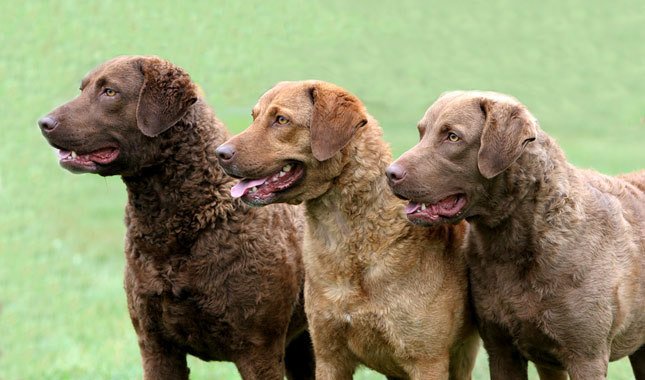
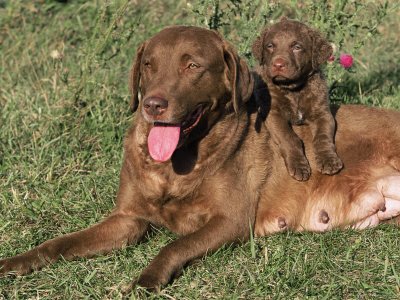
Any shade of brown, sedge, or deadgrass. The colour should blend in as much as possible with the surrounding environment.
Character and Temperament: More Than Just a Hunter, a Loyal Companion
The character of the Chesapeake Bay Retriever is complex and multifaceted. This isn't your typical retriever with a constant smile, like a Labrador Retriever. The Chessie is a serious, determined, sometimes stubborn, and highly intelligent dog. They tend to be a "one-person" or "one-family" dog, to whom they are incredibly devoted and loving.
Intelligence and Trainability: Chessies are very bright and learn quickly, but their intelligence is combined with independence. They may question commands if they don't see the point in them.
Loyalty: They form a deep bond with their family and are excellent protectors. Their protective nature can manifest as wariness towards strangers.
Energy: This is a very high-energy breed that requires daily intensive physical and mental stimulation. Without a "job," a Chessie can become destructive and unmanageable.
Attitude Towards Children and Other Animals: With proper socialisation from an early age, Chessies get along well with children in their family, treating them with patience and protectiveness. However, they can be dominant and intolerant of other dogs, especially of the same sex.
Pros and Cons of the Chesapeake Bay Retriever Breed
Pros:
Incredible loyalty: Forms a very strong bond with its owner and family.
High intelligence: Capable of solving complex problems.
Excellent guard dog: Will always warn of approaching strangers.
Unsurpassed working qualities: The ideal partner for waterfowl hunting.
Robust health and endurance: Built to work in extreme conditions.
Minimal coat care: Does not require trimming or frequent washing.
Cons:
Stubbornness and independence: Not suitable for inexperienced owners.
Requires early and intensive socialisation: Prone to wariness and aggression towards strangers.
High need for physical exercise: Cannot live without a daily job or active games.
Possible aggression towards other dogs: Needs supervision when interacting with other canines.
Strong, distinctive odour: The coat has a musky smell that intensifies when wet.
Not suitable for flat living: Needs space and access to water.
Training and Raising a Chessie
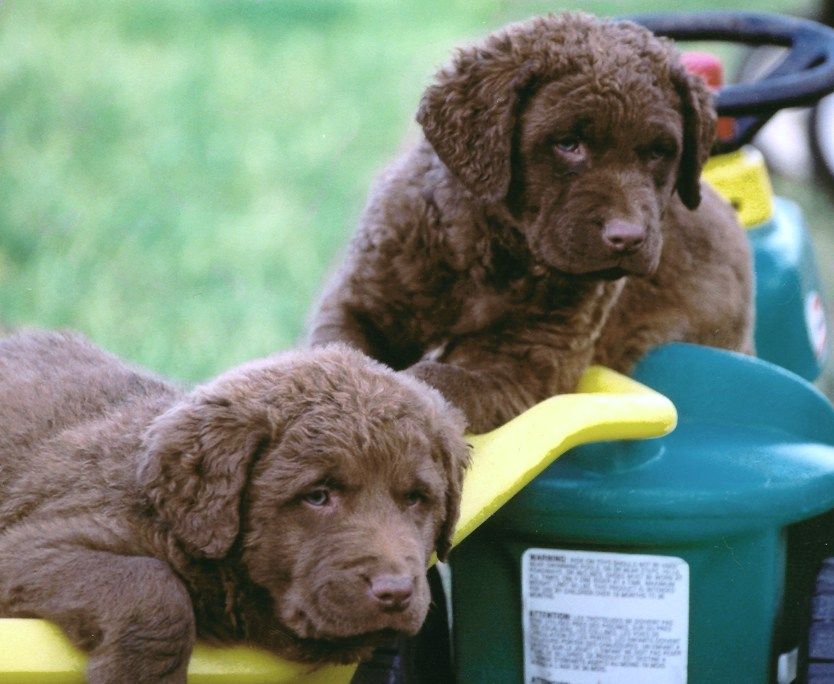
Training a Chessie is a challenge that requires patience, consistency, and an understanding of the breed's psychology. Due to their high intelligence and stubbornness, they will not blindly follow commands. They must respect their owner and see them as a leader. Training should begin as early as possible. Early and intensive socialisation is absolutely key for this breed. The puppy needs to be introduced to different people, sounds, places, and other animals to grow into a confident and well-balanced dog.
Training methods should be fair but firm. Harshness and physical punishment will only worsen the situation and can provoke aggression. Positive reinforcement works best, but a Chessie isn't always willing to work for a simple treat—often, the best reward is praise from a beloved owner or the chance to retrieve an object. It's important to remember that the Chessie differs from other retrievers, such as the playful Nova Scotia Duck Tolling Retriever or the elegant Flat-Coated Retriever, in its seriousness and tendency to make independent decisions.
The Unique Coat: The Secret to Ice-Cold Water Resistance
The Chessie's coat is its greatest asset and a key distinction from other retrievers. It consists of a short, harsh, and wavy outer coat and a dense, fine, woolly undercoat. The undercoat contains a large amount of natural oil, which acts as waterproofing. Thanks to this, water simply doesn't reach the dog's skin, allowing it to stay dry and warm even after prolonged periods in icy water. The coat feels slightly oily to the touch, and this is why it has a distinctive, musky odour, which can be quite strong, especially when the dog is wet. This is an important aspect for prospective owners to consider, particularly if they plan to keep the dog in a flat.
Care and Keeping: What an Owner Needs to Know?
Grooming and Coat Care
Caring for the Chessie's unique coat is surprisingly simple. The main rule is not to overdo it. A weekly brush with a rubber curry comb or grooming mitt is enough to remove dead hair and evenly distribute the natural oils. Bathing a Chessie should be done as infrequently as possible, only when absolutely necessary, and preferably without shampoo, so as not to wash away the protective oily layer. If a bath is required, use specialised shampoos for dogs with oily coats. Frequent bathing can cause the coat to lose its water resistance, making the dog cold. Nails usually wear down on their own, but they should be checked once a month. Pay special attention to the ears, inspecting and cleaning them regularly to prevent infections.
Physical Exercise and Activity
The Chesapeake Bay Retriever is a "working" breed to its core. Exercise is vital for it. A simple walk on a lead twice a day is not exercise for a Chessie, just a warm-up. Ideal activities for a Chessie include:
Swimming and retrieving from water: this is their element and true calling.
Long hikes over rough terrain.
Specialised dog sports: agility, obedience, dock diving, field trials.
Without sufficient activity, their unspent energy will be channelled into destroying your home and garden.
Nutrition
Nutrition: How to Feed an Energetic Hunter?
Health and risks
Health and Hereditary Diseases
Frequently Asked Questions (FAQ) · 4
Is the Chesapeake Bay Retriever suitable for a family with children?
Yes, but with reservations. If a Chessie grows up with children, it will be patient with them and become their reliable protector. However, due to its strength and energy, it might accidentally knock over a small child. All interactions with children should always be supervised by an adult.
Is it true that Chessies have a strong smell?
Yes, their oily, waterproof coat has a characteristic musky odour that some people find unpleasant. The smell intensifies when the dog is wet. This is not a sign of illness or poor hygiene but a natural feature of the breed.
How is a Chesapeake different from a Labrador?
Although both breeds are retrievers, they have very different temperaments. The Labrador is generally friendlier to everyone, more outgoing, and playful. The Chesapeake is more serious, reserved with strangers, has stronger protective instincts, and is prone to dominance. The Chessie's coat is wavy and oily, unlike the Labrador's smooth coat.
Can a Chesapeake live in a flat?
This is highly inadvisable. Chessies need space, ideally a house with a large, securely fenced yard. They require significantly more physical activity than can be provided in an urban flat. Furthermore, their odour can become an issue in an enclosed space.
Video About the Breed
FAQ
How does the Chesapeake differ from the Labrador?
It is more independent, stubborn and protective, more reserved with strangers; it has a water-resistant wavy coat and is built for the coldest water. More of a working dog than a “family retriever”.
Does the Chesapeake love water?
Very much — it was bred to retrieve game from the icy Chesapeake Bay; swimming is its favourite activity.
Is the Chesapeake suited to a novice?
Moderately — it is clever but independent and needs plenty of work; better for an active, experienced owner.